
You may be looking at a reorganization, a hiring push, or a promotion slate and noticing something uncomfortable. The same names keep rising to the top, the same people keep getting cut from the shortlist, and your language around “energy,” “fit,” or “future potential” sounds reasonable until someone asks what those terms really mean.
That's where age discrimination prevention stops being a policy exercise and becomes a leadership test. If your company relies on experienced people to stabilize operations, train others, and carry institutional knowledge, then careless age bias is more than a legal problem. It's a business judgment problem.
A lot of SMB leaders assume age risk only shows up in blatant misconduct. It usually doesn't. It shows up in small decisions that feel normal at the time: targeting “early-career” talent when the role doesn't require it, favoring “high-energy” candidates without defining the job need, or deciding a long-tenured employee is “probably close to retirement” and therefore not worth developing.
That approach is expensive. A 2025 fact sheet from the American Society on Aging cites a 2021 U.S. survey reporting that 78 percent of working adults ages 40 to 65 had personally experienced or directly witnessed age discrimination at work, and it notes that age discrimination cost the U.S. economy approximately $850 billion in lost GDP in 2018. Those numbers should get any operator's attention.
Age discrimination prevention starts with understanding the federal floor. The Age Discrimination in Employment Act of 1967, commonly called the ADEA, is still the core U.S. workplace protection for older workers. If you have enough employees to fall under it, this isn't optional. It affects hiring, pay, promotions, layoffs, training, and daily manager conduct.
If you only frame age bias as a legal concern, you'll miss the bigger point. Companies that exclude or sideline older workers narrow their talent pool, weaken succession depth, and create avoidable friction in performance management.
A stronger approach is to build age inclusion into the same leadership systems you already use for hiring, workforce planning, manager training, and internal communication. If you're reviewing broader latest workforce DEI trends, age belongs in that conversation. Too many employers still treat it as an afterthought.
Practical rule: If a decision can't be explained with job-related criteria and clean documentation, it isn't defensible enough.
Strong age discrimination prevention is rarely flashy. It usually comes down to disciplined basics:
That kind of structure protects the business and improves decision quality. It also makes your workforce more resilient when growth, restructuring, or scrutiny hits.
A manager in Texas rejects an applicant as "too close to retirement." Another manager in Illinois calls for "younger energy" during a promotion discussion. A supervisor in Florida avoids putting an older employee on a new system rollout because "training will be harder." Those are not stray comments. They are liability signals, and in a multi-state business, they spread fast if you do not control the decision process.
At the federal level, the Age Discrimination in Employment Act, or ADEA, protects workers age 40 and older and generally applies to employers with 20 or more employees, as explained by the U.S. Equal Employment Opportunity Commission's overview of age discrimination. It reaches the full employment relationship: hiring, firing, pay, promotions, layoffs, benefits, training, and other terms of employment.
For an owner or HR lead, the rule is simple. Keep age out of the decision unless a narrow legal exception applies. Do not base decisions on retirement assumptions, birth year, generational stereotypes, supposed energy level, or guesses about adaptability. Do not let managers hide those judgments inside softer labels like "culture fit," "long runway," or "fresh perspective."
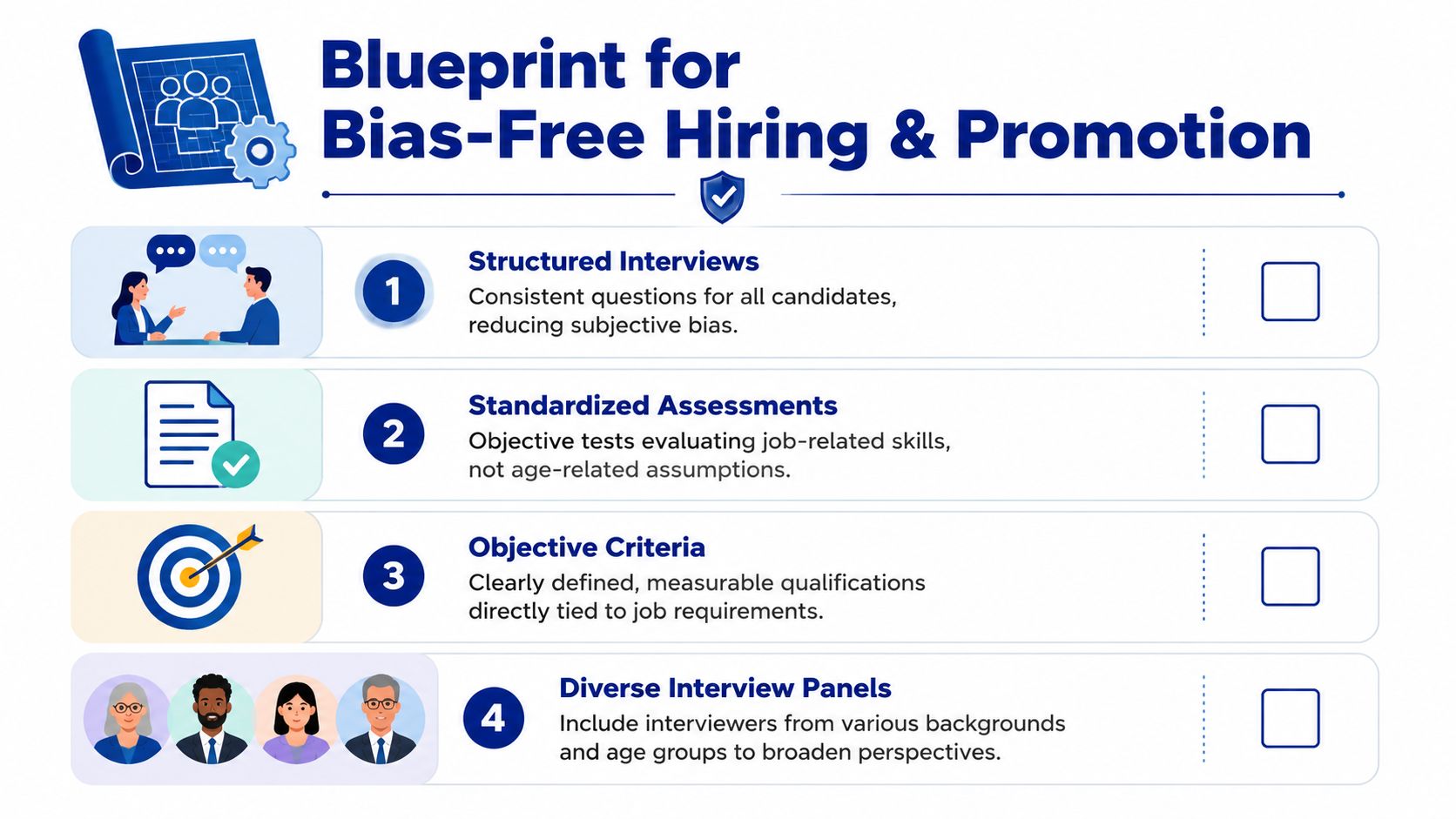
The bigger risk is not usually an obvious slur. It is sloppy process. One manager asks about graduation dates. Another screens out applicants who seem "overqualified." A third gives younger employees the stretch assignments that later justify promotion decisions. That pattern creates the record a plaintiff's lawyer wants.
For multi-state SMBs, federal law is only the floor. State and local rules can cover smaller employers, add protections, or create stricter standards for hiring, records, training, or damages. If your company operates across state lines, do not build one generic policy and assume it holds everywhere. Build a system that can absorb different state requirements without changing your basic standards every quarter.
Start with the points where age bias turns into evidence:
You also need to separate intentional bias from neutral policies that hit older workers harder in practice. That is the difference between direct discrimination and a process that creates unfair results. If your team needs a plain-language explanation, review this guide on the meaning of disparate impact discrimination.
Use a hard standard. If the phrase points to age instead of job performance, remove it.
| Common risky phrasing | Better age-neutral phrasing |
|---|---|
| young and energetic | able to manage a fast-paced workload |
| recent graduate | entry-level role with defined skill requirements |
| digital native | proficient with specific software or systems |
| seasoned but not set in their ways | open to feedback and process change |
| overqualified | compensation and scope alignment to be discussed during hiring |
Good compliance is disciplined operations. The companies that defend these claims well are the ones that train managers to use job-based criteria, document decisions cleanly, and keep the same process across locations. If you want an outside view of practical steps for fairness, focus on the parts that strengthen consistency and documentation. That is what holds up under scrutiny.
Most age discrimination prevention failures are visible in writing before they ever show up in a complaint. Your job descriptions, handbook language, social posts, review templates, and internal announcements tell employees and applicants what kind of workplace you run.
That's why policy audits matter. They force you to align your words with your process. If the language is vague, coded, or inconsistent, your managers will make subjective decisions and then struggle to defend them later.
An age-neutral hiring system begins before the first interview. Review job ads, careers pages, recruiting emails, and employer branding content. The message should signal capability, not youth.
The stakes are real. In the EEOC's report on state age discrimination and older workers, the agency noted that U.S. employers paid over $76 million in 2020 for substantiated age discrimination claims, and that over 94% of working Americans consult employers' social media when job-searching. That makes your public language and imagery part of your risk profile, not just your marketing profile. You can review that context in the EEOC report on older workers and age discrimination.
Use this table as a working filter during your audit.
| Biased Phrase to Avoid | Inclusive Alternative |
|---|---|
| digital native | proficient with required digital tools |
| high energy | able to meet the pace and demands of the role |
| recent graduate | candidates with the listed skills are encouraged to apply |
| youthful culture | collaborative team environment |
| hungry for growth | motivated to take on expanded responsibilities |
| overqualified | assess fit based on role scope and requirements |
A good job description defines the work, the must-have skills, and the decision criteria. It doesn't hint at age, life stage, or personality stereotypes. If your team needs a better drafting standard, use a guide for how to write a compliant job description and then tailor it to your actual role requirements.
Don't stop with recruiting materials. If age isn't explicitly addressed in your internal documents, managers will often assume the company only cares about other protected categories.
Audit these items next:
A lot of employers clean up their job ads but leave interviews informal, promotions subjective, and reviews inconsistent. That doesn't work. Your policy language, interview process, scoring tools, and manager training need to reinforce each other.
Here's the standard I advise. Every document should answer one question clearly: what job-related evidence supports this decision? If a document can't help answer that question, revise it or stop using it.
Written materials matter because they shape behavior before HR ever gets involved.
If your hiring and promotion process depends on instinct, you're exposed. “Gut feel” is where age bias hides, especially when managers are trying to move fast. A defensible system does something simpler and better. It narrows discretion and forces job-related comparison.
The core model is not complicated. Use structured interviews, standardized scoring, age-diverse panels, and applications that don't spotlight age-identifying details early in the process.
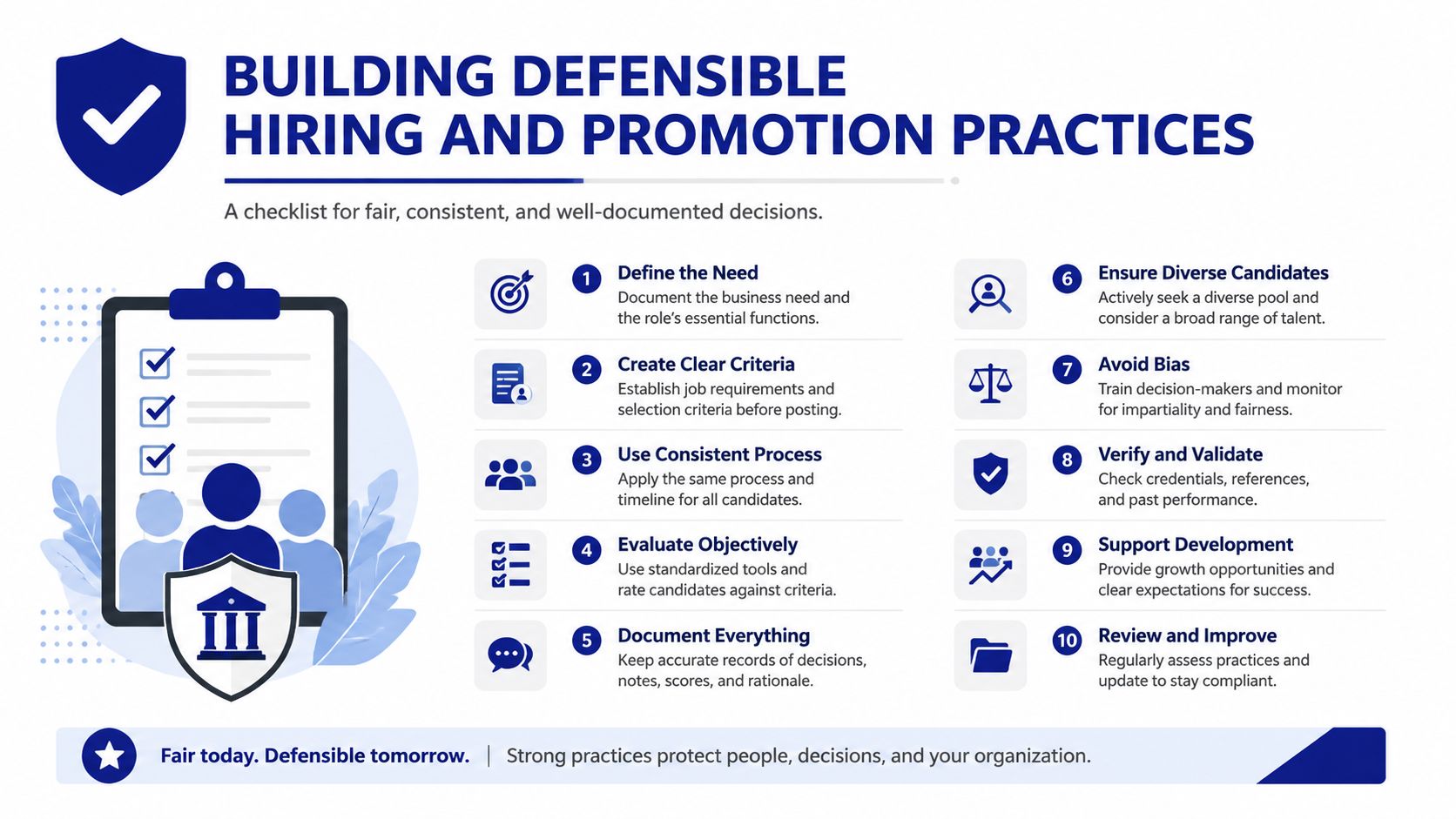
Research summarized in a PubMed Central article on age bias and hiring practices notes that experts recommend fully structured interviews with standardized scoring rubrics, and cites a 2020 AARP survey finding that 78% of workers ages 45 to 65 had experienced or witnessed age discrimination, with bias especially visible in callback and interview stages.
That aligns with what works operationally:
Managers often create exposure with informal conversation. They think they're building rapport. They inadvertently invite bias.
Risky examples include:
None of those questions helps you assess whether the person can do the job.
A stronger interview guide focuses on evidence. Ask for examples of work, judgment, adaptability, and results.
For example:
These questions test performance, not age-coded assumptions.
A surprising number of companies tighten hiring and ignore promotion practices. That's a mistake. Internal advancement decisions often carry just as much risk because managers rely on reputation, familiarity, and narrative.
Use a promotion file that includes:
If you can't explain a hiring or promotion decision without referencing personality impressions, you don't have a defensible process.
This is also where documentation becomes your best protection. Not because you expect conflict every time, but because memory gets rewritten after a challenged decision. Contemporaneous notes, scored rubrics, and clear criteria carry far more weight than retrospective explanations.
Performance management and terminations are where age risk turns expensive. By the time an employee is being disciplined, denied advancement, or selected for layoff, every inconsistency in your system becomes visible. Loose feedback from the past suddenly matters. So do casual manager comments about adaptability, tenure, compensation, or retirement.

If a review says someone lacks “energy” or isn't “forward-looking,” that language creates problems fast. It's vague, subjective, and easy to read as age-coded. Replace it with observable facts tied to the role.
Use measures such as quality, timeliness, customer outcomes, compliance, documentation, teamwork behaviors, and leadership execution. If an employee missed expectations, specify which expectations, when they were communicated, and what improvement was required.
A clean review process should include:
The highest-risk mistake in a reduction or discharge is working backward from a preferred outcome. A leader decides who they want out, then tries to justify it later. That invites inconsistency and bad records.
A better approach is to build a decision file before action is taken. For each person affected, document the business reason, role criteria, prior coaching history, and the reason similarly situated employees were treated the same or differently. If you need a process standard, use a formal termination checklist for employers rather than relying on memory.
The safest termination is not the one with the longest explanation. It's the one with the clearest record.
This gets harder for employers operating across states. Federal law may be your baseline, but state and local rules can be broader. A useful example is New York. State and city protections can reach workers regardless of age, which is broader than the federal 40-and-over framework described elsewhere in this article.
That means a manager practice that seems “federally safe” may still create state-law exposure. The practical answer is to avoid designing different manager habits for each location. Set one company standard for reviews, discipline, and separations that is neutral, documented, and strong enough to hold up under stricter jurisdictions.
During layoffs or restructurings, watch for shortcuts that can create age-related patterns:
High-stakes actions require calm process. Slow the decision down long enough to make it defensible.
A business with 30 employees can create multi-state exposure faster than most owners expect. One remote hire in a stricter jurisdiction, one small acquisition, or one new office can turn a federal-only policy set into a liability.
Federal law gives you a baseline. It does not give a multi-state SMB a safe operating standard.
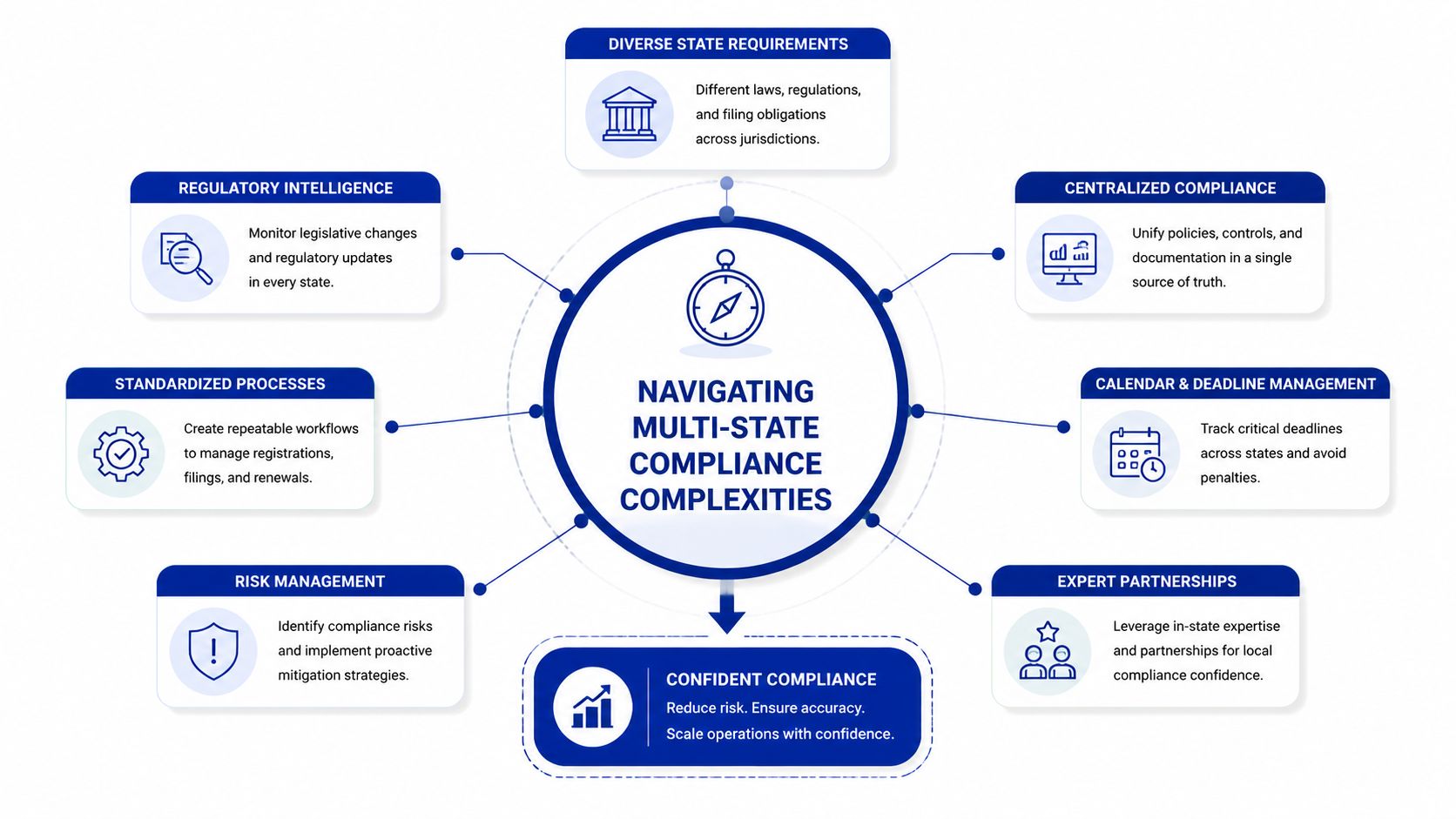
The right move is simple. Build one internal system that can hold up in your stricter jurisdictions, instead of letting managers guess which state gets which rule.
New York is a good example. As explained in this overview of New York age discrimination laws, state protections can reach beyond the federal ADEA framework, including coverage that is not limited to workers age 40 and over. Employer thresholds and filing rules can also differ.
That matters operationally, not just legally. If your handbook, complaint procedure, performance forms, and manager training only reflect federal minimums, you create inconsistency across locations. In a dispute, inconsistency is hard to defend.
Multi-state employers do better with a standard operating model than a patchwork of local habits. Use this approach:
This reduces manager error. It also gives you something more valuable than a policy binder. It gives you a repeatable system you can prove you followed.
Treating multi-state compliance as a legal side note is a management mistake. It belongs in the tools your supervisors use every week, including interview guides, promotion criteria, review templates, disciplinary records, and separation checklists.
That is how you build resilience. Not by reacting to a complaint, but by setting up decisions so they stay consistent across states, managers, and business changes.
If you want help tightening that system, contact us for practical guidance for complex SMB environments. We help business owners put age discrimination prevention into daily operations, clean up weak documentation, and make high-risk people decisions easier to defend.