An effective annual performance review is a cornerstone of talent management and a critical tool for mitigating risk. However, many leaders and employees dread the process, viewing it as a bureaucratic exercise that fails to inspire growth or provide meaningful feedback. This disconnect not only harms morale but also exposes businesses to significant legal vulnerabilities. The solution is not to abandon the annual review, but to transform it with a well-designed template that serves both compliance needs and employee development.
Let's be honest: annual performance reviews are a standard business practice that many of us, leaders and employees alike, have come to dread. While we rely on them for essential documentation, they often feel inaccurate, unhelpful, and disconnected from an employee's actual growth. This creates a dangerous gap for business owners and HR leaders. You need legally sound records to protect the company, but you cannot afford to achieve that by disengaging your best people.

The annual review is too often treated as a necessary but painful corporate ritual. Managers scramble to fill out forms they barely have time for, while employees brace for a conversation that feels more like a judgment than a genuine discussion about their development. The core issue is a fundamental misalignment: businesses need defensible documentation to mitigate legal risk, while employees want meaningful feedback that helps them improve their skills.
When a single process fails to meet both needs, the review becomes little more than an ineffective administrative burden. This failure has real, tangible consequences for your business. When employees see the process as unfair or useless, it leads directly to decreased motivation, increased turnover, and elevated legal risk from poorly documented evaluations.
The data paints a stark picture of this disconnect. Despite decades of criticism, the annual review remains deeply embedded in corporate life, with 71% of companies still conducting them. Yet, this widespread practice masks a serious credibility crisis. An astonishingly low 14% of employees actually believe that performance reviews help them improve, according to recent studies. This tells us that even when reviews are happening, they completely miss the mark.
You can explore more performance management statistics and see just how wide the gap is right here. The negative impact is clear:
The solution is not to eliminate the annual review, but to transform it. By using a modern, structured annual performance review template, you can turn this outdated process into a powerful tool for both risk management and talent development. A defensible process ensures your records are solid, while a forward-looking approach keeps your team engaged and aligned for the year ahead.
A generic, off-the-shelf checklist will not protect your business when it matters most. To build a truly defensible process, your annual performance review template must be customized to reflect your company's culture, specific job roles, and critical compliance requirements. A well-designed template is your shield against legal risk and a roadmap for employee growth. The goal is to build a standardized, flexible framework that your managers will actually use and your employees will respect.
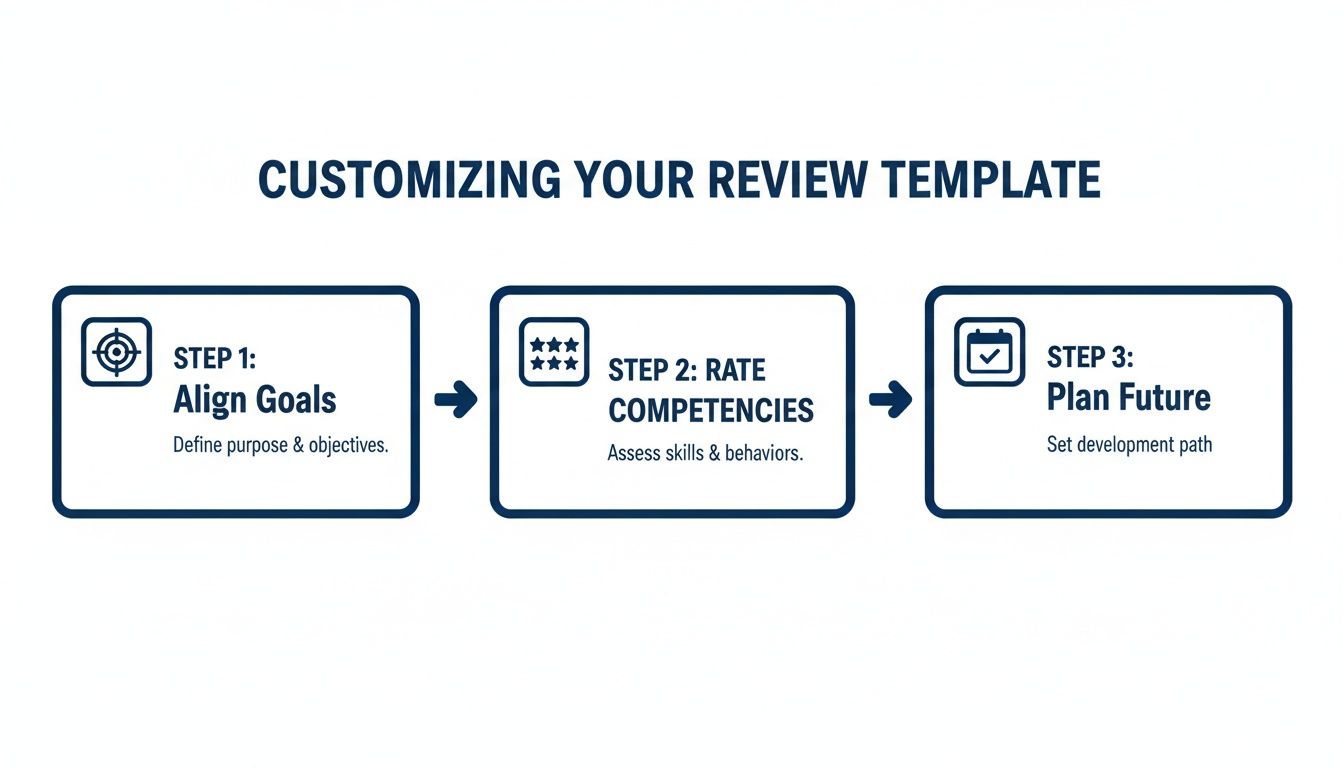
Your first step is to ensure the template directly supports your business objectives. For a review to be defensible, it must evaluate employees against clear, job-related criteria. Vague assessments are an open invitation for claims of bias and inconsistency, which can be devastating in a legal dispute. Start by connecting every section of your template back to a specific business purpose.
Where most generic templates fail—and where legal risk skyrockets—is in their use of ambiguous rating scales. Terms like “Meets Expectations” or “Needs Improvement” are meaningless without concrete definitions. To build a defensible rating system, you must define what each level of performance looks like in practice. For example, instead of just using "Exceeds Expectations," provide a behavioral definition like, "Consistently surpasses all goals, proactively identifies and solves problems, and serves as a model for others."
This level of detail makes ratings more objective and far easier for managers to apply consistently. For each competency or goal, provide specific examples of what constitutes different performance levels. This forces managers to justify their ratings with real evidence instead of relying on gut feelings or recent events. You can learn more about building these criteria in our guide on structuring employee performance review questions.
A strong template must balance looking back with looking forward. While documenting past performance is essential for compliance, focusing only on history can make reviews feel punitive and demoralizing. To counter this, dedicate significant space in your template to future growth.
Include distinct sections for:
By building these forward-looking elements into your annual performance review template, you transform it from a simple report card into a dynamic tool for driving performance. If you need help creating a defensible and effective review process, get in touch with our team of advisors.
A great annual performance review is decided long before the meeting begins. A productive review is about 90% preparation. When managers rush this stage, the conversation becomes a waste of time and opens the door to serious legal risks. Proper preparation transforms a review from an anxious, opinion-based meeting into a constructive, evidence-based dialogue.
The biggest mistake a manager can make is relying on memory, which leads to recency bias, where the last month’s performance overshadows the previous eleven. To avoid this, managers must collect evidence throughout the year, not just at the last minute. Set up a simple system to document performance as it happens, such as a dedicated digital folder for each employee.
What should you be collecting?
Because your notes and the final review form become official records, it's vital to handle them with care. This guide on Mastering Contract Review offers insights into document scrutiny that are directly applicable here.
Once you have your evidence, synthesize it into clear points on the review template. Vague language is your enemy. Phrases like "has a bad attitude" or "is not a team player" are subjective, unhelpful, and a legal minefield. Instead, stick to a behavior-based approach, describing the specific action you observed and its impact on the team or business.
This method ties your feedback directly to documented events and job performance. It makes the feedback easier for an employee to understand and act on, and it makes your evaluation far more legally defensible.
Before considering your preparation complete, perform a quick self-audit. Inconsistency is one of the fastest ways to undermine a review's credibility and create legal risk.
Ask yourself these critical questions:
A surprise negative review is a massive red flag. If you are bringing up significant performance issues for the first time on an annual form, it signals a failure in management, not just employee performance. Consistent, year-round communication is the bedrock of a process that is fair to your people and protective of your business.
The preparation is done, and now it is time for the conversation. This meeting is where your documentation and planning come to life. The goal is to steer the dialogue toward a productive, two-way discussion that feels more like a coaching session than a judgment, even when delivering tough feedback. The tone you set in the first five minutes can make or break the entire meeting.

A well-run review meeting has a clear and logical flow. Instead of jumping straight into critiques, begin with a professional and positive tone, and provide a quick overview of the agenda so the employee knows what to expect.
A great meeting structure looks like this:
Following this sequence turns a potential monologue into a genuine dialogue. When employees get to share their perspective first, they are far more receptive to hearing yours. For a deeper dive, it helps to review examples of performance review self-assessments to see what they are coached to write.
Delivering feedback, especially when it is negative, is a true skill. The words you choose can either open the door to a productive discussion or put the employee on the defensive. Keep the conversation focused on observable performance, not on perceived personality. Your feedback must be tied to specific, behavioral examples.
This is not just a best practice for good management; it is a critical piece of your legal defense. Vague criticisms are easily challenged as personal bias, but fact-based observations are objective and hard to dispute. This approach gives the employee a concrete example they can understand and creates a record showing your evaluation is rooted in job-related conduct.
To keep the conversation constructive and legally sound, it is helpful to know which phrases to use and which to avoid. The language you use should always be specific, tied to business outcomes, and focused on coaching.
Here are some key examples of what to say and what not to say.
Using defensible language protects the company and gives your employees the clear, actionable feedback they need to succeed. Ultimately, your role in a performance review is to be a coach, not just a critic.
The conversation is over, but the work is not finished. Once the annual review meeting wraps up, you have reached the most critical step for compliance: finalizing the documentation. This signed document is your company's official record and your single best defense if a performance-related decision is ever challenged. Mishandling this final stage can undermine all your careful preparation.
Properly completing the annual performance review template after the meeting creates a clear, defensible record that accurately reflects what was discussed. It solidifies feedback, confirms future goals, and officially closes the review cycle. Rushing these final details is a common and costly mistake. For any leader, mastering the art of taking minutes and documenting discussions accurately is a vital skill.
First, add any important notes from the meeting directly onto the form. This includes specific commitments made, clarifications on feedback, or resources you promised to provide. It is also absolutely essential to include a section for the employee to add their own written comments if they choose to do so. This space for employee input is a critical part of a fair and defensible process.
Common items to add after the discussion:
One of the most common points of confusion is what an employee's signature actually means. It is crucial to clarify—both verbally and on the form itself—that signing the document only acknowledges receipt and discussion. It does not signify agreement with the content of the review. This simple clarification can resolve most instances where an employee hesitates to sign.
What if an employee still refuses to sign? Do not force it. The manager should simply make a note on the signature line stating, "Employee received a copy of this review and discussed it on [Date], but declined to sign." Then, the manager should sign and date their note, ideally with a witness (like an HR representative) present to co-sign. This creates a clear, factual record that you followed your process.
Once signed and finalized, the performance review becomes part of the employee's personnel file. This raises a key compliance question: how long must you keep these records? Federal and state laws have specific retention requirements for employment-related documents. Under federal laws like the ADEA and ADA, employers must keep personnel records, including performance reviews, for at least one year.
However, many states have longer requirements, with some mandating retention for the entire duration of employment plus several years after. To stay compliant, your best bet is to adopt the strictest standard that applies to your business. For a deeper look, you can explore our guide on employment records retention requirements. A robust annual performance review template is just one part of a sound HR risk management strategy. If you need expert guidance on creating defensible practices, our advisory team is here to help.
Even with the perfect annual performance review template, leaders still encounter tricky situations that require careful judgment. Here, we tackle some of the most common questions we hear from business owners and HR managers, offering clear, actionable advice to build an effective and defensible review process.
The most significant legal risks in any review process are inconsistency, bias, and a lack of specific evidence. When managers apply evaluation standards differently across their teams, or when a review is filled with subjective criticism and no proof, it becomes a liability in a discrimination or wrongful termination lawsuit. Giving a glowing written review to an employee you later terminate for "poor performance" creates a massive contradiction that can destroy your legal defense.
To protect your organization, you must:
Getting managers to finish high-quality reviews on schedule is a universal struggle, but it is a solvable problem. Reframe reviews from "HR paperwork" into a core leadership responsibility that directly impacts team performance. First, make the process simple with a clean, straightforward annual performance review template and provide clear training. Next, ensure senior leadership communicates that on-time reviews are a non-negotiable part of a manager's job.
Finally, build in real accountability.
It can be jarring when an employee refuses to sign their review, but it is crucial not to force the issue. Your first move should be to calmly clarify what the signature means. Explain that their signature only acknowledges they received the document and that the review discussion happened; it does not mean they agree with its contents.
If the employee still refuses, the manager should handle it professionally by documenting the refusal on the form.
To stop reviews from feeling like a backward-looking critique, you must intentionally shift the conversation toward future growth. While documenting past performance is critical for compliance, at least 50% of the review conversation should be dedicated to what comes next. This simple change turns a potential judgment into a collaborative planning session.
After discussing the previous year's performance, pivot the conversation with questions like:
Your annual performance review template should also have dedicated sections for a "Professional Development Plan" and "Future Goals for the Next Review Period." This structural change forces both the manager and the employee to concentrate on growth, boosting engagement and aligning personal development with company objectives.
A well-structured review process is a cornerstone of effective HR risk management. The experts at Paradigm specialize in helping leadership teams build defensible practices that protect their organizations. If you need a trusted partner to navigate complex employment challenges, we invite you to connect with our advisory team.