
You probably know the scene already. A COO gets a warm note from a trusted peer, an attorney, or an outside advisor asking for an introduction to an HR risk specialist. The problem is that the prospect is dealing with a sensitive termination, investigation, or workplace complaint, and nobody wants loose handling of details, sloppy incentives, or a referral that makes the engagement feel transactional.
That's why b2b referral programs for advisory firms need to be treated as a trust system first, not a lead-gen trick. Word-of-mouth carries real weight in business buying, with 73% of B2B marketing executives ranking it as the most influential factor in vendor consideration in a 2024 Wynter study, and a separate 2025 summary reporting that 63% begin vendor searches by asking peers (Haus Advisors summary of B2B referral marketing statistics). In sensitive services, that creates an opportunity and a risk at the same time.
A lot of teams start with the wrong question. They ask, “What reward should we offer?” before they ask, “What do we need to protect?” That ordering breaks down fast when the referral involves executive decision-makers, employment risk, or an issue the buyer can't discuss casually.
In HR advisory work, the best lead is often also the most delicate one. A referred prospect may be dealing with a complaint, a firing, an investigation, or a multi-state compliance concern, and the referring person may only know enough to trust your judgment, not enough to brief you on the facts. If your program pushes for volume, you can end up pressuring people to share more than they should.
Practical rule: The smaller the circle around the issue, the stricter the referral design should be.
That's where generic “share a link, earn a reward” playbooks fall apart. They assume the seller and buyer both want visibility, but executive teams usually want the opposite. They want speed, discretion, and a clean handoff that doesn't expose the employee, the client, or the referrer.
The job of the program is to preserve credibility while moving the right prospect forward. A referral can lower uncertainty because it transfers trust from an existing relationship, but that trust is fragile. If the referrer thinks the firm will overshare, upsell, or mishandle the matter, the referral stream dries up.
High-stakes professional services don't benefit from noisy pipelines. They benefit from better matched introductions, clearer consent, and tighter control over who gets credit and when. That's especially true when the referrer is a peer, an attorney, an accountant, or an outside advisor whose own reputation is on the line.
A referral program should therefore feel like an operating system. It needs rules about who qualifies, when the ask happens, how disclosure works, and what gets tracked. If those pieces aren't defined, you don't have a referral program. You have informal favoritism with a spreadsheet attached.
The right mindset is blunt: fewer governed referrals can be more valuable than a larger pile of weak leads. For executive-facing services, that's not conservative thinking, it's the only approach that protects trust.
The first mistake leaders make is treating referral design like a marketing campaign. It isn't. It's a policy decision with revenue consequences, and the policy has to be specific enough that sales, operations, and compliance can all execute it the same way.
Start by defining what counts as a qualified referral. For an HR risk advisory practice, that usually means a net-new organization with the right operating profile, a documented business problem, and the kind of exposure that makes judgment matter. If a contact doesn't meet that bar, it shouldn't count as a referral at all.
Then choose the trigger that earns the ask. The cleanest moment is after a verified value event, not immediately after purchase. That can be a completed risk assessment, useful investigation guidance, or a renewal conversation where the client already has proof that the relationship works.
Next, assign a unique referral identifier and a named owner. If one person owns the record, the team can trace source, stage, and outcome without playing detective later. If nobody owns it, the referral gets lost between the intro and the close.
Finally, publish the exclusions list. Existing opportunities, self-referrals, duplicate submissions, and introductions without buyer consent should be out. If you don't exclude them up front, your reporting gets inflated and your referrers learn that rules are flexible.
Operational rule: If the intro can't be tied to a known account, a named owner, and a consented buyer, it doesn't belong in the program.
A referral program also needs speed in the background. Industry benchmarks cited in referral research show that referred deals can close in 20 days versus 100 days for non-referred deals, and another benchmark reports referred B2B leads close 69% faster than non-referred leads (CustomerGauge benchmark summary). Those figures are directional, but they make the same point: referral quality and handoff discipline matter as much as lead count.
| Decision | Default Choice | Trade-Off |
|---|---|---|
| Qualified referral definition | Net-new, executive-level, problem-aware account | Fewer submissions, stronger fit |
| Trigger event | Post-value event, not post-sale hype | Less volume, better timing |
| Attribution structure | Unique ID with a named owner | More administration, cleaner records |
| Exclusions | Existing deals, self-referrals, no consent | Less noise, fewer inflated claims |
The point of this operating system is simple. If your team can't explain the rules in one minute, the rules aren't ready. A serious referral program needs that level of clarity before anyone asks for an introduction.
In sensitive advisory work, the incentive is not the strategy. It's the support structure around the strategy. If the reward feels too loud, it can cheapen the referral. If it feels too small, nobody bothers.
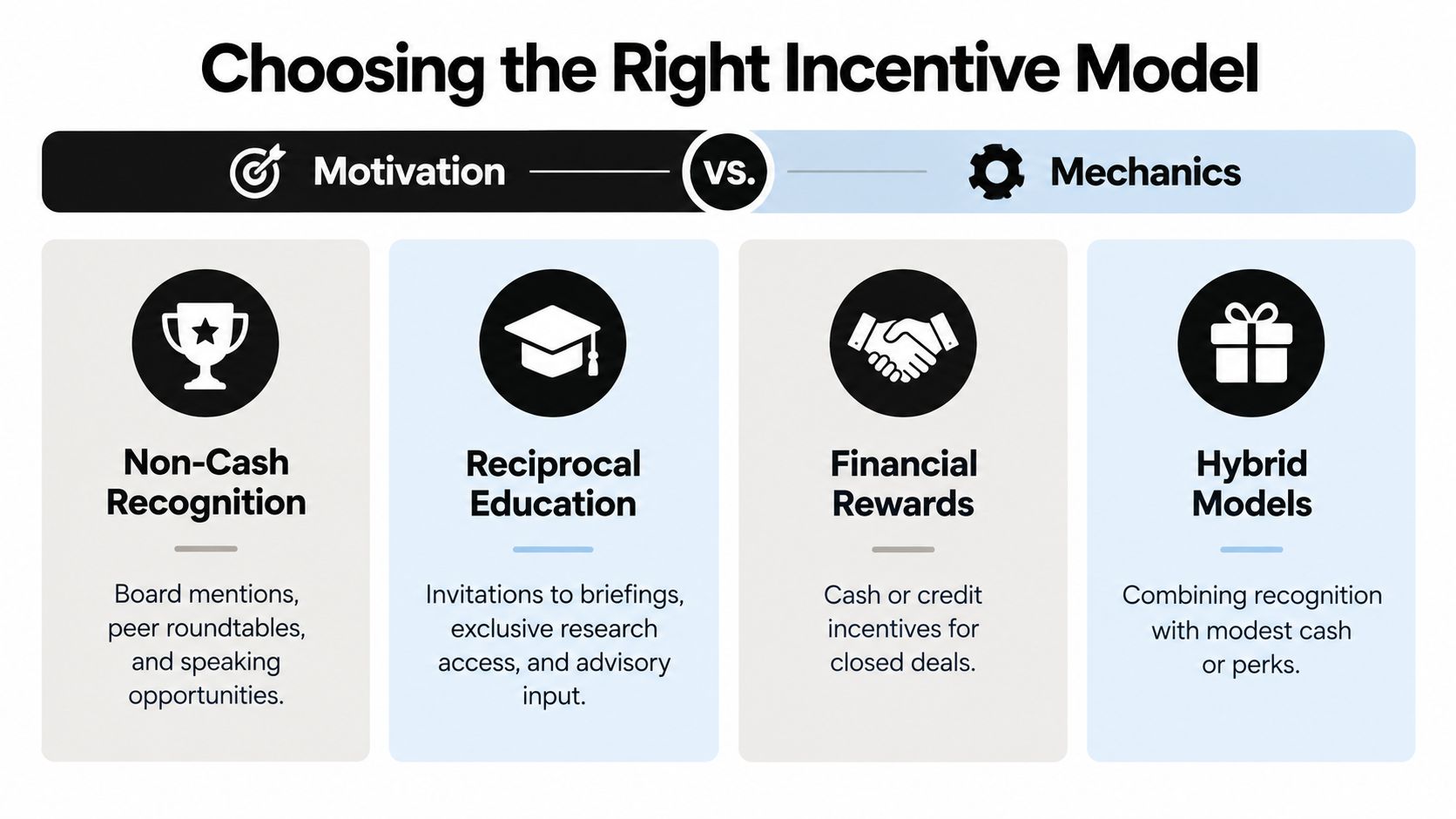
Non-cash recognition is the safest default. Board mentions, peer roundtables, and speaking opportunities work well when the relationship itself is the reward. They also avoid the awkwardness of asking someone to monetize a sensitive introduction.
Reciprocal education is the next best option. Briefings, anonymized case studies, and compliance updates give the referrer something useful without turning the relationship into a cash transaction. This works especially well with executives who care more about insight than perks.
Milestone-based cash can work, but only when the rules are tight. If you go this route, pay after the contract is signed and the first invoice is collected, not when a name gets dropped into the CRM. Anything earlier invites bad credits, confusion, and ugly disputes.
Structured partner arrangements fit accountants, attorneys, and fractional COOs better than general customers. They already influence buying decisions, but they also raise conflict and documentation issues. If you use them, the agreement has to be explicit about who can refer, what can be discussed, and when compensation is allowed.
Reported referral-program data shows that tiered incentive structures generated 27% more referrals than flat-reward programs, while simpler programs converted 2.6 times better than complex ones (SHNO incentivized referral statistics). The lesson isn't “add more complexity.” It's “make the ladder visible and the rules simple.”
For most HR-risk referral programs, I'd start with recognition plus education. It preserves discretion, fits executive networks, and avoids making the introduction look like a sales hustle. If you want a useful baseline for internal rewards thinking, review these 2026 employee incentive suggestions and keep the structure far simpler than consumer-style referral perks.
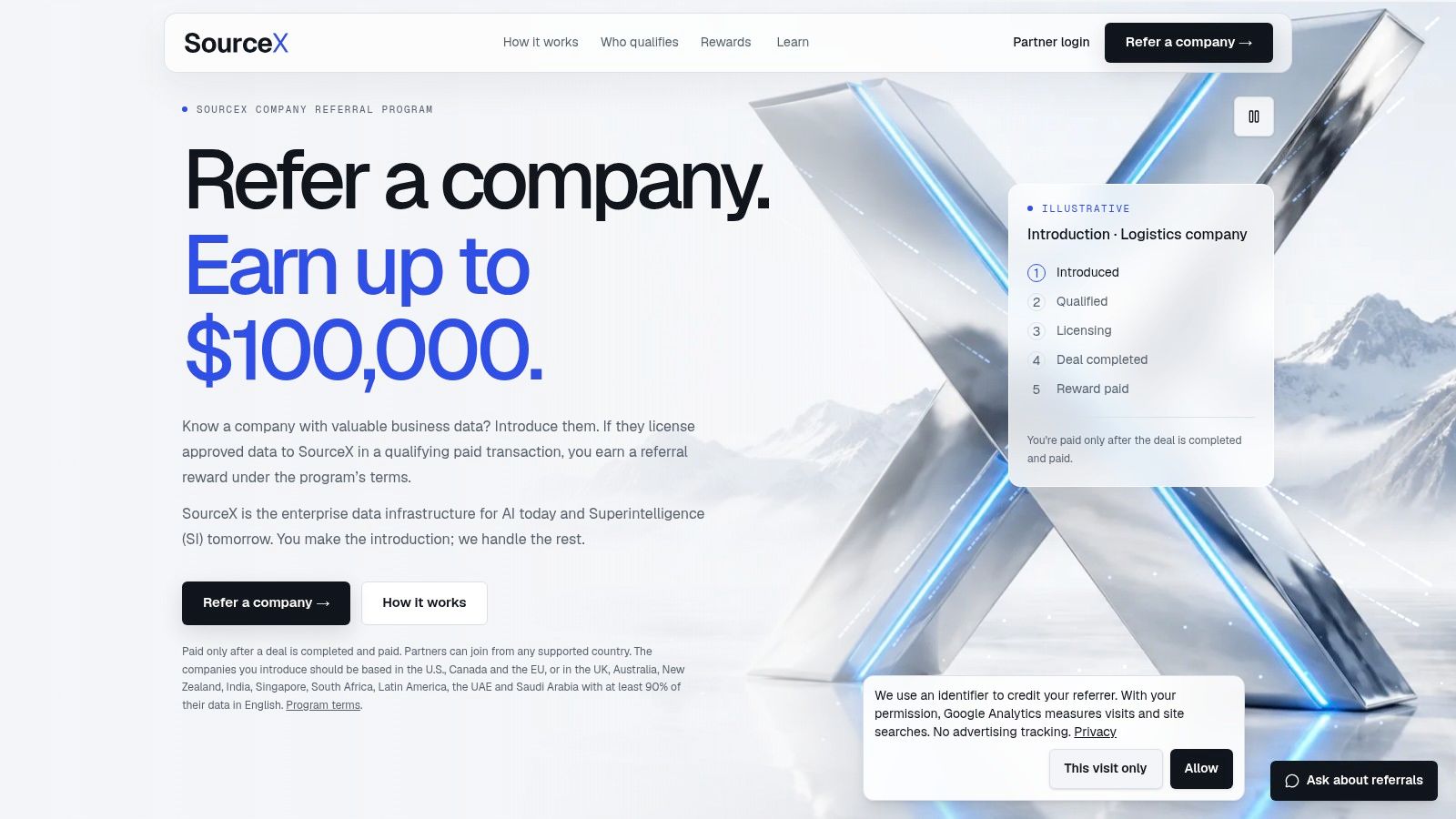
SourceX is built for people who already know businesses worth introducing. It lets advisors, consultants, operators, and well-connected professionals earn from qualified introductions when a company completes a paid licensing transaction for approved business data. The structure is straightforward, you make the introduction, SourceX handles qualification, rights review, pricing, contracting, data preparation, delivery, and payment.
That matters because referral programs in complex B2B settings often fail at the handoff. Partners know a company is a fit, but they don't want to manage evaluation, contracting, or payout complexity. SourceX removes that burden and keeps the partner focused on the intro itself.
The offer is direct. Partners can earn 25% of the Actual Supplier Payout, capped at $100,000 cumulatively per referred company, with a visible dashboard that tracks progress through Estimated, Eligible, Approved, and Paid stages. It also includes a 90-day attribution window, first-valid referral credit, duplicate review, and defined payout conditions tied to buyer acceptance, cleared buyer payment, and SourceX paying the referred company. For a full program overview, the SourceX referral program explains the structure in more detail.
For this topic, the most relevant use case is simple. If you know knowledge-work companies with substantial operating history and significant business records, SourceX gives you a governed way to turn those relationships into a tracked referral stream. It also provides free partner tools, including a fit checker and introduction email builder, so the introduction process stays orderly instead of ad hoc.
Eligible companies span the U.S., Canada, the EU, the UK, Australia, New Zealand, India, Singapore, South Africa, Latin America, the UAE, and Saudi Arabia. Outside the U.S., Canada, and the EU, at least 90% of the data must be in English. That makes it useful for partners who already sit in dense professional networks and want a clear path from intro to payout.
If you're considering whether a structured referral model is worth exploring, SourceX is a practical place to look at how a governed partner program can work without asking you to manage the mechanics yourself. It's not the right fit for every network, but it's a strong example of how qualification, attribution, and payout discipline should look when the referral itself has real commercial value.
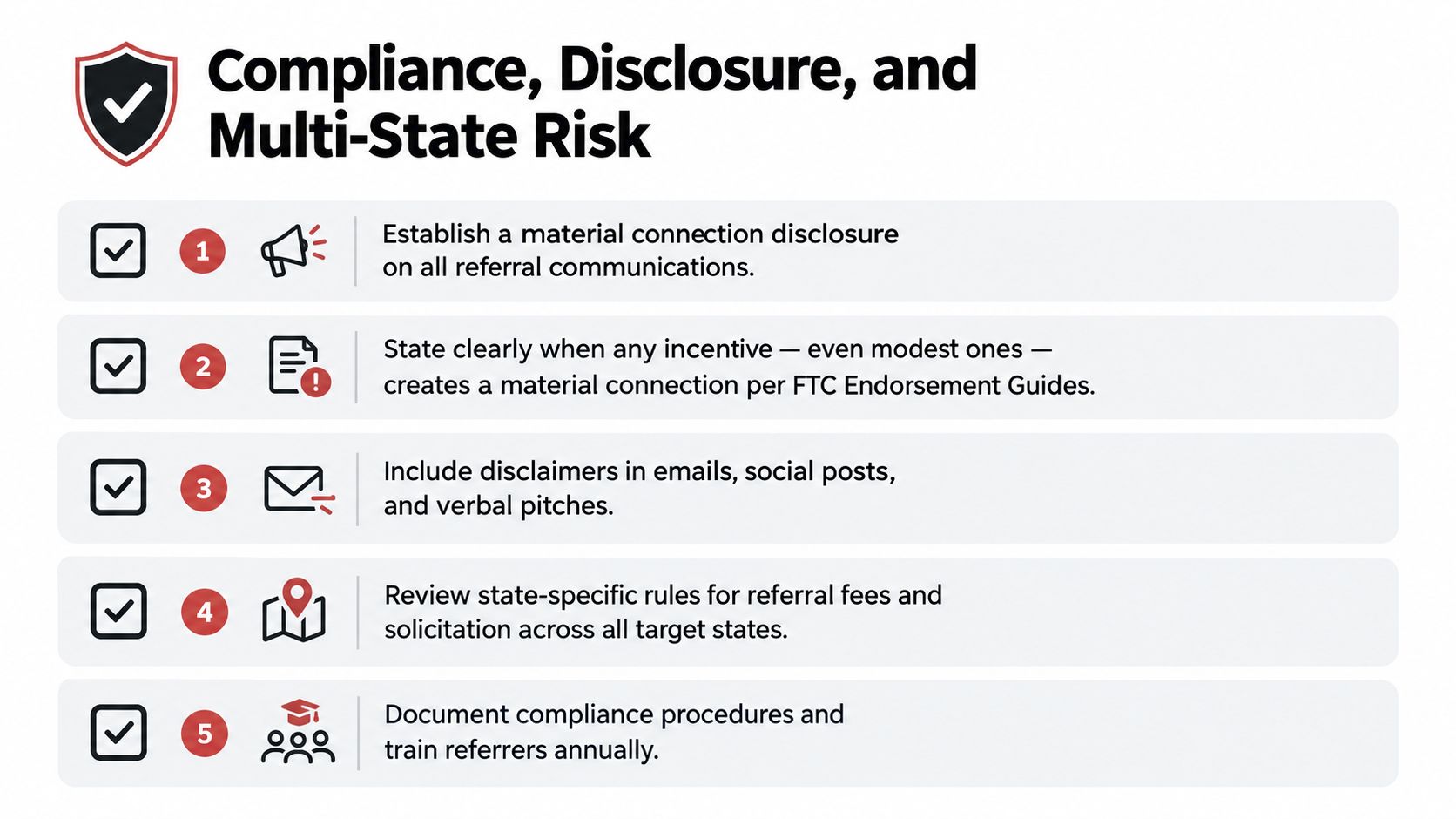
A referral program becomes a liability the moment people start treating incentives as invisible. If someone gets paid, credited, discounted, or otherwise benefited for recommending your firm, that connection may need to be disclosed. The FTC's Endorsement Guides say a material connection should be disclosed clearly and conspicuously when a significant minority of consumers wouldn't expect it and the connection could affect how they evaluate the endorsement (FTC Endorsement Guides).
Your terms should tell participants what they can and can't do. That includes prohibited self-dealing, rules around confidential employee or client information, and who owns the referral relationship once the introduction is made. If the program touches multiple states, that language needs to be especially careful because referral, solicitation, and disclosure expectations can vary.
The safest approach is to standardize the approval gates before any payout is approved. Don't let compensation logic outrun compliance logic. The reward should sit behind a documented review, not ahead of it.
Here's the minimum checklist I'd use:
That last step matters more than many realize. The FTC disclosure obligation is separate from when you choose to pay, so don't confuse “small reward” with “no disclosure needed.” Even a modest benefit can create a material connection if the audience wouldn't reasonably expect it.
The compliance review is not a bottleneck to work around. It's the feature that lets the program scale without damaging trust.
If you need a practical internal control starting point, use assess employment compliance risk as a reminder that referral governance should sit beside the firm's broader risk process, not outside it. A defensible program is one that leadership could explain to a regulator, a client, and a referrer without changing the story.
Many teams measure referrals badly because they count names instead of outcomes. That tells you how active the program looks, not whether it produces credible pipeline. For advisory work, the only metrics worth defending are the ones that show fit, speed, and revenue quality.
Track qualified-referral-to-held-discovery, discovery-to-opportunity, time from introduction to proposal, sales-cycle duration, close rate, client retention, and revenue per referral. Segment each of those by referrer type, because a peer, attorney, and former client don't behave the same way. If you don't break the data out, you'll reward the wrong source behaviors.
You also need a unique CRM record for every referral. Capture the referrer, source, account, opportunity stage, and revenue outcome in the same place, then back it up with “how did you hear about us” prompts and assisted-conversion tagging. That combination helps you see both the formal referral and the backchannel influence around it.
The CRM will undercount influence on its own. A 2025 LinkedIn summary of Trust Factor research reported that 82% of B2B buyers participate in backchannel conversations that vendors do not see, and 74% are significantly more likely to consider a product when someone in their network uses it (LinkedIn summary of Trust Factor research). If you rely only on tracked links, you'll miss a big part of how executive buying really happens.
Measured correctly, a referral program tells you who trusts you enough to risk their own reputation.
That's the signal. Not the submission count. Not the email open rate. The trust signal is whether the intro becomes a held discovery call with the right decision-maker and then moves to a qualified opportunity.
A good rollout doesn't start with a blast email. It starts with a narrow, controlled launch that proves the rules work before the network widens. The teams that rush this usually end up with sloppy attribution, awkward referrer expectations, and a lot of activity that never becomes revenue.
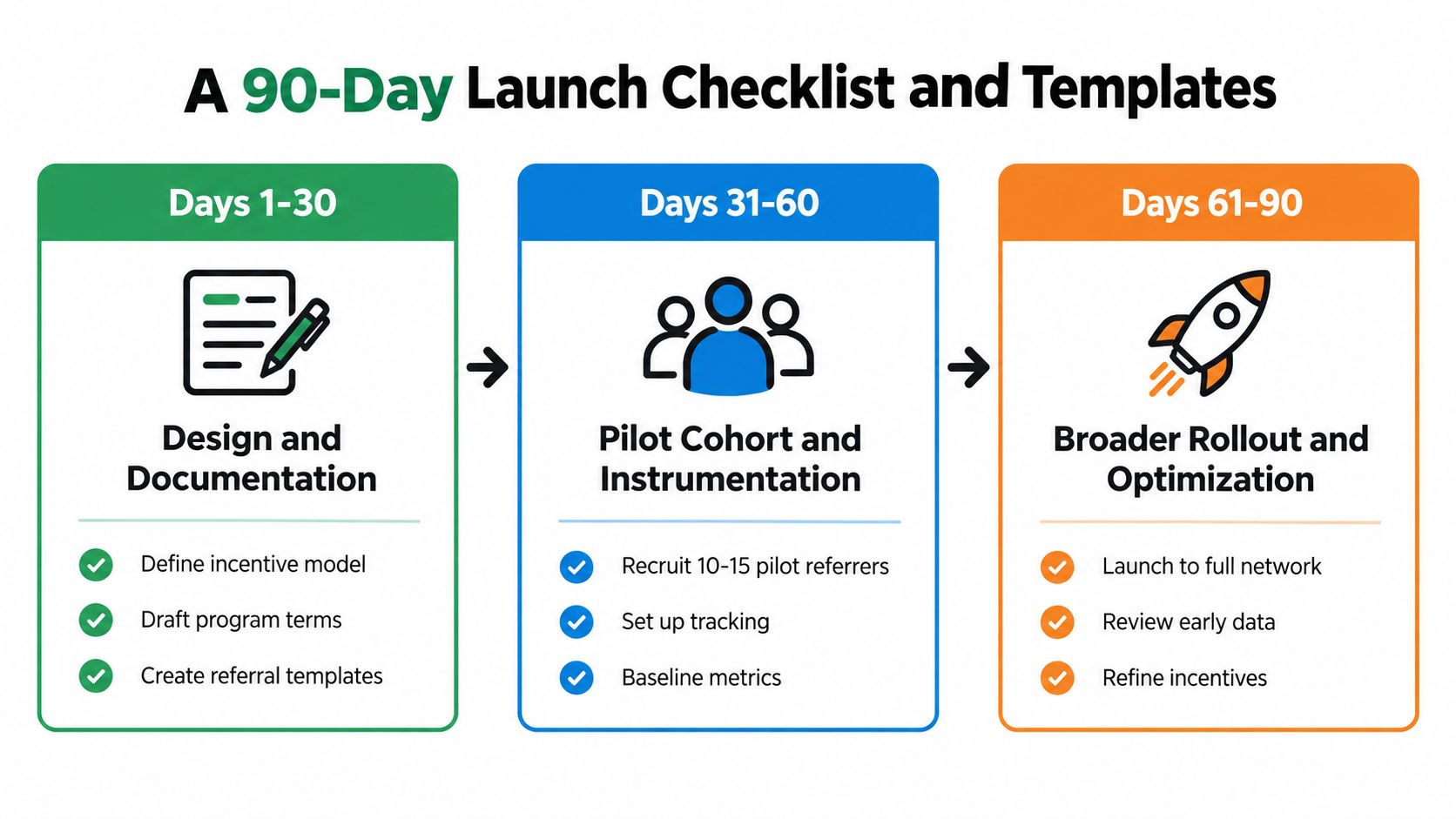
Lock the rules first. Define the qualified referral, the trigger event, the attribution record, the exclusion list, and the payout milestone. Write the terms in plain English so a busy executive can read them once and understand what counts.
Build the core templates at the same time. You need a referrer brief, a quality-introduction one-pager, a disclosure note, and a payout checklist. If those documents aren't ready before launch, the team will improvise, and improvisation is where referral programs go off the rails.
The first template should tell referrers what a good introduction looks like. Keep it practical:
The second template belongs in the discovery workflow. Use one line that asks how the prospect heard about the firm, then move on. Don't interrogate them for confidential context. You want source data, not a fishing expedition.
Start with a small referrer cohort. Pick people who already trust the firm, understand the value, and won't treat the program like a guessing game. A narrow pilot surfaces weak language and process gaps faster than a broad release.
At this stage, track every referral in CRM and review each one for fit, consent, and stage movement. Use the pilot to test whether the program is producing held discovery calls or just polite introductions. If the held-call rate is weak, the problem is usually the definition of qualified, the timing of the ask, or the trust level of the referrer.
Available B2B data reports that 51% of companies do not actively track referrals, which makes it hard to know what is really working (ThinkImpact B2B referral statistics). That's exactly why the pilot phase matters. It forces the program to become measurable before it becomes visible.
Once the pilot works, expand carefully. Don't open the floodgates. Add new referrers in waves, compare source quality by cohort, and tighten any language that's causing confusion. A controlled rollout protects the program from bad habits that are expensive to unwind later.
Use this cadence for the soft launch:
The contrarian position is the right one here. For HR risk advisory and other high-trust services, fewer well-matched, properly consented referrals usually beat broad referral campaigns. A visible or over-incentivized referral can make a serious advisory engagement look transactional, and that erodes the trust that made the introduction possible in the first place.
If you want a simple diagnostic, count how many referrals became held discovery calls with executive decision-makers over the last year and compare that with total submissions. If the ratio is low, the issue is almost never reward size. It's qualification, timing, and trust.
A defensible referral program starts with governance, not enthusiasm. Define who can refer, what counts as a qualified introduction, when the reward triggers, who owns the follow-up, and which disclosures are required before anyone speaks for the company. That is the operating system, and it should be written before the first invite goes out.
The failures are predictable. Paying for unqualified leads creates noise and inflates expectations. Promising rewards before compliance review invites disclosure and conflict problems. Single last-click attribution hides the actual source of influence. Referrals that expose confidential employee or client information create reputational damage no pipeline can justify.
Fraud risk is another reason to stay disciplined. Research on loyalty programs reports that 72% of program managers encounter active fraud, and referral and loyalty fraud has been estimated at about $1 billion annually (Mental Momentum research summary). Duplicate identities, suspicious patterns, and ownership rules need to be checked from the start, before the program scales.
If you are sizing outside help, review hourly rates for HR consultants before you scope the design review. That keeps the conversation grounded in the actual cost of getting the rules right.
For sensitive service lines, the right next move is a design review. A bigger incentive will not fix a qualification or governance problem. We work with leadership teams that need referral systems to stay precise, defensible, and aligned with real-world HR risk. If that is the standard you need, talk with Paradigm International and pressure-test the program before it becomes a problem.