
A hiring manager is ready to extend an offer. The role matters, the team is stretched, and everyone wants to move fast. Then the background report lands in your inbox, and the core question isn't whether you ran a check. It's whether your process would hold up if the decision were challenged by the candidate, a regulator, or your own board.
For most SMB leaders, the background investigation process starts as an operational task and turns into a risk issue the moment something goes wrong. A delayed report can stall a start date. An inaccurate record can knock out a qualified candidate. An inconsistent review can create exposure across states and job categories.
That's why this process needs more than a vendor login and a hiring checklist. Criminal background checks are performed by 92% of employers, and the market for third-party screening services is projected to reach $5.8 billion by 2032. At the same time, the broader cost of underemployment for Americans with criminal records is estimated at between $78 billion and $87 billion annually, which reinforces why accuracy and rigor matter in hiring decisions, not just speed (Cornell ILR on criminal background searches).
A sound program starts with a simple hierarchy. Some checks are basic identity and criminal record screens. Others add employment and education verification. Higher-risk roles may require deeper review, tighter adjudication standards, and more documentation before a final decision.
Practical rule: The more sensitive the role, the less you can rely on a one-size-fits-all screening package.
If you also deal with housing, contractor placement, or mixed-use screening questions, it helps to understand adjacent compliance frameworks such as FCRA rules for tenant screening, because the same core principles apply. Clear disclosure, consent, accuracy, and proper adverse action procedures aren't optional.
A defensible process does three things well. It verifies the right facts, applies standards consistently, and documents how decisions were made. That's what protects the business when growth, multi-state hiring, and legal complexity collide.
A background report only helps if the people reviewing it understand what it contains. Many leaders treat it as a red-or-green hiring signal. That's a mistake. A proper review starts by knowing which facts were verified, which were not, and where gaps can still exist.
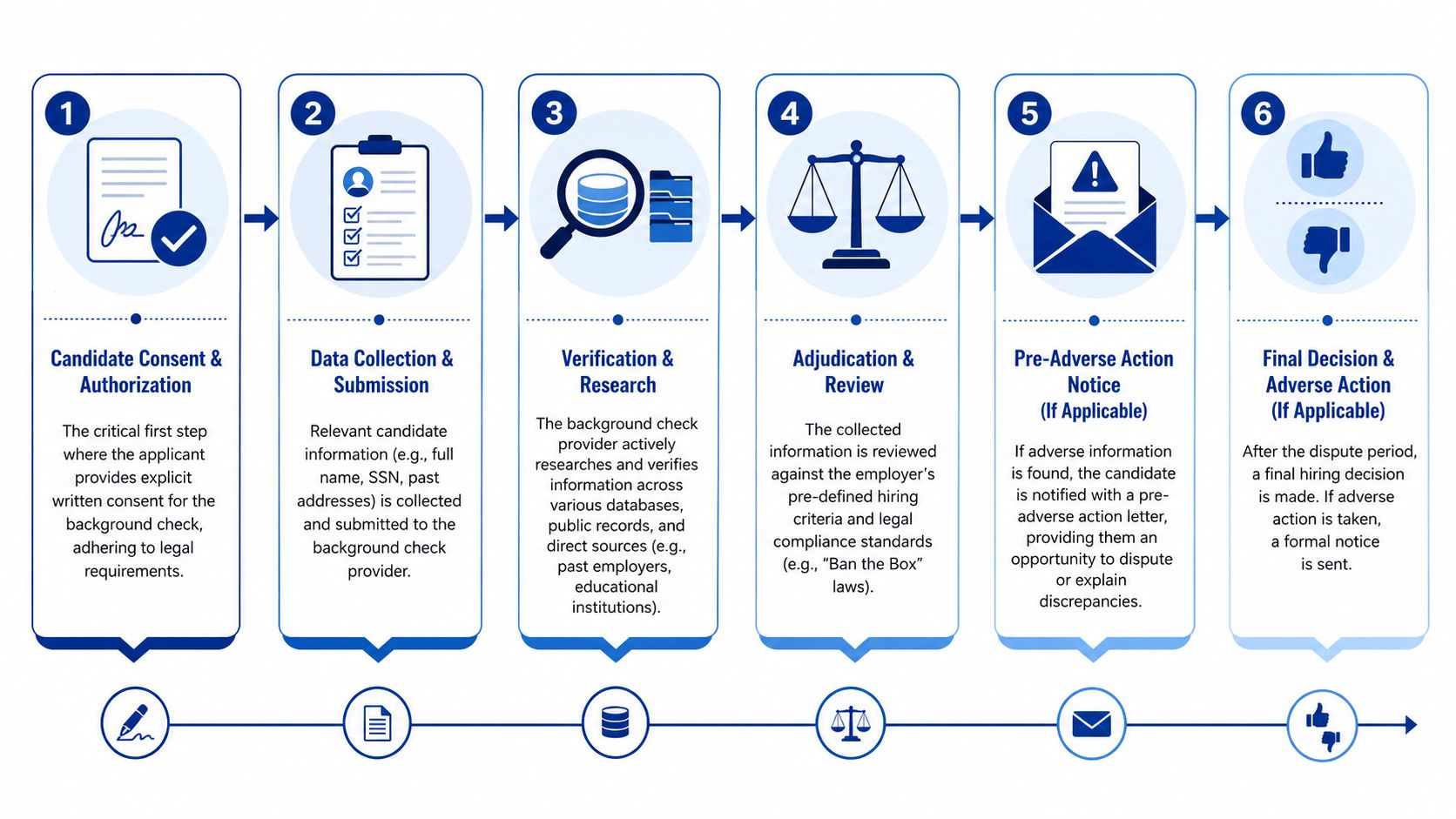
Here's the full workflow at a glance.
The first layer usually focuses on identity and criminal history. In practice, that means confirming that the search is tied to the correct individual and reviewing records that are legally reportable for the role and jurisdiction.
Many SMBs overestimate what a report can do. A criminal check doesn't tell you whether someone will succeed in the job. It tells you whether reportable records exist and whether further review is needed under your policy.
Employment verification is often more useful than leaders expect. It isn't just about checking whether someone worked somewhere. Investigators verify job positions, exact dates of employment, wages, and rehire eligibility, and they contact schools to confirm attendance, completion, and degrees to validate self-reported credentials (CaseIQ on background investigation steps).
That matters because résumé inflation rarely appears in a dramatic form. More often, it shows up as adjusted dates, inflated titles, or degrees that were started but never completed.
A background investigation should answer factual questions. It shouldn't guess at intent.
The report is not the hiring decision. Your organization still has to evaluate whether any findings are job-related, consistent with policy, and lawful to use in that location. That review step is where many programs become vulnerable.
A useful internal practice is to separate verification from judgment. Let the screening partner gather the facts. Then have a trained decision-maker apply your written criteria. If your team needs a baseline for building that review structure, this guide to quality background checks is a practical starting point.
Use this lens when reading any report:
That distinction is what turns screening from a clerical task into a controlled risk process.
Most hiring teams only see the beginning and end of the background investigation process. They send the request, then wait for a report. But if you want a defensible program, you need to manage the middle. That's where consistency, timing, and documentation either hold together or break down.
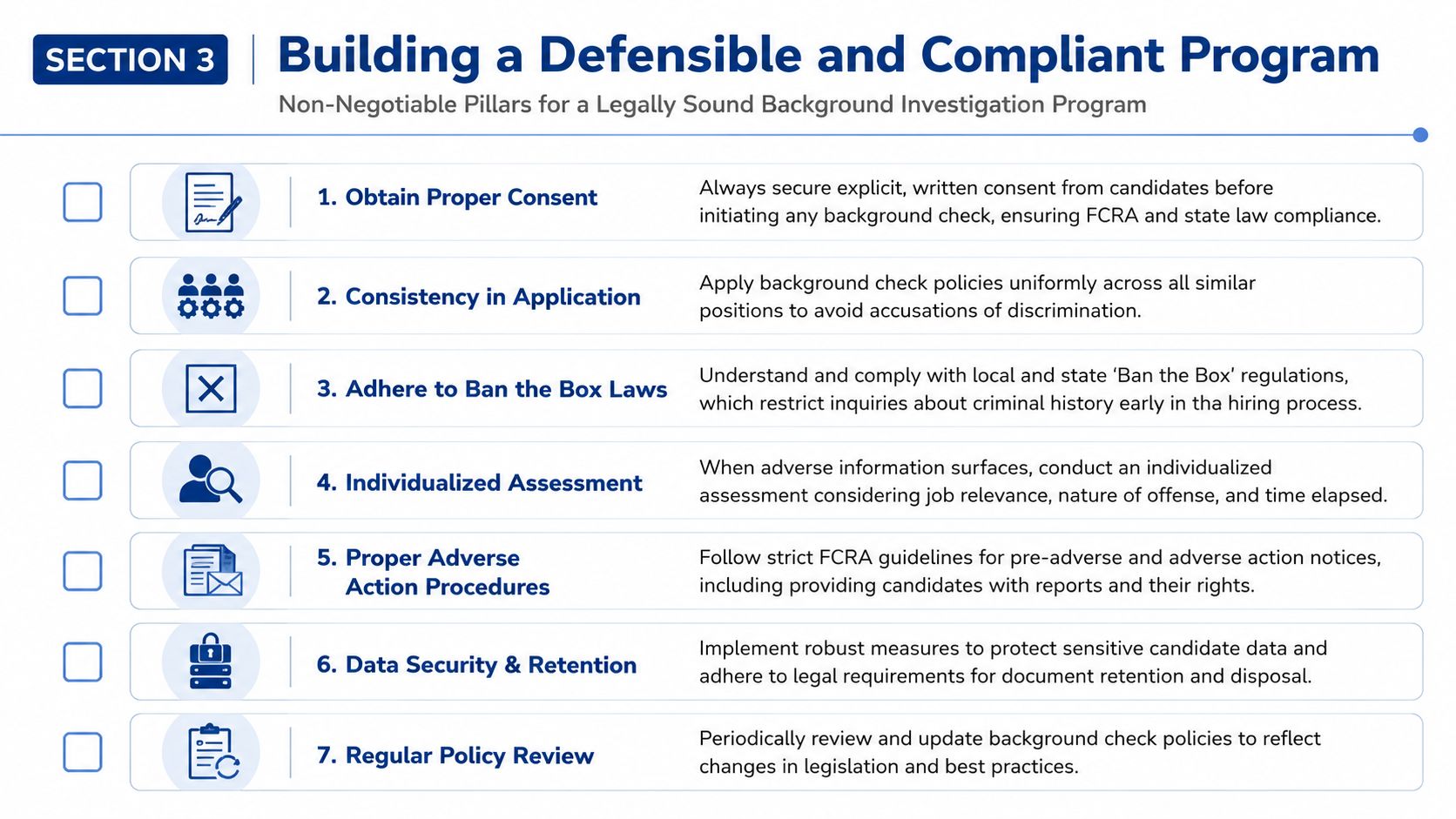
This checklist captures the operating standard.
A clean process follows a predictable order. Consent comes first. Then the candidate's identifying information is collected and sent to the screening provider. The provider runs the authorized searches and returns results for review.
After that, your team applies its criteria. If the report raises concerns that may affect the hiring decision, the process shifts into pre-adverse action review before any final adverse action is taken.
The timing is usually faster than people expect for standard checks. Typical turnaround is one to two days, but it varies by screen type. A criminal background check takes 0 to 3 days, employment verification takes 1 to 3 days, and higher-level security reviews can take two to six months or longer (Yardstik turnaround guide).
The weak point isn't usually the search itself. It's the handoff between report delivery and decision-making. Hiring managers often want to act immediately. Recruiters may not know whether the report triggered a required notice. Multi-state employers may apply one timing rule everywhere, even when local law says otherwise.
That's why defensibility starts with process discipline, not volume. A program is stronger when leaders can show the same sequence happened every time.
Key controls make that possible:
Operational insight: Fast screening only helps when the review process is equally structured. Otherwise, speed just moves the risk downstream.
For SMBs, this doesn't require a large compliance department. It requires a repeatable workflow, clear ownership, and enough discipline to pause when a report raises a real issue.
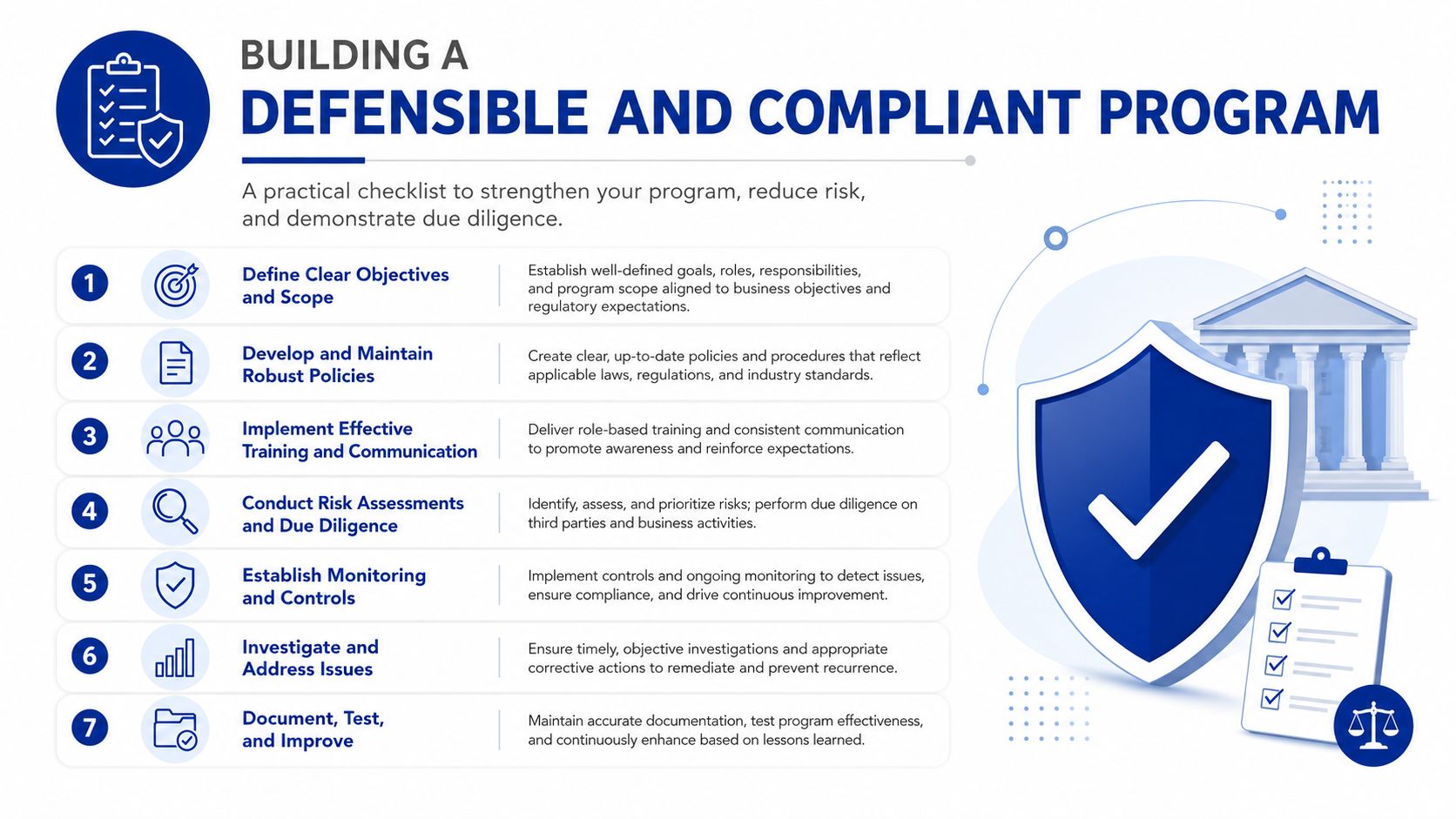
A defensible program isn't built around catching people. It's built around showing that your company acted objectively, consistently, and within the law. That standard matters most when a candidate disputes a report, when two managers handle similar cases differently, or when your business operates across several states with different timing and notice rules.
This visual is a useful summary of the core governance pieces.
A proper investigation is a fact-finding process. The investigator's role is to gather and report relevant information, not to decide whether the person should be hired. That distinction protects the integrity of the process.
It also matters when the candidate's application doesn't match verified records. If discrepancies appear between self-reported information and verified facts, the investigator must conduct a discrepancy interview before compiling the final report (Texas Police Chiefs sample background manual). In other words, you don't skip straight from inconsistency to rejection.
For SMBs, the strongest compliance move is often the simplest one. Write down your process before you need to defend it. A good policy identifies which checks apply to which roles, when in the hiring process they occur, who reviews results, and how adverse findings are evaluated.
Your program should include at least these controls:
Your best defense is a file that shows what you checked, why you checked it, who reviewed it, and how the decision was reached.
Federal law gives you a baseline, but it doesn't simplify the state-by-state complexity. That's where many growing businesses get exposed. They apply one national practice, then discover too late that a local rule changed the permissible timing or required a different step.
That's also why privacy rules need to be part of screening design, not an afterthought. If your team is tightening its data handling and employee record standards, this overview of employee privacy rights is worth reviewing alongside your screening policy.
A defensible background investigation process should feel boring on paper. That's a good sign. Predictable steps, documented decisions, and limited discretion are what keep a hiring process from becoming a legal problem.
A company with employees in one state can often manage screening through a single policy and a careful vendor setup. A multi-state employer can't rely on that model for long. The background investigation process becomes more complicated because the federal baseline is only the beginning.
The core rule is straightforward. Your policy must define which checks are conducted for specific positions and the procedural stage for screening, because federal law allows screening after consent while state and local laws may impose tighter timing restrictions (GoodHire background check policy guide). That sounds simple until you're hiring remotely across multiple jurisdictions at the same time.
The biggest mistake is treating compliance as a uniform national setting. It isn't. The same role may require different timing, notice language, or decision protocols depending on where the candidate lives or works.
A better approach is to create a core federal process, then layer location-based rules on top. That usually means legal review of your forms, workflow logic in your applicant tracking system, and a clear map of who owns local compliance updates.
Use a role-and-location matrix, not a generic checklist. The matrix should show which package applies to each role family and whether any state or city rule changes timing or review standards.
| Position type | Primary risk concern | Process adjustment |
|---|---|---|
| Finance and payroll roles | Access to funds and sensitive financial data | Add stronger adjudication controls and tighter reviewer approval |
| Healthcare and patient-facing roles | Safety, trust, and regulated environments | Confirm job-specific screening sequence and documentation |
| Remote administrative roles across states | Location-based legal variation | Apply state-specific timing and notice workflows |
| Temporary or seasonal hires | Pressure to move quickly | Use a shortened but still documented approval path |
In multi-state hiring, consistency doesn't mean identical treatment. It means applying the correct rule set consistently for the same role and location.
COOs often ask whether this level of structure is excessive for an SMB. It isn't. Once your company hires across state lines, the cost of an informal process rises quickly. The issue isn't only legal risk. It's also credibility. If two candidates in similar roles receive different treatment because managers improvised, the process becomes harder to defend.
Strong screening programs separate operations from guesswork. They don't make every decision easier, but they make each decision traceable.
The strongest background investigation process is not the broadest one. It's the one that matches the role. Too little screening creates exposure. Too much screening creates cost, delay, and legal risk when information isn't relevant to the job.
Federal investigations offer a useful model for thinking about scope. High-risk roles require a 5-year retrospective review with in-person source interviews, while low-risk positions use a National Agency Check with Inquiries focused on records, which shows how investigation depth should follow role risk rather than habit (Yale Law background investigation overview).
| Risk Level | Example Roles | Common Search Components |
|---|---|---|
| Low | Receptionist, junior coordinator, entry-level support | Identity check, criminal search, employment verification |
| Moderate | Practice manager, payroll administrator, operations lead | Criminal search, employment and education verification, stronger discrepancy review |
| High | CFO, compliance lead, healthcare leader with sensitive access | Expanded verification, deeper review of inconsistencies, executive-level adjudication |
The point isn't to copy a federal model into private employment. The point is to adopt the logic behind it. If a role has greater access, greater authority, or greater potential to harm the business, your review should be more thorough and more carefully documented.
Start by asking what the person can access, influence, or expose. Money, sensitive data, vulnerable clients, controlled environments, and regulatory obligations all increase the need for tighter review.
Use those answers to build a tiered framework:
A useful comparison comes from sectors that rely on trust-sensitive screening frameworks, including volunteer and faith-based settings. If you want to see how role context changes screening expectations, this overview of church background checks shows why access to vulnerable populations often drives a different level of scrutiny.
Screening should answer a business question tied to the role. If you can't explain that connection, the search may not belong in your program.
The risk-based model also helps with fairness. Candidates are more likely to view the process as legitimate when the scope aligns with the actual responsibilities of the job.
A vendor decision can create risk before the first report is even ordered. For a multi-state SMB, the wrong provider does more than slow hiring. It can leave gaps in notices, inconsistent county coverage, weak dispute handling, and poor documentation when a candidate challenges a decision months later.
Price matters, but defensibility matters more. A low-fee provider is expensive if your team has to patch compliance steps by hand, chase missing verifications, or explain to counsel why the audit trail is incomplete.
Start with the situations that cause problems. Ask each vendor how they handle mismatched records, delayed courthouse searches, incomplete employment verifications, and candidate disputes. Ask who owns the adverse action workflow, what documentation your team can retrieve later, and how state-specific rules are addressed when your hiring footprint expands. If the answers stay high level, treat that as a warning.
A useful review list includes:
Multi-state hiring adds another layer. Some vendors look efficient in a demo, then struggle once you hire across jurisdictions with different timing rules, disclosure language expectations, or limits on report use. A COO setting up a first formal program should test for that early, before the provider becomes embedded in recruiting operations.
Vendor choice also needs to fit your front-end hiring process. If managers are inconsistent in interviews, screening volume rises and adjudication gets messy because too many borderline candidates make it through. Resources like AI-powered interview tips can help tighten interview discipline so the screening program is reviewing stronger, better-matched applicants.
If you are comparing platforms and service models, this guide to background check tools and services is a practical place to start. Some employers also pair a screening vendor with advisory support from firms like ours when internal teams need help setting decision rules, escalation paths, and documentation standards.
A vendor supplies information. Your program must show that the information was obtained, reviewed, and used in a controlled and consistent way.
The best vendor relationships stay clear on roles. The provider delivers accurate reporting, responsive support, and a usable record of each step. Your internal team keeps ownership of policy, adjudication, exceptions, and final hiring decisions. That division of responsibility is what holds up when a hiring choice is reviewed by counsel, regulators, or a candidate's attorney.
A strong background investigation process doesn't exist to create barriers. It exists to support sound hiring decisions with verified facts, consistent standards, and documented judgment. That's what protects culture, operations, and leadership credibility when a hiring decision is questioned later.
For SMBs, the essentials are clear. The process needs to be compliant, role-based, consistent across similar positions, and flexible enough to account for multi-state requirements. It also needs disciplined review on the back end, because the report itself doesn't make the decision.
When those pieces are in place, hiring becomes more stable. Leaders can move faster without acting recklessly, and teams can explain why a decision was made in a way that holds up under scrutiny. As your organization grows, adds locations, or hires into more sensitive roles, that structure becomes less of a best practice and more of a business necessity.
If your team is building or tightening a background screening program and needs a defensible approach for multi-state hiring, regulated roles, or higher-risk decisions, Paradigm International Inc. can help you assess the process, identify weak points, and put clearer guardrails in place.