Expanding across states changes the HR question quickly. A team that once needed employee records, time off, and basic payroll may soon need coordinated tax filings, location-specific policies, benefits administration, audit trails, and a reliable process for sensitive employee decisions. A simple HRIS can store information without helping leadership decide what to do when a complaint, termination, or manager-conduct issue crosses jurisdictions.
That pressure affects a wide range of employers. The U.S. Small Business Administration reported approximately 34.75 million small businesses in 2024, representing 99.9% of all firms, while small businesses employed about 59.0 million people. The same SBA small-business analysis shows that most small businesses have no employees, while employer firms vary widely in complexity. A ten-person local employer and a ten-person regulated consultancy may need very different HR controls.
The strongest BambooHR alternative depends on the actual priority. You may need payroll simplicity, workforce management, deeper automation, employee engagement, a PEO model, or advisory support alongside software. The comparison below focuses on multistate and regulated SMB operations, including compliance coverage, integration quality, implementation burden, pricing structure, migration risk, and the point where software stops being enough. For broader workforce planning, compare the system's cost with the hiring economics discussed in this Tandem Space hiring cost guide.
Visit Rippling if you want HR, payroll, benefits, IT access, and employee devices connected to one employee record. That model is particularly useful when onboarding and offboarding must trigger several actions at once, such as provisioning applications, assigning policies, starting payroll tasks, and removing access when someone leaves.
Rippling's strongest fit is an organization that values automation and policy enforcement more than a minimal setup. Its U.S. payroll capabilities include state tax registration and filing automations, while configurable workflows can apply different rules according to role, location, or employment change. Optional global payroll and employer-of-record services extend the platform beyond a purely domestic HRIS.
Practical rule: Ask Rippling to demonstrate a complete state transfer, promotion, onboarding, and offboarding workflow using representative employee records. A feature list won't show whether the approval history and downstream actions are easy to audit.
The single-record model can reduce duplicate entry between HR and IT, and native device and application management can improve control over access. It also creates more dependencies inside one vendor relationship. Modular pricing can become difficult to forecast when payroll, benefits, IT, global services, and other capabilities are added, so request an itemized proposal with renewal assumptions.
For multistate operators, the guide to HRIS for multi-state operators provides useful context for testing permissions, audit logs, and policy workflows. Rippling is a strong choice when the organization can support a deliberate implementation. It may be excessive for an employer that only needs straightforward payroll and core employee records.
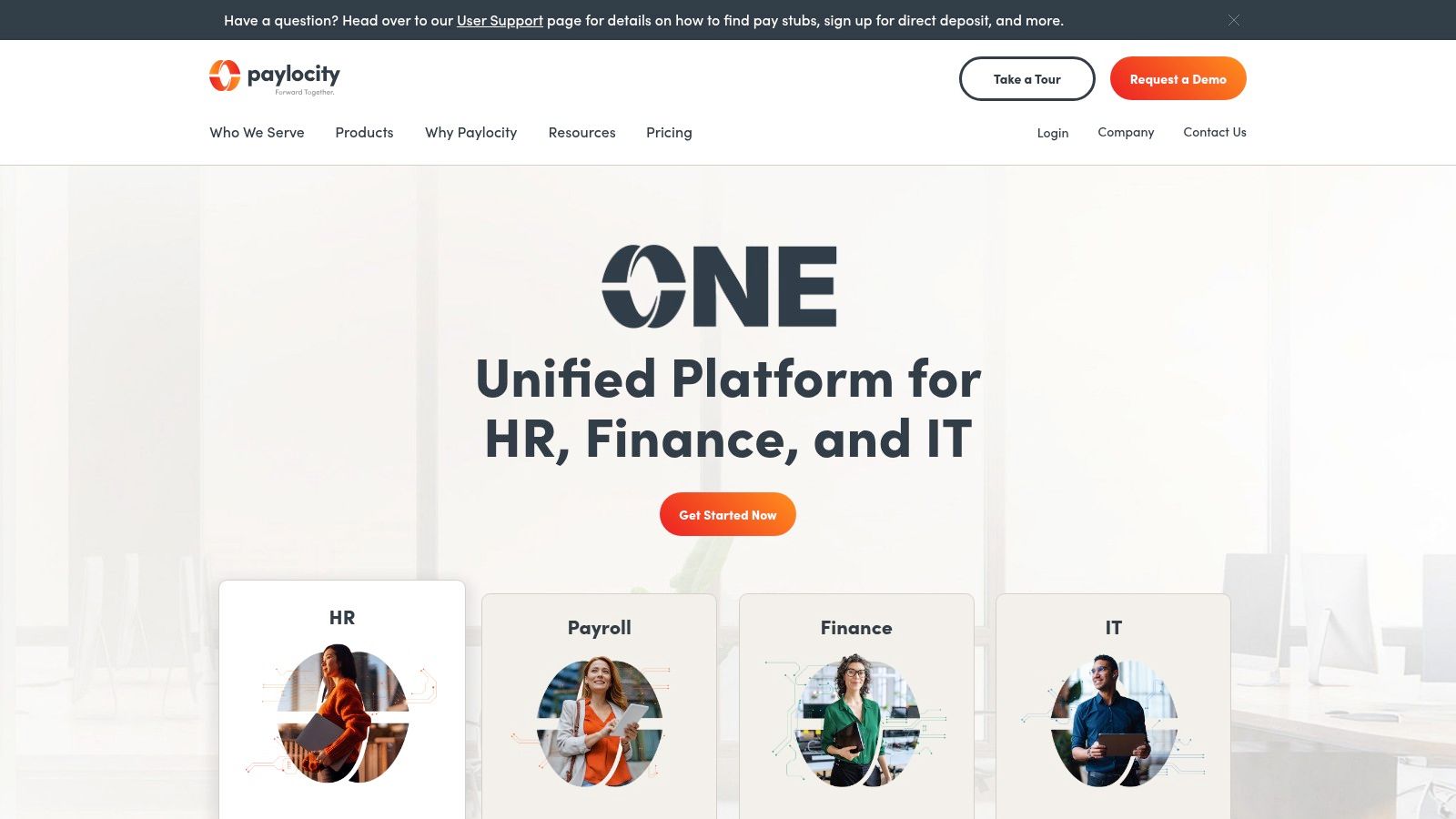
Paylocity combines payroll, HR, time, benefits, analytics, and employee-experience tools in one HCM platform. Its engagement layer includes surveys, recognition, and a social community feed, which makes it a better fit than a payroll-only system for organizations trying to preserve communication and culture while adding locations.
For compliance-oriented teams, the practical value lies in connecting employee data with time and attendance, benefits administration, and ACA tracking. Geofenced clock-ins and scheduling can help distributed employers create more consistent time records, although the employer still needs to validate local rules and review exceptions.
Paylocity's mobile experience can support managers and employees who don't work from a desk. Its integration ecosystem can also reduce the need to replace every surrounding business system during migration. The limitation is breadth. A platform that touches payroll, time, benefits, engagement, and analytics will require process decisions, manager training, and ownership for configuration.
Quote-based pricing makes a detailed proposal essential. Ask the vendor to separate the core platform, required modules, implementation services, support, and renewal terms. Then test whether the engagement features will really be used, rather than paying for a broad suite that leaves high-risk employee-relations decisions outside the system.
Paylocity works well for a growing SMB that treats employee experience as an operating priority. It may not be the best choice for a lean employer seeking the fastest possible payroll deployment.
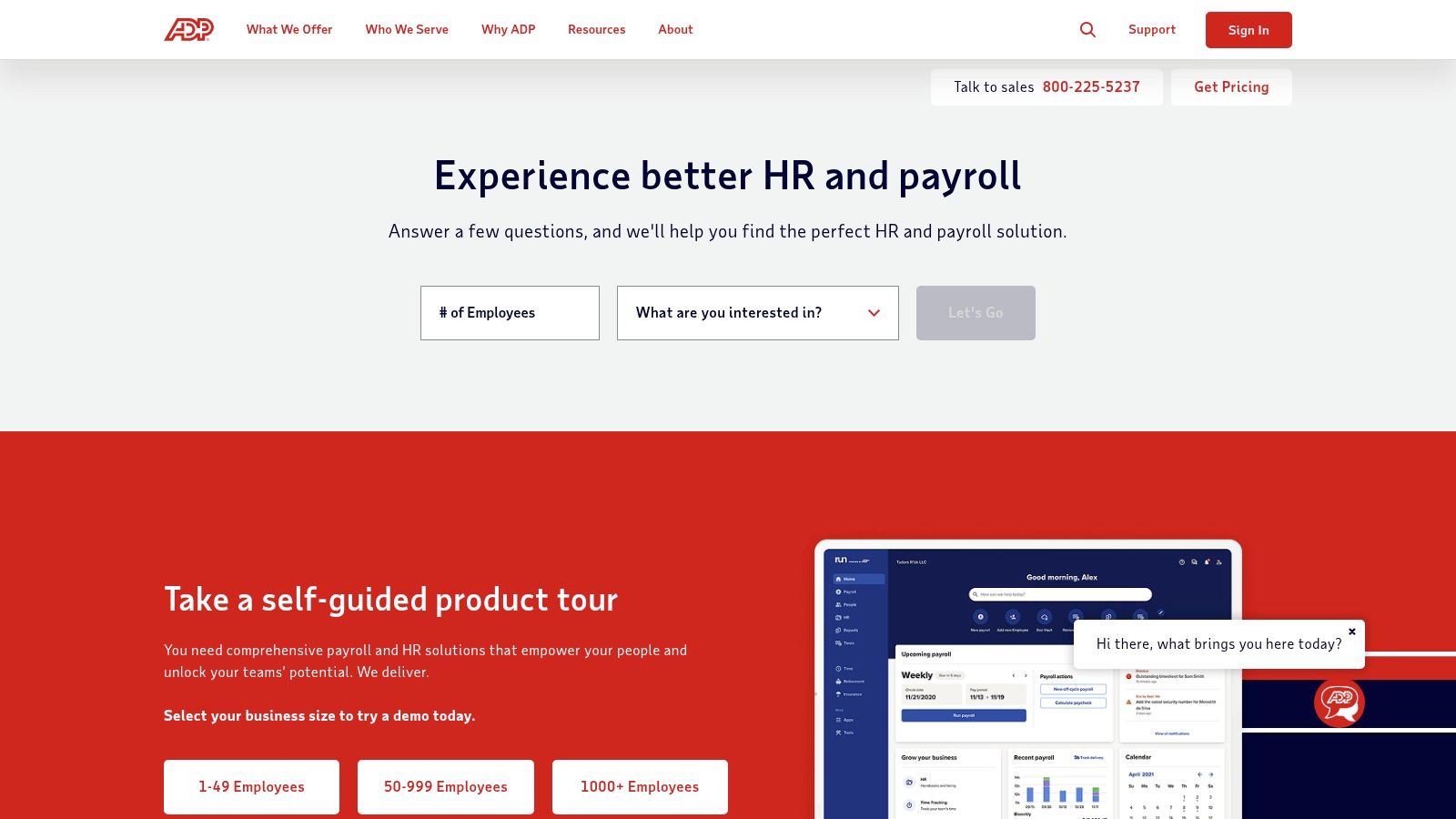
ADP Workforce Now is a mature HCM for SMB and mid-market employers that need broad payroll, HR, time, benefits, and partner capabilities. Finance and payroll teams may find the platform familiar, which can matter when an organization needs to hire a replacement administrator or coordinate closely with accounting.
The platform supports end-to-end payroll and tax processing, onboarding and termination workflows, time and attendance, benefits administration, and a large third-party marketplace. Packaged tiers can provide a path to more capability, but the buyer must understand which tier and add-on address each operational requirement.
ADP's breadth can help employers avoid assembling disconnected systems. It can also introduce configuration decisions that a small HR team isn't prepared to own. Quote-based pricing varies, so compare the complete cost of payroll, time, benefits, implementation, support, and integrations rather than relying on a starting figure.
A payroll platform can calculate and file obligations, but it won't decide whether a termination process is consistent, sufficiently documented, or appropriate under the facts.
Before signing, ask who owns state tax registration, correction filings, year-end adjustments, data validation, and escalation when a payroll issue affects an employee. A practical SMB payroll management advice resource can help leadership separate payroll administration from broader HR risk. Workforce Now is a sensible shortlist option for employers that value ecosystem depth and established payroll operations, but implementation ownership must be explicit.
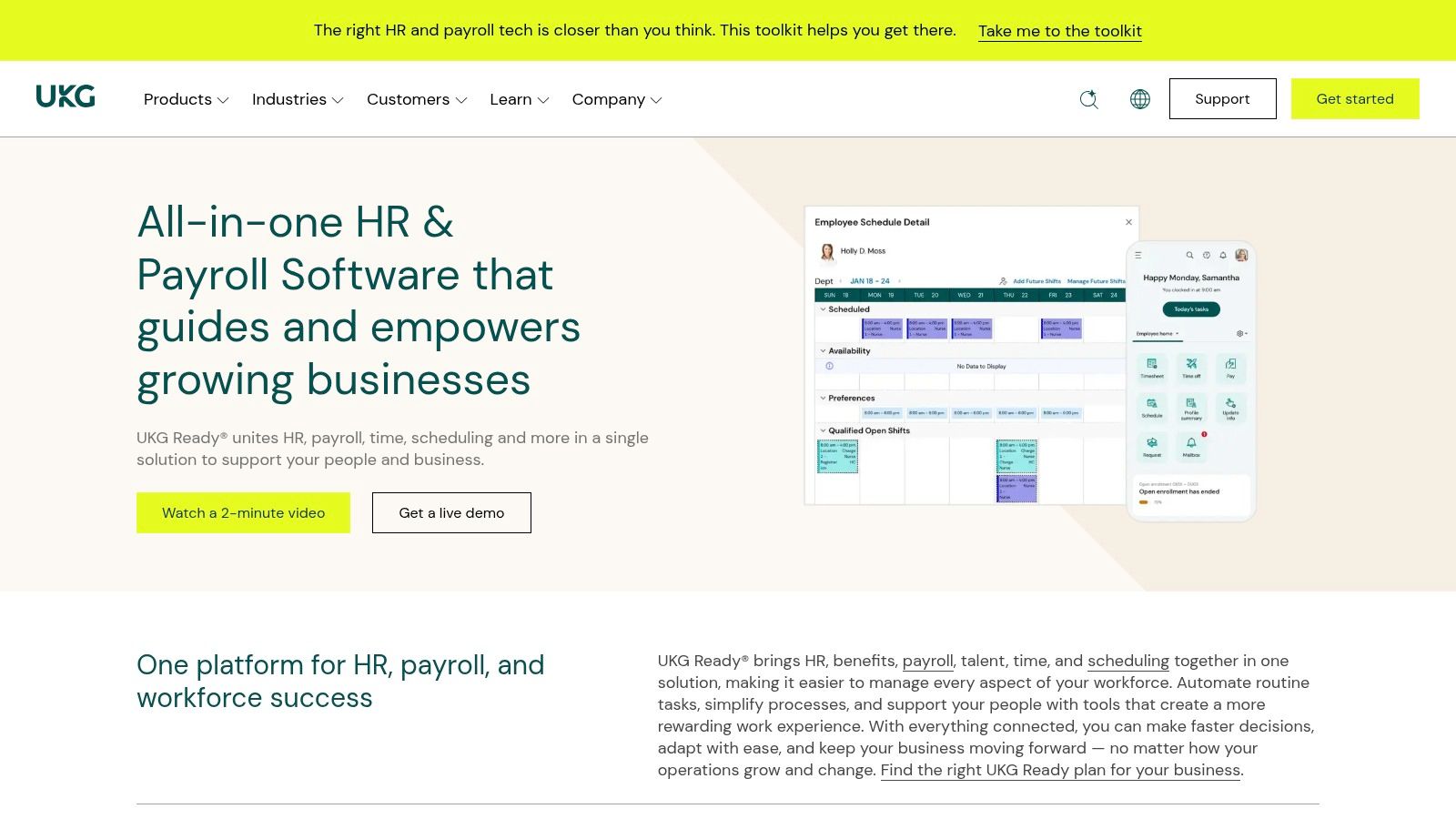
UKG Ready is built for SMBs that need more than employee records and basic payroll. Its workforce-management foundation supports time, attendance, scheduling, HR, payroll, and talent in configurable packages. That makes it particularly relevant for employers with hourly teams, location-based rules, complex schedules, or operational requirements that change by site.
The platform's value is strongest where time data directly affects payroll and compliance. Configurable rules can help standardize scheduling and attendance administration, while UKG's broader analytics and workforce-management experience provide a stronger operational foundation than lightweight HR tools.
UKG Ready can be more demanding to implement than a simpler HRIS. The buyer must define pay rules, approval paths, job and location structures, manager permissions, and exception handling before employees begin using the system. A partner-led implementation may help, but it also makes it important to document who is responsible for configuration quality.
Pricing isn't presented as a simple public rate. Request a proposal that distinguishes package level, selected capabilities, implementation, integrations, support, and future changes. Ask for a live demonstration using the organization's actual scheduling and time scenarios, including missed punches, location transfers, overtime review, and manager approval.
UKG Ready fits a multistate employer where workforce management is central to risk control. It may be more system than necessary for a professional-services business with salaried employees and limited scheduling complexity.
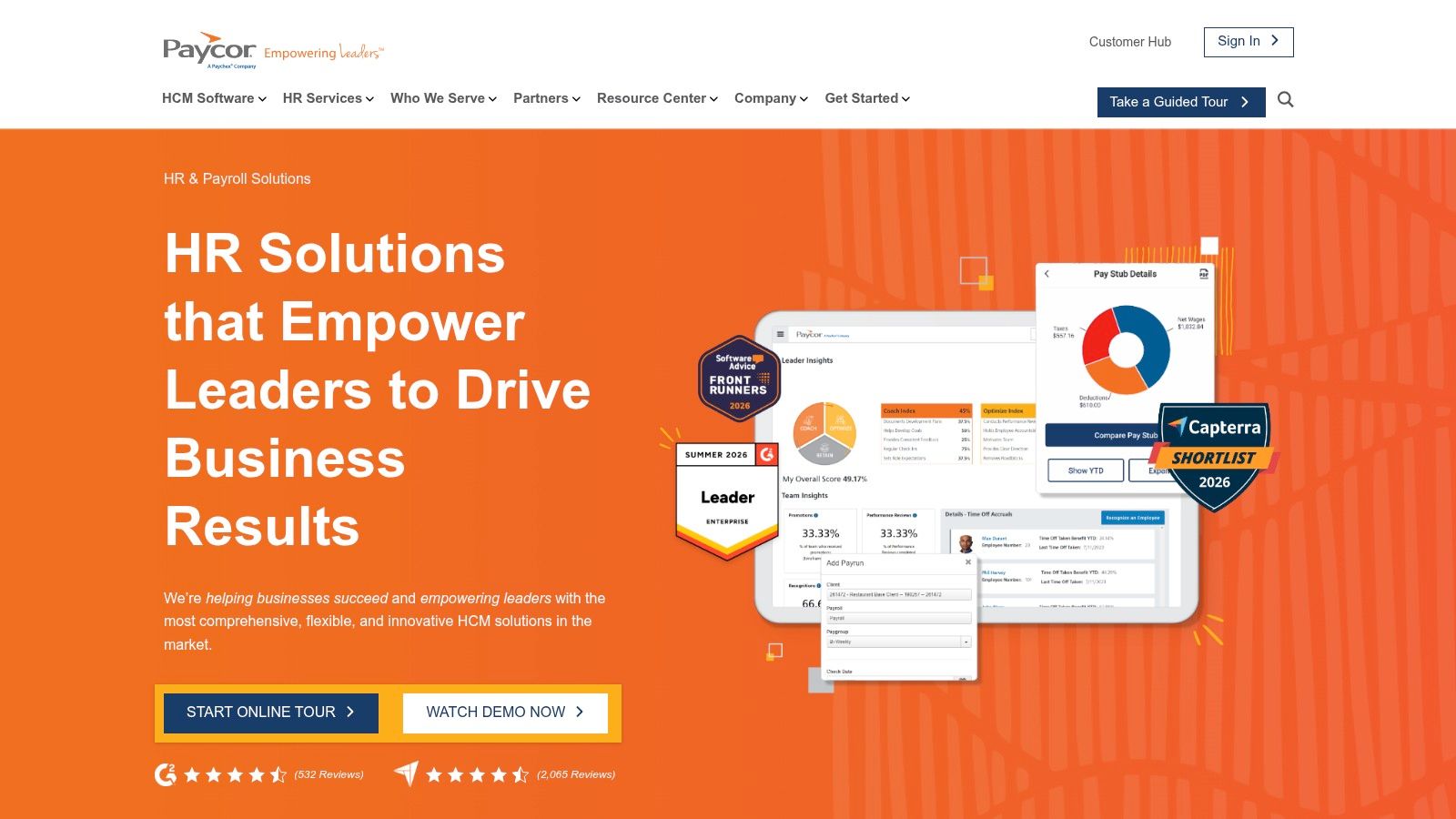
Paycor offers payroll, HR, onboarding, talent acquisition, learning, performance, time, scheduling, and analytics for SMB and mid-market employers. It suits organizations that want to standardize people operations across multiple locations without immediately adopting an enterprise-scale platform.
Payroll and tax processing, unlimited payroll runs, time administration, and ACA-related capabilities address important operational needs. The broader talent layer can also help a company connect recruiting, onboarding, learning, and performance processes instead of managing each through separate tools.
Paycor's implementation and service approach is geared toward SMBs, which can make it approachable for organizations without a large HRIS team. Its analytics and AI-assistant initiatives may also support routine reporting and administrative work. Those benefits depend on clean data, clear ownership, and managers who understand what the system can and cannot determine.
Guided, quote-based purchasing can make it difficult to compare bundles. Build a requirements matrix before the demo. Mark each feature as essential, useful, or unnecessary, then ask the vendor to identify the exact package, integration, or manual workaround required for each item.
For multistate organizations, test state-specific onboarding, time, leave, benefits, and reporting workflows rather than accepting a general compliance demonstration. Paycor is a reasonable middle-ground option for employers seeking suite breadth and SMB-oriented implementation. It isn't automatically the lowest-burden choice just because it targets smaller organizations.
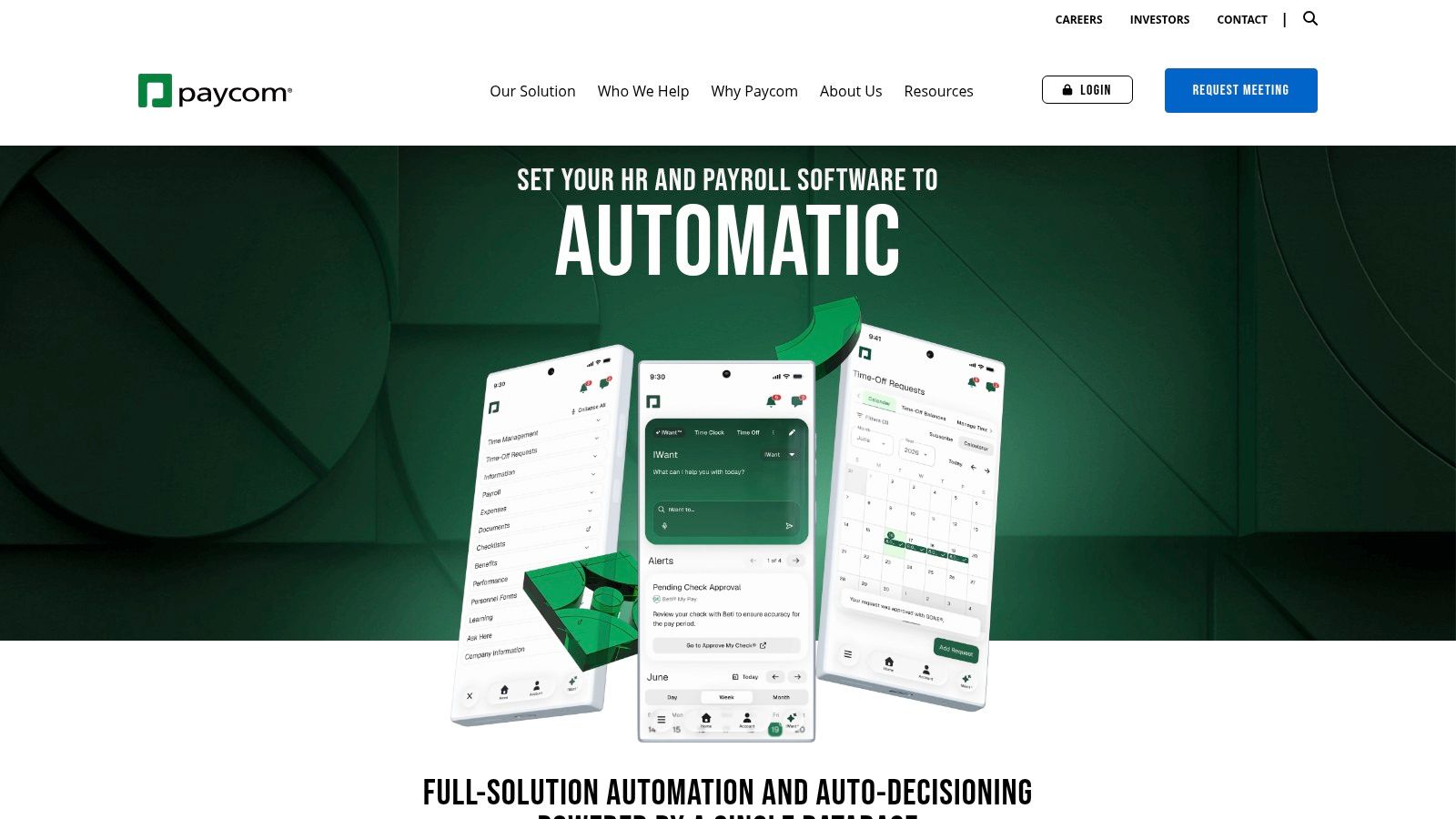
Paycom takes an all-in-one approach to payroll, HR, time, talent, benefits, reporting, and employee self-service. Its Beti workflow moves payroll review toward employees, giving them a defined opportunity to identify certain errors before payroll is finalized.
That employee-driven review can reduce avoidable corrections when the organization has reliable employee data and clear accountability. The platform's single-database approach also limits the data silos that appear when HR, payroll, time, and talent systems operate independently.
Paycom is attractive when leadership wants one vendor and one connected data environment. Mobile self-service and broad reporting can reduce routine questions, while integrated workflows can support headcount growth without immediately adding more point solutions.
The risk is assuming that integration eliminates the need for controls. Ask how the system records employee changes, manager approvals, payroll corrections, access permissions, and exceptions. Determine whether an employee's review can be distinguished from an administrator's approval, and identify who investigates a discrepancy that the workflow doesn't resolve.
Customized pricing and contractual commitments make total-cost verification important, particularly for smaller headcounts. Include implementation, modules, support, renewal increases, data exports, and termination assistance in the commercial review. Paycom is a strong candidate for an employer committed to a consolidated suite. A small organization with limited payroll complexity should compare its administrative burden and total cost against a simpler payroll-first platform.
Gusto is a payroll-first platform for small and growing employers that want a relatively simple way to manage payroll, tax filings, onboarding, basic HR, time, and benefits. It can be a practical BambooHR alternative when payroll accuracy and deployment speed matter more than advanced talent management.
The platform supports multistate payroll and tax filings, brokered health benefits, broker integrations, onboarding, and time and attendance add-ons. Its published add-on structure and month-to-month terms can make commercial comparisons easier than quote-only systems, although the buyer still needs to calculate the cost of the features required as the organization grows.
Gusto works best when the employer needs defensible fundamentals: employee records, payroll history, tax administration, onboarding documentation, and clear approvals. Well-organized help resources can support a lean team, but support materials aren't a replacement for judgment in a difficult employee-relations matter.
Advanced HR, talent, reporting, and compliance controls are lighter than those found in broader mid-market suites. Add-ons can also raise the total cost when the company adds time, benefits, or compliance-related requirements. Before selecting Gusto, test exports, role permissions, document retention, payroll corrections, and the process for handling a new state.
A payroll-first platform is often the right answer when the organization has limited complexity and wants to avoid paying for unused functionality. It becomes less compelling when leadership needs deep investigations workflows, advanced workforce management, or extensive cross-functional automation.
Justworks offers both a payroll and HR tools track and a full professional employer organization model. The PEO option adds co-employment, benefits administration, HR consulting, employment-practices liability insurance, and centralized support, which can appeal to a multistate SMB without a dedicated internal HR function.
Its payroll capabilities cover multistate filings and W-2 and 1099 administration. PEO Basic includes compliance support, HR consulting, retirement access, and related support, while PEO Plus adds medical, dental, vision, HSA, FSA, and mental-health benefits. Global employer-of-record services are available as an optional addition.
A PEO can reduce the number of vendors and centralize benefits and compliance administration. It doesn't mean the company's executives stop owning workplace decisions. Managers still need to identify issues, preserve facts, follow internal policies, and escalate high-risk situations.
Published pricing across tiers improves initial transparency. The buyer should still separate per-employee PEO fees, benefits costs, insurance charges, pass-through expenses, and any payroll-only alternative. Confirm what support covers, when a consultant becomes involved, and whether the organization can retain required documentation after leaving.
Justworks is a good fit when centralized administration and benefits access are more valuable than maximum software customization. Its ATS and other specialized capabilities may require integrations, and the PEO cost can exceed payroll-only software. Choose it because the service model matches the risk profile, not just because it offers more features.
TriNet provides PEO and ASO options alongside payroll, tax, HR administration, workers' compensation, benefits, and industry-oriented services. That distinction matters. A buyer choosing a PEO receives a co-employment service model, while an ASO arrangement generally keeps the employment relationship with the company and provides administrative support.
TriNet's benefits administration and access to national carriers may reduce the procurement and administrative burden for smaller employers. Industry packages and marketplace integrations can also help organizations with specialized operating environments. For a risk-sensitive SMB, the depth of the service relationship may be more important than an attractive HRIS interface.
Quote-based pricing requires a careful commercial review. Ask TriNet to identify per-employee fees, pass-through costs, benefits premiums, workers' compensation charges, implementation services, and renewal provisions. Confirm which responsibilities remain with company leadership under the selected model.
A PEO may limit the employer's carrier choice compared with using an independent broker. It may also change how benefits, payroll corrections, employee complaints, and employment-law questions are escalated. Those trade-offs should be documented before the contract is signed.
The COO guide to HR consulting rates can help leadership compare a PEO service model with an HRIS plus separate advisory support. TriNet makes sense when a company wants established PEO experience and centralized administration. It may be less suitable for an employer that needs complete control over benefits design, carrier selection, or internal HR workflows.
HiBob, commonly called Bob, is a modern HRIS focused on core HR, onboarding, time off, compensation, performance, engagement, analytics, and organizational design. It fits employers that view manager experience, employee engagement, and flexible organizational structures as central requirements.
The platform's surveys, shout-outs, configurable workflows, and organizational data model can support distributed or multi-entity teams. Its global-ready structure is useful when the company needs a consistent people-data layer across locations and countries, while U.S. payroll is typically connected through a payroll partner.
HiBob's user experience can help managers adopt HR processes that feel more collaborative than administrative. Its flexibility also makes it attractive for organizations with matrixed teams, evolving structures, or a strong focus on performance and compensation.
The main limitation for a U.S. multistate employer is payroll architecture. If payroll sits with another provider, the implementation team must map employee fields, pay groups, locations, deductions, approvals, and change timing between systems. An API connection isn't the same as a native integration. API-based synchronization may require scheduled transfers, monitoring, mapping, and error resolution, as explained in this payroll integration guidance.
Ask both vendors to show how a job change, state transfer, compensation update, termination, and payroll correction move through the connected systems. HiBob is a strong option when engagement and organizational design lead the decision. It isn't the obvious choice when native U.S. payroll and centralized tax administration are the primary requirements.
| Product | Core focus / capabilities | User experience & service | Value proposition / strength | Best fit / target customer | Pricing & considerations |
|---|---|---|---|---|---|
| Rippling | Modular HRIS: payroll, benefits, time, device/IT provisioning; 50‑state compliance tooling | Strong automation and single employee record; broad integrations | Reduces manual risk in onboarding/offboarding; enforces policy and IT controls | Multi‑state SMBs needing integrated HR+IT and defensible processes | Opaque modular pricing; add‑ons can raise TCO; watch for incremental fees |
| Paylocity | Unified HCM: payroll, time/scheduling, benefits + engagement hub | Modern mobile UX, social/recognition features; requires change management on rollout | Combines engagement tools with compliance and payroll | SMB → mid‑market prioritizing culture, engagement, and manager tools | Quote‑based pricing; complex plan components |
| ADP Workforce Now | End‑to‑end payroll, tax, time, benefits + large third‑party marketplace | Familiar platform for finance/payroll teams; vendor ecosystem; variable service reports | Proven scale and broad partner ecosystem for multi‑state complexity | SMBs needing mature payroll, scale, and many integrations | Quote‑based; pricing varies by package and service level |
| UKG Ready | WFM‑centric SMB suite: time/attendance, scheduling, HR/payroll bundles | Strong out‑of‑the‑box workforce/time UX; heavier implementation | Deep workforce management and configurable compliance rules | Distributed teams with complex scheduling/time rules | Limited pricing transparency; partner ranges published |
| Paycor | HCM: payroll, time, talent, learning, embedded analytics/AI | SMB‑oriented implementation and support; growing AI features | Scales into talent + analytics; practical compliance support | Multi‑location SMBs seeking standardization and analytics | Quote‑based; guided quoting required |
| Paycom | All‑in‑one HCM: payroll (Beti), HR, time, talent, reporting | Mobile self‑service; single‑database design to reduce silos | Shifts payroll error detection upstream; integrated vendor model | Organizations scaling headcount wanting tight payroll control | Customized pricing and contractual commitments; verify TCO for small orgs |
| Gusto | Payroll‑first: multi‑state payroll, HR basics, onboarding, add‑on catalog | Easy deployment; clear docs and month‑to‑month terms | Transparent pricing and simple, defensible HR basics | Small multi‑state employers needing straightforward payroll/compliance | Transparent add‑ons; expanding needs can raise total cost |
| Justworks | Payroll/HR tools or full PEO (co‑employment, benefits, EPLI) | Published tiered pricing; no PEO implementation fee; 24/7 support on PEO | PEO centralizes compliance and benefits administration | SMBs wanting PEO model to simplify multi‑state benefits/compliance | PEO PEPM fees higher than payroll‑only; tradeoffs on carrier choice |
| TriNet | ESAC‑accredited PEO & ASO: payroll, HR admin, workers' comp, industry packages | Experienced PEO service; must clarify PEO vs ASO purchase | Deep PEO expertise, industry‑tailored packages, multi‑state strength | Risk‑sensitive SMBs needing PEO and industry benefits solutions | Quote‑based; understand PEPM vs pass‑throughs and carrier limitations |
| HiBob (Bob) | Modern HRIS: core HR, org charts, performance, engagement; global data model | Strong UX for managers/employees; flexible multi‑entity support | Engagement and org design focus; good for matrixed/distributed orgs | Mid‑market growth orgs prioritizing culture and global structure | Quote‑only; modules and headcount affect total cost; often pairs with payroll partner |
The best BambooHR alternative isn't necessarily the platform with the longest feature list. It is the system, service model, or combination that matches the organization's operational risk, internal capacity, and appetite for managing connected vendors.
Start with the payroll question. A payroll-first option such as Gusto can suit a smaller employer that needs multistate tax filing, onboarding, benefits, and basic HR without a large implementation. A broader HCM such as ADP Workforce Now, Paylocity, Paycor, Paycom, or UKG Ready makes more sense when payroll must connect with time, scheduling, benefits, analytics, talent, and manager workflows.
A PEO such as Justworks or TriNet deserves serious consideration when centralized administration, benefits access, workers' compensation support, and HR consulting are more important than maximum control over the underlying system. A PEO can reduce administrative fragmentation, but it changes the relationship between the company, the vendor, and the employees. Leadership should understand exactly who owns each compliance and employee-relations responsibility.
An HRIS paired with payroll may be the better route when engagement, performance, compensation, or organizational design leads the buying decision. HiBob can provide that people-management layer, but the payroll integration becomes a control point that requires ownership, monitoring, and documented exception handling. Rippling offers a more unified approach when HR, payroll, IT access, devices, and workflow automation should operate from the same employee record.
The labor market also reinforces why scalability deserves attention. Bureau of Labor Statistics data show that firms with 249 or fewer employees generated 52.8% of U.S. net job creation from the first quarter of 2021 through the second quarter of 2024. The same BLS analysis of small-business job creation shows substantial movement between quarters. Hiring surges, reorganizations, contraction, and geographic expansion can change HR requirements faster than a small team expects.
Before signing, require clear answers on:
The independent HR Systems Survey found that 51% of SMB organizations had used their current HRMS for three years or less, compared with lower proportions in larger segments. That short tenure makes migration governance and exit planning practical buying requirements, not administrative afterthoughts.
Software can standardize workflows, restrict permissions, preserve records, and surface alerts. It can't replace judgment for terminations, investigations, manager conduct, documentation standards, accommodations, or unusual multistate decisions. Technology research also shows the gap between adoption and control. The U.S. Chamber of Commerce reports that approximately two-thirds of small businesses use technology to recruit and manage their workforce, while separate HR-software research in the same small-business technology report identifies continued reliance on spreadsheets or paper for parts of recruiting, onboarding, and talent management.
The right decision may be a powerful HCM, a narrow payroll platform, a PEO, or a carefully governed combination of tools. It may also require a decision partner outside the software contract. Paradigm International Inc. supports SMB leadership teams with employee-relations guidance, investigations, documentation, policy and handbook development, leave and accommodation support, and multistate compliance considerations. Learn more about Paradigm International's advisory support when the organization needs structure and judgment alongside its HR technology.
Paradigm International Inc. helps owners, COOs, executive teams, and HR leaders guide high-stakes people decisions, strengthen documentation, and reduce preventable employment risk as organizations grow across states. If you're evaluating BambooHR alternatives and need advisory support beyond payroll or HR software, visit Paradigm International Inc. to learn how its structured, advisory-first approach can support defensible HR operations.