
Navigating an employee's leave after a loss is one of the most delicate situations a leader can face. In the U.S., there is no federal law requiring bereavement leave, leaving employers to manage a complex mix of state and local rules. This can be challenging for any business, but it's especially tricky for companies operating in multiple states. A single, standardized policy might seem efficient, but it can create significant legal risks if it doesn't meet the specific requirements in every location where you have staff.
Guiding an employee through a period of grief requires a mix of genuine compassion and a solid understanding of your legal duties. Since there's no federal standard, bereavement leave is governed state by state, and sometimes even city by city. This reality creates a tricky compliance landscape, especially for companies with a distributed workforce. What is perfectly legal in one state might fall short in another.
A growing number of states—including California, Illinois, and Oregon—now have laws requiring employers to give employees time off to grieve. These laws typically define:
It's tempting to create a simple, generic bereavement leave policy, but it's a risky move. For example, offering a standard three days of unpaid leave might seem reasonable, but it would violate California's law, which requires up to five days of leave. Similarly, if your policy defines "family member" too narrowly, you could exclude relationships that are protected under state law, leading to compliance violations.
The real balancing act for employers is maintaining a consistent company culture while adapting to the different demands of each state's bereavement leave laws. Getting this wrong can lead to legal fines, decreased employee morale, and damage to your company's reputation.
Viewing bereavement leave as just another employee perk is a mistake. It is a critical piece of employment law that often intersects with other protected leaves, like the Family and Medical Leave Act (FMLA). Deep grief can sometimes trigger serious health conditions, such as depression, which could give an employee additional legal protections you need to be aware of.
Understanding the legal landscape is the first step toward building a policy that is both compassionate and legally sound. When you know exactly what is required, you can support your team members through their toughest moments without putting your organization at risk. If you need help creating a compliant and consistent HR framework for your multi-state team, our experts can provide the clarity you need.
When it comes to bereavement leave, compliance obligations almost always start and end at the state level. In the United States, there is no federal law that requires private-sector employers to provide bereavement leave. This creates a challenging compliance landscape where individual states have stepped in, leading to a patchwork of rules that can change dramatically across state lines.
For any business with employees in more than one state, this patchwork can be difficult to navigate. A policy that is perfectly fine in one location could be non-compliant just a few miles away. As more states recognize the importance of giving grieving employees job-protected time off, the laws continue to evolve. Staying current is not just a good practice—it is essential for compliance.
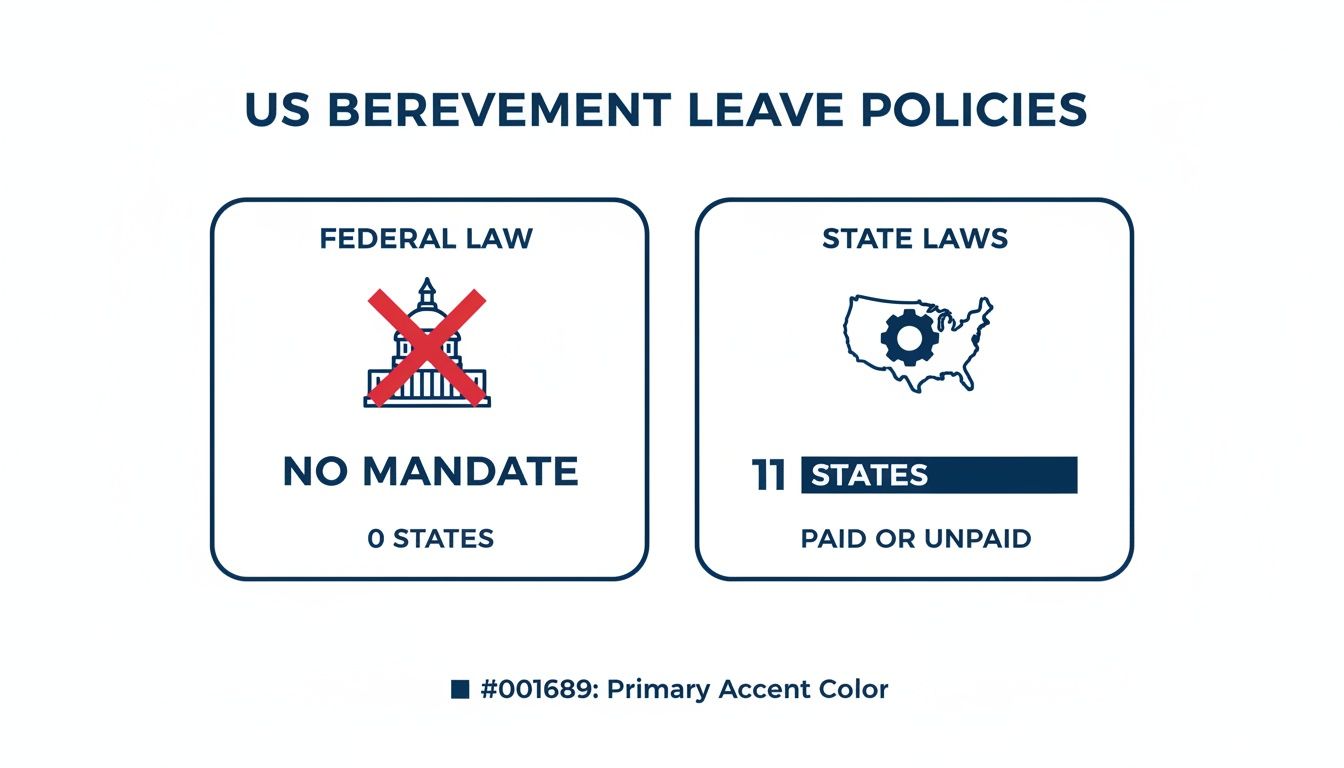
As the infographic shows, the burden falls on employers to understand and follow the specific laws in every state they operate in. This jumble of regulations is exactly why a single, uniform bereavement policy often creates risk for multi-state businesses.
State-specific bereavement laws reveal a handful of key areas where rules diverge, creating compliance traps for employers. Understanding these variations is the first step toward building a policy that holds up under scrutiny.
Here are the core areas where state laws tend to differ:
To see just how different these laws can be, it's helpful to compare a few key states. This variability makes multi-state compliance challenging, as a mismatched policy can easily lead to wrongful denial claims or conflicts with other protected leaves. You can find more tips on managing these issues in our guide to employee handbook requirements by state.
The table below provides a snapshot of the current bereavement leave landscape.
This comparison makes it clear: what is compliant in one state can be insufficient in another. For example, a standard 3-day policy would fall short in California, Illinois, and Oregon, exposing the employer to risk.
The biggest takeaway for any HR leader or business owner is that state laws set the minimum standard. Your company policy must meet or exceed these requirements in every single state where you have people on payroll. Anything less is an invitation for legal trouble.
The practical impact is that a "one-size-fits-all" bereavement policy is a risky bet. Your policy needs to be flexible enough to comply with the most generous state law you're subject to, or you need to create state-specific addendums. For instance, if your company handbook offers three days of leave but you have employees in California, your policy is non-compliant for those workers.
Managers must be trained on the specific rules that apply to their direct reports to prevent inconsistent—and illegal—application of the policy. The definition of "family" is another critical detail. A policy that only covers a spouse, parent, or child will fall short in states that also protect leave for the death of a grandparent, sibling, or domestic partner. Regularly auditing your policy against current laws is essential risk management.
Juggling different types of leave requests can be one of the trickier parts of HR, and it becomes even more complex when protected leaves overlap. A common point of confusion is where a company’s bereavement policy ends and the federal Family and Medical Leave Act (FMLA) begins. Getting this right is critical for staying compliant and supporting your employees without creating legal risk.
First, standard bereavement leave—the few days an employee takes to attend a funeral and handle immediate affairs—is not typically considered FMLA leave. The FMLA is designed for an employee's own serious health condition or for caring for a family member with one. Grieving, by itself, does not automatically qualify. However, the situation is not always that straightforward.
There are key scenarios where an employee's need for time off after a death could trigger FMLA protections. This is where you need to proceed carefully to avoid any claims of FMLA interference. While your standard policy might offer three to five days, an employee's needs may extend far beyond that, potentially pushing their request into FMLA territory.
Two main situations cause this overlap:
In these cases, the employee is no longer just taking time to grieve; they are taking medically necessary leave. This distinction is the key to navigating bereavement leave laws and FMLA correctly. You can get a better handle on the specific employee requirements by using an FMLA eligibility checklist.
When an employee’s request for time off goes beyond your standard bereavement policy, clear communication and proper documentation are essential. If you suspect the leave might qualify under FMLA, it is your responsibility as the employer to initiate the official process by providing the required FMLA notices and forms.
Navigating the transition from bereavement leave to FMLA requires both compassion and procedural precision. Never diagnose an employee’s condition yourself; always rely on a formal medical certification to determine if their absence qualifies as a serious health condition under the FMLA.
Follow these key steps:
Failing to spot a potential FMLA situation can lead to serious legal consequences. By understanding how bereavement and FMLA can interact, you can support your people during their most difficult times while protecting your organization.
To build a forward-thinking bereavement policy, it is helpful to look beyond U.S. borders. While domestic bereavement leave is a patchwork of state-level rules, many other countries have established more generous, government-mandated standards. Looking at these global trends provides valuable context for shaping your own company's approach to supporting employees.
Abroad, particularly in Europe, there is a clear cultural and legal shift toward providing meaningful support for grieving employees. These international standards are shaping employee expectations, especially in global companies or those competing for international talent. The goal isn't to apply foreign laws but to recognize where the future of employee support is headed.
In many European countries, paid and extended bereavement leave is a legal right, not just a perk. This mindset treats time off for grief as an essential part of employee well-being, similar to sick or parental leave. It stands in sharp contrast to the U.S. model, where leave is often unpaid and limited to a few days, if it is offered at all.
Europe's bereavement leave landscape is evolving, with significant changes planned. The UK’s Paternity Leave (Bereavement) Act, effective in 2026, will give fathers or partners up to 52 weeks of leave if the mother passes away. Denmark will provide 12 weeks of paid leave for bereaved parents starting in 2026. As you can discover more insights about these upcoming compliance changes on hrexecutive.com, the global standard is moving toward more substantial support.
These examples show a growing consensus: supporting employees through loss is a fundamental responsibility. For U.S. companies, especially those with a global footprint or remote teams, these trends are important to consider.
You might wonder why laws in other countries should matter to a U.S.-based business. The answer relates to talent acquisition, employee retention, and building a strong employer brand. In a competitive labor market, a thoughtful and compassionate benefits package can be a powerful differentiator.
Offering a bereavement policy that aligns with more progressive global standards sends a clear message: you value your employees as whole people. It demonstrates a commitment to their well-being that goes beyond legal minimums, fostering loyalty and a positive work culture.
Here are a few strategic advantages of a globally-informed view on bereavement leave:
Ultimately, learning from global bereavement leave trends is not about copying international laws. It is about understanding the direction of employee support and making a strategic decision to lead in supporting your most valuable asset: your people.
Let's move from legal theory to practical application. Building a bereavement leave policy is not just about checking legal boxes; it is about creating a framework that genuinely supports your team during their most difficult times. A well-written policy ensures compliance with all relevant bereavement leave laws and gives your managers clear, consistent guidelines to follow.
This clarity is vital. It empowers managers to act confidently and fairly, which helps you avoid the inconsistent enforcement that can lead to discrimination claims.

A strong policy is built on a few key pillars. Each one needs to be defined with precision to eliminate gray areas for both employees and the leaders who support them.
First, your policy needs to spell out who is eligible for leave and for what reasons. Vague language is a recipe for confusion and can create unnecessary stress for an employee who is already navigating a difficult situation.
To build a solid framework, your policy must explicitly cover these core areas:
Nailing down these details upfront creates a reliable process. It means that when an employee needs support, they know exactly what to expect.
Beyond the “what,” your policy needs to outline the “how.” This means creating a simple, clear procedure for requesting and documenting the time off. The goal is to make the process as painless as possible for a grieving employee while meeting your company's administrative needs.
Your procedural guidelines should include:
A policy's true value is measured by how it functions in a real-world crisis. Your procedures should aim to reduce an employee's burden, not add to it. A compassionate process strengthens trust and reinforces a supportive company culture.
Legal compliance is just the starting point. A great policy recognizes the human side of grief. More companies are realizing that offering more than the bare minimum is a smart investment in employee loyalty and well-being. A compassionate policy might also highlight resources like access to professional grief counselling.
Global standards can also offer valuable perspective. For instance, countries like China (3 paid days), Brazil (2 paid days), and France (14 paid days for the loss of a young child) have national policies. Understanding these approaches can help you build a more competitive benefits package. You can read the full research about global leave policies on remote.com to see how your policy compares.
When you combine legally required components with genuine, practical support, you create a bereavement policy that not only manages risk but also takes care of your team.
Moving from theory to practice is where you manage HR risk effectively. A well-written bereavement leave policy is only as good as its application. This checklist is a practical roadmap to audit your current practices, spot potential compliance gaps, and ensure your approach is both legally solid and genuinely supportive.
Think of these as actionable steps to stress-test your existing bereavement policy and procedures. Each item is designed to minimize risk and reinforce a compassionate company culture.
First, let's look at the policy itself. Is it clear, complete, and compliant with all relevant bereavement leave laws? Ambiguity is your enemy here; precision is key.
Even a perfect policy can be undermined by inconsistent application. Your managers are on the front lines, so they need the right training and tools to handle these sensitive situations correctly every time.
A well-documented policy is your first line of defense, but consistent execution by trained managers is what truly protects your organization. Ensure every leader understands their role in applying the policy fairly and compassionately.
Here’s how to check if your team is operationally ready:
This checklist provides a structured path forward. For personalized guidance on strengthening your HR compliance framework, our team is ready to help. Please contact us to learn more.
Navigating employee leave during a time of grief often brings up practical questions that are not always covered in a standard policy. Leaders need clear, direct answers to handle these sensitive situations with both compassion and consistency. Here are some of the most common questions employers ask about bereavement leave laws and company policy.
There is no federal law requiring paid bereavement leave, and only a few states mandate any form of payment. For most employers, this time off is unpaid unless your company policy states otherwise. The most important thing is to apply your pay policy consistently to all eligible employees to avoid claims of unfair treatment. If your policy offers unpaid leave, it should clarify whether employees can use accrued vacation or sick time to receive pay.
Yes, you can generally ask for reasonable documentation to verify the need for leave. This could include a copy of an obituary, a funeral program, or verification from a funeral home. The key is to handle this request with sensitivity. Frame it as a standard procedural step for your records, not as a sign of distrust, and keep the process as simple as possible for the grieving employee.
If an employee's needs exceed your policy’s limits, it is time to open a dialogue and explore other options. This conversation must be handled carefully to ensure you are considering all legal protections.
It is helpful for employees to understand their company's bereavement policy limitations to manage expectations from the start.
Navigating the complexities of bereavement leave laws requires precision and good judgment. A well-crafted policy not only ensures compliance but also demonstrates your commitment to supporting your team through life's most challenging moments. Building a supportive and legally sound workplace is an ongoing process.
If you are looking to strengthen your HR practices and reduce employment risk, our team can provide the expert guidance you need. Contact us for a consultation to learn more.