The most popular advice on Bereavement Leave Pay & FMLA is wrong in a way that creates real audit risk. Employers hear “be compassionate,” then assume that means every death-related absence should be treated as protected leave. It doesn't. FMLA is a job-protection statute for specific qualifying reasons, not a general bereavement mandate, and a sloppy policy creates problems fast when you manage employees across multiple states.
The practical mistake is even bigger for SMBs with managers who handle leave informally. One supervisor approves paid time off, another labels the same absence as FMLA, and payroll codes the result differently from location to location. That inconsistency is exactly how employers end up with interference claims, documentation gaps, and policy language they can't defend later.
FMLA is often described as if it's the answer to every family crisis. It isn't. The statute, enacted in 1993, gives eligible employees of covered employers up to 12 workweeks of job-protected leave in a 12-month period for qualifying family and medical reasons, and federal law treats that leave as unpaid unless employer-provided paid leave runs concurrently under the employer's policy (U.S. Department of Labor FMLA overview).
Bereavement is not one of the qualifying events. That matters because employers sometimes assume a death automatically creates FMLA protection. It doesn't, and the Department of Labor's funeral leave guidance is blunt that federal law does not require bereavement pay or a stand-alone bereavement entitlement (DOL funeral leave guidance).
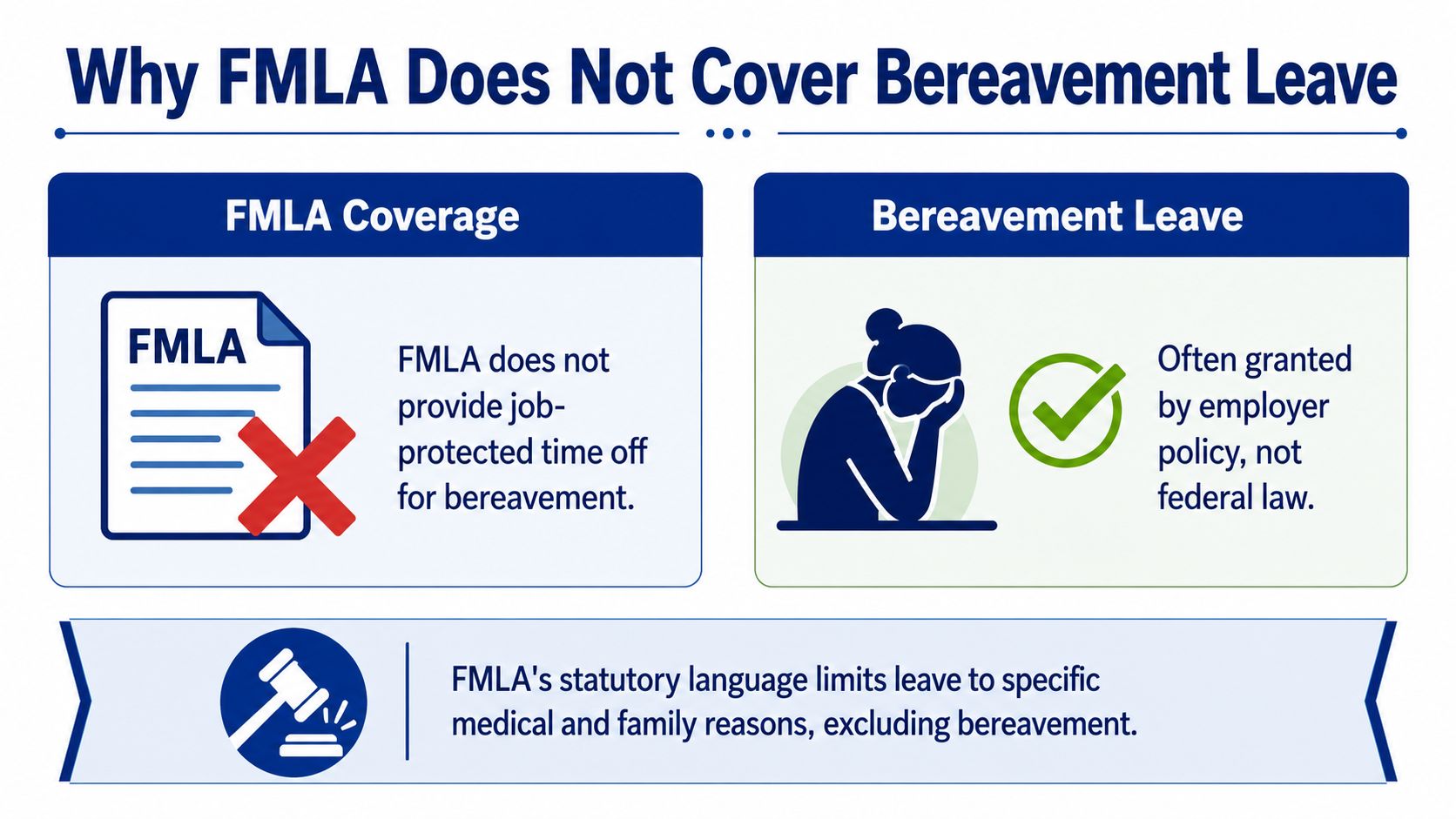
The legal line is simple. Bereavement leave is usually a policy benefit, while FMLA leave is tied to a statutory reason and eligibility test. If an employee needs time after a death, the employer's bereavement policy governs unless some other protected condition is present.
That other condition can be a serious health condition that develops after the loss. Guidance discussing grief and FMLA notes that bereavement itself is not covered, but grief can overlap with a qualifying medical condition when there's documentation supporting treatment and inability to work (Evermore's FMLA and bereavement FAQ). That is the line HR has to police.
Practical rule: Don't treat the death as the trigger. Treat the medical condition as the trigger, and only if the certification supports it.
For managers, the safest workflow is to send policy questions to HR and route any signs of depression, anxiety, or ongoing treatment through your leave process. If you need a system for tracking that transition, leave absence management is the kind of operational control that keeps bereavement, medical leave, and payroll coding from drifting apart.
Even when a grief-related condition may qualify, FMLA only protects a narrow slice of employees. Multi-state SMBs get burned here because they assume anyone in the company can invoke FMLA once the personal situation feels serious enough. The law is stricter than that.
An employee is eligible only if they've worked for a covered employer for at least 12 months, completed at least 1,250 hours of service in the prior 12 months, and work at a site where the employer has 50 or more employees within 75 miles (DOL FMLA fact sheet). Eligibility is measured when leave starts, not when the request is made. That timing matters when a request comes in during a period of fluctuating schedules, seasonal staffing, or rehiring.
| FMLA Eligibility Criteria at a Glance | Requirement | Common SMB Pitfall |
|---|---|---|
| Employment length | 12 months with the employer | Counting months wrong after breaks in service |
| Hours worked | 1,250 hours in the prior 12 months | Assuming full-time status automatically qualifies |
| Worksite threshold | 50 employees within 75 miles | Counting the wrong reporting site for remote staff |
The worksite rule trips up distributed teams. A remote employee doesn't get counted by home address just because they work from home. Employers need to tie eligibility to the proper reporting site and keep that designation consistent.
A separate trap is the hours threshold for part-time staff. If a worker is close to 1,250 hours, HR should check payroll records before making any statement about protection. Don't guess, because a guess becomes the company's position.
Audit standard: Verify eligibility before you promise job protection. Once a manager says “you're covered,” you've created a problem even if the employee later turns out not to qualify.
A clean process is simple. Issue the eligibility notice quickly, keep the staffing record current, and use one standard review path for every bereavement-related request. If you want a practical reference for building that workflow, the FMLA compliance advice for multi-state employers is worth using as an internal benchmark.
Employers cause confusion when they treat paid bereavement and FMLA as if they're substitutes for each other. They're not. One is usually a policy benefit, the other is a federal job-protection framework, and the two can overlap without meaning the same thing.
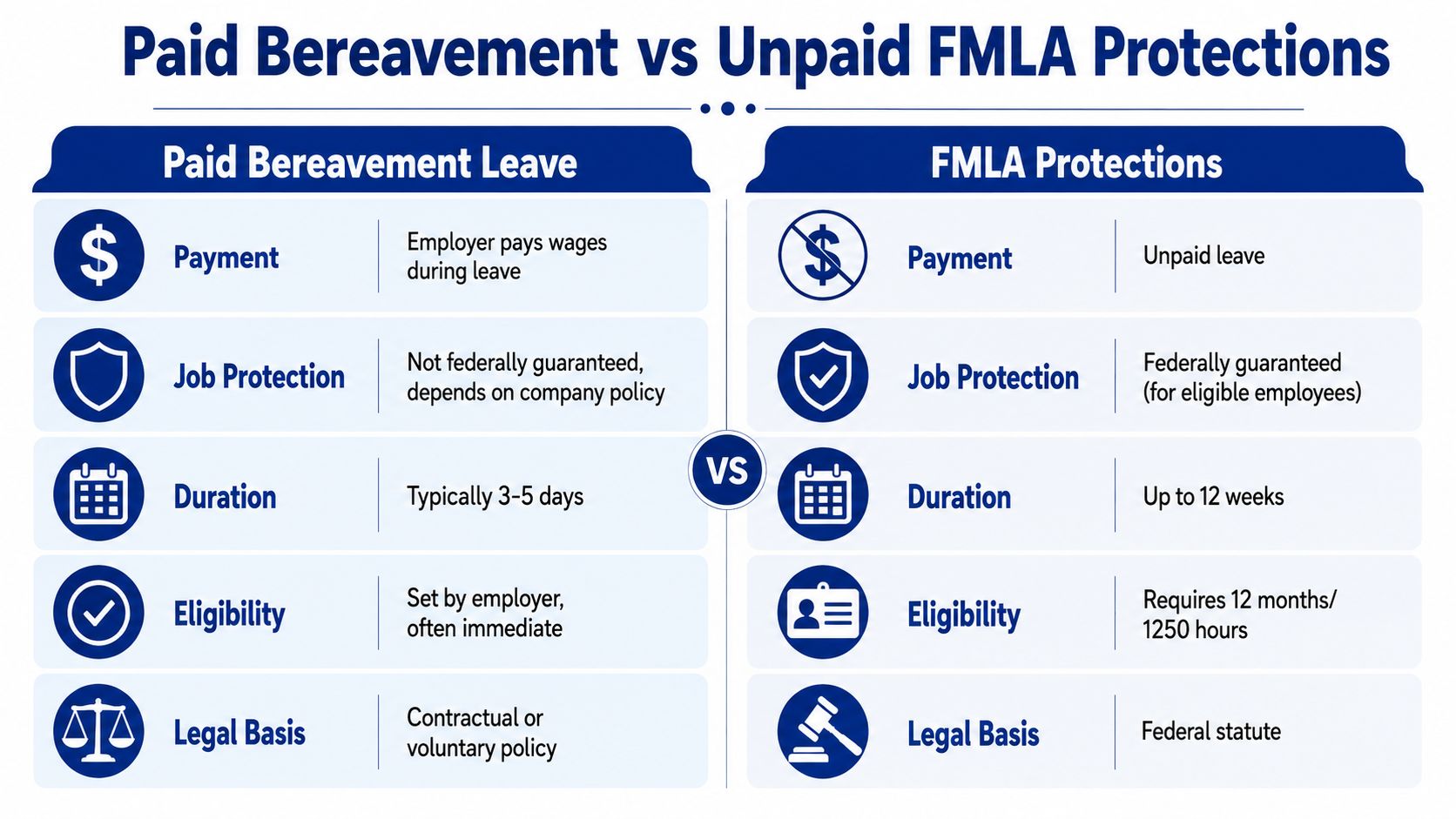
Paid bereavement leave comes from policy, contract, or a state rule. FMLA comes from statute. Paid bereavement is often short, employer-funded, and designed for immediate loss-related time away. FMLA can extend far longer, but it's unpaid under federal law and centered on eligibility, certification, and restoration rights (BLS family leave benefits fact sheet).
The documentation standards are different too. Bereavement policies often ask for a death certificate, obituary, or funeral proof. FMLA focuses on medical certification when the leave is tied to a serious health condition, not the death itself. That's why HR has to stop supervisors from blending the two and demanding the wrong paperwork.
The biggest trap comes when paid bereavement ends and the employee still can't function because grief has become a medical issue. At that point, the employer should stop treating the absence as funeral-related leave and evaluate whether FMLA applies. If the employee is eligible and the certification supports it, the leave changes character.
For policy language, use something like this in substance, not as a quote. Paid bereavement leave may run concurrently with other leave only when permitted by law and company policy. The company may require employees to use applicable paid leave, but it should not assume that paid time away automatically resolves FMLA obligations.
Compliance point: Never say, “You've used your bereavement days, so you're done.” If the employee has a qualifying condition, the company may still owe protected leave.
For multi-state operators, that distinction matters even more because federal law sets the floor, not the full rulebook. If an employee is in a state with separate bereavement protections, your policy has to reconcile both tracks without promising more than the law requires.
The old advice was to write one national bereavement policy and apply it everywhere. That doesn't work anymore. Multi-state employers now operate in a patchwork where state rules can expand who qualifies, how much leave is available, and whether the leave is paid or unpaid.
At minimum, employers need to identify where the employee works and then map that location to the controlling rule. The high-risk mistake is letting headquarters policy override a state mandate or, just as bad, giving a richer benefit in one state and accidentally creating inconsistency elsewhere. For a broader legal overview, use HR guidance on bereavement leave as your internal reference point.
| State Bereavement Leave Mandates Comparison | Leave Duration | Paid/Unpaid | Eligibility Threshold | Covered Relationships |
|---|---|---|---|---|
| California | Up to 5 days | Unpaid unless company policy says otherwise | 5+ employees, 30 days of service | Broad family list, including domestic partners and parent-in-law |
| Illinois | Up to 10 workdays | Unpaid unless company policy says otherwise | Covered employers, FMLA-linked eligibility rules may apply | Child, spouse, domestic partner, sibling, parent, grandparent, grandchild, stepparent |
| Maryland | Use accrued leave | Paid through accrued leave | 15+ employees | Spouse, parent, child |
| Oregon | Up to 2 weeks per family member, 4 weeks per year | Unpaid unless company policy says otherwise | 25+ employees, 180 days and 25 hours per week average | Any family member, including extended relatives and in-laws |
| Vermont | Up to 12 weeks of parental and family leave entitlement, subject to statutory limits | Unpaid, though accrued leave may be used | Covered employers and eligible employees under the act | Broad family and caregiving relationships |
| Washington | Varies by mandate | Varies by mandate | Varies by mandate | Family and household members as defined by the applicable rule |
The compliance lesson is plain. Oregon, Illinois, Maryland, California, Vermont, and Washington do not behave like a single policy universe. Your handbook should reflect the most protective requirement for each employee's work location, not the company's preferred shortcut.
Managers should not decide whether a request “feels like” bereavement leave. They should check the employee's site, the applicable state rule, and the internal policy tier, then hand the case to HR if there's any mismatch. That's how you avoid creating a precedent in a state that never required it.
Don't centralize the wrong answer. Centralize the review, then localize the result.
Bereavement itself doesn't trigger FMLA. Grief can still matter when it develops into a serious health condition that requires treatment and keeps the employee from doing the job. That's where employers need discipline, not sympathy-driven improvisation.
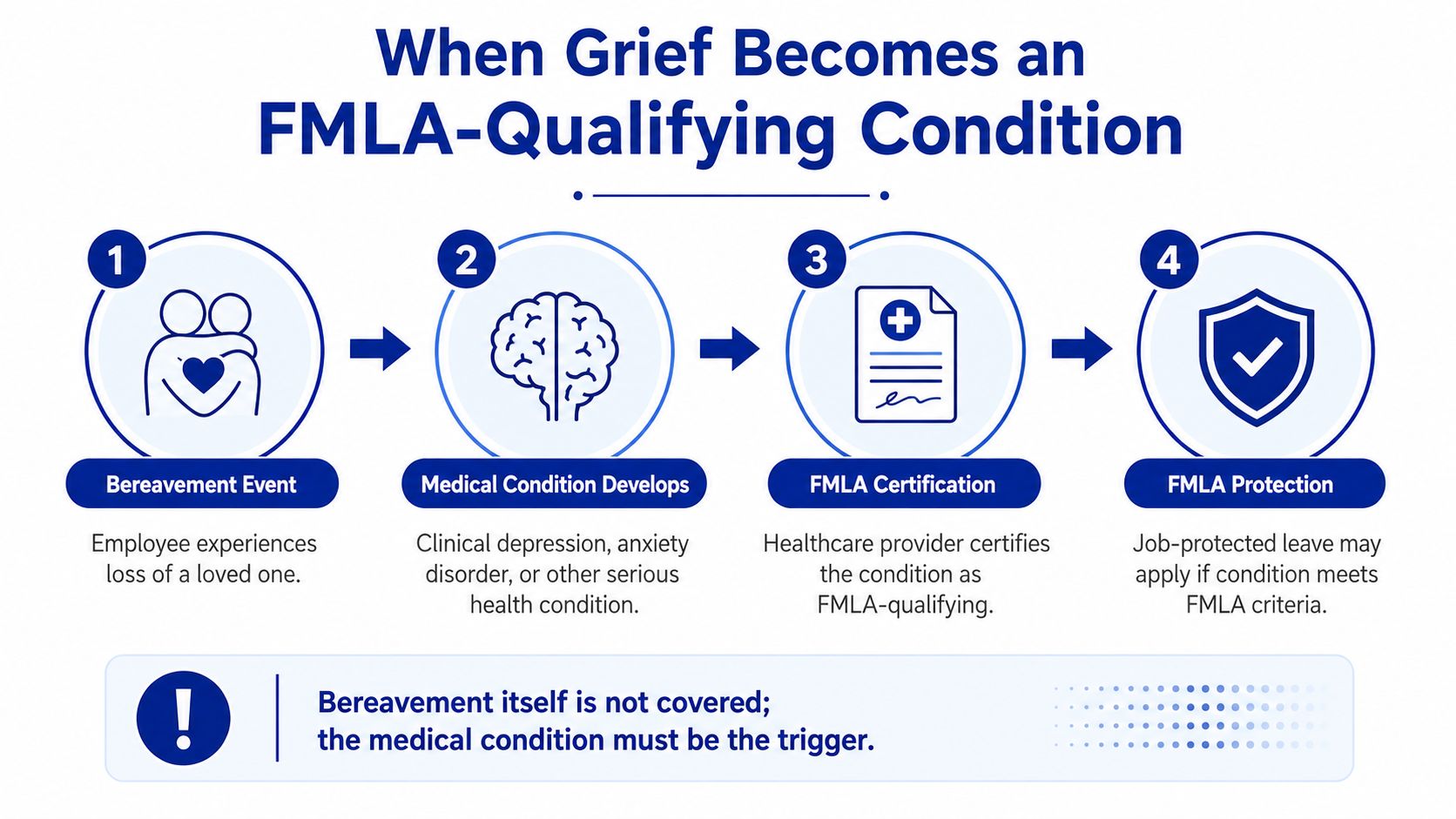
A diagnosis alone isn't enough. The medical certification has to support a qualifying serious health condition and show that the condition prevents the employee from performing essential job functions. Clinical depression, anxiety disorders, and similar conditions can fit that framework when the documentation is complete and credible (Evermore's FMLA and bereavement FAQ).
The employer's job is to manage the paperwork correctly. If the leave is intermittent for therapy, follow-up care, or recurring episodes, the certification should match the actual pattern of leave. If the documentation doesn't support the request, the company should not label the time off as FMLA just to be kind.
A good HR review asks three questions.
If the condition worsens or treatment changes, recertification can become necessary under the normal leave process. That keeps the file defensible and prevents managers from guessing about whether a shortened schedule or extra absences are still protected.
Bottom line: Treat grief as a possible medical issue only after documentation supports it. Otherwise, you're converting a policy leave into a legal entitlement by mistake.
This is also where employers should separate compassion from administration. The employee deserves sensitivity. The file still needs dates, certifications, and a clear decision trail, because that record is what holds up later.
Frontline managers are where most of the exposure starts. They aren't trying to cause trouble, but they often promise more than the company can deliver or ask questions they have no business asking. The fix is a short, repeatable script and a strict escalation rule.
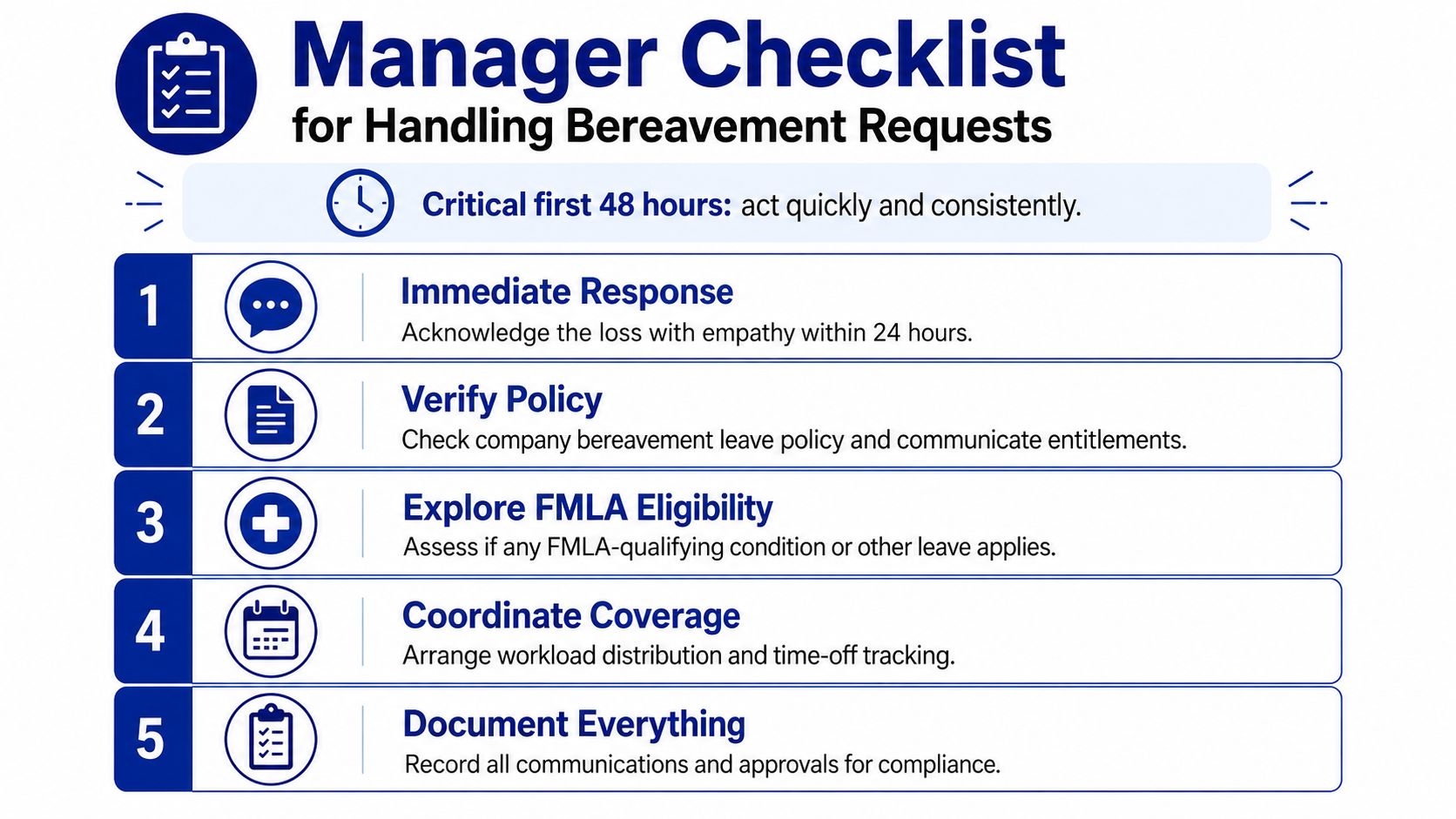
Start with empathy, then move to process. Managers should acknowledge the loss, avoid prying into the cause of death, and say they'll connect the employee with HR for leave details. If the employee mentions treatment, inability to sleep, panic, or ongoing medical care, the manager should stop there and escalate.
A manager should never promise that the leave is job-protected unless HR has confirmed it. A casual statement can undercut the company's later position, especially if the employee turns the conversation into a reliance issue. That's why managers need a narrow script, not improvisation.
If the death relates to a life insurance or beneficiary issue, the manager should stay out of the details and refer the family to the appropriate process. A useful external reference for that part of the conversation is the beneficiary claim process, which can help HR understand where employees may be directed for non-leave administrative needs.
A weak bereavement policy looks compassionate on the surface and dangerous in an audit. It's usually vague, inconsistent, and written as if one national rule can cover every state, every job class, and every manager. That's the setup for interference claims and internal disputes.
The policy should clearly define who is covered, how much leave is available, whether it's paid or unpaid, and what documentation may be requested. It should also say that bereavement leave is separate from FMLA and doesn't create automatic job protection. That one sentence prevents a lot of avoidable confusion.
Use broad but controlled family definitions so the policy can absorb stricter state rules without constant rewrites. If your organization operates in states with more expansive coverage, don't draft a narrow family list that forces local exceptions everywhere. If you need a structural reference for handbook consistency, the Paradigm International Inc. requirements guide is the right place to anchor a policy audit.
A defensible policy usually includes these elements:
Do not write a policy that says “all employees receive job-protected bereavement leave” unless that's true in every location. Do not promise the same paid benefit everywhere if your state obligations differ. And do not let managers make local exceptions on the spot, because those exceptions turn into precedent.
The strongest policy is the one HR can explain in one sentence and defend in one file.
Review the policy every year against the states where you have employees, not where you hope to stay. For multi-state SMBs, that cadence matters more than polished language. It keeps the handbook aligned with the law instead of the last crisis.
If you need a leave policy that survives multi-state scrutiny, Paradigm International Inc. can help you tighten the rules, separate bereavement from FMLA, and build a process managers can follow. Visit Paradigm International Inc. to see how an advisory approach can reduce leave-related exposure and make your handbook more defensible.