


A lot of business owners land on this issue in the same way. A manager changed a pay plan, someone was let go without the notice process described in an offer letter, or an employee is claiming the company promised something it never meant to guarantee. At that point, the question isn't academic. It's whether your records, contracts, and manager actions can survive scrutiny.
Breach of contract employment issues are often more document-driven than leaders expect. They usually turn on what was promised, what was documented, what changed, and whether the business followed its own process. If you treat them like ordinary employee relations disputes, you can make a manageable problem much harder to defend.
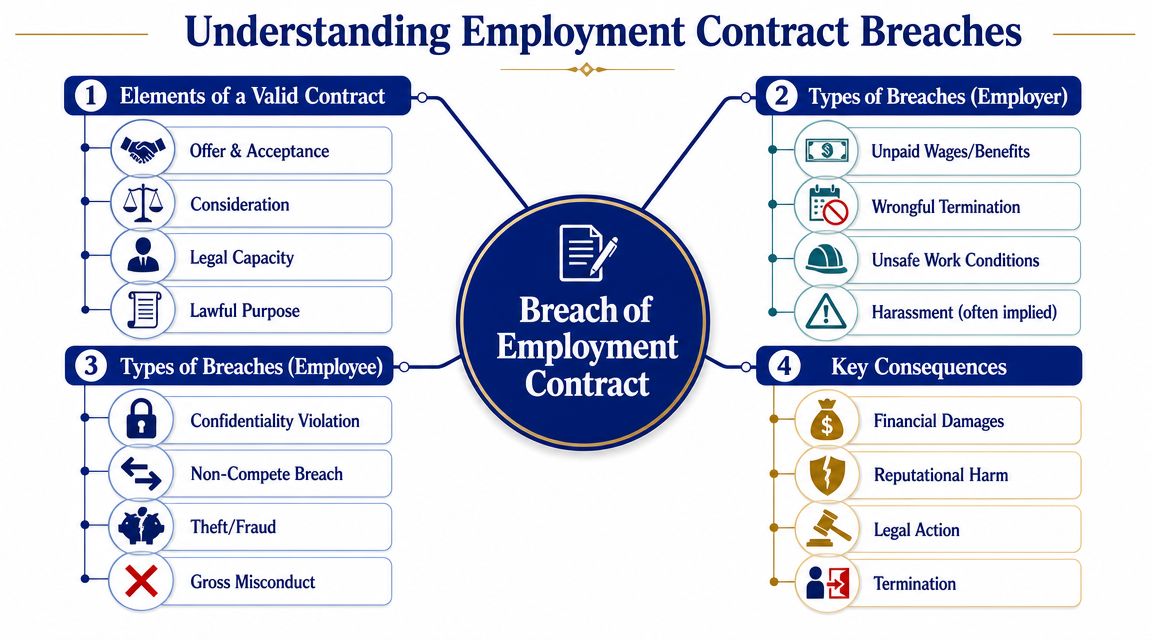
An employment contract is a binding set of terms between employer and employee. Sometimes that contract is a formal signed agreement. Sometimes it's built from an offer letter, compensation plan, policy document, or even verbal commitments that later look specific enough to be treated as promises.
That distinction matters because many SMB leaders think, “We don't use formal contracts, so we don't have contract risk.” That's not a safe assumption. If you need a practical primer on how employment agreements are formed, this overview of what an employment contract is is a useful starting point.
Express contracts are the easiest to spot. They include written agreements covering compensation, notice, duties, bonuses, severance, confidentiality, or restrictive covenants. Oral agreements can also count, but they're harder to prove and defend because the evidence usually comes down to competing recollections.
Implied contracts create more surprise exposure. These can arise when an offer letter sounds unconditional, a handbook reads like a guarantee, or a manager makes specific assurances about job security, commissions, promotion timing, or termination process. Leaders often underestimate how much risk can be created by casual language that later gets treated as a commitment.
Practical rule: If a manager says it, HR repeats it, and payroll administers it, a claimant may argue it was more than an informal conversation.
In employment-contract disputes, the core liability test usually follows a four-part framework. The claimant must show a valid contract, their own performance or readiness to perform, the employer's failure to perform a specific contractual term, and resulting damages, as outlined in this discussion of the contract breach framework in employment disputes.
For business leaders, the important point is that breach is usually not proven by generalized unfairness. It is more often tied to a specific deviation such as:
Not every bad workplace decision becomes a breach claim. Poor communication, unpopular restructuring, personality conflict, or a manager's rough handling of a situation may create morale or legal issues of other kinds, but a contract claim usually needs a specific promise that can be identified and measured.
A useful internal test is simple:
| Question | Why it matters |
|---|---|
| Was there a clear term? | Vague expectations are harder to enforce than defined promises |
| Can you locate the term in writing? | Offer letters, emails, plans, and policies often become key exhibits |
| Did the company depart from that term? | Contract cases turn on actual deviation, not broad dissatisfaction |
| Is there measurable loss? | Without tied damages, many claims weaken quickly |
When leadership understands those basics, the conversation shifts from emotion to evidence. That's where defensibility starts.
Most breach disputes don't begin with dramatic misconduct. They usually start with a practical business move that someone thought was minor. A revised commission formula. A “temporary” change in duties. A rushed termination. A delayed bonus payment that was assumed to be discretionary when the written plan didn't say that clearly.
On the employer side, the most common flashpoints involve compensation and separation terms. If an agreement promises a bonus subject to stated conditions, a commission under a defined formula, continued benefits for a set period, or severance after a without-cause termination, failing to honor those terms can trigger a claim. The same is true when a contract requires a process before discipline or termination and the company skips it because a manager wants speed.
A familiar pattern looks like this: the company hires a sales leader with an offer letter that references base pay, target incentive pay, and a year-end review of performance. Midyear, revenue softens and leadership changes the plan without a signed amendment. If the original documents were framed as binding terms rather than discretionary guidelines, that decision can create real exposure.
Another pattern shows up at separation. An executive agreement says termination without cause triggers notice or severance, but the company uses “cause” language loosely because the relationship has deteriorated. If the file doesn't support that classification, the dispute quickly becomes contract-centered.
Some other examples include:
Contract risk isn't one-directional. Employees can also breach employment-related agreements by disclosing confidential information, violating a non-disclosure obligation, misusing company property, or ignoring enforceable post-employment restrictions.
In practice, these disputes often become harder when the employer's own documentation is weak. If confidentiality language is broad but training was inconsistent, or if restrictive covenants exist on paper but weren't administered uniformly, enforcement becomes more complicated.
Broken promises cause business damage before a lawsuit ever arrives. A 2022 systematic review found negative relationships between psychological contract breach and outcomes including job satisfaction at r = −0.45 to −0.38 and organizational trust at r = −0.53 to −0.36, according to this systematic review on psychological contract breach.
That research matters because leaders often focus only on legal liability. The operational cost starts earlier. When employees believe the company doesn't keep its word, trust drops, commitment weakens, and manager credibility is harder to recover.
The early warning signs are usually visible if someone is paying attention:
Those are the moments when a normal employee issue becomes a breach of contract employment problem.
When a possible breach is raised, speed matters. So does discipline. The wrong first response is a defensive email, a rushed call to the employee, or a manager trying to “clear things up” before records are preserved.
The better response is structured. Leadership should move in a sequence that protects evidence, narrows the issue, and gives counsel a clean record to work from.

The first job is to identify the exact promise at issue. Ask one question before anything else: What term does the employee say was breached? Until that is clear, leaders tend to investigate too broadly and create unnecessary statements that later complicate the defense.
Then preserve the record. Pull the offer letter, employment agreement, handbook acknowledgment, compensation plans, emails about the disputed issue, performance records, disciplinary history, and separation communications if the employee has already exited.
Use a basic chronology:
| Action | Purpose |
|---|---|
| Identify the disputed term | Keeps the review focused on contract language |
| Freeze relevant records | Prevents accidental loss or alteration |
| Build a timeline | Shows when the promise was made, changed, or denied |
| Confirm decision-makers | Clarifies who approved, communicated, or modified terms |
Interview only the people who need to be interviewed. That usually includes the manager, HR, payroll or finance if compensation is involved, and anyone who communicated the disputed promise. Keep those conversations factual and avoid speculative language.
If termination is part of the dispute, review the file against the process required. If your managers need a clearer standard for handling separations with lower legal risk, this guide on how to fire an employee legally is worth keeping in your leadership toolkit.
The file should answer a simple question: what did the company promise, and where did its conduct match or depart from that promise?
In breach-of-employment-contract cases, damages are typically economic, such as unpaid wages or lost contractual severance. The claimant must tie each loss to a specific contractual promise and show the loss was foreseeable, as explained in this summary of damages in employment contract breach matters.
That has two practical implications.
First, leadership should map each claimed loss to an actual contract term. If the employee says they lost commission, identify the plan language and the calculation period. If they claim severance, confirm the trigger conditions and whether the company met them.
Second, don't ignore non-court remedies when a cure is still possible. In some disputes, carrying out the promised obligation may be part of the solution, and counsel may evaluate specific performance options alongside monetary resolution.
Not every breach allegation should be fought to the end. Some should be corrected quickly because the documentation shows the company missed a step. Others warrant a negotiated business resolution because the cost of litigating the issue exceeds the value of proving a point.
A disciplined decision path looks like this:
An advisory team can be useful. Leading advisory firms support leadership teams on documentation review, investigation structure, and defensible HR decision-making when a contract dispute overlaps with broader employment risk.
One final point gets missed often. Don't let managers freelance their response. Once a potential claim exists, one well-meaning apology or one careless message saying “we'll make this right” can shift the posture of the case.
Keep communications centralized, limited, and documented. Calm process usually beats reactive reassurance.
The cleanest breach case to handle is the one that never forms. That doesn't come from longer documents alone. It comes from alignment between what your company writes, what managers say, and what payroll and HR administer.
Many businesses already have decent forms. Their real problem is inconsistency. One manager promises a different severance approach. Another edits an offer letter without review. A handbook says one thing while the termination practice says another.
Contract claims are typically narrower than statutory workplace claims, and damages are often limited to financial loss. In the UK tribunal system, there is a statutory cap of £25,000 on awards in breach-of-contract claims heard there, according to this explanation of breach of employment contract remedies. That limitation highlights a practical truth for employers everywhere: precise language about pay, notice, and benefits often drives the exposure.
That means prevention work should focus first on the terms most likely to be disputed.
A contract can be well drafted and still create risk if leaders apply it unevenly. When two employees under similar terms receive different treatment, the written agreement loses practical strength. In disputes, that inconsistency often becomes part of the narrative against the employer.
A defensible HR system usually includes:
Good contracts help. Consistent administration is what makes them hold up under pressure.
For multi-state SMBs, variation is the primary challenge. The company may use one onboarding packet, but different leaders in different locations may explain terms differently. That is where implied commitments start to appear.
A practical prevention model includes one operating rule: no material change to compensation, title, reporting line, notice expectations, or severance language should happen without a written review. If the organization can't identify the current controlling document quickly, it is already carrying unnecessary risk.
This is also where audits matter. Not academic audits. Operational ones. Pull a sample of active offer letters, compensation plans, handbook acknowledgments, and recent termination files. Then check whether the company is administering those terms the way it says it does.

Most implied-contract problems start in ordinary conversations. A manager tries to reassure a candidate. An executive tries to calm a worried employee. Someone says, “You'll definitely get that bonus if you stay,” or “We'd never terminate without giving you months to fix it.”
Those statements may feel harmless at the time. They rarely are.
The most effective training is narrow and practical. Teach managers which topics require HR review, which phrases to avoid, and when to stop talking and document the issue instead. That kind of discipline protects the business and the manager.
Strong agreements don't eliminate disputes, but they narrow them. They reduce guesswork, limit side interpretations, and give leadership a cleaner record when decisions have to be made quickly.
The most overlooked problem is not usually missing language. It's language that conflicts with handbooks, offer letters, commission plans, and manager statements. A frequently overlooked issue is distinguishing express contracts from implied promises created by offer letters, handbooks, or manager statements. Those implied-contract theories can limit at-will termination rights and expose employers to wrongful-termination claims even when no formal employment agreement exists, as discussed in this review of express versus implied employment promises.
Some clauses do more practical work than others.
At-will and disclaimer language matters even in at-will states. It should state clearly that employment is at will unless a separate written agreement signed by authorized leadership says otherwise. That disclaimer should also appear consistently across offer letters, handbooks, and policy acknowledgments.
Termination clauses should define what happens for cause, without cause, resignation, and material breach. If you use cause, define it carefully. If you use a cure process for certain breaches, spell out who gives notice, how notice is delivered, and what happens if the problem is fixed within the allowed period.
Entire agreement clauses are critical because they help prevent side promises from being treated as contract modifications. They won't cure every bad fact pattern, but they give the employer a stronger argument that the written agreement controls.
Most contract disputes I see are compensation disputes wearing different labels. Base salary is rarely the central issue. The friction usually comes from variable compensation, eligibility conditions, timing, approval rights, or what happens when employment ends near a payout date.
A useful drafting checklist looks like this:
For companies managing hybrid or distributed teams, agreement structure also matters outside classic compensation terms. A detailed comprehensive guide for agency remote work can be a useful model for thinking through written expectations around location, equipment, confidentiality, availability, and work rules that otherwise get handled informally.
If a separation agreement or release is part of your process, it should fit the original employment documents rather than contradict them. Too many businesses introduce separation terms at the end of employment without checking whether the offer letter, executive agreement, or handbook created earlier commitments that still matter.
If your organization uses templates at exit, review them alongside this employment separation agreement template so the release language, severance terms, and ongoing obligations line up with the rest of the file.
Clear drafting doesn't just help in court. It helps managers make better decisions before lawyers are involved.
The difference is usually straightforward.
| What works | What does not |
|---|---|
| Defined terms for pay, notice, and termination | Vague references to “standard company policy” |
| One controlling document hierarchy | Multiple documents that say different things |
| Written amendment rules | Manager-side verbal assurances |
| Cure procedures for fixable breaches | Immediate action without notice where the contract suggests process |
| Consistent disclaimers | Handbooks that sound like guarantees |
A good contract is not one that says everything. It is one that says the important things clearly, matches how the business operates, and leaves little room for improvised promises.
Breach of contract employment problems rarely come from one document alone. They come from a chain of decisions. Someone drafted unclear language, someone made an extra promise, someone skipped a process step, and no one stopped to reconcile the record before the issue escalated.
That's why the best defense is operational, not just legal. Clear agreements matter. Consistent administration matters more. When leaders train managers carefully, control document versions, review compensation changes before rollout, and handle separation decisions with discipline, they reduce both legal exposure and internal distrust.
This work also improves the employee experience. People don't expect perfection, but they do expect clarity and follow-through. A business that communicates terms carefully and applies them consistently is easier to trust, easier to work for, and easier to scale.
If your team is facing a live dispute or wants to tighten its contracts, documentation standards, and termination process before a problem develops, there's real value in addressing the issue early and with structure.
If your leadership team needs help building defensible HR practices around contracts, investigations, terminations, or multi-state employment risk, Paradigm International Inc. works with SMB operators who need structured guidance during high-stakes people decisions.


