
When an employee calls out of work, it's easy to see it as just a gap in the schedule. But experienced leaders know it’s much more than that—it’s a critical moment that tests your company’s policies, leadership, and operational resilience. Treating absences as a minor administrative headache is a mistake. Each one carries hidden costs and potential legal risks, from lost productivity and team burnout to discrimination claims. Getting your response right is non-negotiable.
Unscheduled absences are a core leadership challenge, not just an HR problem. A reactive or inconsistent approach is a fast track to operational chaos and legal exposure. This is particularly true for businesses operating across multiple states, where a patchwork of leave laws can turn a simple call-out into a compliance nightmare.
Without a clear playbook, managers are left to improvise. That improvisation often leads to inconsistent enforcement and, eventually, accusations of favoritism or discrimination.
The financial and operational costs pile up quickly. It’s not just about one person’s lost output for the day; the ripple effect is where the real damage happens.
Every single call-out is a potential landmine. An employee mentioning a "doctor's appointment" or a "family emergency" could be signaling a situation protected by laws like the FMLA or ADA. If a manager brushes it off, asks the wrong questions, or disciplines the employee for what turns out to be a legally protected absence, your company is facing serious legal risk.
Shifting your view of absences from an administrative task to a strategic one is the first step toward building a more resilient organization. To dig deeper into how these situations fit into the bigger picture, leaders should explore proactive human capital risk management.
The danger lies in treating all absences equally. An employee with the flu requires a different response than an employee whose parent was just hospitalized. A standardized, yet flexible, protocol protects both the employee and the business.
Major events can trigger widespread, unplanned absences that can paralyze a business without strong policies in place. Just look at the aftermath of the Super Bowl. A recent survey revealed that 22.6 million U.S. employees planned to miss work the next day. That included 3.2 million who admitted they would call in sick even if they felt fine.
This chaos highlights the need for tight policies on communication, PTO requests, and no-show protocols. Without them, you’re inviting operational disruption. You can explore more about these workforce absence findings.
Navigating these challenges demands clear protocols and consistent execution. If you need expert guidance on developing defensible HR practices that work, we can help. Contact Paradigm for a consultation to ensure your approach is both compliant and effective.
How your managers react in the first five minutes after an employee calls out of work can set the tone for your company culture and, more importantly, your legal risk. This initial, brief conversation is your first and best opportunity to turn a potentially messy situation into a structured, compliant process.
The goal here isn't to play detective. It’s to acknowledge the call, gather only the most essential details, and clarify the next steps—all without asking questions that could land you in hot water. A manager who sounds annoyed or asks overly personal questions can make an employee feel punished for being sick. That’s a huge problem, especially if the absence turns out to be protected by law. A solid protocol gives your leaders the confidence to respond consistently and supportively, whether they're dealing with a 24-hour bug or something far more serious.
This simple decision guide shows exactly how to steer the conversation based on what the employee tells you.
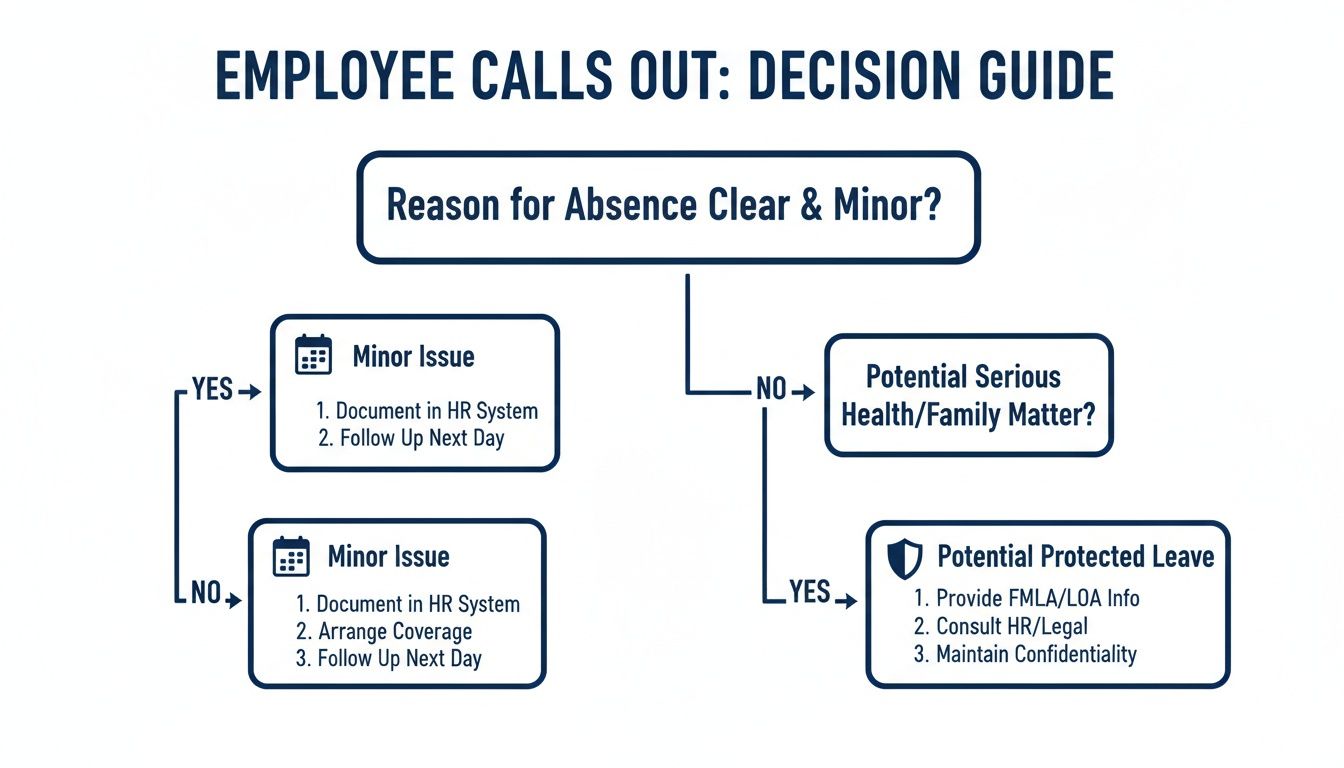
As you can see, the flowchart highlights a critical fork in the road. It directs managers to either treat the absence as a routine event or to immediately recognize the need for a more careful, legally-aware approach.
Your managers need a few simple, reliable phrases they can use every single time. A script takes the guesswork out of the equation and, most importantly, prevents them from accidentally asking inappropriate or illegal questions about an employee’s health.
The key is to sound supportive while staying focused on business continuity. A good script also ensures every manager collects the same basic information, which is vital for fair and consistent documentation down the line. It also trains them to be better listeners who can pick up on phrases that signal a more complex situation.
To help your front-line leaders navigate these conversations, here’s a quick-reference guide on what to say and what to avoid.
| Do Say/Ask This | Don't Say/Ask This |
|---|---|
| "Thanks for letting me know. I'm sorry to hear you're not well." | "What’s wrong with you? You sounded fine yesterday." |
| "Do you expect to be out for just today, or will it be longer?" | "Are you really sick? We're swamped today." |
| "Please keep me updated on your status as per our policy." | "I need a doctor's note before you can come back." |
| "Is there any urgent work I should be aware of or reassign?" | "Can you just log on for an hour to finish that report?" |
| "I hope you feel better soon." | "Well, this puts me in a really tough spot." |
This table isn't about creating robotic managers; it's about providing guardrails. The "Do's" keep the conversation professional, empathetic, and brief, while the "Don'ts" represent common missteps that can escalate a simple absence into a major HR headache.
A manager’s goal in the first five minutes is not to diagnose the problem or determine if the reason is "good enough." Their job is to receive the notification, ensure operational continuity, and escalate if the situation suggests a need for HR involvement. This disciplined approach is fundamental to risk management.
One of the most valuable skills you can teach a manager is how to recognize when a simple "I'm sick" call might be something more. Certain words should immediately trigger a "hands-off" response where the manager’s only job is to pass the baton to HR or another designated leader.
Managers must be trained to listen for anything that could signal a protected leave situation under the FMLA, ADA, or state-level laws. It's critical to remember that employees don't have to use magic words like "I need FMLA" to trigger your company's legal obligations.
Here are some common trigger phrases to watch for:
The moment a manager hears something like this, their training should kick in. Their only job is to show support and then hand it off cleanly. The right response is: "Thank you for sharing that with me. I'm going to have someone from HR follow up with you to discuss resources that might be available." This simple handoff prevents managers from mishandling a complex situation that requires specialized HR knowledge.
This structured protocol is the cornerstone of managing employee absences effectively. For expert help in building and implementing defensible HR frameworks like this for your team, please get in touch with our advisory team.
In HR, there's a timeless rule that every manager needs to live by: if it wasn't documented, it never happened. Once an employee's call-out is handled, your very next move is to create a clear, objective record of the event.
This isn't about micromanagement. It’s about building a consistent, defensible record of attendance that lets you make fair decisions. When you have an accurate log of all absences, you can address attendance issues based on objective facts, not a manager's memory or subjective feelings. That factual basis is your single best defense against claims of unfair treatment or discrimination.

Creating a solid record means capturing the right details—without getting intrusive. The goal is to log the administrative facts of the absence, not pry into an employee's private medical life. A simple, standard form or digital log is the key to getting this right every time.
For every single call-out, your managers should immediately log these key details:
This simple log creates a factual account of what happened and when. It removes any guesswork and ensures every manager is gathering the same standardized information, department to department.
The purpose of an absence log is to establish an objective timeline of events. It must be factual, concise, and completely free of personal opinion or medical details. This discipline protects both the employee's privacy and the company's legal standing.
Over time, these individual records build into a powerful dataset. This is where you shift from being reactive to proactive. Tracking absences helps you spot patterns that might point to bigger issues, like policy abuse, flagging engagement, or even a hidden need for a workplace accommodation.
For instance, your logs might show one employee is frequently calling out on Mondays or Fridays. While a single absence is no big deal, the pattern suggests something is up. It could be a sign of burnout, or it might point to a recurring personal issue where the employee needs support.
Without hard data, addressing this is nearly impossible. A manager might feel like an employee is "always out," but feelings don't hold up. A documented record lets you have a conversation based on facts. You can say, "I've noticed you've been absent on four of the last six Fridays. I wanted to check in and see if everything is okay." This approach is supportive and far more effective than an accusation.
To make this process foolproof, use a straightforward tracking log. The key is to keep it simple and focused only on the essential, non-intrusive details. Here’s a basic template you can adapt for your team.
| Date of Absence | Employee Name | Reason Given | Notified Manager | Date/Time of Call |
|---|---|---|---|---|
| Oct 28, 2026 | John Smith | "Feeling unwell" | Jane Doe | 10/28 @ 7:15 AM |
| Nov 01, 2026 | Sarah Lee | "Child is sick" | Mark Chen | 11/01 @ 6:50 AM |
| Nov 04, 2026 | John Smith | "Stomach bug" | Jane Doe | 11/04 @ 7:30 AM |
Maintaining a log like this is a fundamental step toward fair and consistent discipline. For a deeper look into creating legally sound records, our guide on documenting employee discipline provides more context and best practices.
What happens when a simple call-out for a sick day hints at something more serious? This is the moment a routine staffing issue can transform into a complex legal situation, demanding careful and compliant handling. Mishandle it, and your business could face significant legal and financial risk.
An employee doesn't need to use "magic words" like “I need FMLA” or “I need an ADA accommodation” to put you on notice. The instant a manager hears an employee mention needing surgery, dealing with a chronic illness, or caring for a seriously ill family member, the clock starts ticking. This is the critical handoff point where the situation must be escalated to HR or a designated leader who knows the ins and outs of leave laws.

Your front-line managers are your first line of defense. They need to be trained to spot the subtle cues that an absence might fall under the protections of the Family and Medical Leave Act (FMLA), the Americans with Disabilities Act (ADA), or a similar state law.
Federal law provides a baseline for this. The FMLA, for instance, gives eligible employees up to 12 weeks of unpaid, job-protected leave each year while requiring their group health benefits to be maintained.
These are the kinds of scenarios that should immediately raise a red flag for any manager:
When managers hear things like this, their only job is to alert HR. They absolutely should not probe for medical details, offer advice, or make judgments about the employee's situation.
A core concept in leave management is understanding what the law considers a "serious health condition." It's not just for life-threatening illnesses. The FMLA definition is broad and can be confusing, but it generally covers any condition involving:
Disciplining an employee for an absence tied to one of these conditions—without first exploring their eligibility for protected leave—is a massive compliance blunder.
The most common mistake leaders make is applying a standard attendance policy to a legally protected absence. Doing so can be seen as interference or retaliation, turning a straightforward leave request into a costly legal battle.
If an employee's absence stems from a disability, the ADA may require you to begin the interactive process. Think of this as a structured, good-faith conversation between you and the employee to find a reasonable accommodation that helps them perform their job's essential functions.
This process is triggered anytime an employee requests an accommodation or when you become aware that one might be needed. Potential accommodations could include an intermittent leave schedule, a modified work week, or the ability to work from home. The goal is to land on a solution that supports the employee without causing undue hardship to the business.
Figuring out the nuances between different types of absences is a huge challenge for many employers. For a more detailed breakdown, you can learn more about managing a leave of absence from work and the specific obligations involved.
When an absence seems to qualify for protected leave, you have the right to ask for medical certification from a healthcare provider. But this process is a minefield of privacy rules and legal requirements. You have to handle it with extreme care.
Properly navigating protected leave isn’t just a good idea; it’s a fundamental requirement of running a business today. Building a clear process that aligns your attendance policy with your legal duties protects your company and, just as importantly, supports your people when they need it most.
Your attendance policy is the foundation of your entire absence management strategy. Without a clear, consistently enforced policy, managers are left to improvise—a recipe for confusion, perceived favoritism, and serious legal risk. A well-crafted policy isn't about being rigid; it's about creating a predictable and fair framework that protects both the business and your employees when someone needs to call out.
A strong policy is what moves you from making subjective judgments in the heat of the moment to following an objective, established process. It provides the clear standards you need to manage attendance effectively, ensuring every situation is handled with consistency. This document becomes the very backbone of a fair workplace culture.
To be effective, your attendance policy must be comprehensive and crystal clear. Vague language is an open invitation for misinterpretation and disputes. Every policy should nail down several non-negotiable elements to ensure there’s no room for confusion for either employees or managers.
These key components form the operational core of your attendance management system:
Many businesses are drawn to "no-fault" attendance policies, which assign points for absences regardless of the reason. While this system seems objective on the surface, it’s fraught with legal risk if not managed with extreme care. The primary danger is that it can illegally penalize employees for using legally protected leave.
For example, if an employee receives a point for an absence that qualifies under the FMLA, you've just broken the law. Your policy must explicitly state that absences covered by the FMLA, ADA, or other protected leave statutes will not be counted toward any disciplinary action.
A no-fault policy can only succeed if it is meticulously designed to carve out all forms of protected leave. Without these explicit exceptions, you are essentially creating a system that punishes employees for exercising their legal rights, exposing your company to significant liability.
Drafting policy language requires a delicate balance between firmness and flexibility, especially for businesses operating in multiple states. Your policy must be robust enough to be your company-wide standard but adaptable enough to comply with a patchwork of local and state mandates. For instance, several states have specific paid sick leave laws that must be perfectly integrated.
Beyond the policy document itself, effectively managing employee availability requires robust systems. This is particularly true in industries with complex scheduling needs. For example, specialized healthcare staff scheduling software is often necessary to manage call-outs and ensure proper coverage while adhering to strict regulations.
Ultimately, your attendance policy should be a living document, reviewed and updated regularly with legal counsel to reflect changes in the law. It’s also crucial to align it with other related policies. As you refine your approach, take a look at our detailed guidance on creating a paid time off policy that works in tandem with your attendance rules.
Even with a rock-solid attendance policy, you're going to run into tricky situations with employee absences. These gray areas are where managers often get stuck. Let's walk through some of the most common questions we hear, giving you clear, practical answers to help you handle these moments with confidence.
This comes down to one thing: what does your written attendance policy say? If your policy is crystal clear that employees must call a specific supervisor or a designated absence hotline, then a text message is a policy violation. The key is to handle the method of communication separately from the absence itself.
Your manager's response should acknowledge the heads-up while firmly redirecting the employee back to the correct channel. This reinforces your standards without turning a simple call-out into a major incident.
A good response looks like this:
This approach validates that the employee tried to communicate while still upholding the integrity of your process. Consistently enforcing your procedure is the only way to maintain a fair and predictable system for everyone on the team.
This is a tough, but incredibly common, challenge. While a doctor’s note might excuse an absence according to your policy, a clear pattern of frequent call-outs—even documented ones—often signals an underlying issue that needs a different approach. It’s time to shift from a disciplinary mindset to one focused on support and compliance.
A pattern of regular, documented absences could trigger your legal obligation to begin the interactive process under the Americans with Disabilities Act (ADA). The goal is no longer about tracking infractions. It’s about figuring out if the employee has a condition that might require a reasonable accommodation. This is a critical pivot.
When an employee's attendance becomes a recurring issue despite them providing doctor's notes, it is no longer just an attendance problem. It is a potential sign of a chronic health condition, and the employer's focus must shift from discipline to exploring accommodation.
Instead of issuing warnings for the absences, the right next step is to have a confidential conversation. You might say something like, "I've noticed you've had to miss work frequently for health reasons, and I want to make sure you have the support you need. Is there an accommodation that might help you meet the job's attendance requirements?" This opens the door to solutions like intermittent leave or a modified schedule, protecting both the employee and the business.
Knowing when to ask for help is a non-negotiable leadership skill. Most call-outs are routine, but some carry serious legal risk and require immediate escalation to HR, senior leadership, or legal counsel. Your front-line managers must be trained to spot these red flags and understand that their only job in these moments is to pass the information up the chain.
You need a clear protocol for escalating any of the following scenarios:
These situations are legal minefields. Escalating them immediately ensures a coordinated and compliant response that protects everyone involved from preventable risk.
Managing employee absences correctly is a cornerstone of effective HR risk management. We partner with business leaders to build the defensible policies and structured processes needed to navigate these complex situations with confidence. If you would like to learn more about how we can help you protect your organization, contact our team today.