
A business owner reviews a contractor who invoices through an LLC, uses a personal laptop, and attends every team meeting. The worker is paid per project, but a manager assigns daily priorities, approves time off, and expects the person to perform a core operating function indefinitely. The agreement says “independent contractor,” yet the relationship looks increasingly like employment.
That situation is common, and the contract label doesn't settle it. A 1099 form, LLC registration, invoice, or signed contractor agreement can support your position, but none creates legal immunity. Regulators examine what the business and worker do in practice.
Worker classification is an operational risk decision, not an onboarding checkbox. The central question is whether the worker is genuinely operating an independent business or functioning as part of your workforce. That answer can change when the assignment expands, supervision increases, the relationship becomes indefinite, or the work moves closer to your core operations.
The historical record shows why agencies treat this issue seriously. The U.S. Government Accountability Office cited the IRS's last full estimate, which found that in 1984, 15% of employers misclassified 3.4 million workers as independent contractors. The resulting estimated tax loss was $1.6 billion at the time, equivalent to about $2.72 billion in inflation-adjusted 2006 dollars. The figures appear in the GAO-referenced enforcement report.
This wasn't merely a technical tax problem. Misclassification can affect Social Security, unemployment, income tax, wage and hour obligations, workers' compensation, and benefits. The same historical reporting noted that workers uncovered through state audits rose from about 106,000 to more than 150,000 during the 2000-2007 period. That history supports a straightforward conclusion: classification has long been a structural compliance issue.
A written agreement matters, but it only documents what the parties intended. It doesn't override the facts. If the business sets the worker's schedule, controls the methods, supplies the tools, requires exclusivity, and integrates the person into daily operations, the agreement may conflict with the relationship regulators observe.
A contractor's business identity also isn't decisive. An LLC, business website, professional title, and invoices can show some independence, but they don't prove that the worker bears meaningful entrepreneurial risk or serves an independent market.
Practical rule: Classify the relationship you operate, not the relationship described in the template.
For executives, the right review questions are practical:
Review those questions before engagement, at renewal, and whenever responsibilities change. A contractor arrangement that began as a defined project can drift into a staff role without anyone formally changing the paperwork.
Under the Fair Labor Standards Act, the federal analysis isn't a single checkbox. The Department of Labor asks whether the worker is economically dependent on the hiring entity or in business for themself. Its framework evaluates six factors, then weighs the entire relationship. The Department of Labor's economic reality guidance confirms that no single factor decides the outcome.
Opportunity for profit or loss asks whether the worker can affect financial results through managerial skill, pricing, scheduling, hiring help, purchasing, or business decisions. Earning more by working more hours looks weaker than increasing profit through an independent service model.
Investments compares the worker's investment with the business's investment. Personal tools alone may carry limited weight if the company supplies the systems, workspace, equipment, clients, and infrastructure needed to perform the work.
Permanence examines whether the relationship is project-based and limited or ongoing and indefinite. Recurring work isn't automatically employment, but a continuing role with no defined endpoint can indicate dependence when combined with other factors.
Control covers the company's authority and actual conduct. Detailed instructions, close supervision, mandated processes, fixed schedules, and approval requirements can point toward employee status. The relevant evidence includes both the written right to control and the control exercised in practice.
Integration asks whether the worker's function is integral to the business. A specialist can still be integrated if the company relies on that person to deliver a central product or service. Core operational work deserves closer scrutiny than an outside project.
Skill and initiative considers more than technical ability. A worker's specialized knowledge supports independence when paired with business initiative, independent judgment, marketing, client development, and control over how services are delivered.
A worker might have a specialized skill and use personal equipment while still being economically dependent on one company. Another worker might perform recurring assignments but control pricing, methods, staffing, client relationships, and business investment. The analysis turns on the complete economic picture.
Build a factor-by-factor file. For each factor, record the contract language, operating facts, supporting documents, and any facts that cut the other way. Then assess whether the worker is genuinely in business for themself, rather than awarding a pass because one characteristic looks contractor-like.
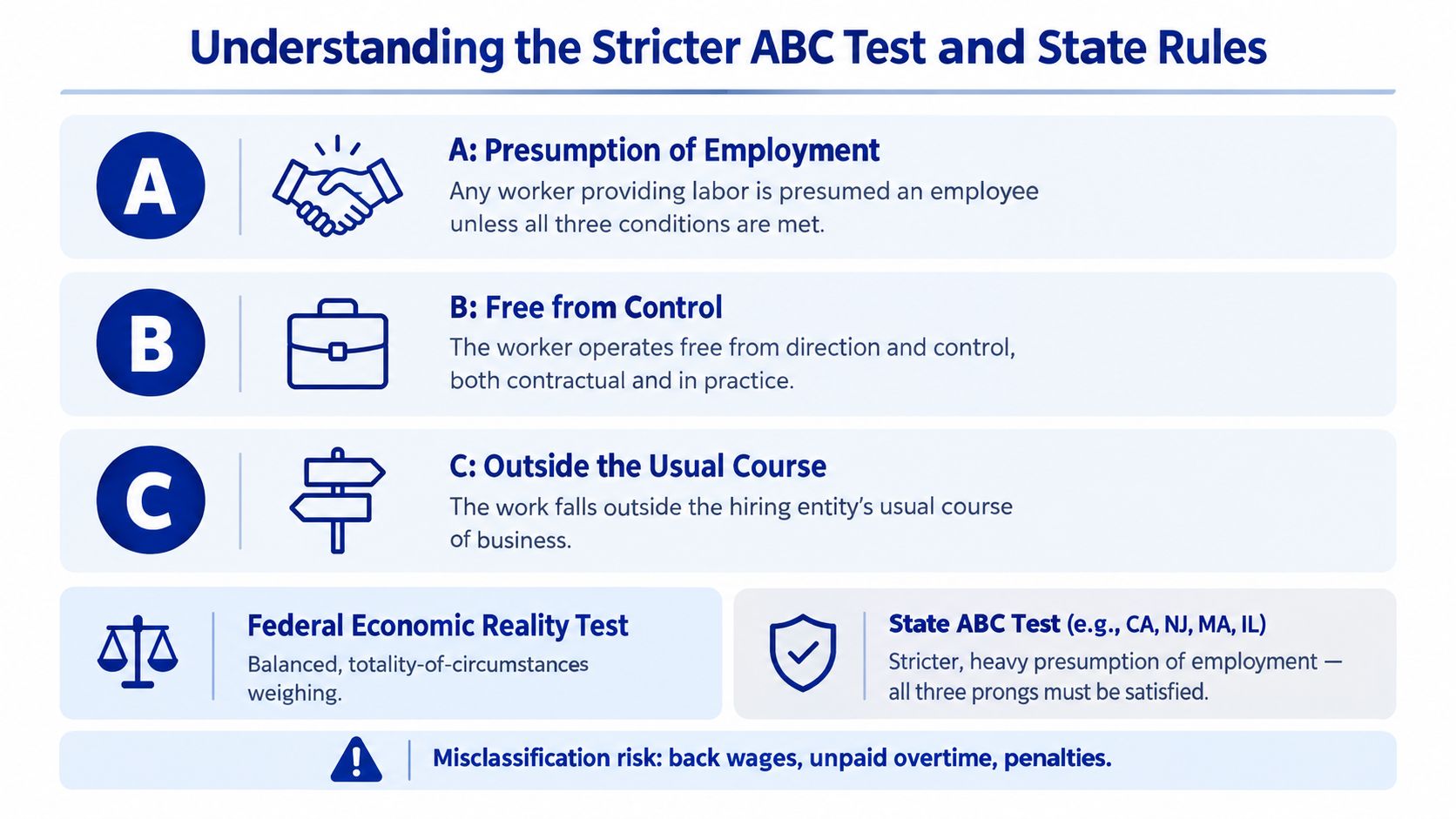
The ABC test starts with a presumption of employment. To establish contractor status, the business must satisfy all three prongs. The commonly used formulation requires that the worker is free from control and direction, performs work outside the company's usual course of business, and is customarily engaged in an independently established trade or business. The ABC test materials describe this three-part structure.
At least 18 states and the District of Columbia use the ABC test for certain workplace laws, according to the cited classification materials. The consequence for a multi-state company is clear: a worker may appear independent under a federal economic analysis yet fail a state test that requires every prong.
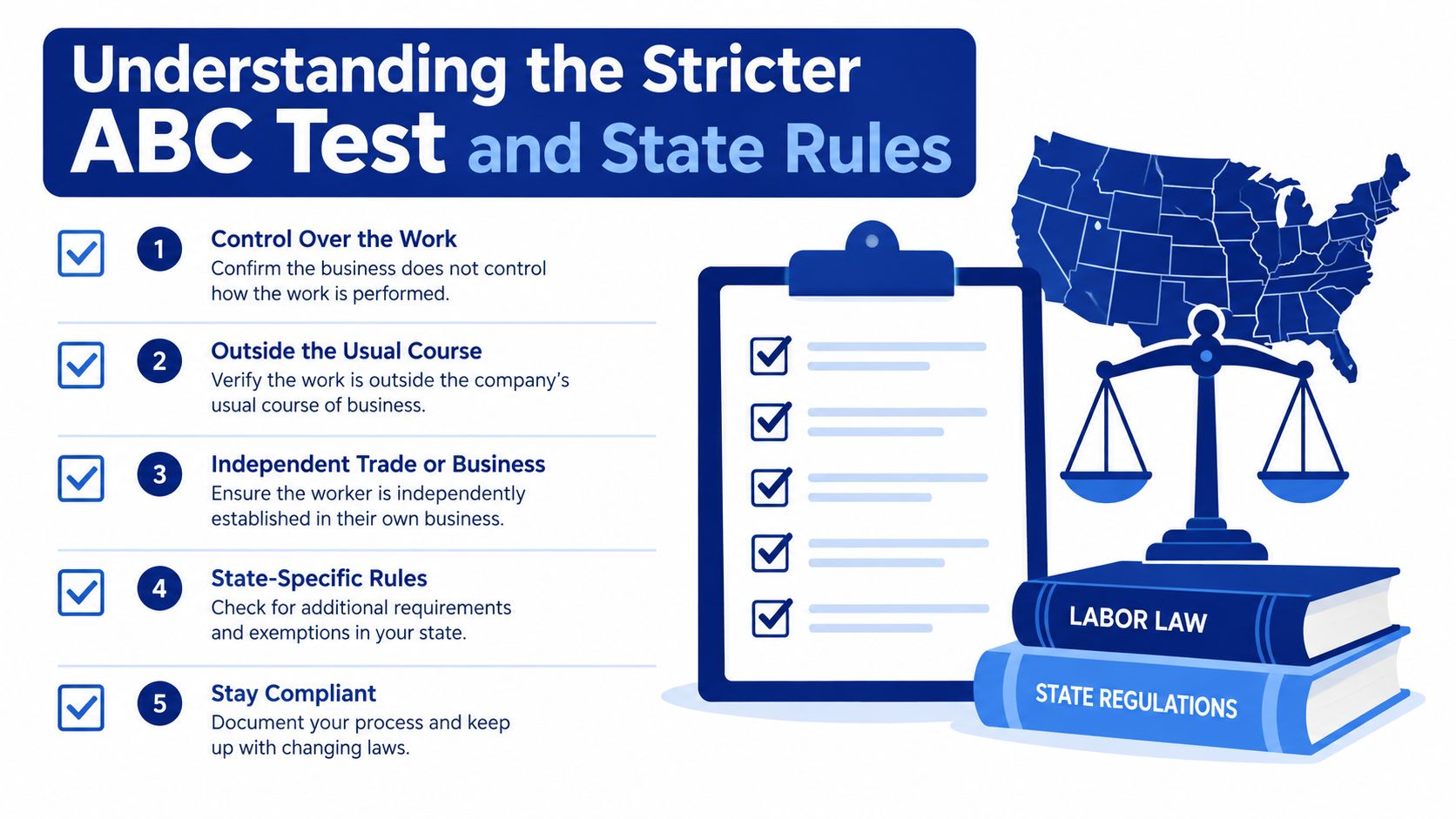
A, freedom from control: The worker must be free from direction and control under the agreement and in daily practice. Deliverables, deadlines, security requirements, and acceptance standards can be consistent with a contractor relationship. Directing the manner and means of routine work is much harder to defend.
B, outside the usual course: This is often the hardest issue. If your company sells marketing services, a marketer delivering those services may perform work inside the usual course even if the person uses a personal laptop and invoices through a business entity. If your company manufactures equipment, a contractor handling an external facility project may have a stronger position than a contractor performing your production work.
C, independently established business: Look for a real business that can operate without your company. Evidence may include serving other clients, advertising services, maintaining business infrastructure, carrying commercial risk, and making independent decisions about delivery. Branding alone isn't enough.
A professional services firm should map each worker's actual tasks against its own revenue-generating activities. A “fractional executive,” “consultant,” or “1099 marketer” label doesn't answer the usual-course question. The closer the role sits to the company's core offering, the more difficult the classification becomes under an ABC-style rule.
Multi-state employers should also identify the law being applied. Wage and hour, unemployment, workers' compensation, tax, and benefits rules may not use the same test. Before expanding contractor use, leaders should navigate handbook requirements alongside a state-by-state classification review. Insurance obligations deserve separate attention, so use a practical resource to find the right coverage for the business and the engagement.
The IRS looks at classification through a common-law control analysis. Its framework is organized into behavioral control, financial control, and the relationship of the parties. That differs from the federal wage and hour analysis, which focuses on economic dependence, and from the ABC test, which requires all three statutory conditions.
A company should run these analyses together rather than choosing the most favorable one. Tax treatment doesn't cure wage and hour exposure, and a contractor agreement that supports one conclusion may conflict with actual control over the work.
| Control Category | Key Evaluation Factors |
|---|---|
| Behavioral control | Instructions about when, where, and how work is performed, plus training and supervision |
| Financial control | Unreimbursed expenses, worker investment, tools and equipment, payment structure, and the ability to realize profit or loss |
| Relationship of the parties | Written contracts, employee-type benefits, permanence, and whether the work is a key aspect of the business |
The IRS describes these categories in Topic 762 on independent contractor status. Use the categories as an evidence map, not as a formality.
A company can specify the result it needs without controlling every method used to produce it. Risk rises when managers train the worker in company procedures, require fixed working hours, dictate detailed processes, review routine activity, or require permission for ordinary decisions.
The right to control can matter even when the manager rarely exercises it. Review policies, messages, meeting invitations, timekeeping, approval workflows, and system permissions. Those records often reveal more than the agreement.
A genuine business typically makes decisions about pricing, expenses, equipment, clients, and delivery. A worker who receives wage-like payments, uses company resources, has expenses routinely covered, and cannot meaningfully affect profit or loss may look financially dependent.
The relationship category adds context. Benefits, indefinite service, a central role, and employee-style treatment can weaken contractor classification. Don't assume that paying by invoice solves those issues. Invoices describe payment mechanics, not the complete relationship.
A defensible classification file should allow another reviewer to reconstruct the decision from evidence. Start with the worker's location, the laws that may apply, the services being purchased, and the business facts supporting independence. Then compare the written agreement with how managers operate in practice.
The risk is not theoretical. A GAO review reported that the IRS's last broad estimate found about 756,000 of 5.15 million employers had misclassified workers. A later federal labor study cited Department of Labor and workforce audits in which 38% to 42% of employers either misclassified workers or had other wage-and-hour violations in audit samples. Those figures are reported in the GAO review.
Keep documents that demonstrate how the relationship works:
Use HR documentation for multi-state employers to strengthen the broader recordkeeping process, but don't let a general HR file substitute for a classification analysis.
For a multi-state workforce, identify where services are physically performed and which agencies may review the relationship. Compare the actual arrangement against the federal economic factors, the IRS categories, and any applicable ABC-style standard.
A weak file often contains a strong contract but little operational evidence. A strong file shows consistency between the agreement, invoices, schedules, tools, communications, management behavior, and the worker's independent business activity.
Evidence beats labels: If the file says “independent,” but calendars, messages, systems, and approvals show an embedded staff role, the operational record will carry more weight.
If a review shows that a contractor functions like an employee, don't wait for a complaint or audit. Pause expansion of the arrangement, preserve relevant records, identify every affected jurisdiction and obligation, and obtain advice on a coordinated correction. Just changing the payment method or issuing a different tax form won't resolve earlier exposure.
The current federal environment makes outdated templates especially dangerous. The Department of Labor said it would stop enforcing the 2024 rule and return to the long-standing economic reality framework, while a 2026 proposed rule again centers on economic dependence rather than a single bright-line formula. The change is discussed in recent federal classification guidance. State standards can still diverge, so leaders must track the law applicable to each worker and obligation.
Prospective reclassification may be appropriate when the role is essential, ongoing, supervised, and integrated. Move the worker into the employee structure, align payroll and benefits processes, update manager practices, and document the effective date.
Restructuring may work when the business needs an outside service. Narrow the scope, define deliverables, remove employee-style supervision, preserve control over results rather than methods, and confirm that the worker operates an independent business. Don't restructure on paper while keeping the same daily practices.
Remediation planning is necessary when prior periods may involve wage, tax, unemployment, workers' compensation, or benefits exposure. Coordinate the review before communicating a correction, because one agency's treatment may not resolve another agency's requirements.
If the relationship must end, use a carefully prepared risk-reducing termination letter and coordinate it with the classification review. Avoid retaliatory language, unsupported admissions, or casual explanations that create unnecessary inconsistencies.
The executive decision is simple, even when the analysis isn't: if the worker looks embedded, treat that as a warning requiring documented review. If the business can't prove genuine independence across the applicable tests, continuing the arrangement is usually harder to defend than correcting it.
Paradigm International Inc. helps owners, COOs, HR directors, and executive teams evaluate worker classification, document multi-state decisions, and address broader employment risk with a structured advisory process. Visit Paradigm International Inc. to discuss a defensible approach for contractor reviews, reclassification, and related HR decisions.