Navigating the decision to rehire a former employee can be complex.Navigating the decision to rehire a former employee can be complex. While it might seem counterintuitive to bring back someone you once terminated, the answer to, "Can you rehire a fired employee?" is often yes. In fact, it is a more common practice than many business leaders realize. However, successful rehiring depends on having clear internal policies, thorough documentation, and a careful review of the original separation.
In a competitive talent market, bringing back a "boomerang employee" can be a strategic advantage. Recruiting is both expensive and time-consuming. Rehiring a former team member means onboarding someone who already understands your company culture and operational processes. This can significantly reduce the training and ramp-up time required for a new hire.
However, this decision should never be made casually or based on instinct. It must be a structured, defensible business choice. Without clear, consistently applied policies, you risk making arbitrary decisions that can lead to significant legal and operational risks.
The idea of rehiring a former employee often arises during critical moments, such as when a key person resigns unexpectedly or when you struggle to fill a specialized role. This approach has gained traction; a 2023 SHRM survey found that 42% of employers have rehired employees they had previously terminated. This data highlights a shift toward offering second chances, particularly if the termination was due to fixable issues or if the individual has since acquired new skills. You can explore the complete research from Paradigm to understand how these trends are shaping modern HR strategy.
This decision tree offers a quick visual guide for an initial assessment.
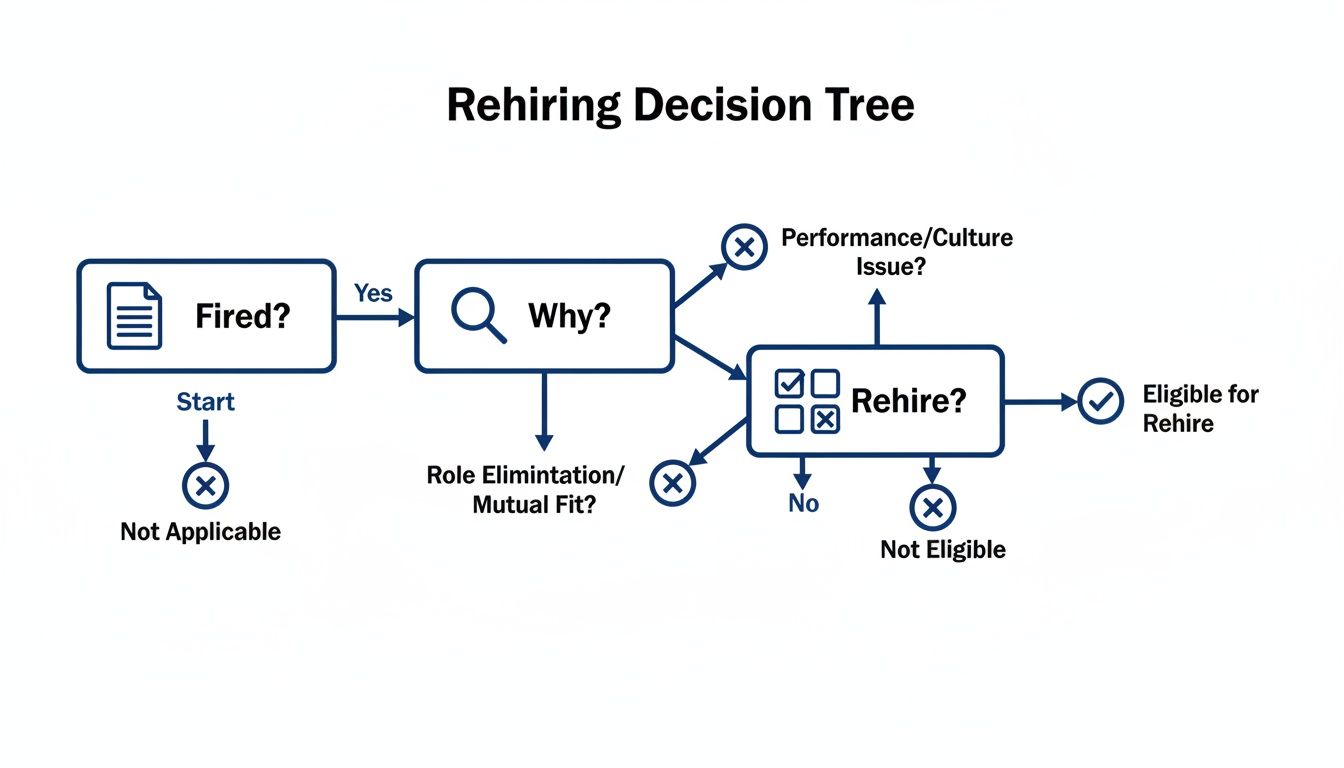
As the flowchart illustrates, the process begins with the documented reason for the original termination. This single piece of information serves as your most important initial filter.
To guide your thinking, consider this initial decision matrix. It helps frame the conversation around the potential benefits and drawbacks.
| Factor | High Rehire Potential | Low Rehire Potential |
|---|---|---|
| Reason for Termination | Layoff, restructuring, role elimination, or fixable performance issues. | Gross misconduct, policy violations, theft, harassment, or safety breaches. |
| Documentation | Clear, detailed records of performance plans and exit interviews. | Vague notes, missing documentation, or records of severe misconduct. |
| Employee Attitude | Professional exit, acknowledged issues, and a desire to return. | Hostile departure, burned bridges, or blame-shifting. |
| Team Impact | Was a positive, collaborative team member. | Caused conflict, damaged morale, or was a poor cultural fit. |
This matrix provides a structured way to weigh the pros and cons from the very beginning.
While the opportunity is clear, the risks are equally real. Rehiring someone terminated for serious misconduct can damage team morale and create legal exposure. Without a formal rehire policy, you risk making inconsistent decisions that could be perceived as bias or favoritism, potentially leading to a discrimination claim.
The key is to transition from reactive, one-off choices to a proactive, policy-driven approach. A well-defined rehire policy establishes a fair, consistent, and legally defensible process. By creating clear guidelines, you provide your organization with a roadmap to make smart, strategic decisions while mitigating unnecessary risk.
If your organization needs assistance developing these types of defensible HR policies, our team can help. Feel free to reach out to our advisory team to discuss your specific needs.
When considering whether to rehire a former employee, the first and most critical question is not about their new skills or your current business needs. It is about why they were terminated in the first place. Not all terminations are equal, and understanding the distinction is key to making a sound and defensible rehiring decision.
The fundamental question every leader must ask is: Was the termination due to performance, or was it due to misconduct? This distinction is not just an internal policy matter; it determines whether a second chance is even a possibility.
Let's break down the two main categories of termination. Differentiating between them is the first step toward building a fair and consistent rehiring process.
Performance-Based Terminations: These occur when an employee fails to meet the clear, measurable expectations of their role. This could involve consistently missing sales targets, struggling with new software, or producing work that requires frequent corrections. These are often "fixable" issues. A former employee may have since gained new training or professional maturity, making them a suitable candidate in the future. Solid documentation, such as well-structured work improvement plan templates, is invaluable here.
Misconduct-Based Terminations: This category is entirely different. Terminations for misconduct result from an employee violating company policy, ethical standards, or the law. Examples include theft, harassment, dishonesty, workplace violence, or serious safety violations. Unlike a skills gap, these actions break the fundamental trust required in an employer-employee relationship. From a risk management perspective, these offenses are generally considered unforgivable.
This distinction is reflected in company practices. A 2024 survey revealed that 51% of U.S. companies have rehired employees terminated for performance reasons. By contrast, only 12% would consider rehiring someone fired for integrity issues like dishonesty or harassment.
It is essential to establish a firm, documented boundary between these two types of terminations. A rehire decision should never be based on a manager's vague recollection or personal feelings. The goal is to create a clear, uncrossable line. Terminations for integrity breaches, major policy violations, or illegal acts should automatically render a former employee ineligible for rehire, without exception.
This firm stance achieves two important objectives. First, it protects your company culture by ensuring that individuals who have demonstrated a significant lack of integrity are not brought back. Second, it provides a clear, non-discriminatory, and legally sound reason for refusing to rehire certain individuals, which is a crucial element of proper what is disciplinary action.
By categorizing terminations based on their root cause, you shift the conversation from a subjective and risky one to a structured and objective one. If the reason was performance-related, the discussion can proceed. If it was due to misconduct, the door is closed. This simple filter is the foundation of any sound rehire strategy.

When deciding whether to rehire a former employee, your memory is not a reliable source. The most valuable asset you have is clear, objective documentation. It transforms hazy recollections into a factual, defensible record of events. This practice is not just about legal protection; it is about making sound, consistent business decisions.
Think of your employee files as your organization's "black box." When a rehire application arrives, these records provide an unbiased account of what happened and why. Without them, you are left relying on feelings and impressions, which is a recipe for inconsistent and risky choices. Good documentation allows you to answer the most critical question with confidence: "What was the specific, business-related reason for the original termination?"
While it is easy to say "document everything," what does that mean in practice? Vague notes like "bad attitude" or "not a team player" are legally weak and useless for future decisions. Effective documentation is always specific, objective, and behavioral. For employers, meticulous record-keeping is non-negotiable, and using one of the best document automation software platforms can help ensure records are precise and easily accessible.
The goal is to create a paper trail that tells a clear and complete story. This record should demonstrate that the company provided feedback, gave the employee a chance to improve, and acted on legitimate business reasons. To learn more about this process, review our detailed guide on documenting employee discipline.
Your documentation must be a complete file that justifies the termination decision. This removes ambiguity and becomes the cornerstone for determining rehire eligibility later. A comprehensive termination file should always include these key elements:
By focusing on behaviors rather than personalities, your documentation becomes an objective business record. This level of detail separates a defensible decision from a potential lawsuit and provides the factual basis needed to evaluate if a former employee is a viable candidate.

Making rehire decisions on a case-by-case basis is one of the fastest ways for a business to encounter legal trouble. When managers are left to their own judgment, inconsistency is inevitable, creating a direct path to claims of favoritism or discrimination. A formal, written rehire policy is not just bureaucratic paperwork; it is your best defense.
Without clear rules, you invite ambiguity. A well-crafted policy provides a blueprint for every rehire decision, establishing the rules upfront. It empowers your managers to act consistently and gives HR a solid framework for managing re-employment with confidence.
A critical piece of your offboarding process is formally designating whether a departing employee is eligible for rehire. This is often managed through an internal "Do Not Rehire" list. It is essential to understand that this is not an informal blacklist for personal grudges but a formal, documented status based on the objective facts of the termination.
The decision to place someone on this list must be directly tied to the documented reason for their separation. For example, an employee terminated for falsifying expense reports should be permanently coded as ineligible for rehire. This is a business decision based on a documented act of dishonesty. This designation must be made at the time of termination and recorded with an objective, non-discriminatory business reason.
A strong rehire policy does not need to be complicated, but it must be clear and comprehensive. It removes personal feelings from the equation and roots every decision in objective business logic. For business owners and HR leaders, ensuring this policy aligns with other critical documents, such as those outlined in our overview of essential employee handbook sections for compliance, is key.
The table below outlines the essential elements every rehire policy should include.
Components of a Defensible Rehire Policy
| Policy Component | Key Consideration | Risk Mitigation Benefit |
|---|---|---|
| Eligibility Criteria | Clearly define who is eligible (e.g., left in good standing) and who is ineligible (e.g., terminated for gross misconduct, theft, harassment). | Prevents inconsistent application of rehire decisions and reduces discrimination risk. |
| Waiting Period | Establish a minimum time before a former employee can reapply, typically six to twelve months. | Ensures a sufficient gap for the individual to have plausibly gained new skills or addressed previous performance issues. |
| Application Process | Mandate that all former employees follow the standard application process for a specific, open role, just like any external candidate. | Eliminates shortcuts and accusations of favoritism, ensuring a fair and level playing field for all applicants. |
| "Do Not Rehire" Protocol | Formalize the process for marking an employee as ineligible, linking the decision directly to documented, non-discriminatory termination reasons. | Creates a defensible record and prevents the accidental re-employment of individuals who pose a risk to the business. |
| Reference Check Handling | Instruct HR and managers on how to respond to reference checks for former employees, particularly those marked as "ineligible for rehire." | Maintains consistency and avoids potential defamation claims by sticking to neutral, verifiable information (e.g., dates of employment, title). |
By including these elements in your formal policy, you create a system that is fair, predictable, and protective of your organization. This transforms the decision of whether to bring back a former employee from a recurring dilemma into a structured, manageable process.
If your business operates across state lines or in a highly regulated industry, a one-size-fits-all rehire policy is not just a poor strategy—it is a significant risk. The simple question, "Can we rehire this person?" becomes entangled in a web of different state laws and industry rules. A decision that is perfectly safe in one state could create serious legal trouble in another.
This is where risk management is critical. Your rehire policy needs a consistent core philosophy but must also be flexible enough to adapt to local laws.
State employment laws are notoriously inconsistent. For any multi-state business, your rehire policy must account for these crucial differences. Here are a few key areas where state laws often differ:
A core principle of multi-state HR is that your policies should always meet the standard of the most restrictive applicable law. This means your policy in a state with strong employee protections will need to be more rigorous than in a state with more employer-friendly laws.
Beyond state laws, some industries have their own regulations that can automatically disqualify someone from being rehired. These rules often apply to roles involving public trust, safety, or financial integrity and typically override a company's internal policy.
Consider these examples:
The stakes are incredibly high. The National Labor Relations Board (NLRB) logged 1,100 unfair labor practice charges related to rehiring disputes in 2024 alone, many of which stemmed from poor documentation. You can explore our risk advisory insights to learn more about managing these exposures.
Building a strategy that accommodates these complexities requires a deep understanding of your business operations and the relevant legal landscapes. If your organization needs help creating a defensible rehire framework, our team is here to assist. You can contact us for a consultation.
Deciding whether to rehire a former employee is a strategic business move, not just an HR task. The benefits—a known cultural fit, reduced recruitment costs, and faster onboarding—are attractive. However, the risks, from damaging team morale to creating legal exposure, are significant and require careful consideration.
This guide has outlined the cornerstones of a sound rehiring strategy. By making the original reason for termination your starting point and grounding every decision in objective documentation, you establish a firm basis for your choices. Supporting this with a formal written policy and staying informed about multi-state complexities puts your organization on solid defensive ground.
The most critical shift is moving from reactive, gut-feel decisions to a proactive, structured framework. This is how you effectively manage risk and turn "boomerang employees" into a genuine asset. A structured approach transforms an uncertain process into a predictable and defensible one.
A successful rehiring program is built on clear, documented, and consistently applied principles. These pillars work together to protect the business while allowing for smart talent decisions.
By embracing this structured method, your organization can confidently answer the question, "Can you be rehired after being fired?" with a strategic and legally sound "yes" when the circumstances are right. It turns a potential liability into a calculated business advantage.
If you need support building this kind of defensible HR framework, the team at Paradigm is here to help. You can contact our advisory team to discuss how we can support your leadership.
When it comes to rehiring a previously terminated employee, several practical questions often arise. For business owners and HR leaders, getting these answers right is key to making consistent, fair, and legally sound decisions. Here are some of the most common questions we encounter.
A "do not rehire" list is an internal record of former employees deemed ineligible for future employment. Yes, these lists are legal, provided the reasons for placing someone on the list are non-discriminatory and directly tied to objective, documented evidence. For example, placing an employee terminated for theft on this list is defensible. However, using it to retaliate against someone for a protected activity, like reporting a safety violation, would be unlawful.
No, in almost all cases, you should not. When an employment relationship is terminated, it creates a clean legal break in service. If you rehire that person, they should be treated as a brand-new employee in every respect. This means their prior tenure does not count toward seniority, vacation accrual, or benefits eligibility unless a formal company policy states otherwise. They must complete all new hire paperwork, including a fresh Form I-9, and go through the standard introductory period.
Your official offer letter should be crystal clear. It must state that the person is being hired as a new employee and that their previous service will not be recognized for seniority or benefits.
You need to consider reference checks in two scenarios: when you are checking their references and when another company asks you for a reference about them.
Yes, any applicant can file a lawsuit if they are not hired. The real question is whether their claim has merit, which depends on their ability to prove the decision was unlawful. If a former employee can provide credible evidence that your decision not to rehire them was based on a protected characteristic (like age, race, or gender) or was in retaliation for a protected activity, they might have a case. This is why having a clear, consistently applied rehire policy and solid, objective documentation is your best defense.
Building a defensible HR framework is a proactive step toward protecting your business. To learn more about how we partner with leadership teams, we invite you to schedule a consultation with us today.