


A former employee who was dismissed for serious misconduct has applied for an open role. The hiring manager remembers the person's skills, the operations team needs help, and the business is wondering whether enough time has passed to consider a return. The central question is simple: can you be rehired after being fired for gross misconduct?
The answer is yes, legally possible in some circumstances, but never automatic. A sound decision depends on the employer's policy, the original investigation, the nature of the conduct, the proposed role, consistency with comparable cases, and the controls available to reduce repeat risk.
Gross misconduct creates a difficult tension for business leaders. The organization may still value the former employee's experience, but the original dismissal signals a serious concern involving trust, safety, integrity, or workplace conduct. Rehiring without reviewing that concern can expose the business to operational, discrimination, reputational, and reference-related risks.
A multi-state employer should treat the decision like a risk assessment, not a popularity vote. Start by reconstructing what happened, confirming that the original process was defensible, and checking whether the former employee appealed or provided meaningful mitigation. Then compare the old role with the proposed role, including supervision, access to systems, contact with customers, and authority over money or sensitive information.
The legal analysis also changes by jurisdiction. Internal policy matters, but it can't override applicable employment, discrimination, licensing, safeguarding, or retaliation rules. A consistent process helps the organization explain why one former employee was reconsidered while another was not.
The practical questions are:
A defensible outcome may be a refusal to rehire, a carefully controlled new hire, or, in limited situations, reinstatement after an appeal or documented review.
Gross misconduct generally describes conduct serious enough to justify dismissal, potentially without notice. Acas describes gross misconduct as conduct that is very serious or has very serious effects, with examples including fraud, physical violence, gross negligence, and serious insubordination. Acas also states that dismissal may be justified without notice, even for a first offense, but the employer must investigate, allow the employee to respond, and follow a fair disciplinary process.
That distinction matters. A dismissal labeled “gross misconduct” doesn't create a universal lifetime ban on future employment. Rehire after dismissal for gross misconduct is legally possible, but it isn't an automatic entitlement. The outcome usually depends on the employer's policy, the circumstances of the original dismissal, and the risk created by the alleged conduct.
Review the decision in four stages:
Validate the original finding. Confirm the rule allegedly breached, the evidence collected, the employee's response, the decision-maker's reasoning, and any appeal outcome. An accusation is not the same as a substantiated finding.
Classify the risk. Dishonesty, violence, harassment, retaliation, safeguarding failures, and serious confidentiality breaches may justify a continuing no-rehire position because the potential harm remains substantial.
Test for changed circumstances. A materially different role, new supervision, verified remediation, or substantial mitigation may support reconsideration. Passage of time alone is a weak justification if the new job recreates the original conditions.
Check comparable cases. Ask whether similarly situated employees were retained, rehired, or permanently excluded after comparable conduct. An informal manager opinion shouldn't replace an objective comparison.
A former employee who successfully appealed may need to be assessed differently from someone whose dismissal was upheld after a complete investigation. The same applies where the evidence was disputed or the proposed job removes the access, authority, or supervision conditions that contributed to the original risk.
The right conclusion isn't “gross misconduct always means no.” It is “the organization must document why this person is, or isn't, suitable for this role now.”
A rehire decision can change meaning across jurisdictions. State law, public-sector rules, industry regulation, discrimination protections, and the quality of the original process all influence the risk. Treat an internal “ineligible for rehire” label as an employer risk designation, not as a universal legal status.
The available guidance also differs by country. In the United Kingdom, the Acas framework emphasizes fair procedure before dismissal. The Acas statutory Code of Practice, in force since March 11, 2015, calls for an investigation, an opportunity for the employee to respond, communication of the decision, and an appeal opportunity.

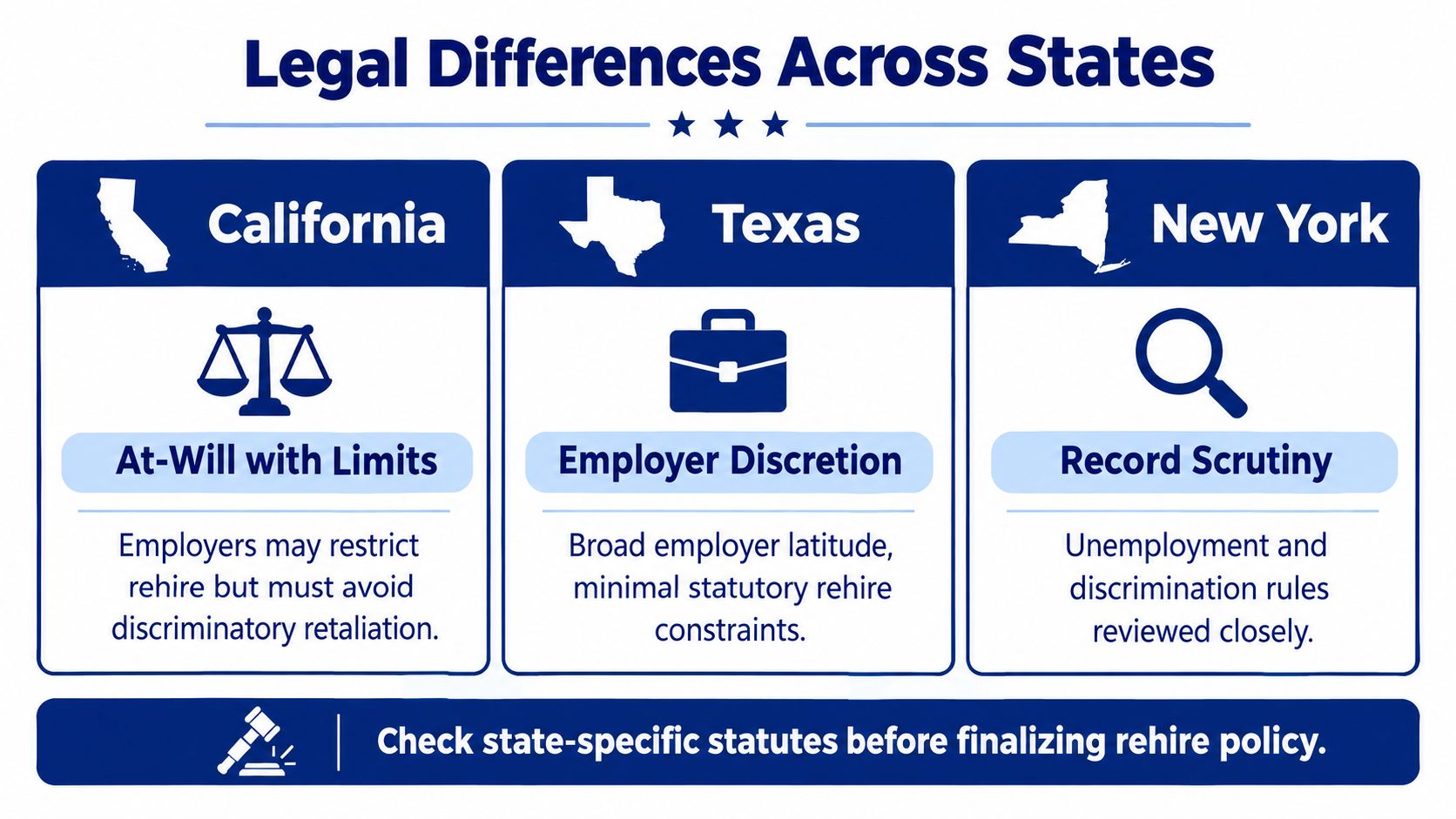
A useful comparison starts with the proposed role, not the former employee's label. California generally gives employers broad discretion in employment decisions, subject to discrimination and retaliation restrictions. Texas also allows substantial discretion in many employment matters, while contracts, public policy, protected activity, and consistent treatment can still create risk. New York employers should assess state and local discrimination, retaliation, personnel-record, and industry requirements before approving a rehire.
Public-sector rules may be more specific than private-sector practice. Tennessee, for example, permits a statewide “ineligible for rehire” designation in specified gross-misconduct circumstances. The former agency must also provide the reason for separation when another agency considers hiring the person. A private employer should not treat that rule, another state's policy, or an informal HR convention as a nationwide standard.
Before a manager makes a commitment, ask four questions:
Then examine the role itself. Licensing, patient safety, vulnerable people, financial authority, and regulated information can turn a general personnel decision into a specialized compliance issue. Employers expanding across state lines can use a multi-state HR risk advisory to compare handbook language, approval practices, and local obligations.
Rehire also differs from “dismissal and rehire.” Acas uses that phrase for ending an existing contract and offering employment again on changed terms. It does not describe hiring a former employee whose earlier employment ended for misconduct. In England, Scotland, and Wales, employers are expected to use dismissal and re-engagement only as a last resort, consult fully, and provide a fair reason, procedure, notice, and appeal. Collective consultation is legally required when the proposal affects 20 or more employees at one establishment within 90 days or less. An employment tribunal may increase compensation by up to 25% for unreasonable noncompliance with the statutory code. Acas explains the distinction between these arrangements.
A former employee applies for a safety-sensitive role after being dismissed for serious misconduct. The hiring manager remembers the person's skills, while HR sees potential legal, operational, and reputational exposure. A rehire policy should give both perspectives a disciplined way to reach a decision.
Start by defining how past separations are classified. Categories might include ordinary performance exits, redundancy, unresolved allegations, substantiated serious misconduct, successful appeals, and cases requiring independent review. For each category, state whether the outcome is permanent, subject to review, or limited to a particular role or business unit. This prevents a broad “do not rehire” flag from replacing judgment.
Risk should determine the approval path. A former supervisor may provide useful context, but high-risk cases should go to HR, legal counsel, compliance, or an independent panel. The policy can require evidence of the original findings, the disciplinary outcome, any appeal, the rule applied, and information later provided by the applicant.
Role design then becomes part of the decision. A rehire may be possible only with restricted system access, closer supervision, dual approval for sensitive transactions, or exclusion from duties connected to the original incident. A lone-worker operation should also connect employment decisions with a lone worker policy that works, covering check-ins, escalation, supervision, and emergency response.
Exceptions need a written test. The decision-maker should identify what has changed, explain the safeguards, and show that comparable cases received consistent treatment. EEOC guidance notes that similarly situated employees who committed misconduct of comparable seriousness should be considered when assessing whether discipline was applied differently. The comparison should address the conduct, role, prior record, mitigation, and outcomes for other employees.
If reconsideration is allowed, specify who may request it, what new evidence is required, and when the review can occur. A Paradigm International rehire policy guide can help leaders organize eligibility criteria, exception approvals, and recordkeeping requirements. The result is a policy that treats rehire as a controlled risk decision, not an automatic ban or an informal manager preference.
A rehire decision can fail years later if the file contains only “not eligible for rehire.” Documentation should let a new decision-maker reconstruct the reasoning without relying on a former manager's memory or an incomplete HR-system label. It works like an evidence trail, connecting the original conduct, the proposed role, and the safeguards.
Keep two records with clear cross-references. The investigation file should contain the allegation, evidence, employee response, findings, disciplinary decision, and appeal. The rehire file should capture the application, proposed duties, risk analysis, approving authority, controls, and final rationale. Store access and retention should follow applicable privacy and employment requirements.
A useful review asks five connected questions:
What could recur? Define the scenario precisely, such as unauthorized access, harassment, financial manipulation, retaliation, or disclosure of confidential information.
What would the impact be, and how likely is recurrence? Consider the original evidence, time passed, role changes, conduct since termination, and any explanation or mitigation. A manager's instinct is not a sufficient risk assessment.
Which safeguards fit the role? Controls may include restricted access, dual approval for transactions, conduct training, closer supervision, a lawful probationary period, and scheduled review checkpoints.
Would those safeguards work? A control that records harm after it occurs is not equivalent to one that prevents or detects the conduct early. Test who owns each control and what evidence will show that it operated.
Why is the outcome consistent? Record the decision-maker, evidence considered, conditions attached, and reasons the result matches or differs from comparable cases.
Reference handling deserves its own review. UK government guidance states that an employer generally does not have to provide a reference, but a reference supplied must be fair and accurate and may state that the person was dismissed. The government's reference guidance also indicates that assertions should be supported by records such as warning letters. Authorize specific respondents, use one verification template, preserve each response, and define what substantiated separation information may be disclosed lawfully. A neutral-reference rule cannot control informal manager comments, so access to reference requests should be limited.
Screen a refusal to rehire or negative reference for retaliation concerns involving prior protected complaints or participation in an EEO process. Keep screening results distinct from internal disciplinary records, since materials on how expunged records still surface illustrate why different information sources require separate handling. HR teams can browse these HR templates to organize investigations and employment decisions.
A former employee returns after an appeal succeeds, or applies for a different role after a dismissal for gross misconduct. The decision is not just whether to say yes. Leaders must choose an employment structure that matches the evidence, the legal position, and the controls needed to manage future risk.
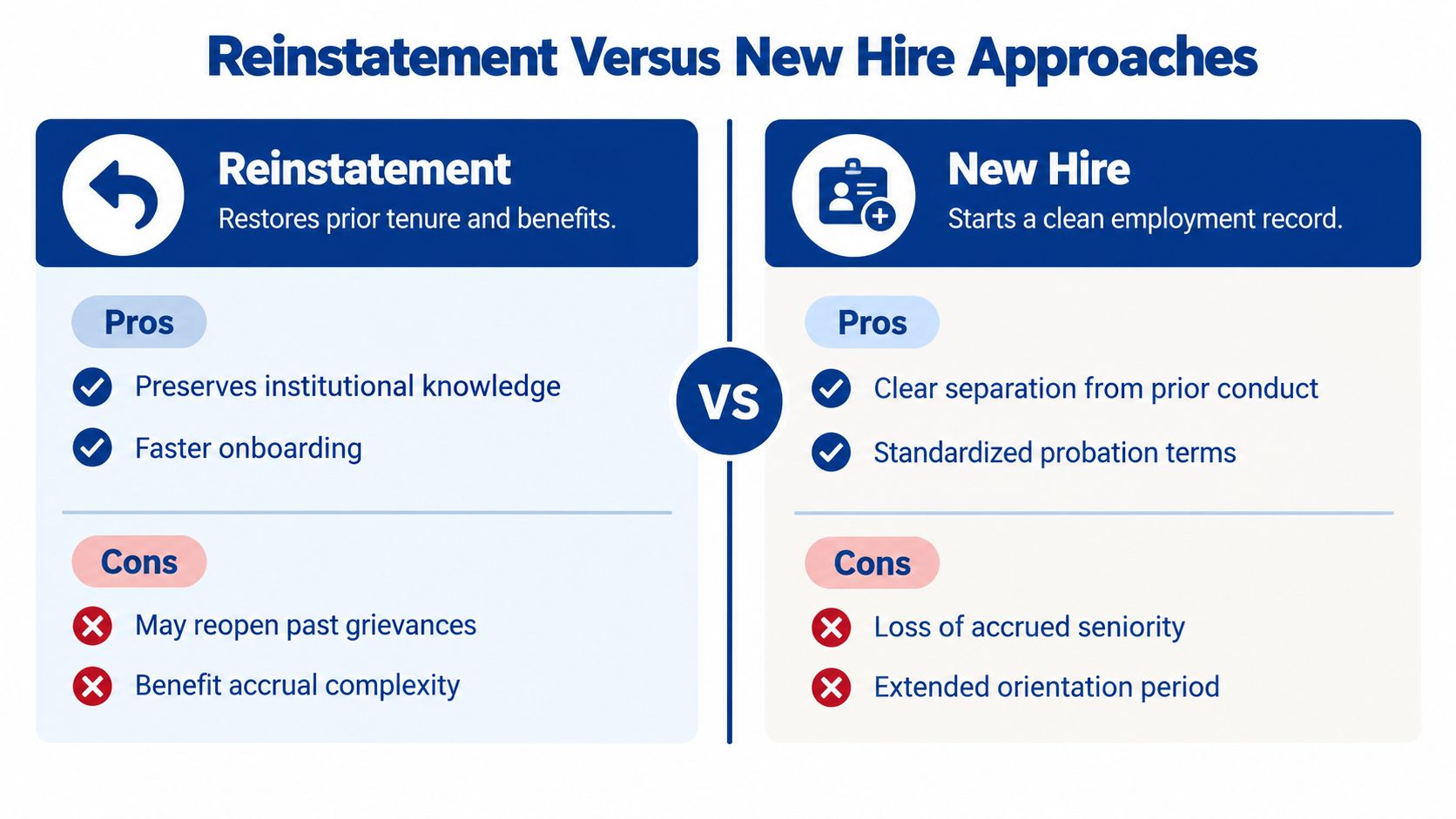
Reinstatement treats the return as a continuation or restoration of the earlier employment relationship. It can preserve institutional knowledge, service history, benefits treatment, and familiarity with systems. This approach may fit a successful appeal, a documented procedural error, or a finding that the original termination could not be sustained.
The risk is that reinstatement can reopen questions about seniority, benefits, accrued rights, and the validity of the original discipline. It may also confuse employees if the organization has not explained why the earlier misconduct no longer determines the employment decision. A written decision should identify what changed and which safeguards now apply.
A new hire creates clearer separation from the former employment record. The organization can define the role, reporting line, access rights, probationary terms, training requirements, and approval controls in a new agreement, subject to applicable law and contract obligations. The employee may lose continuity, however, and a new contract does not erase the prior misconduct. The earlier facts still belong in the risk assessment.

Use the structure that best controls the identified risk. Reinstatement is more defensible when the original decision was overturned, an appeal succeeded, or continuity has legal and operational importance. A new-hire model may fit when the former employment ended definitively and the new role has materially different duties, supervision, or access.
Before approval, test the arrangement against five questions:
A policy could state:
“A former employee dismissed for substantiated gross misconduct is not eligible for rehire unless an authorized review determines that material new facts, a successful appeal, or a substantially changed role supports an exception. Any exception requires written approval, documented risk controls, and a consistency review against comparable cases.”
Adapt that wording to the governing jurisdiction and actual practice. Dismissal and rehire used to change existing contract terms can create separate consultation and procedural requirements under the Acas guidance cited earlier.
The answer to can you be rehired after being fired for gross misconduct is qualified. A prior dismissal doesn't automatically create a lifetime legal ban, but it does require a careful, documented risk assessment. The employer should verify the original investigation, consider appeals and mitigation, compare treatment of similar cases, assess the new role, and establish controls before approving a return.
Multi-state employers should review their policy regularly, train managers on misconduct standards, and audit rehire decisions for consistency and retaliation risk. Reference responses should remain accurate, authorized, and separate from the rehire approval process.
A disciplined framework gives leaders room to consider exceptional cases without weakening standards. It also gives them a clear basis for declining a return when the risk remains too high.
International Inc. supports owners, HR leaders, and executive teams with workplace investigations, disciplinary decisions, termination documentation, and multi-state HR risk reviews. If your organization is evaluating a former employee dismissed for gross misconduct, visit Paradigm International Inc. to discuss a structured and defensible approach.


