
Getting compensation right is one of the toughest balancing acts for any leader. You need to make offers that are fair, competitive, and legally defensible—all while managing one of your largest business expenses. The comp ratio formula is a straightforward metric that brings much-needed clarity to your entire compensation strategy, turning complex data into actionable insight.

When compensation is misaligned, the consequences can be immediate. You risk losing top talent, facing costly pay equity claims, or overspending on payroll. Many leaders still rely on inconsistent practices or gut feelings, which can open the door to serious legal and financial risks. This is where the compa-ratio transforms from an HR buzzword into a vital tool for business management.
Instead of just looking at a list of salaries, the compa-ratio provides a standardized percentage showing exactly where an employee’s pay falls within their established salary range. This context is what allows you to make sound, defensible decisions. It helps you answer tough questions with confidence.
By turning complex salary data into a single, easy-to-understand metric, compa-ratio empowers you to manage payroll with precision. It provides the objective data needed to back up every pay decision and minimize risk.
This guide is built for business owners and HR leaders who need practical, actionable insights. We will walk through what a compa-ratio is, how to use the formula with step-by-step examples, and how to interpret the results to make better business decisions. Our goal is to give you the tools to build a compensation framework that attracts and retains the right people while protecting your business.
Ready to build a more defensible compensation strategy? Reach out to us today to learn how our team can provide the expert guidance you need.
Think of compa-ratio as your company’s “pay speedometer.” It’s a simple but powerful percentage that shows you how an employee's salary compares to the midpoint of their designated pay range. A compa-ratio of 100% means that person is paid precisely at the market midpoint for their role—a perfect match with your established pay structure.
The real value of this metric is the fundamental question it helps answer: “Are we paying this person competitively and equitably?” For business leaders, the comp ratio formula is an essential bridge between raw salary data and strategic, defensible decision-making. It directly informs core business objectives like budget control, talent retention, and internal pay equity.
Relying on raw salary figures alone can be misleading. A $90,000 salary might be exceptionally high for one role but dangerously low for another. Compa-ratio cuts through this noise by standardizing your analysis, allowing you to compare compensation levels across vastly different jobs and departments with a single, consistent metric.
This gives you the objective data needed to justify pay decisions, proactively spot potential pay gaps, and manage your overall payroll costs with far greater precision. It turns a spreadsheet of complex pay data into clear, actionable insight.
By shifting the focus from absolute dollar amounts to relative market positioning, compa-ratio gives leaders a defensible framework for every pay conversation. It turns subjective discussions into objective, data-driven analysis.
To use compa-ratio correctly, it is critical to understand what this metric measures—and what it does not. It is not a complete measure of an employee’s total value or a substitute for performance management. However, it is a vital indicator of how your pay practices align with the market and your internal structure.
| Metric Focus | What Compa-Ratio Tells You | What Compa-Ratio Does Not Tell You |
|---|---|---|
| Internal Equity | How an employee's base pay compares to the established midpoint for their specific role and level within your company. | The fairness of pay between different job roles (e.g., if a designer is paid fairly compared to an engineer). |
| Market Competitiveness | Whether an individual's salary is above, at, or below the market midpoint you have set for their position. | Whether your company's entire pay structure is competitive against the market, only how individuals fit within it. |
| Pay Progression | Where an employee is positioned within their pay band, often reflecting their experience or tenure in the role. | An employee's specific performance level, although performance can be a key factor in determining their position in the range. |
Ultimately, compa-ratio is a tool for strategic alignment, not a standalone solution. It provides a snapshot of individual pay positioning, which must be interpreted with broader context to be truly effective.
Compa-ratio is more than just a calculation; it is a critical component of responsible HR and risk management. With growing demands for pay transparency and a steady rise in pay equity legislation, having a defensible system for managing compensation is no longer optional. In fact, many organizations now use formal salary structures, making metrics like compa-ratio a standard practice for assessing alignment and fairness.
Regularly calculating and reviewing these ratios helps you:
This metric is a foundational element of any sound pay strategy. If you are looking to build a more resilient and equitable compensation framework, connect with an expert at Paradigm to ensure your practices are both competitive and compliant.
Calculating a compa-ratio is more straightforward than it sounds, and it’s one of the most powerful tools for getting an objective look at your pay strategy. At its core, the comp ratio formula is a simple equation that cuts through complex salary data to give you a single, actionable percentage. This is what moves you from gut feelings about pay to genuinely data-driven decisions.
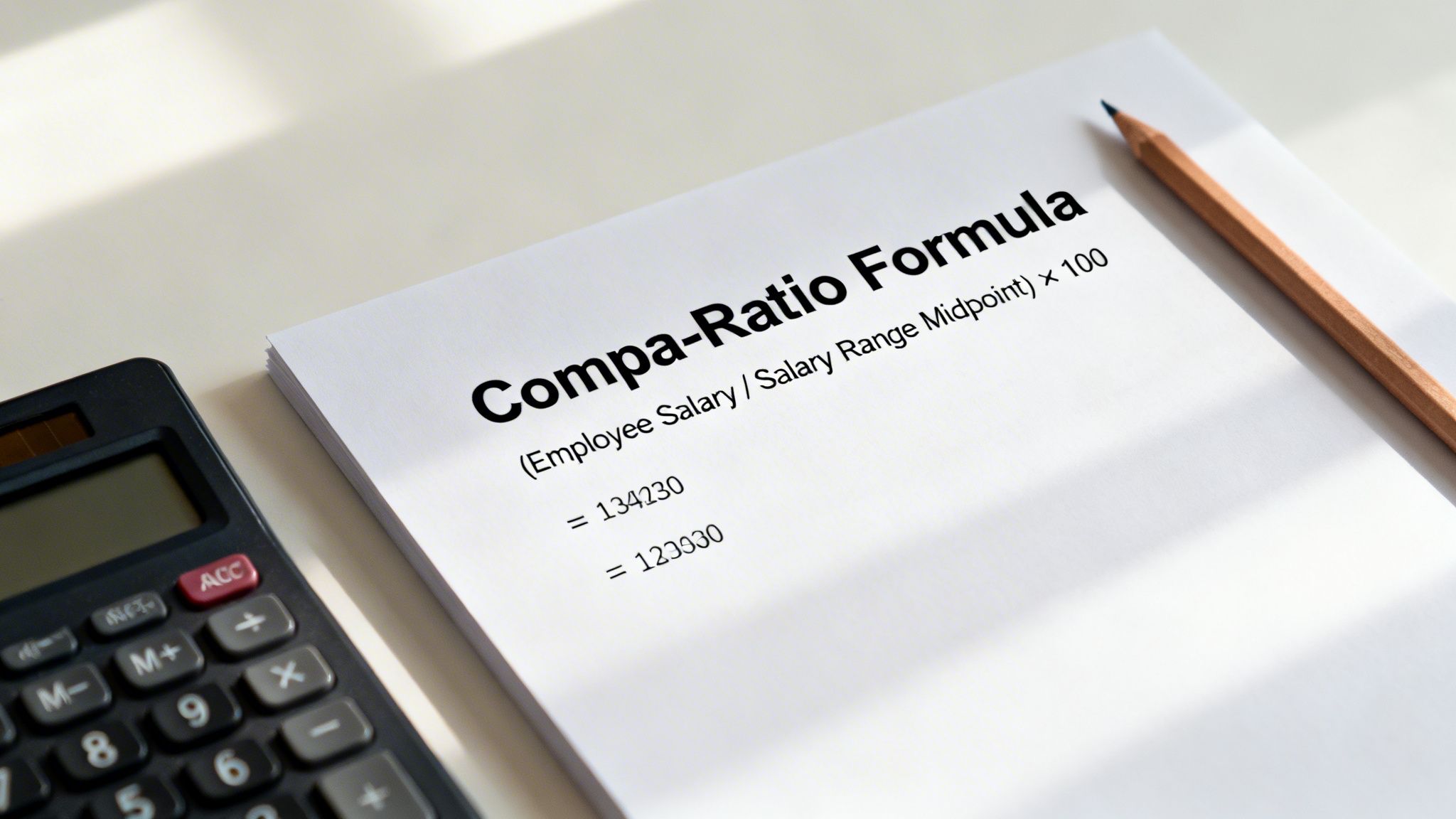
Here, we'll break down the formula, explain each component, and then walk through practical examples for an individual employee and an entire team. By the end, you’ll be ready to apply this essential metric in your own organization.
The compa-ratio is a quick health check for an employee’s pay. It’s a simple division problem that instantly tells you where their salary sits in relation to your company’s established pay range for that specific role.
The formula is: (Employee's Actual Salary / Salary Range Midpoint) x 100 = Compa-Ratio
Let's unpack the two key numbers you'll need for this calculation.
Without reliable market data informing your midpoints, your results will not provide useful insights. Understanding how individual pay compares to competitive salaries is a non-negotiable part of effective talent management and business operations.
Let’s put the comp ratio formula to work with a real-world example. Imagine you are reviewing the pay of a Senior Marketing Manager.
Identify the Employee's Actual Salary: Your payroll data shows the employee’s annual base salary is $115,000.
Determine the Salary Range Midpoint: Your company has established a salary range for this role from $96,000 to $144,000. The midpoint is $120,000.
Apply the Formula: Now, plug those two numbers into the formula.
($115,000 / $120,000) x 100 = 95.8%
This employee’s compa-ratio is 95.8%. This single number gives you immediate context, showing that the employee is paid slightly below the market midpoint for their role.
While individual ratios are useful for targeted reviews, a group compa-ratio provides a high-level view of pay trends. It helps you analyze compensation within a department or team, flagging potential systemic issues that might otherwise go unnoticed. To get the group ratio, you add up all actual salaries and divide by the sum of all corresponding midpoints.
The formula for a group is: (Sum of All Actual Salaries / Sum of All Salary Range Midpoints) x 100 = Group Compa-Ratio
Let’s try this for a small customer support team with three employees.
| Employee | Role | Actual Salary | Salary Range Midpoint |
|---|---|---|---|
| Ben | Support Specialist | $52,000 | $55,000 |
| Carla | Support Specialist | $58,000 | $55,000 |
| David | Senior Specialist | $68,000 | $70,000 |
Sum the Actual Salaries: $52,000 + $58,000 + $68,000 = $178,000
Sum the Salary Range Midpoints: $55,000 + $55,000 + $70,000 = $180,000
Apply the Group Formula:
($178,000 / $180,000) x 100 = 98.9%
The group compa-ratio for this team is 98.9%. This indicates that, as a whole, the team is paid very close to the market targets for their roles. This metric is a great starting point for deeper HR analytics, and you can learn more about unlocking the potential of HR analytics for strategic business decisions in our related guide.
Getting comfortable with the comp ratio formula is a foundational step toward a fair and defensible pay strategy. If you need help developing your salary ranges or putting these analytics into practice, Contact Paradigm's advisory team to discuss your compensation challenges.
You've calculated the compa-ratio—now what? The real value of this metric lies not in the percentage itself, but in how you use it. A compa-ratio is not a simple pass/fail grade; it is a powerful data point that tells a story about where an employee’s pay stands against your company's strategy and the external market.
Understanding that story is what allows you to make compensation decisions that are fair, consistent, and financially sound.

A compa-ratio of 100% means an employee is paid exactly at the market midpoint. In reality, you will see a spread of ratios across your organization, which is both normal and expected. An employee’s position within their pay range should ideally reflect factors like experience, performance, and tenure.
To make sense of these percentages, it is helpful to group them into zones or bands. Each band tells a different story and suggests different actions. These are guidelines, not rigid rules, but they create a consistent framework for analyzing pay and deciding on next steps. The goal is to understand why an employee’s pay falls where it does and whether that placement is justified.
| Compa-Ratio Range | Common Interpretation | Potential Action Items |
|---|---|---|
| 80% - 90% | The employee is likely new to the role, still developing skills, or recently promoted. Performance may be meeting expectations. | This is often an appropriate range for new hires. Monitor progress and plan for future salary increases as proficiency grows. |
| 90% - 110% | The employee is fully proficient and performing as expected. Their salary is well-aligned with the market midpoint. | This is the target zone for most solid, experienced performers. Standard merit increases are typically sufficient. |
| 110% - 120% | This individual is often a top performer, has critical or rare skills, or has extensive tenure. They consistently exceed expectations. | This ratio rewards high value. Ensure performance reviews justify this premium. It can be a powerful retention tool for critical talent. |
These guidelines provide a starting point, but the real work begins when you start asking questions about the numbers.
A compa-ratio is the beginning of an investigation, not the final word. A "high" or "low" ratio is not inherently good or bad without context. Your job as a leader is to explore the "why" behind any numbers that stand out.
A compa-ratio transforms a simple salary number into a powerful piece of business intelligence. It prompts you to ask critical questions: Does this employee’s pay align with their performance and experience? Or have we uncovered a potential pay inequity?
For example, an employee with a compa-ratio of 85% might be perfectly positioned if they were hired six months ago. However, that same 85% for a five-year veteran who consistently exceeds expectations is a major red flag. This could signal a retention risk or a case of pay compression, where the gap between new hire and tenured employee pay shrinks.
Some situations justify compa-ratios outside the typical 90% to 110% target zone. Having clear documentation for these cases is essential for making fair and defensible pay decisions.
Interpreting these results correctly is a core part of building a fair and strategic compensation system. If you need assistance analyzing your company's pay structure, contact Paradigm to speak with an HR advisor and gain the clarity you need.
A compa-ratio is a powerful tool, but its insights are only as good as the data you use. Flawed data will lead to flawed conclusions, undermining your entire effort to build a fair and defensible pay strategy. Getting the inputs right is about making confident pay decisions you can stand behind, transforming a simple calculation into a strategic management tool.
The cornerstone of any compa-ratio analysis is the salary range midpoint. This number cannot be arbitrary; it must reflect the current market rate for that specific role. Using outdated or irrelevant data to set your midpoints is like building a house on a shaky foundation—the entire structure is compromised from the start.
To set accurate midpoints, you need reliable salary benchmark data from reputable sources specific to your industry, company size, and job roles. Many companies adjust their pay structures annually, which shows how critical it is to refresh your data regularly to keep pace with the market. Without credible benchmarks, your compa-ratio only compares a salary to an internal number, telling you nothing about competitiveness.
In a world of remote and distributed teams, a one-size-fits-all salary range is often ineffective. The cost of labor can vary significantly from one city to another. Applying a single national midpoint to employees in both a high-cost urban center and a lower-cost rural town will distort your compa-ratio results.
For an accurate analysis, you must apply geographic differentials to your salary ranges. This means adjusting the midpoint up or down based on local market data for each employee's location.
A compa-ratio is meant to measure an employee's pay against the relevant market. This crucial step ensures you are making a true apples-to-apples comparison, which helps prevent overpaying in some markets and underpaying—and losing great talent—in others.
When you apply the comp ratio formula, consistency is essential. To ensure your comparisons are meaningful across different roles and people, it is standard practice to focus only on an employee's base salary. You should generally exclude other forms of pay from the calculation.
These variable forms of pay include:
Including these variable elements can create a misleading picture. For instance, a salesperson who had an exceptional year might show an inflated compa-ratio if you include commission, masking the fact that their base salary is below the market midpoint. By sticking to base pay, you get a stable, consistent metric for evaluating your core salary structure.
Even with perfect data, you will have compa-ratios that fall outside the ideal 80% to 120% range. These are not necessarily problems, but they always require an explanation. For every employee whose compa-ratio is significantly high or low, you must document the business reason behind it.
This documentation is your first line of defense in a pay equity audit or if a compensation decision is challenged. Justifiable reasons might include:
This documentation turns your compa-ratio from a static number into a dynamic management tool. It provides the crucial context needed to justify every pay decision you make. If you need expert guidance on sourcing market data or structuring your analysis, Contact Paradigm to speak with an advisor and ensure your strategy is built on solid ground.
Calculating compa-ratios is just the first step. The real value emerges when you embed this metric into your company’s core operations. Turning the comp ratio formula into a strategic tool helps you build a consistent, fair, and defensible framework for every pay decision. This roadmap is about proactively managing compensation, reducing legal exposure, and building a more resilient and equitable organization.
The true power of compa-ratio is unlocked when it becomes a go-to tool in your key people processes. Instead of relying on gut feelings, you can ground every compensation decision in objective, reliable data.
For your analysis to hold up, the data behind it must be accurate. It's a hierarchy of information, where each piece builds on the last.
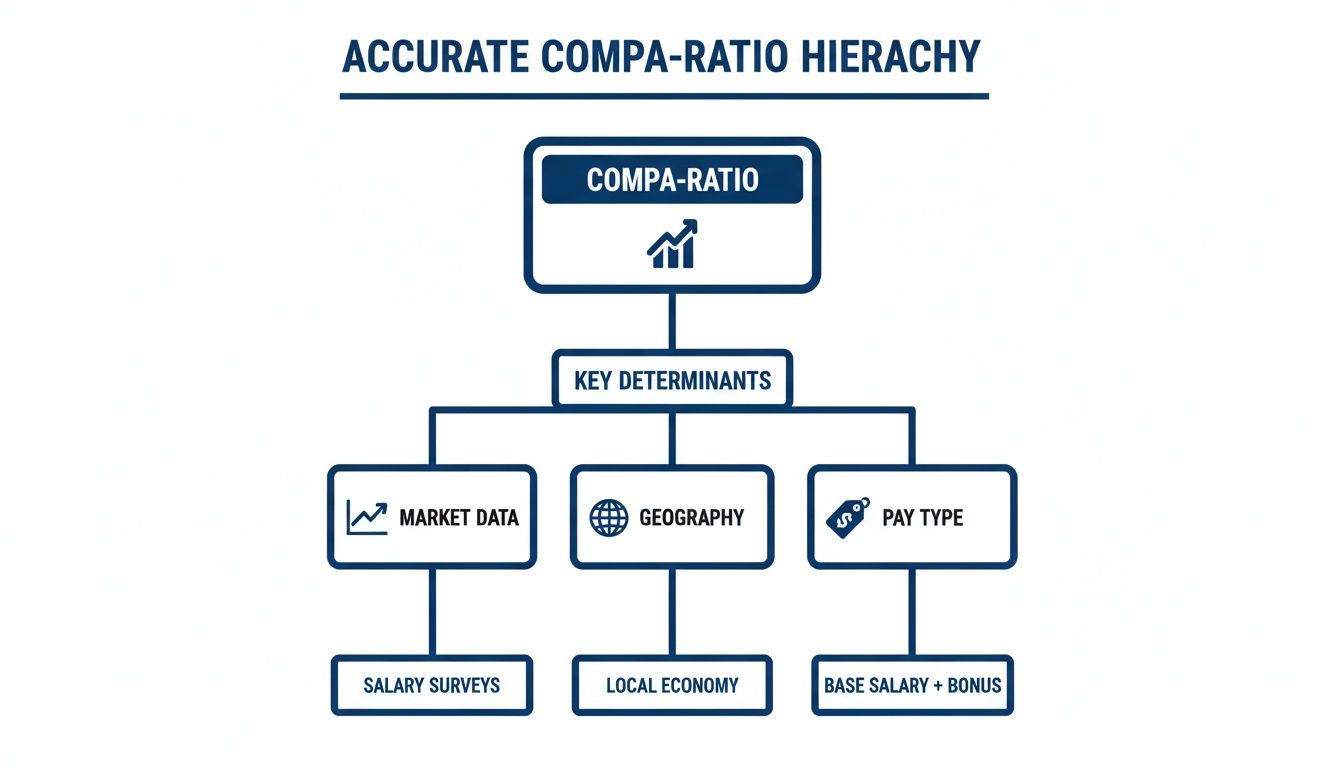
As the chart shows, a defensible compa-ratio starts with solid market benchmarks and is then refined by specific details like geography and different types of pay.
Think of group compa-ratios as your early warning system for systemic pay disparities. By analyzing ratios across departments, job levels, or demographic groups, you can uncover patterns that are invisible when looking at individuals alone. If one team’s average compa-ratio is significantly lower than others, it is a red flag that demands immediate investigation.
By regularly monitoring group compa-ratios, you shift from reacting to pay complaints to proactively identifying and correcting potential inequities. This proactive stance is the foundation of a defensible pay strategy and a key element of HR risk management.
It’s also vital to look beyond your own walls. Staying current with evolving regional requirements, such as pay equity legislation, is essential for building a pay strategy that is not just fair, but fully compliant.
To ensure your pay practices are applied consistently, you need clear governance for all compensation decisions. This means documenting the "why" behind every salary action, especially for outliers who fall far above or below the midpoint. A well-defined pay structure, supported by clear documentation and expert guidance from a compensation consultant, is what makes your pay practices truly defensible. It proves your decisions are methodical and based on legitimate business factors—not bias.
As you start working with the comp ratio formula, practical questions will arise. Leaders often wonder how this metric applies in the real world and what to do in specific scenarios. Getting these details right is key to building a pay strategy that is both fair and defensible. Here are straightforward answers to common questions from business owners and HR leaders.
You should calculate and review compa-ratios at least once a year. The annual salary review cycle is the perfect time for this, as it ensures your pay rates keep pace with market shifts. However, compa-ratios are also useful for ad-hoc reviews during key moments.
You should also run the numbers when you are:
You cannot calculate a meaningful compa-ratio without an established salary range midpoint. The entire formula depends on having a reliable market benchmark for comparison. If you do not have formal ranges, your first and most critical step is to develop them.
Trying to use the compa-ratio formula without a defined salary midpoint is like trying to measure an object without a ruler. The result is just a number, offering no real insight into whether your pay is competitive or equitable.
Discovering an employee has a very high or low compa-ratio is not a problem in itself—it is a signal to investigate and document the "why." A high ratio (>115%) could be justified by exceptional performance or critical skills. Likewise, a low ratio (<85%) might be appropriate for an employee still growing into their role. The key is to document the business reason, ensuring every pay decision is consistent and defensible.
Building a defensible compensation strategy is a critical part of proactive HR risk management. If you’re ready to navigate these high-stakes decisions with confidence, learning more about how a partnership can support your goals is a logical next step. To connect with our team and explore your options, please contact Paradigm to speak with an HR advisor.