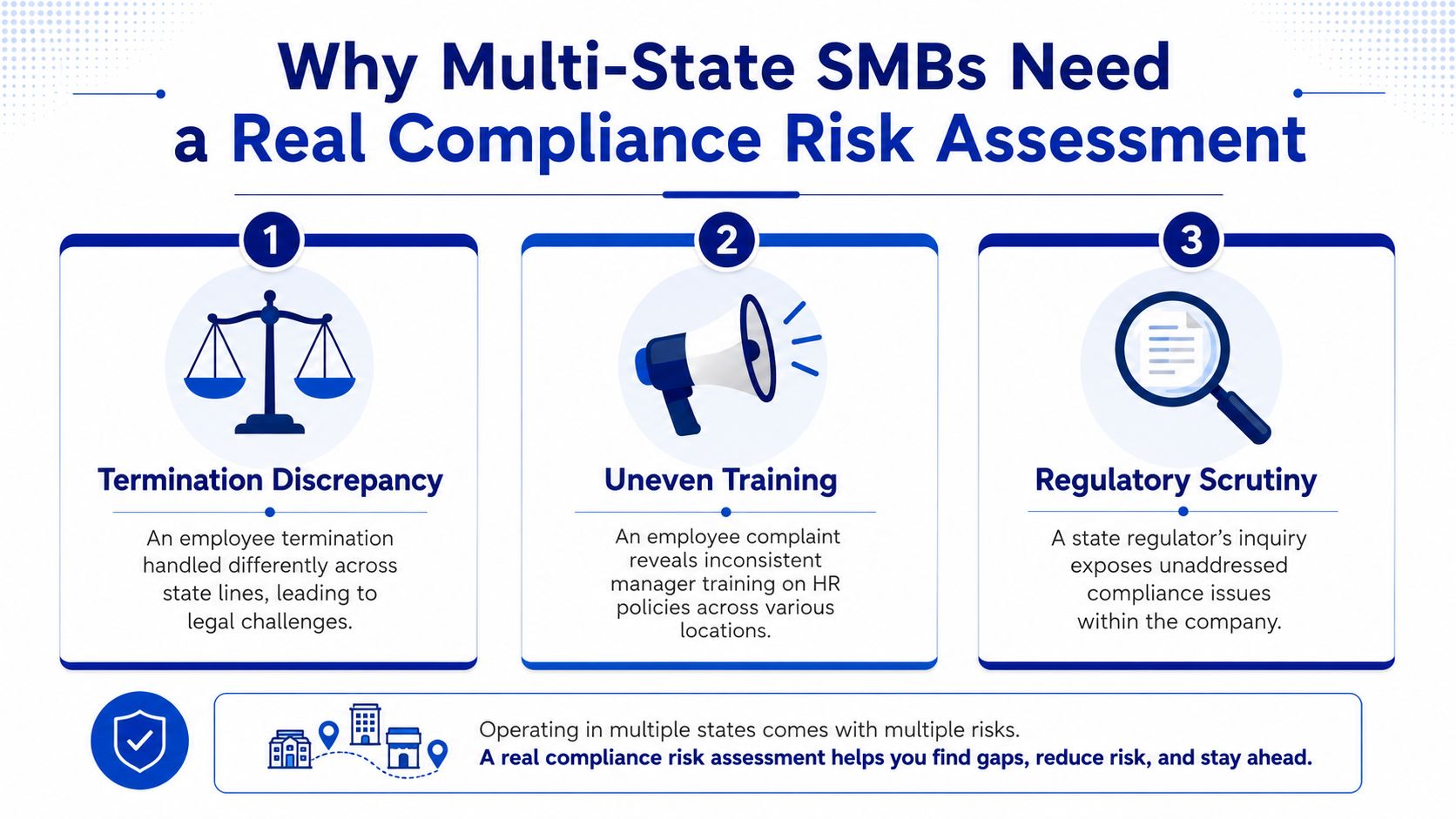
The termination felt straightforward until it crossed state lines. One manager handled it one way in Texas, another would have handled it differently in California, and the founder only realized the gap after an employee complaint pulled HR into a mess that should never have reached that point. That's the core job of a compliance risk assessment, it turns those scattered judgment calls into a documented process leaders can defend.
For multi-state SMBs, this is not paperwork for its own sake. It's the difference between guessing and making decisions with a record that shows who reviewed the facts, what controls existed, and where the risk sat before the company acted.
A remote team with people in Texas, California, and New York can look simple on a spreadsheet and messy in practice. The payroll setup may be clean, but the people decisions are rarely clean. One manager escalates concerns early, another skips HR review, and a third applies a local rule they only half understand.
That gap shows up fast in termination calls, complaint intake, manager misconduct, and leave decisions. A real compliance risk assessment gives leaders a documented way to decide who reviews the facts, what control failed, and what action the company can defend if someone later asks why it acted the way it did. For a plain-language explanation of what regulatory compliance risk means in practice, use the concept before the crisis forces the issue.
One reason this matters is cost. Secureframe's compliance statistics summary shows that breach incidents with a noncompliance factor cost an average of $4.61 million overall in 2025, and they cost $174,000 more on average than breaches without that factor. Secureframe's compliance statistics summary makes the financial point plain, weak controls are expensive.
Structured review is already normal in stronger compliance programs. White & Case's 2023 global anti-corruption benchmarking survey found that 79% of respondents said they conduct documented anti-corruption risk assessments, and 48% do them annually or more often. White & Case's 2023 global anti-corruption benchmarking survey also found that 18% of companies with fewer than 10,000 employees did not conduct an anti-corruption risk assessment and did not plan to do one. That is the middle-market problem in one line, too many companies still rely on instinct where they need a record.
Third parties matter too. The same survey said 59% of respondents identified third parties as their most significant corruption risk, which is a reminder that a company's exposure does not stop at its own payroll. Multi-state SMBs cannot treat compliance as an internal-only issue.
Practical rule: if a people decision would be hard to explain to a state investigator, it needed a documented review before anyone acted.
A useful external companion to this topic is Lighthouse Consultants' risk guide, especially if you want a broader management lens on risk discipline.
Start with where people work, not where the company is incorporated. A good scope statement names the jurisdictions, the functions, and the risk categories you're reviewing, then says what's out of scope and why. If you skip that step, the assessment balloons into a generic exercise nobody can finish or trust.
Map the federal baseline, then layer in the state and city rules that apply to each employee location. Add the internal policies, offer letters, handbooks, contractor agreements, and any manager scripts that shape day-to-day decisions. For a multi-state employer, that usually means looking at HR, wage and hour, leaves, contractor classification, and data privacy as separate risk buckets, not one blended category.
A defensible scope reads like this:
The point is not to be exhaustive. The point is to be clear enough that an attorney, board member, or outside advisor can validate the boundaries in a few minutes.
If a company has no workers in a state, don't include that state just because someone might move there later. If a policy exists on paper but managers never use it, include the operating gap, not the policy as if it were effective. That's especially important for remote teams, where location can shift and policy enforcement can drift. This overview of remote worker compliance across multiple states is useful context if your team is juggling home-office employees in more than one jurisdiction.
A one-page scope memo is enough if it tells the truth about the business. A bloated scope memo usually hides uncertainty.
One more practical standard matters here. If the scope can't be summarized in plain language, it's probably not ready for a leadership review. The best SMB assessments stay narrow enough to complete and broad enough to matter.
Once the scope is set, stop talking in abstractions. Ask what could go wrong in this business, with these managers, in these states. That shift matters because a compliance risk assessment only works when it reflects how the company behaves, not how the handbook says it should behave.
Start with the facts sitting in the business already. Pull from four places before you score anything:
If the same complaint pattern shows up twice, or a manager describes a shortcut that bypasses HR review, that is the failure scenario. Build the assessment from those moments, because they show where the process breaks.
Document each scenario in three lines:
That format keeps the review usable. A California manager who moves straight to termination after a performance issue, skips HR review, and treats a remote employee as a purely internal matter is not posing an abstract legal question. That manager is creating an operational breakdown, and it usually surfaces in the complaint file, the termination notes, or the exit interview.
Keep the line between HR and the wider compliance environment clear.
Third-party conduct, corruption exposure, and vendor behavior can sit close enough to people risk that they belong in the assessment. White & Case's survey found third parties were the most significant corruption risk for 59% of respondents, which is why multi-entity businesses should keep that exposure visible while they evaluate people-related failures. White & Case
For a practical companion view on HR risk inputs, Benely's piece on mitigating HR compliance issues is a useful read. It follows the same operating logic. Look at what people do, then compare it with what the policy says should happen.
The most workable model for SMBs is still the simplest one. Score likelihood from 1 to 5, score impact from 1 to 5, multiply them, then adjust the result based on how well the current controls work. That gives you a semi-quantitative score leaders can review without pretending the business runs on pure math.
Inherent risk is the exposure before controls do anything. Residual risk is what remains after you evaluate preventive and detective controls. That difference matters because a high-risk scenario with strong controls may not need urgent remediation, while a lower-scored issue with weak controls can still deserve immediate attention.
| Sample Risk Heatmap for an SMB Assessment | Low Impact 1 to 2 | Moderate Impact 3 | High Impact 4 to 5 |
|---|---|---|---|
| Likelihood 1 to 2 | Low | Low to Moderate | Moderate |
| Likelihood 3 | Low to Moderate | Moderate | High |
| Likelihood 4 to 5 | Moderate | High | Critical |
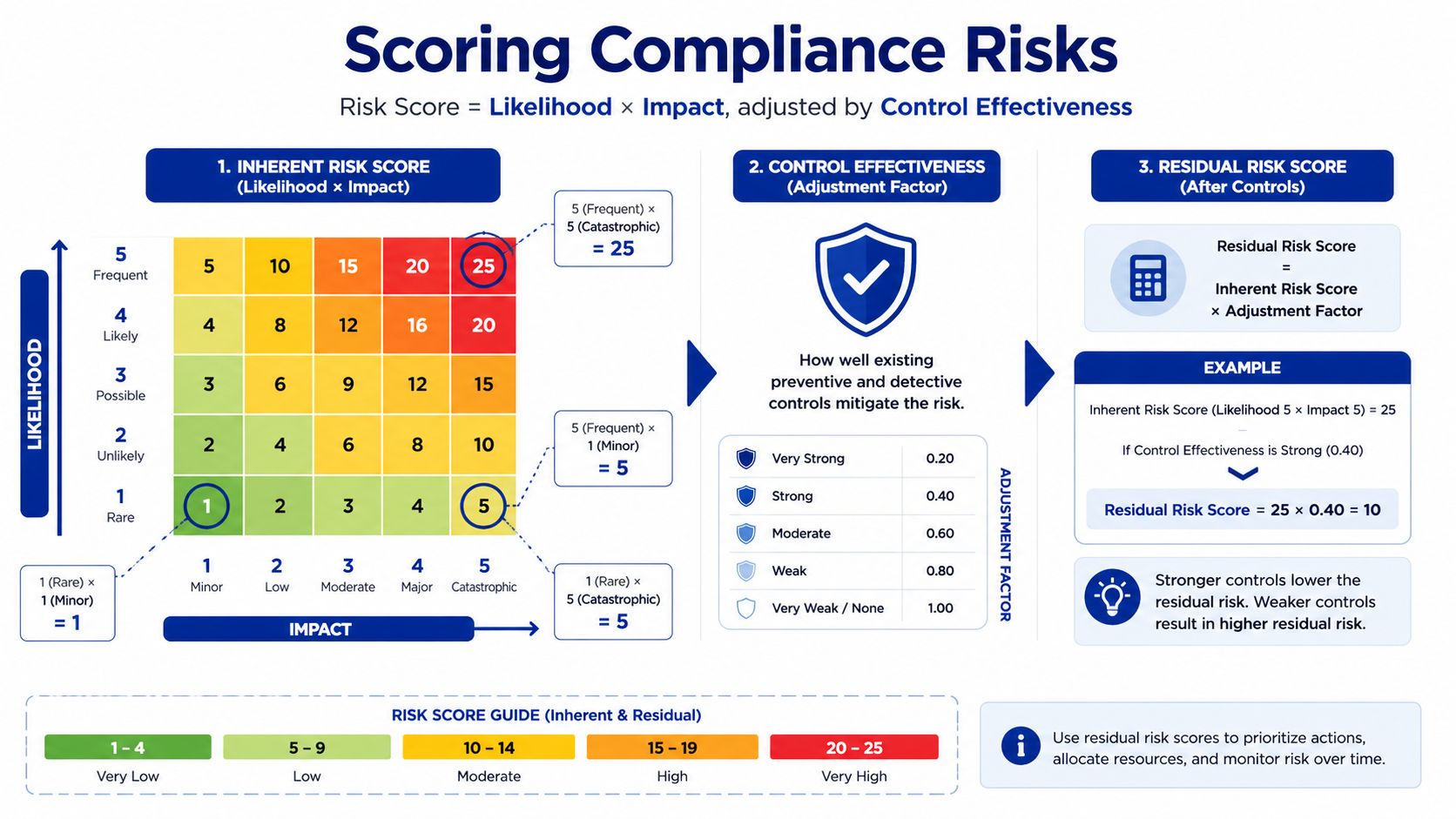
The scoring model only works if you're honest about control design and operating effectiveness. A policy that exists but nobody uses is not a strong control. A manager script that isn't followed is not a real safeguard.
The common failure points are predictable:
Euronext's risk methodology guidance also points to evidence from incidents, hotline reports, audit findings, and regulator feedback, because those sources catch repeat patterns that annual reviews miss. Euronext's compliance risk assessment methodologies is useful here because it reinforces the same basic discipline, look at evidence, score consistently, and adjust for controls.
The first score is not the answer. It's the starting point for a harder question, what still needs to change before the company can defend the decision?
A residual risk register is where the assessment becomes usable. It ranks what's left after controls are considered, assigns an owner, sets the next action, and shows when the issue should escalate. Without that register, the assessment turns into a memo nobody uses when the next hard decision lands.
A one-page register is usually enough for a lean leadership team. The columns that matter are simple:
That format forces discipline. It stops the team from treating every issue as a crisis and makes room for a practical distinction between what the company can absorb and what needs leadership or outside counsel.
A higher score doesn't automatically mean the issue is urgent this week. A termination process gap that affects only one workflow might be less urgent than a lower-scored issue that sits inside a repeatable manager behavior pattern. The essential question is whether the risk can create a bad decision in the next month, not whether it looks scary in a spreadsheet.
For example, if a discipline gap in one state could lead to inconsistent termination handling, the register should name the HR owner, the review step that failed, and the escalation route if the case involves protected leave, a complaint, or potential retaliation. That's the kind of issue that belongs on leadership's radar. It does not belong in the same bucket as low-impact clean-up items.
A practical rule helps here.
If a risk item can be fixed by changing one manager habit, assign it to the person who owns that habit. If it requires policy rewrite, training, and leadership sign-off, treat it as a cross-functional item.
The best register fits the business, not the other way around. A 40-row spreadsheet nobody opens is worse than a short list with real owners and real deadlines.
A remediation plan should read like a work order, not a philosophy document. Name the owner, the action, the deadline, and the proof that shows completion. If you can't tell whether the fix happened, the risk assessment hasn't closed the loop.
Policy updates are fast to draft and slow to matter. Operating changes are slower to build, but they're what change behavior. If the risk came from a manager bypassing HR review, rewriting the handbook won't fix it by itself. The manager needs a new script, a new approval path, and a clear consequence if they skip both.
Lean teams usually get the most traction from a small set of moves:
Each one should have a completion artifact. That can be a revised template, a training deck, a sign-off from leadership, or a dated review note showing the new process went live.
Documentation should be dated, owned, and traceable. Keep the assessment record, the source documents, the names of participants, and the sign-off showing who approved the action. If the issue later becomes part of an investigation or audit, the file should show the logic from risk identification through remediation, not just a final conclusion.
Incident logs, manager interview notes, and investigation files should also stay on a consistent retention schedule. Not every case becomes important, but the cases that seemed minor often become the ones people ask about later. That's also where basic legal-hold awareness matters. If a matter might turn into litigation, preserve the relevant records instead of cleaning them out on a routine schedule.
International Inc. is one option for SMBs that need support with workplace investigations, documentation standards, manager conduct, and HR risk decisions. The value there isn't volume, it's having a decision partner when a people issue stops being routine and starts carrying legal exposure.
A strong plan shows what the company changed, what evidence proves it changed, and what risk score gets updated after the change. That makes the assessment repeatable instead of theatrical. It also makes the next round faster, because the team isn't rebuilding the same argument from scratch.
Annual-only review cycles miss the moments that create real exposure. A new state opening, a leadership change, a merger, a regulator inquiry, or a complaint that reveals a pattern should all trigger a fresh look. If the business waits for the calendar, it's already late.
A workable rhythm is simple:
That cadence keeps the loop closed without creating a compliance department no one can staff. It also forces the team to use the same evidence sources it used at the start, which keeps the review grounded in operations instead of opinions.
The broader logic is consistent with continuous monitoring guidance, and a previous internal note on continuous compliance monitoring fits well here. For Washington-based employers, By Design Law Firm & Legal Consultancy, PLLC has a compliance program for Washington companies that can help anchor the local side of the discussion.
One person should own the register. One leader should receive the report. One escalation path should be obvious when a risk crosses the tolerance threshold. If everyone owns it, no one does.
That's the difference between a lightweight framework and a decorative one. The first keeps pace with the business. The second gets pulled out when someone asks for a document, then forgotten again the next day.
International Inc. helps SMB leadership teams handle high-stakes people decisions with structure, documentation, and defensible judgment. If you need support turning a compliance risk assessment into practical HR action across states, visit Paradigm International Inc. to learn how they work with owners, operators, and executive teams.