
A vendor is missing service levels. An executive with a written agreement is no longer a fit. A clinical contractor has created risk, but the business still needs continuity on Monday morning. In each of those moments, the problem usually isn't just whether you can end the relationship. It's whether the contract gives you a clear, defensible way to do it without creating a second problem around pay, notice, access, records, or transition.
That's why a contract termination clause matters. It isn't boilerplate. It's a practical control point that tells both sides what happens when performance drops, trust breaks, or business priorities change. If the clause is vague, the dispute shifts from the underlying issue to the exit process itself.
For SMBs, the stakes are often higher than people expect. Many leaders are used to the flexibility of at-will employment, but a written contract changes that analysis. Once you commit terms on duration, notice, cause, severance, or post-employment obligations, you need the ending to be drafted as carefully as the beginning. If you need a quick refresher on how contracts alter the employment relationship, this overview of employment contracts is a useful starting point.
A strong termination clause does one thing well. It replaces uncertainty with process.
Historically, that mattered because ongoing contracts without an express end mechanism could be governed by vague “reasonable notice” rules instead of a clean contractual exit. In commercial commentary, McMillan notes that continuing contracts were often presumed terminable only on reasonable notice, and for dependent business relationships courts could require substantial notice. The paper gives a concrete example of 12 months' notice for a 5-year distributorship in some circumstances, which is exactly the kind of uncertainty most SMBs can't absorb across multiple jurisdictions. McMillan's guidance is direct that ongoing business contracts should include clear termination provisions rather than relying on implied rules in law, as discussed in McMillan's termination clauses commentary.
That history still shows up in modern drafting. When the clause is weak, leaders end up arguing over timing, documentation, and who owes what after the relationship ends. When the clause is strong, they follow a sequence already agreed to in writing.
Clear termination language doesn't eliminate conflict. It limits where the conflict can go.
In practice, that's the difference between a manageable separation and an operational scramble. The best clauses define the trigger, the notice method, the cure path if one exists, and the obligations that survive the end of the deal.
Most business owners don't need a legal lecture on termination. They need to know what the clause is doing for them in real life.
It sets the rules for how the relationship ends. That includes who can terminate, for what reason, with what notice, after what documentation, and with what follow-up responsibilities. In regulated or multi-state settings, that structure matters because a loose exit can affect payroll, benefits, vendor continuity, patient or customer handoffs, system access, and record retention all at once.
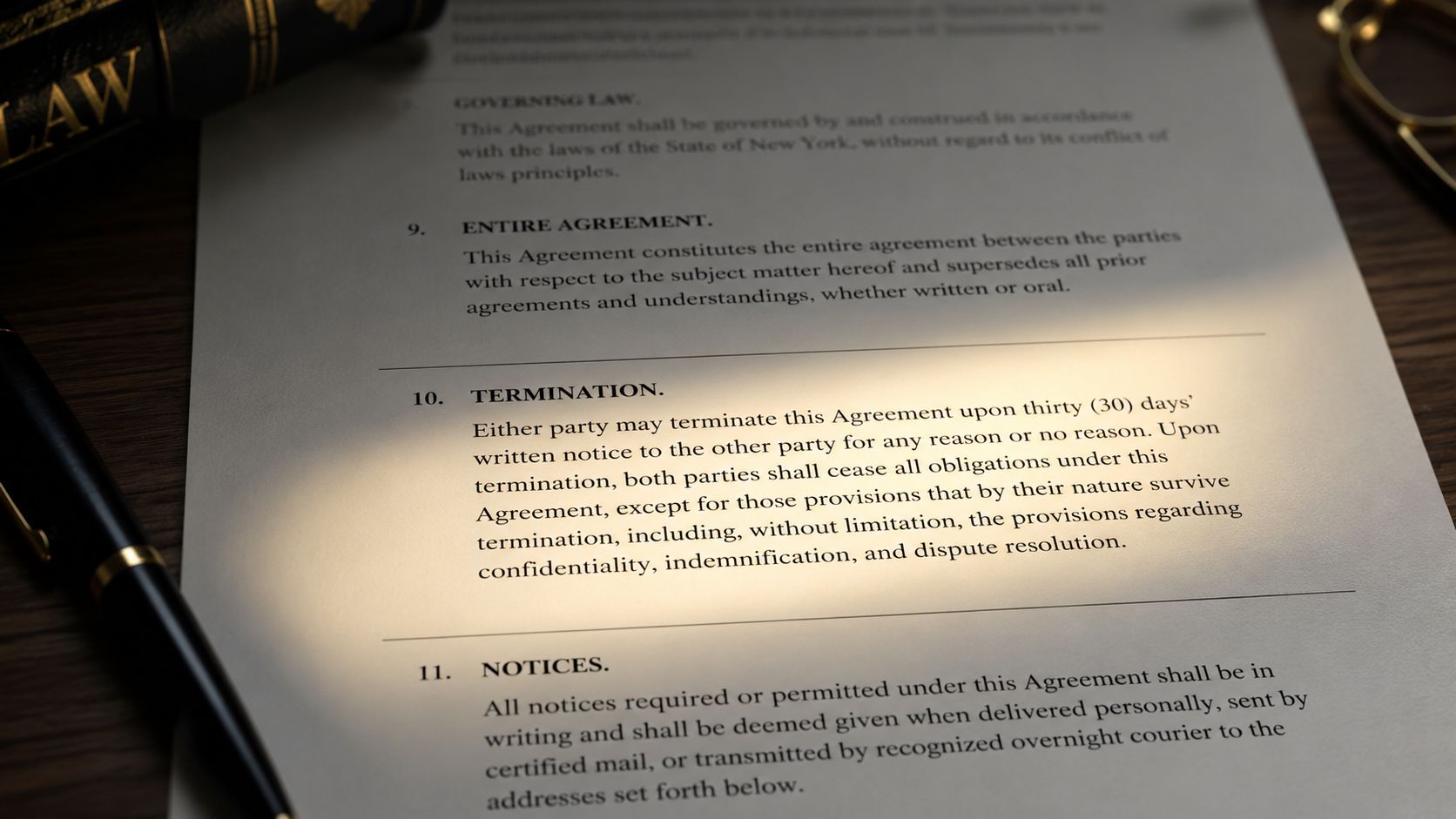
At-will employment gives employers and employees broad flexibility to end the relationship, subject to legal limits. A contract narrows that flexibility because the parties have agreed in advance to specific terms. If you want a practical comparison, this explanation of the employment at-will doctrine helps frame why termination language becomes so important once you move into written agreements.
That's why a contract termination clause example should never be copied blindly from a template site. The question isn't whether the wording sounds formal. The question is whether it matches the business reality you'll face when the relationship has to end under pressure.
A defensible structure usually separates termination for cause from termination for convenience.
A cause-based right is tied to something measurable, such as a material breach, failure to maintain required credentials, or another serious default. A convenience right allows termination without alleging fault, but usually only after a defined notice period. In a Virginia provider agreement sample, termination without cause used 60 days' written notice, while a material breach required a 30-day cure period, with immediate termination triggers for issues such as licensure failure, missing liability insurance, or government findings of fraud, waste, or abuse, as shown in the Virginia termination clause sample.
That split works because it reflects two different business needs:
Value is predictability.
Without a clear clause, parties often fight about whether the issue was serious enough, whether enough notice was given, and whether there was a fair chance to fix the problem. With a clear clause, the contract itself answers those questions before the dispute starts.
Most contracts use two main exit paths. Both can be valid. Both can also create problems if they're drafted without operational context.
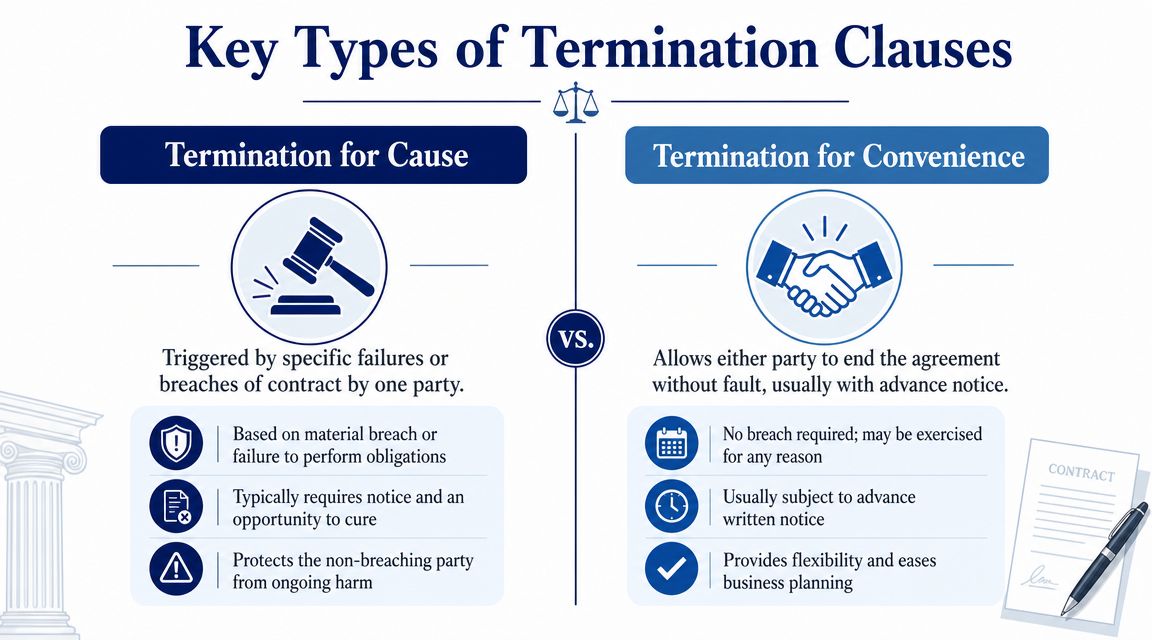
A for-cause clause is triggered by a defined failure. That might be a material breach, repeated nonperformance, failure to maintain licensure, loss of required insurance, fraud, or another event the parties agree is serious enough to justify termination.
This structure works best when the clause uses objective language. “Unsatisfactory performance” by itself is often too loose. “Failure to meet stated reporting obligations after written notice” is much stronger because the facts are easier to document.
Practical rule: If you can't explain to a manager what “cause” means without opening a debate, the clause is probably underdefined.
Here is a simple employment-oriented example:
Employee agreement example
The Company may terminate this Agreement for Cause upon written notice if Executive materially breaches this Agreement, engages in fraud, or fails to maintain any license required for the position. If the breach is capable of cure, Executive will have 30 days after written notice to cure the breach. If the breach isn't cured within that period, termination will become effective immediately.Why this works: “Materially breaches” limits the clause to serious failures. “Written notice” creates a record. The cure language prevents a fight over whether the employee had a fair chance to correct the issue.
A convenience clause allows one or both parties to exit without proving breach. Business owners often like this because it feels flexible. Sometimes it is. Sometimes it also creates instability if transition obligations are missing.
A common structure allows termination without cause on advance written notice. In the same Virginia sample discussed earlier, that period was 60 days' written notice for termination without cause, while more serious for-cause events followed a different path.
Here is a vendor-facing example:
Vendor agreement example
Either party may terminate this Agreement without cause upon 60 days’ written notice to the other party. During the notice period, Vendor will continue to perform the Services, cooperate in transition activities reasonably requested by Company, and return or securely delete Company data as required by the Agreement.Why this works: The notice period protects continuity. The transition language prevents the vendor from treating notice as a shutdown date. The data language addresses one of the most common operational gaps in modern service contracts.
The answer is often both, but not always with equal weight.
A senior executive agreement may need a narrow cause definition and tightly controlled notice language. A services agreement may need both cause and convenience rights because the business can't stay locked into poor performance, but also can't tolerate a chaotic exit. If you're comparing approaches for ending agreements, Greiner Law Corp on canceling agreements is a useful practical reference on how termination rights and cancellation mechanics differ in practice.
A workable contract termination clause example balances these realities:
| Clause type | Best use | Main risk if drafted poorly |
|---|---|---|
| For cause | Performance failure, misconduct, regulatory issues | Cause is too vague to enforce cleanly |
| For convenience | Strategic exit, repricing, business change | Relationship can end abruptly without transition support |
| Immediate termination trigger | Fraud, loss of licensure, serious compliance failure | Trigger list is incomplete or inconsistent with the business risk |
The mistake I see most often is not including the wrong type. It's assuming the trigger is the whole clause. It isn't. The mechanics after the trigger are where disputes usually start.
A termination clause usually gets tested on a bad day. A vendor misses a regulatory deadline in one state, an executive disputes the stated reason for separation, or a managed service provider loses access credentials but still has copies of sensitive files. In each case, the business does not need a prettier template. It needs language that can be enforced, documented, and carried out by HR, operations, finance, and IT without confusion.
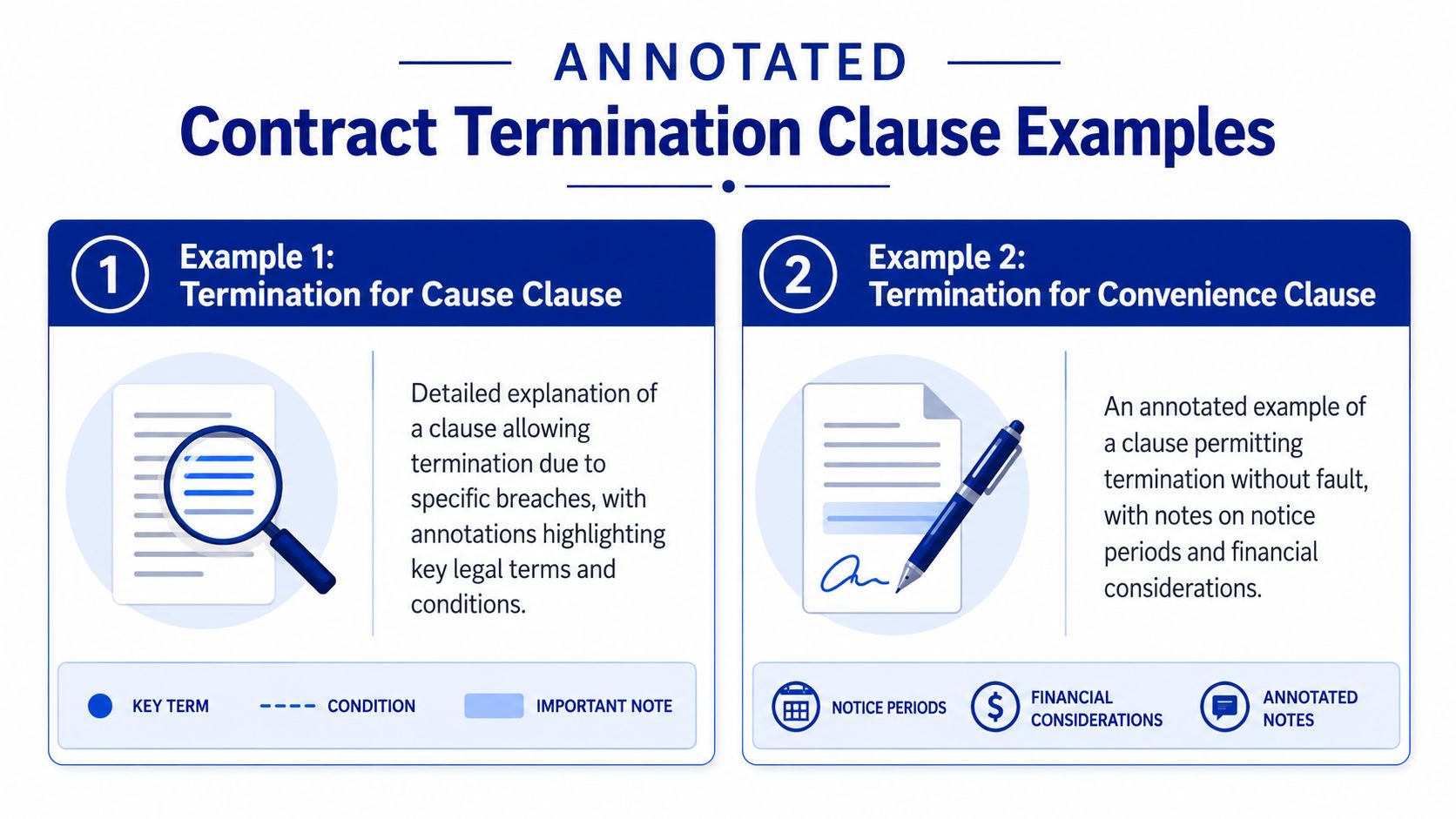
Notice language is where many disputes start. If the clause does not identify the delivery method, effective date, and authorized recipient, the parties end up arguing about process instead of breach.
Here is an executive employment example with practical annotation:
Example 1, executive agreement
Employer may terminate Executive's employment for Cause upon written notice specifying the grounds for termination. If the stated grounds are capable of cure, Executive will have 14 days from receipt of notice to cure the breach. Employer may terminate this Agreement without Cause upon written notice, subject to any payment obligations separately stated in this Agreement.Annotation: “Specifying the grounds” creates a record the company can defend later. The 14-day cure period fits issues that can be corrected quickly, such as a reporting failure or policy breach that does not require immediate removal. Separating the termination right from the payment consequences also helps payroll, HR, and counsel administer the exit without rewriting the reason for termination after the fact.
For SMBs operating across state lines, that precision matters even more. Notice language should align with the company's actual approval chain and communication controls. If HR sends the notice but the contract requires delivery only to a registered office, the business may have a valid complaint and still lose time arguing over whether termination was effective.
A cure provision should match the risk. Some failures can be corrected. Others should trigger immediate exit because delay creates compliance exposure, customer harm, or security risk.
A legal education primer notes that right-to-cure language is commonly framed as a remediation window, with sample discussions that include written notice before termination and a shorter cure period for breaches that can be remedied, as described in this termination clause primer video.
Use the cure period to separate fixable performance problems from failures that cannot be tolerated. Late reporting, service-level misses, and incomplete invoicing may justify a short correction window. Fraud, loss of licensure, data misuse, or exclusion from a government program usually belong in the immediate-termination category.
A vendor clause often needs more operational detail than an employment clause:
Example 2, master services agreement
Company may terminate this Agreement for material breach by Vendor upon written notice describing the breach in reasonable detail. Vendor will have 30 days after receipt of such notice to cure the breach, except where the breach is not capable of cure. Upon termination or expiration, Vendor will promptly cease use of Company systems, return Company property, and provide available cooperation reasonably necessary to transition the Services.Annotation: “Reasonable detail” strengthens the file if the vendor later claims the notice was too vague to act on. The cure window gives the company a measured path for ordinary service failures while preserving immediate termination for conduct that creates legal or operational exposure. The post-termination sentence does real risk-control work. It addresses system access, asset return, and transition support before those issues can be used as bargaining chips.
That last point is where generic forms usually fall short. In regulated or multi-state operations, the termination clause has to reflect who shuts off credentials, who confirms data return, and who signs off that the handoff is complete.
The strongest examples treat termination as an operating event, not just a legal right on paper.
Construction, staffing, software, and executive agreements all raise different exit risks. In owner-contractor language commonly used in practice, termination for cause often ties the defaulting party to added completion costs if the work must be finished by someone else. Termination for convenience usually follows a different payment rule, covering approved work performed and certain incurred costs up to the termination date. That distinction prevents a common dispute. Parties should not be using the same payment logic for a fault-based exit and a business-choice exit.
For SMBs, especially those in healthcare, financial services, manufacturing, education, or government contracting, these are the provisions that deserve close review:
These details are where a defensible clause earns its keep. A contract termination clause example should show how the business exits cleanly, preserves evidence, limits service disruption, and reduces the chance that a routine dispute turns into a claim.
The trigger gets most of the attention. The mechanics usually determine whether the clause is usable.
A right-to-cure provision is a common feature, typically giving the breaching party a 10- to 30-day window to correct the issue before termination can take effect. That kind of structure turns a dispute into a documented process with a clear timeline, as described in the legal education primer noted earlier. In operational terms, that means fewer arguments about surprise, fairness, and whether someone had a real opportunity to fix the problem.
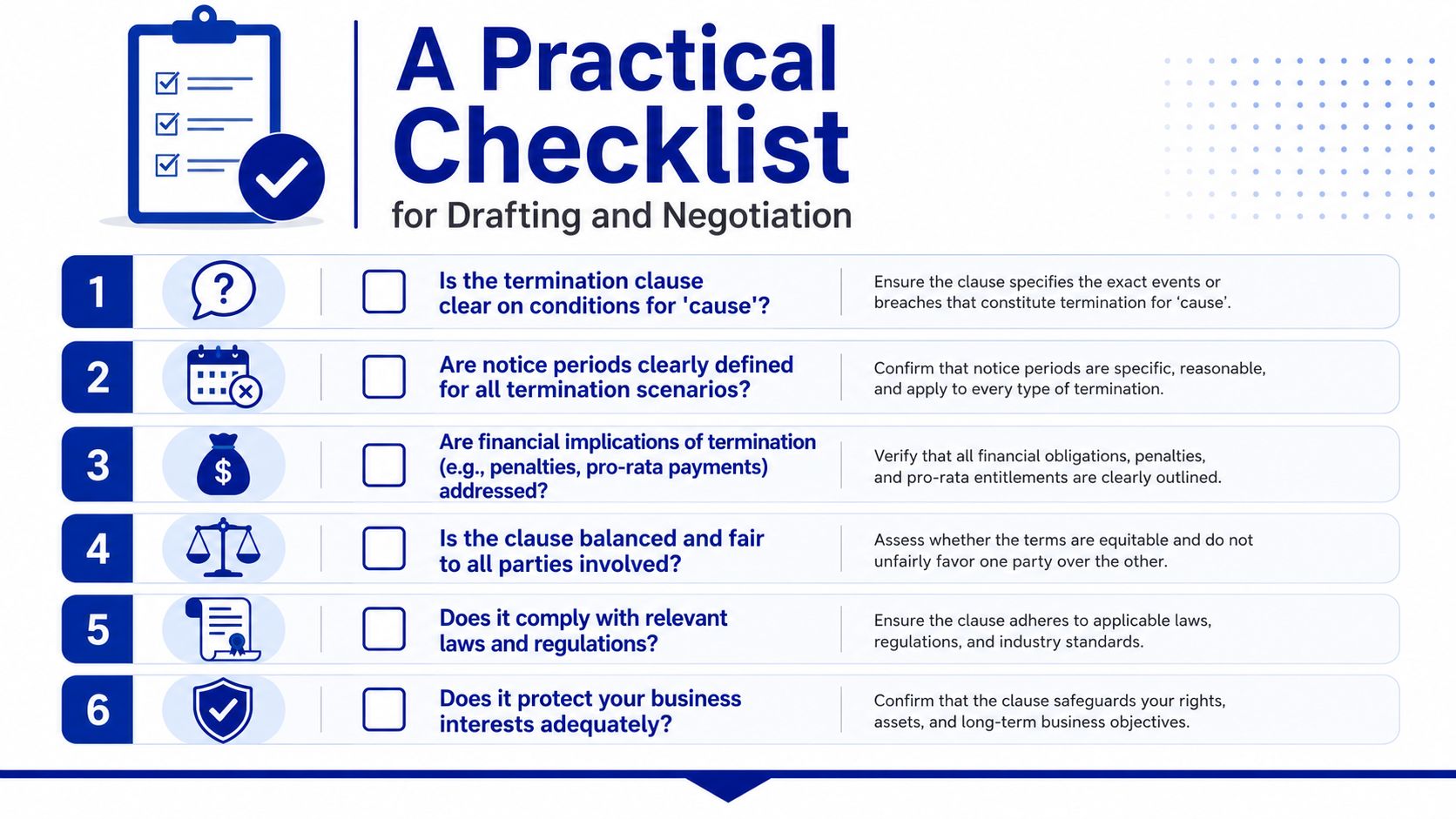
Before you approve a contract, check whether the termination section answers these practical questions:
Many owners push for broad convenience rights because they want room to maneuver. That instinct is understandable. It's not always the safest choice.
If the other party can also walk away easily, your business may lose a key vendor, specialist, or service line during a sensitive period. If the clause doesn't require cooperation during transition, the notice period may not protect you. The best drafting balances exit flexibility with continuity obligations.
The safest clause usually isn't the broadest one. It's the one your team can enforce without guessing what happens next.
Generic language often misses the operational details that matter in multi-state or regulated environments. A healthcare practice, professional firm, or distributed employer may need language around licensure, insurance, records, handoffs, and secure data return that a general business template won't cover.
That's why the strongest clauses are built backward from real failure points. Start with the messy ending. Then draft the contract so the ending is controlled.
A business owner signs a vendor or employment agreement on Friday, then needs to end it six months later during a compliance issue, service failure, or leadership change. That is when weak termination language stops being a legal drafting problem and becomes an operating problem. The clause has to tell managers what to do, in what order, on what timeline, and with what record of the decision.
Does this contract change an at-will relationship?
If the agreement involves an employee and includes a fixed term, a defined cause standard, severance obligations, or mandatory notice, it may limit the flexibility the business would otherwise have. That should be a deliberate decision tied to hiring risk, retention goals, or a negotiated concession.
Will the clause work in real operations, not just on paper?
A defensible clause uses objective triggers, a clear notice method, and steps your team can carry out. If HR, finance, IT, or line management would have to guess how to issue notice, document breach, suspend access, or close out pay, the drafting is incomplete.
Have state and industry rules been checked where the work is being performed?
This matters more for SMBs operating across states or in regulated settings. Professional licensing rules, patient or customer record obligations, wage payment timing, data handling requirements, and limits on restrictive covenants can all affect how a termination clause should be written and negotiated.
Use this list before final approval, and again before renewal or amendment:
I have seen otherwise workable clauses fail because the legal trigger was clear but the internal process was not. No one knew who sent notice, who approved the final payment position, or who owned the handoff with IT and operations. In a multi-state business, those gaps create extra risk fast.
For organizations that need structured HR risk support around high-stakes exits, International Inc. works with SMB leadership teams on defensible documentation, manager guidance, and separation planning in more complex employment environments.
A termination clause isn't just an exit right. It's a business continuity tool.
The strongest clauses define the trigger, the notice path, the cure process when appropriate, and the duties that continue after termination. That's what keeps a contract dispute from turning into an access issue, a payroll issue, a customer issue, or a compliance issue.
This area is also changing. Contracts increasingly have to address data handling, vendor concentration, and faster renegotiation cycles, not just classic breach language. If you're evaluating how technology fits into legal workflow and drafting support, this guide to AI use cases in law is a useful read. The key is using tools to improve review and consistency, not to replace judgment about risk.
If your company operates across states, relies on regulated services, or uses key-person and vendor agreements that can't fail messily, termination language deserves deliberate review. The clause should work on the day the relationship is strongest and on the day it needs to end.
If your team is reviewing executive agreements, vendor contracts, or other high-risk arrangements, Paradigm International Inc. can help you build a more defensible approach to contract-related HR and operational risk.