
Ending a professional relationship with an independent contractor can be a sensitive process. When it's time to part ways, the contractor termination letter is more than just a formality—it's a critical legal document that can either protect your business or expose it to significant risk. A poorly written letter can quickly escalate a simple contract ending into a costly legal dispute.
Unlike terminating an employee, ending a contractor relationship is governed entirely by the terms of the signed agreement. This is a business-to-business separation, and the letter serves as your official record. Getting the details right is essential for a clean, professional, and low-risk separation.
Think of the contractor termination letter as the final, official word on your business relationship. It formalizes the decision, sets a clear end date, and connects the action directly to the terms of your contract. This isn't like at-will employment, where you can often terminate without cause. With contractors, the agreement you both signed is the ultimate authority.
If you don't follow the rules laid out in your contract, you open the door to disputes. The biggest risk is a legal challenge. If your termination letter is vague, emotional, or contradicts the contract's terms, it becomes Exhibit A in a potential lawsuit. Understanding what constitutes a breach of contract is crucial, as this is often the core issue.
Getting this wrong can lead to more than just a simple contract dispute. The language you choose must be precise, because a single misplaced phrase could invite a worker misclassification claim—an expensive and increasingly common headache for companies.
Here are the main risks you need to avoid:
You should treat every contractor termination letter as a risk management tool. Its job is to close the door on the business relationship cleanly, leaving no gray areas that could be challenged later.
Ultimately, this document is your primary line of defense. It shows you acted professionally and followed your contractual obligations. Treating it like a simple form letter is a gamble with serious financial consequences.
Before writing a contractor termination letter, the most critical work happens. The strength of your termination depends on the groundwork you lay now. Your first and most important step is to review the original contractor agreement carefully. This document is your rulebook and dictates every move you can legally make.
Your main goal is to find the termination clause. This section lays out the specific conditions for ending the relationship. Think of it as the playbook you must follow exactly to avoid an immediate and costly breach of contract claim.
Not all termination clauses are created equal, so you must know which one applies to your situation. Contracts generally allow for two ways to part ways: for convenience or for cause.
Next, find the notice period. The contract will specify how much warning you must give—it could be seven days, 30 days, or more. Ignoring this timeline is a common and costly mistake. Finally, look for a "cure period," which gives the contractor time to fix the problem before you can officially terminate.
If you’re terminating for cause, documentation is everything. This is not the time for vague complaints. You need a clean, objective paper trail that proves the contractor failed to meet their obligations.
A contractor termination letter without supporting evidence is just an opinion. A letter backed by a well-organized paper trail is a defensible business decision.
Your evidence file needs to be concrete. Start gathering items like:
This documentation proves the termination is based on a contractual failure, not just personal dissatisfaction. This simple chart shows how quickly a contractual slip-up can escalate.
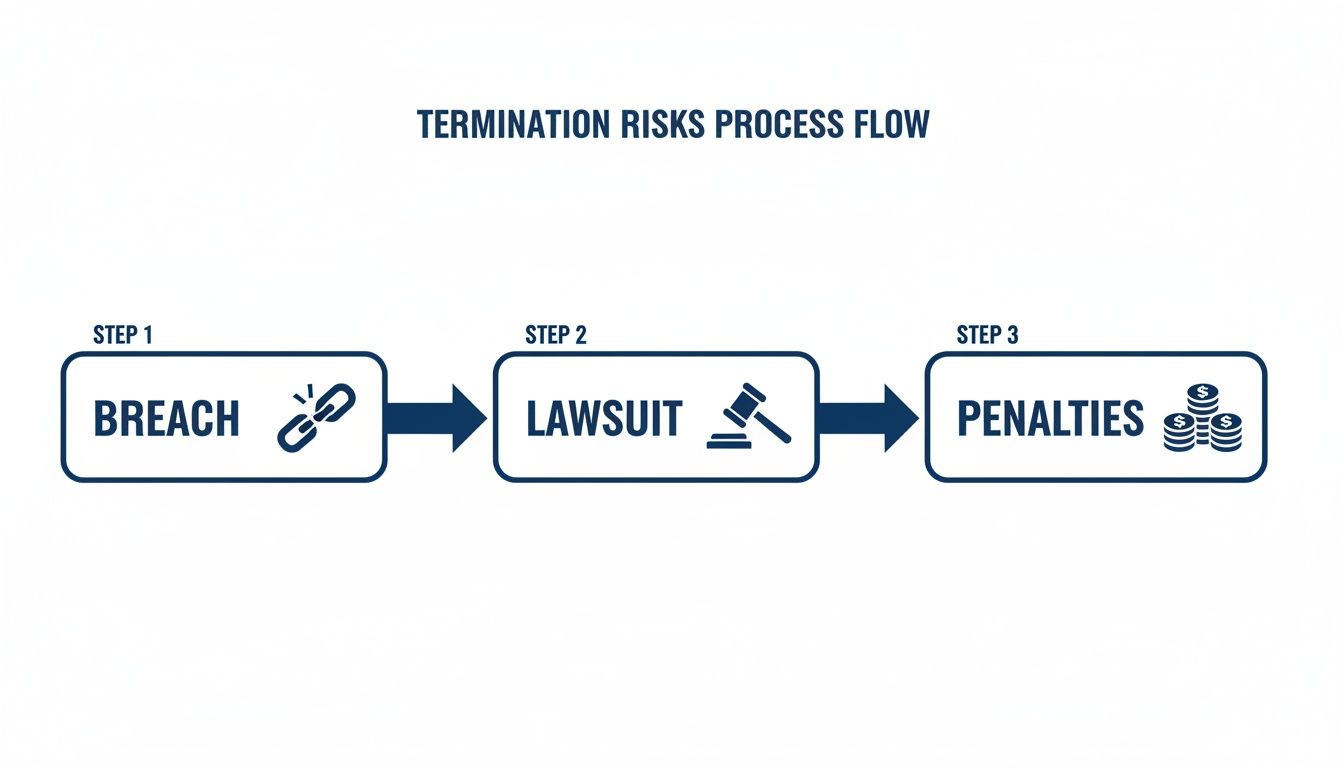
Failing to follow the contract is a direct line to legal challenges and expensive penalties.
One last, crucial check: review how you've worked with the contractor. The words you use in communications, and especially in the termination letter, can accidentally create misclassification risk. This happens when your actions make the relationship look more like an employer-employee dynamic.
Be very careful with your language. Avoid words like "performance review," "disciplinary action," or "warning," which are employee terms. Instead, frame the issue around the contractor's failure to meet the "terms of the agreement" or "contractual obligations." It’s a subtle but legally massive distinction. For a deeper dive, learn more about employee vs. contractor classification.
Completing these checks before drafting the letter ensures your actions align with your contractual rights and helps you sidestep unnecessary legal headaches.
A well-crafted contractor termination letter is precise and clear. It is not the place for lengthy explanations or subjective feelings. Its sole job is to formally and legally close a business relationship based on the terms of your contract.
Think of it as the final, official record of your agreement. Each section has a specific legal purpose, and when done right, the entire document becomes unambiguous, professional, and defensible. Let's break down how to build a letter that protects your organization.

The very first sentence needs to be direct and clear. State that the letter is a formal notice of termination for their independent contractor agreement. Any ambiguity here opens the door to confusion and potential disputes down the road.
Right after that statement, specify the exact effective date of the termination. This date is legally critical. It locks in the final day of service, the cutoff for payments, and the start of any post-termination obligations. For example, "This letter serves as formal notice that we are terminating our Independent Contractor Agreement, effective at 5:00 PM on October 31, 2024."
Here is where you build your legal defense. You must explicitly reference the specific clause of the contract that gives you the right to terminate. This is non-negotiable. It directly connects your action to the pre-agreed terms, proving you’re acting within your contractual authority.
A simple termination for convenience might state: "This termination is made in accordance with Section 8.2 of our agreement, which permits termination with 30 days' written notice."
When terminating "for cause," the approach is similar but requires more precision. You must connect the reason directly to a specific contractual breach.
This factual approach grounds the termination in objective evidence.
By rooting every statement in the contract, you transform the letter from a simple notification into a legal instrument. It confirms you are not acting arbitrarily but are instead enforcing the mutual agreement both parties signed.
This table breaks down the mandatory and recommended clauses to include for legal defensibility. Getting these right is key to a smooth and low-risk separation.
Including these elements creates a comprehensive record that leaves little room for misinterpretation.
Once you've established the termination, the letter must shift to the practical steps for winding down the relationship. Uncertainty breeds conflict, so be as specific as possible.
Here are the key logistical points to cover:
A clear, well-structured contractor termination letter is an essential tool for risk management. For a more detailed breakdown, we have compiled additional resources on termination letter requirements.
Hiring contractors from different states or countries is a great way to grow, but it complicates your offboarding process. When it’s time to part ways, a one-size-fits-all termination letter is a recipe for a legal headache. What’s perfectly fine in your home state can cause problems just one border away.
The rules for notice periods, final payments, and valid reasons for termination can change dramatically between jurisdictions. A process that’s airtight in Texas might fall apart under California’s stricter contractor protection laws. Similarly, a standard U.S. template is unsuitable for a contractor in the United Kingdom or Canada.
Relying on a single termination template for all your contractors is a common and dangerous mistake. Every state and country has its own legal framework governing contracts. Assuming your local rules apply everywhere is the fastest way to face a legal dispute.
You’ll find major differences in a few key areas:
The rule of thumb is simple: your termination process has to follow the laws of the location where the contractor lives and works, not where your company is based. Getting this wrong can invalidate your termination letter.
So, how do you handle this? It comes down to doing your homework before you act. Researching local laws is a non-negotiable part of your pre-drafting checklist for anyone outside your immediate area.
International notice periods vary widely. For instance, some countries scale the notice period based on length of service. You can get more insights on how notice periods differ by country on Remote.com, but it’s clear that mishandling these rules is an easy way to trigger a claim.
To build a defensible process for your distributed team, assume every location is different. For U.S.-based contractors, a great first stop is the Department of Labor website for that specific state. For international contractors, check the official government labor sites for their country.
Your goal is to get clear answers to these critical questions:
This localized due diligence is essential for any business with a distributed workforce. It ensures your termination letter is a legally sound document that protects your company, no matter where your talent is.
A single misplaced word or an overly emotional phrase in a contractor termination letter can undermine all your careful preparation. To help you draft a document that is both professional and defensible, we’ll look at how to handle two common scenarios: termination for convenience and termination for cause.
It is just as important to know what to include as it is to know what not to include. The goal is always to be clear, factual, and strictly aligned with the contract.
A termination "for convenience" is typically the most straightforward scenario, but it still requires precision. This option is only available if your contract explicitly allows for it. The letter should be neutral, direct, and focused on logistics.
Here’s a simple structure you can adapt:
Key Takeaway: Notice the complete absence of emotion or subjective reasoning. The letter's strength comes from its direct reference to the contract and its focus on clear, actionable next steps. It confirms you are exercising a right you both agreed to.
Even with a template, it's easy to make mistakes that create unnecessary risk. These errors often come from an attempt to soften the blow or an impulse to vent frustration. Both can lead to serious legal and financial headaches.
The construction industry offers a useful parallel. A global review found that contractor terminations often fall into clear categories like financial issues or performance shortcomings. You can discover more insights about contractor termination causes and see how common these issues are across industries.
Here are the most common and damaging mistakes to avoid.
Using subjective critiques is one of the fastest ways to invite a dispute. Words like "disappointing," "unprofessional," or "poor attitude" are opinions, not facts, and have no place in a termination letter. They weaken your legal standing by making the termination seem personal.
The revised statement is powerful because it's objective and tied directly to the contract.
Failing to reference the specific contract clause that gives you the right to terminate is a massive error. Without that citation, your action can look arbitrary and may be considered a breach of contract itself. Your letter must show that you are acting within the agreed-upon rules.
The reason stated in your termination letter must match all other documentation. If your internal emails talk about missed deadlines but your letter mentions budget cuts, that discrepancy can be used to argue the stated reason is a pretext. Your entire paper trail needs to tell the same, factual story.
Terminating the contract doesn’t end all responsibilities. Most agreements have clauses—like confidentiality and non-solicitation—that stay in effect long after the work stops. Forgetting to remind the contractor of these "surviving obligations" is a missed opportunity to reinforce their legal duties.
Avoiding these common slip-ups is just as important as including the right clauses. Reviewing your draft with this checklist in mind helps you create a letter that is clear, defensible, and professional.
Sending the contractor termination letter is a major step, but it doesn't close the book on your responsibilities. A clean separation requires a structured follow-through to tie up loose ends and protect your business from future risk. This final action plan is what closes security gaps and creates a complete, defensible record.
The moments right after a contract ends are when logistical and security oversights are most likely to happen. Your immediate focus should be on securing your company’s assets, both digital and physical.

Your first priority is to immediately deactivate all access credentials. This is a non-negotiable security measure that should happen at the same time as the termination.
Keeping a detailed log of returned assets gives you a clean record showing that all company property has been accounted for.
Once security is handled, you can shift to final administrative tasks. Clear internal messaging prevents confusion and ensures a smoother transition for your team.
Properly managing the final steps of a contractor separation is not just good housekeeping; it’s a critical risk management function. An incomplete offboarding process leaves your business exposed to data breaches, property loss, and legal disputes.
Notify any internal team members who worked with the contractor and provide a clear plan for how their responsibilities will be handled. You might also consider conducting exit interviews to gather feedback that could improve how you work with contractors in the future.
Finally, process the last payment according to the contract and local laws. Securely store the termination letter and all related documentation. This complete file is your ultimate defense if questions arise later. Following meticulous post-termination procedures is essential. For a more detailed guide, you can use our complete termination checklist for employers.
When you're ending a contractor relationship, specific questions often arise. Even with a solid plan, unique situations require clear answers. Let's walk through some of the most frequent inquiries from business leaders and HR managers.
While a phone call may feel like a professional courtesy, it should never replace a formal, written contractor termination letter. A phone call is temporary and open to interpretation, but a written document creates an undisputed legal record of the termination date, reason, and next steps.
The letter is your primary evidence if a dispute ever arises. Always follow any verbal discussion with a formal letter sent through a trackable method, like certified mail or an email with a read receipt.
This is a critical distinction, and the answer lies entirely within your contract.
The notice periods and final payment obligations often differ for these two scenarios, so it is vital to know which one applies before you act.
If a contractor's reaction turns hostile after receiving the termination notice, your priority is to de-escalate. Remain calm and professional. Do not get drawn into an argument about the decision.
From that point on, keep all further communication brief, in writing, and focused only on the logistical steps outlined in the letter. Immediately revoke all system and building access to mitigate security risks. Document every interaction and consult your legal counsel if the situation escalates.
Navigating contractor separations requires precision and sound judgment. To learn more about how to manage employment risk and maintain defensible practices, our team is here to help. If you need support with complex terminations or multi-state compliance, contact us to learn how we can help.