
Navigating difficult economic conditions often forces business owners and HR leaders to make tough decisions about their workforce. Among the most common strategies are furloughs and layoffs, but these terms are not interchangeable. Understanding the fundamental difference between furlough and layoff is the first step toward making a sound, strategic choice that protects your business while treating your employees with respect. A furlough is a temporary pause, while a layoff is a permanent separation. This distinction carries significant legal, financial, and cultural consequences.
A furlough is a temporary, mandatory leave of absence where the employment relationship remains intact with the full expectation that the employee will return. Think of it as a pause button. In contrast, a layoff is a permanent termination of employment with no guaranteed return. It’s a full stop. Grasping this core difference is essential for making a strategic decision during challenging times.

When facing economic pressure, the choice you make has ripple effects across your entire organization. A furlough preserves your trained team, allowing you to reduce payroll costs immediately while planning for a future recall. It maintains a connection with your valuable employees.
A layoff severs that connection entirely. This permanent separation impacts the morale of your remaining staff and creates long-term costs associated with recruiting and training new talent later. This is not just an administrative task; it is a pivotal decision with distinct legal, financial, and cultural outcomes.
The choice between a furlough and a layoff has significant and lasting consequences for your people, your finances, and your ability to recover. The fundamental difference boils down to one simple question: Do you intend to bring the employee back? Your answer to this question determines everything else, from benefits administration and legal compliance to your long-term operational health.
Picking the right path means honestly assessing whether you are facing a short-term challenge or a long-term structural shift in your business. This is the fork in the road that will guide your strategy.
To help you see the differences at a glance, this table breaks down how these two actions compare across the most critical areas for any business. This provides a high-level overview, but the real impact lies in the details of how each action plays out financially, operationally, and legally.
| Attribute | Furlough | Layoff |
|---|---|---|
| Employment Status | Remains an employee on temporary, unpaid leave. | Employment is permanently terminated. |
| Intent to Recall | Yes, the expectation is a return to work. | No, the position may be permanently eliminated. |
| Pay | Pay stops during the furlough period. | Final paycheck is issued; no further pay. |
| Health Benefits | Can often be continued; requires planning for premium payments. | Benefits end; COBRA is the only option for continuation. |
| Final Paycheck | No final paycheck; pay resumes upon return. | Final paycheck includes all wages owed plus accrued PTO (per policy/state law). |
| Recall Process | Simple and fast; employees return to their roles. | Requires a full recruitment, hiring, and onboarding process. |
Choosing between these options requires a deeper look at how each one impacts your organization and your team. With a furlough, the individual is still legally your employee. The formal employer-employee relationship is preserved. In a layoff, that relationship is severed completely, and the person becomes a former employee.
This directly ties into the expected outcome. A furlough is defined by the expectation of return, used to weather a slowdown with the full intent to bring staff back. A layoff offers no such promise; the role itself might be gone for good.
Pay and benefits also diverge significantly. Furloughed employees stop receiving a salary but can often keep their health benefits, though you’ll need a clear plan for how premiums will be paid. Laid-off employees get a final paycheck, and their benefits stop. Their primary option for health coverage is COBRA, which is often prohibitively expensive.
From a cash flow perspective, a furlough gives you immediate relief from payroll expenses. The primary ongoing cost may be the employer’s share of health insurance premiums. A layoff cuts all labor costs—salary, benefits, and payroll taxes—but can trigger other expenses like severance packages and outplacement services.
Operationally, the difference is night and day. Recalling furloughed employees is fast, allowing your business to ramp up quickly. After a layoff, you have to rebuild your team from the ground up, a slow and expensive process that creates knowledge gaps. Our guide on how to handle layoffs dives deeper into the financial and cultural costs.
Your choice depends on your long-term strategy. If you anticipate a recovery and need your skilled team ready to go, a furlough is often the better move. If the business has fundamentally changed and certain roles are no longer needed, a layoff might be the necessary, though more difficult, path.
Getting the legal details right when reducing your workforce is non-negotiable. The line between a furlough and a layoff is filled with compliance traps that can lead to fines and lawsuits, especially for businesses operating in multiple states. What seems like a straightforward business decision can quickly become complex.
The biggest legal fork in the road often relates to notice periods. Under federal law, the Worker Adjustment and Retraining Notification (WARN) Act requires a 60-day advance notice for mass layoffs. A short-term furlough, on the other hand, may not trigger this requirement because it is not technically an "employment loss." But the details matter.

The federal WARN Act applies to employers with 100 or more employees when a layoff affects 50 or more people at a single site. A temporary furlough planned to last less than six months is a critical exception. However, if that furlough unexpectedly extends beyond the six-month mark, the government can reclassify it as a layoff, triggering WARN Act duties retroactively.
A furlough lasting over six months can be seen as a "constructive layoff." This means you could be liable for failing to provide the legally required 60-day notice, leading to back pay and penalties for every affected employee.
State-level "mini-WARN" acts add another layer of complexity, often with lower employee thresholds and stricter rules. For a multi-state business, this is a major compliance risk. For a deeper analysis of these state-by-state variations, you can explore additional insights on furlough and layoff compliance. Knowing these local rules is essential before you make a move.
Another critical legal split is how you handle an employee's final wages. This is where the core difference between the two actions becomes clear.
Failing to issue a timely final paycheck after a layoff can result in significant fines, sometimes calculated as a full day's wage for every day the payment is late.
Eligibility for unemployment insurance (UI) also differs. Laid-off employees are permanently out of a job, so they can apply for full unemployment benefits immediately. Furloughed employees are in a gray area. Most states do allow furloughed workers to collect UI, treating the temporary work stoppage as a form of unemployment. Be prepared for your UI tax rate to increase following claims from either group.
Perhaps the single biggest legal risk in any workforce reduction is a discrimination claim. Whether you furlough or lay off employees, your decision-making must be rooted in objective, non-discriminatory, and job-related criteria. This is not just a good idea; it's your primary legal defense against disparate impact claims.
To protect your business, your selection process must be consistent and thoroughly documented. Consider these defensible criteria:
Avoid subjective reasons like "bad attitude," which are nearly impossible to defend in court and can be seen as a cover for discrimination. Our guide on employment law for small business offers more detail on building compliant HR practices. The legal lines between a furlough and a layoff are more than administrative details—they are fundamental to managing risk.
The choice between a furlough and a layoff extends far beyond an employee’s immediate status. It is a strategic decision that triggers deep financial and operational consequences, shaping your company’s ability to recover and grow. Making the right call means looking past immediate payroll savings and modeling the true cost of each path.
On the surface, a layoff immediately stops all labor expenses, which can feel like a decisive win when cash flow is tight. However, a furlough offers a more nuanced approach, preserving your most valuable asset—your trained workforce—while still providing significant payroll relief.
When you furlough an employee, your most significant savings come from payroll. The primary cost that may remain is the employer's portion of health insurance premiums. A layoff eliminates both payroll and benefits costs but often comes with new, substantial expenses.
These upfront layoff costs can quickly offset the perceived savings, making the immediate financial picture more complex than it first appears.
The true financial gap between a furlough and a layoff becomes clear when you look toward your future recovery. This is where a furlough often proves to be the smarter long-term investment. Recalling a furloughed team is operationally smooth and financially efficient.
Consider the cost of refilling roles after a layoff. Rehiring can be incredibly expensive, with some estimates placing the cost of replacing a single mid-level employee at over $20,000. In contrast, furloughs slash payroll without the added cost of severance, and bringing back furloughed staff is about 25% cheaper than sourcing new talent. You can discover more about the cost-benefit analysis of these options to better inform your financial modeling.
Beyond the balance sheet, the operational impact is just as critical. A layoff creates immediate and often permanent knowledge gaps. When you let experienced employees go, you lose their unique skills, deep understanding of your processes, and client relationships. This loss forces your remaining staff to pick up the slack, leading to burnout and lower productivity.
A furlough, on the other hand, is designed to minimize this disruption. Your team remains intact, even while on leave. When market conditions improve, you can recall them quickly, allowing operations to ramp up almost seamlessly. This operational agility is a crucial advantage, enabling a much faster return to full productivity.
How you handle a workforce reduction shapes employee morale, your internal culture, and how the outside world sees your brand for years to come. The choice between a furlough and a layoff sends a powerful, distinct message to your current team and the broader talent market.
A transparent, well-managed furlough can signal a deep commitment to your people, communicating that you value them enough to wait for their return. Conversely, the finality of a layoff can breed fear and shatter trust among remaining staff, often fueling negative reviews on platforms like Glassdoor. When navigating these choices, it is critical to proactively protect your business's online reputation.
No matter which path you take, the perceived fairness of the process—known as procedural justice—is everything. Employees who feel they were treated with dignity and respect are far less likely to hold a grudge, even when facing bad news.
For a furlough, this means clear communication about the reasons, expected duration, and the plan for bringing everyone back. For a layoff, it means delivering the news with compassion, providing unambiguous information about severance and benefits, and offering genuine support. This is a strategic move that preserves relationships and minimizes brand damage.
A furlough sustains a sense of belonging and hope, telling your team they are still valued. This can foster incredible loyalty and gratitude when you are ready to bring them back, leading to a more engaged workforce. Layoffs, however, often create "survivor's guilt" and anxiety among the employees who stay, which can lead to a dip in productivity and higher voluntary turnover.
This focus on fairness has a direct impact on retention. Research shows that furloughed employees who believe the process was unfair are much more likely to quit when recalled. A study in the Journal of Management found that when employees felt a furlough was unjust, their likelihood of quitting after being recalled shot up by 25%. Preserving that trust is financially critical.
Clear and empathetic communication is the cornerstone of protecting your brand and employee experience. In these moments, you must be direct, honest, and consistent.
Your actions during a workforce reduction define your company’s character. By prioritizing dignity and respect, you can navigate a challenging business necessity while reinforcing your values.
Choosing between a furlough and a layoff is a consequential decision with no one-size-fits-all answer. The right path hinges on your specific business circumstances, financial reality, and long-term goals. This framework is designed to help you navigate that choice by asking a series of direct, strategic questions.
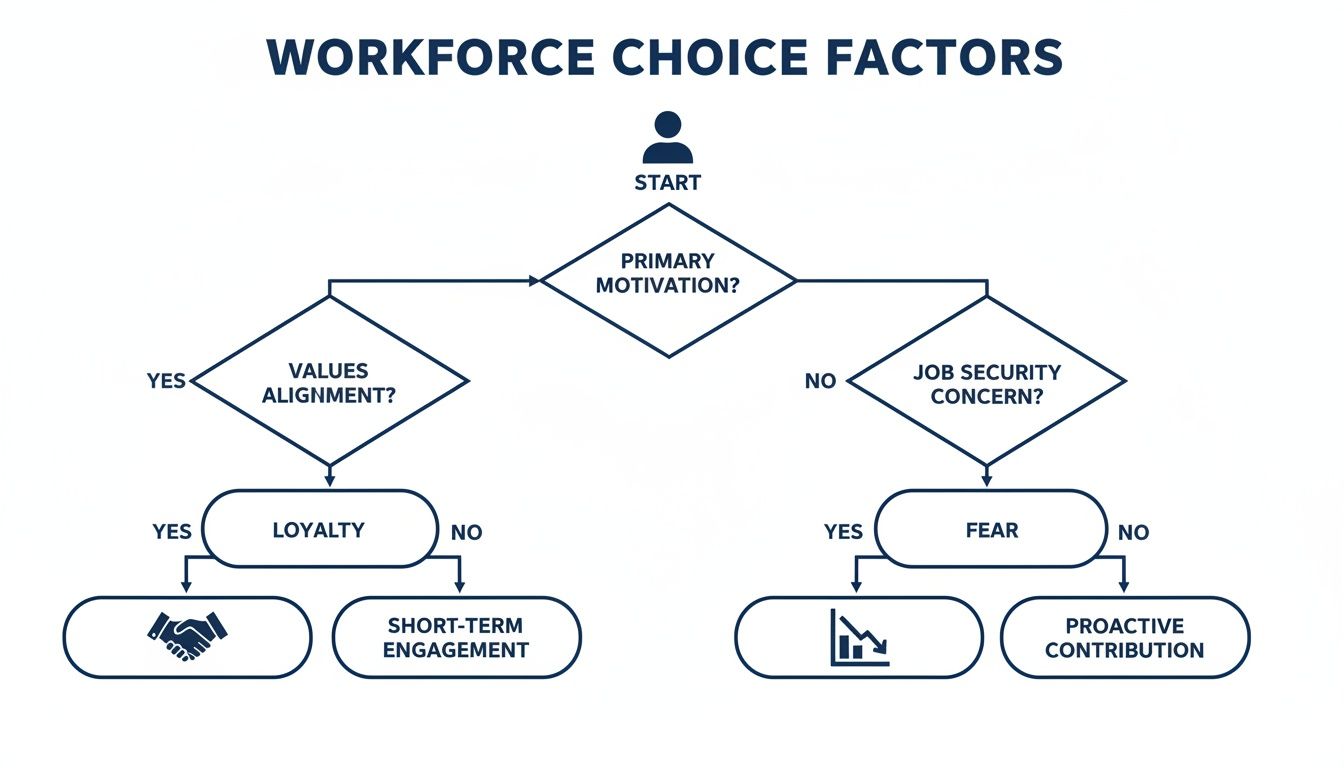
As the visual shows, decisions rooted in preserving talent and loyalty tend to foster engagement, while those driven by fear can lead to instability. It is a stark reminder of how critical it is to align your choice with your desired cultural and operational future.
This is the first and most critical question. Your timeline will immediately point you in one direction.
Next, assess the strategic value of the employees and roles in question. Not all positions are equally difficult to replace. A furlough is a strategic investment in retaining specialized talent. A layoff is an acknowledgment that a role, as it exists, is no longer essential.
Think about the real cost and time it would take to recruit, hire, and train replacements. If these employees hold deep client relationships or possess highly specialized skills, retaining them through a furlough preserves a valuable company asset. If the roles are redundant, a layoff is the more direct approach.
Your financial health and administrative resources are the practical guardrails for this decision.
When you synthesize these factors, the best path forward usually becomes much clearer. The key is understanding the core difference between furlough and layoff and applying this framework honestly.
Choose a Furlough When:
Choose a Layoff When:
When navigating workforce reductions, business leaders and HR professionals have pressing questions. Making the wrong move can lead to significant legal and financial blowback. Here are answers to common questions about the difference between a furlough and a layoff.
No. For non-exempt (hourly) employees, allowing them to perform any work—even checking a quick email—can trigger wage and hour obligations under the Fair Labor Standards Act (FLSA). For exempt (salaried) staff, the rules are just as strict. If they perform any work during a furlough week, you may be required to pay their full salary for that entire week. The only compliant path is a strict, zero-work policy.
Your selection process must be built on objective, non-discriminatory, and job-related criteria. Relying on subjective feelings is a direct path to a potential lawsuit.
Your strongest defense is a consistent and well-documented rationale. Consider these defensible criteria:
It is critical to document your criteria and the business rationale before making any announcements. This step is vital for proving your process was fair and not a pretext for discrimination.
Because a furlough is a temporary leave, you can typically continue offering health benefits. The main decision is how premiums will be paid. Many employers continue their contribution, while the employee's portion is handled either through pre-payment or collected upon their return. This contrasts with a layoff, where benefits are terminated, and a laid-off employee’s only option is COBRA, which requires them to pay 100% of the premium plus an administrative fee.
Making these high-stakes decisions correctly is critical to avoiding preventable legal exposure and protecting your company's future. The complexities involved often require expert guidance to ensure your actions are both strategic and compliant.
If you are facing these difficult choices and want to learn more about navigating them effectively, our team is here to help. For support with your specific situation, please contact us.