A restaurant manager notices that a line cook worked through a scheduled meal period to keep service moving. The employee later asks whether that missed break must be paid. The answer depends on what kind of break it was, whether the employee was fully relieved from duty, the employee's classification, and the state where the work occurred.
The question, “Do I have to pay for a break my employee skipped?”, can't be answered safely with a simple yes or no. Federal law, state premium-pay rules, wage statements, time records, and payroll practices can all affect the result.
The manager in this example may believe the employee chose to keep working. That fact alone doesn't resolve the pay issue. If the employee was handling orders, answering questions, monitoring equipment, or responding to a supervisor during an unpaid meal period, the break may not have been a genuine duty-free meal period at all.
Business owners often face several questions at once:
The safest approach treats a skipped break as a payroll and compliance event, not merely a scheduling inconvenience. A manager's schedule may show that a break was assigned, but the time record should show what occurred. If the employee worked instead of taking the break, the business needs a process for recording that work and applying any state-specific payment obligation.
This matters most for organizations operating across state lines. Federal law provides a baseline, but states can require more protective break practices and additional compensation. California, Washington, and Oregon illustrate how a missed break can create obligations beyond ordinary hourly pay.
A defensible response starts with four facts: the break's type, the employee's actual activity, the governing state rule, and the records supporting the payroll decision.
Start with the employee's real working conditions, not the label on the schedule. Rest breaks and meal periods serve different legal functions, so treating every break as the same type of time can create payroll and compliance problems.
A short rest break is a brief pause to get coffee, use the restroom, or sit away from a workstation. Under federal wage-and-hour rules, breaks lasting 5 to 20 minutes count as paid work time, as explained by the U.S. Department of Labor's break guidance.
If an employee skips that break and keeps working, the time generally remains paid time. The missed break does not become a separate unpaid amount merely because it was listed on the schedule. The employer must still review whether state law requires a separate remedy, such as premium pay, and whether the time record reflects the work performed.
A meal period follows a different rule. A bona fide meal period is usually at least 30 minutes and must release the employee from duty. If the employee answers messages, remains responsible for operations, continues working, or is interrupted before the period ends, the entire meal period can become paid working time, according to Timeero's explanation of federal break laws.
A useful comparison is a work lane and a personal lane. During an unpaid meal period, the employee must leave the work lane completely. Eating while monitoring a front desk, watching a production line, or responding to customer requests does not provide the same uninterrupted break as being free from those responsibilities.
When an employee reports a skipped break, gather facts before deciding that the employee waived anything:
For a broader review of employment law breaks compliance, connect the break classification to the employee's actual conditions. Use the same questions across locations, while allowing each state's rule and payroll process to control the final correction. The practical rule is straightforward: a break is not unpaid merely because the schedule labels it unpaid.
A scheduled 30-minute meal period does not automatically become unpaid time. If the employee keeps preparing orders, monitoring operations, or answering work requests, the business must assess the period as working time under the federal baseline.
The Fair Labor Standards Act establishes the federal floor. It does not require employers to provide meal or rest breaks, but it controls how offered breaks are paid. The federal regulation structure in 29 C.F.R. § 785.18 addresses short rest periods, while 29 C.F.R. § 785.19 addresses meal periods.
| Break type | Federal treatment | Employer's practical question |
|---|---|---|
| Short break from 5 to 20 minutes | Paid work time | Was the employee paid for the time and protected from improper interruption? |
| Meal period of 30 minutes or more | Potentially unpaid | Was the employee completely relieved of duty? |
| Interrupted meal period | Generally compensable working time | Did the employee perform work or remain responsible for operations? |
Short breaks of 5 to 20 minutes count as paid work time. A meal period of 30 minutes or more may be unpaid only when the employee is completely relieved of duty, consistent with federal guidance.
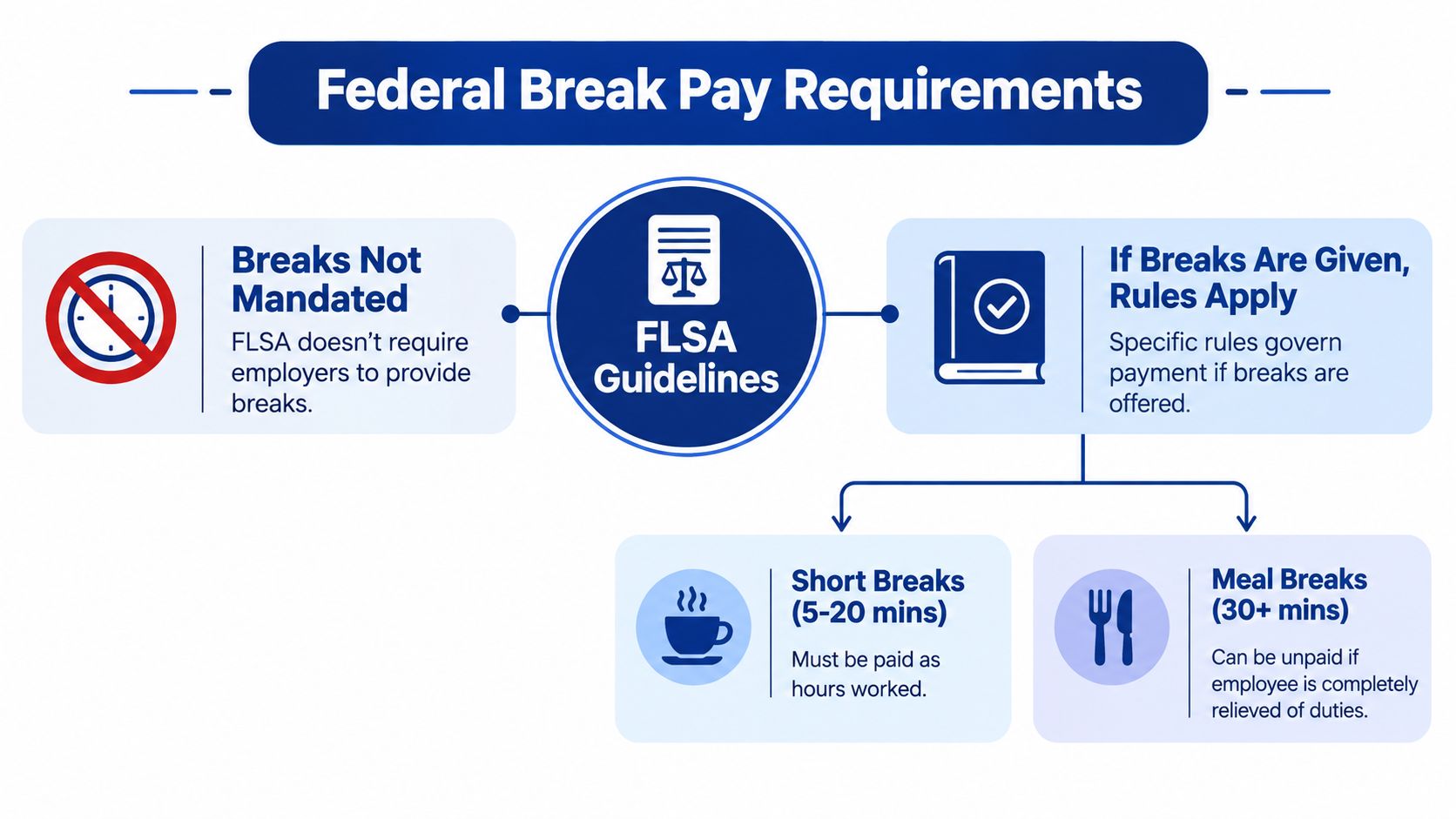
If an employee works through a scheduled meal period, record the time worked and include it in pay. A schedule creates an opportunity for unpaid time, like placing a sign on a lane. It does not close that lane if the employee must keep driving work forward.
The same rule applies to a short break. Because a short rest break would already be paid time, an employee who works through it must still receive credit for those hours. A manager should not erase the period because the employee chose, or felt required, to keep working.
Federal rule in practice: The schedule identifies a break opportunity. The employee's actual duties determine whether an unpaid meal period existed.
Federal law is only the starting point. State requirements may add mandatory breaks, premium pay, special payroll corrections, or recordkeeping duties. A single policy used across several states can therefore miss obligations that do not appear on a federal timecard. Use location-specific rules and retain the records supporting each correction.
A missed break can create two separate payroll questions. The employer may owe pay for time the employee worked, and state law may require an additional premium because a required break was not provided. Treating both issues as one correction can leave a hidden wage obligation unresolved.
Several states impose break rules that go beyond the federal baseline, including California, Washington, and Oregon, as summarized in Frontier Law Center's comparison of break penalty rules. The specific trigger depends on the employee's work location, the type of break, and whether the break was shortened, interrupted, or missed.
| State | Meal Break Premium | Rest Break Premium | Notes |
|---|---|---|---|
| California | One additional hour of pay at the employee's regular rate for each workday a required meal break isn't provided | One additional hour of pay at the employee's regular rate for each workday a required rest break isn't provided | A workday can trigger a separate premium for each type of violation, allowing up to two premium hours when both a meal and rest break are missed |
| Washington | Missed or interrupted meal-period obligations can create pay liabilities under state rules | Missed paid rest breaks count as hours worked | A worker who completes 40 hours in a week and misses a required 10-minute paid rest break can be owed overtime at 1.5 times the regular rate for that missed 10 minutes |
| Oregon | If a meal period is less than 30 minutes for any reason, the entire meal period must be paid | State requirements can exceed the federal baseline | Payment can be required even when the employer didn't know the employee skipped or shortened the meal period |
California has a clear premium structure. Under California Labor Code section 226.7, one additional hour of pay at the regular rate applies for each workday a required meal or rest break is not provided. California courts have treated that premium as wages rather than only a penalty, which affects payroll processing and final-pay practices. California Chamber of Commerce's meal and rest break guidance explains that the premium must appear on wage statements and be paid promptly at termination.
A defective break can also trigger the California premium. A meal period that begins too late, ends too early, or is interrupted by work may qualify as a violation even when the employee spent some time away from the workstation.
Washington creates a different payroll concern. A missed paid rest break counts as hours worked, so the added time can affect overtime calculations when the employee reaches the applicable weekly threshold. Oregon creates a recordkeeping challenge of its own because a meal period shorter than 30 minutes must be paid, regardless of why it was shortened.
For multi-state employers, use location-specific timekeeping rules rather than one national correction code. Keep the scheduled break, actual break, interruption, premium calculation, and payment record together. That checklist helps payroll distinguish ordinary worked time from a separate state premium.
Employee classification changes the payroll analysis, but it doesn't make break practices irrelevant. Start by identifying whether the worker is nonexempt or exempt under the governing federal and state rules, then examine what the employee did during the break.
Nonexempt employees generally must receive pay for compensable work time. If a nonexempt employee works through a scheduled meal period, answers work messages during an unpaid break, or performs production duties while supposedly off the clock, those activities need to be recorded and paid under the applicable rules.
A hospitality example makes the distinction clear. A nonexempt server who eats while remaining responsible for a table section hasn't necessarily taken a duty-free meal period. A manufacturing employee who monitors a machine during lunch may still be working. An office employee who responds to client messages during an unpaid meal period may have converted part or all of that time into work.
Exempt salaried employees are usually paid on a salary basis rather than by tracking each hour. That doesn't mean a business can require them to work through every scheduled meal period without examining the policy or state requirements. If the organization promises an unpaid meal period, it should provide a genuine opportunity for the employee to stop working and should avoid creating pressure that makes the break impractical.
Exempt status also can't repair a misclassification problem. A worker labeled “manager” may not satisfy the applicable exemption requirements, especially if the person primarily performs nonmanagerial production work. Leaders who need a refresher can review understanding FLSA exemption rules and compare the classification to the employee's actual responsibilities.
Use these questions before deciding whether payment is due:
For a practical comparison of understanding exempt and nonexempt employees, align classification, scheduling, and payroll rather than handling each issue in isolation.
A scheduled break on a timecard is only a plan, not proof that the employee was free from work. In a skipped-break dispute, records should connect the scheduled period, the actual time away, work performed, payroll treatment, and any correction. Treat the record like a chain. If one link is missing, the business may struggle to explain how it reached the payment decision.
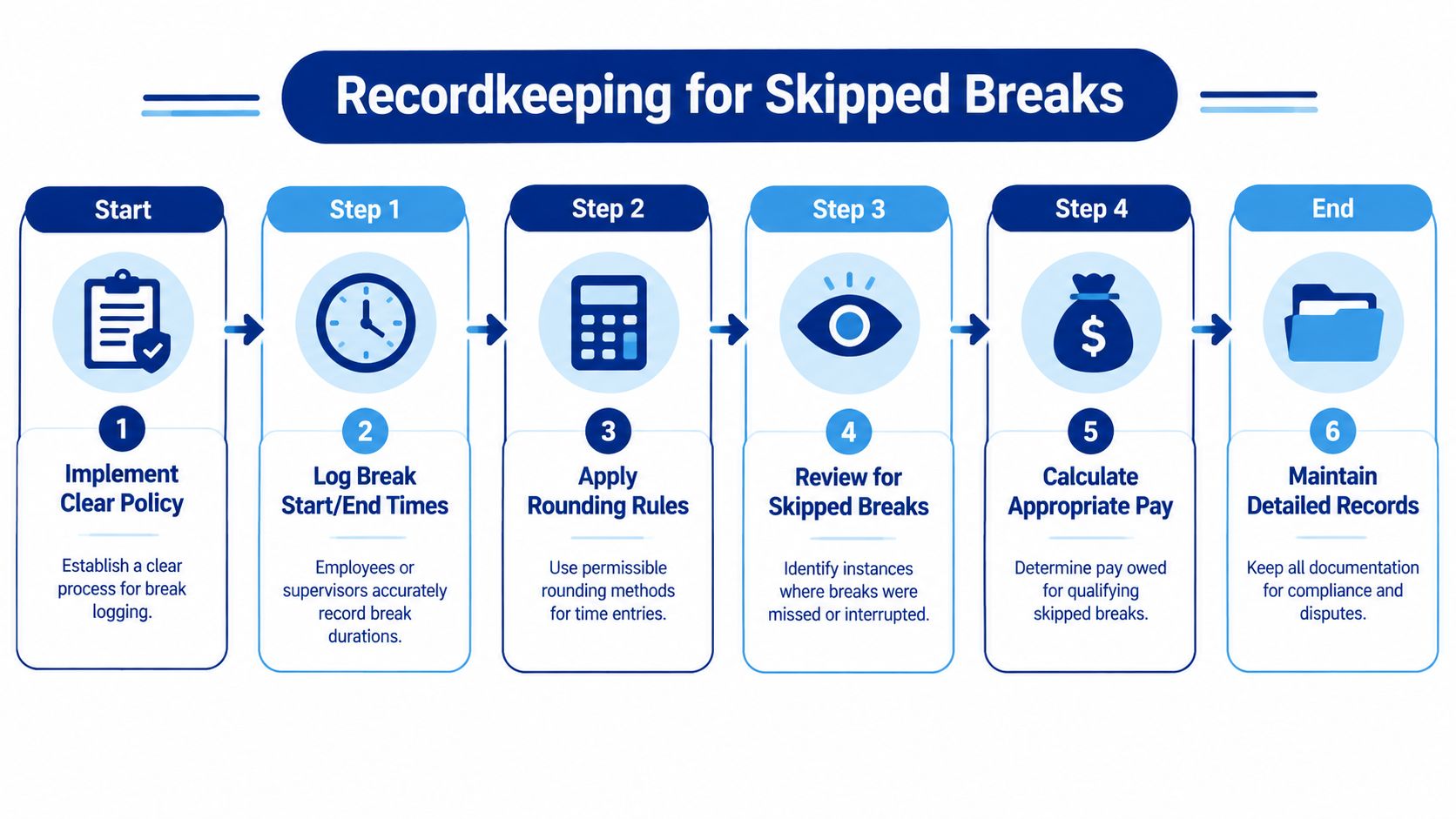
Automatic meal deductions need a manual checkpoint. If an employee reports working through a deducted period, payroll should investigate and correct the entry before pay is finalized.
Rounding can hide a late or shortened break when the system changes the recorded times without adequate review. The business should be able to identify which entries were rounded, who edited them, and whether the final record matches the work performed. California's missed-break rules can require an additional hour of pay at the regular rate for each workday when a required meal or rest break is missed, and the payment must appear on wage statements, as noted in California Chamber's wage and hour guidance.
Payroll control: Route every break exception through the same review process as another wage adjustment. It should not vanish inside a generic timecard edit.
Multi-state employers should maintain a location-based rule matrix, separate payroll codes, approval paths, and audit reports. guidance on compliant global hiring provides useful context for organizing payroll processes across differing employment requirements. Before closing payroll, compare the employee's work location, recorded break event, correction, and applicable premium rule.
A break policy should tell employees what to do before, during, and after a missed break. It should also tell managers what they must not do. A policy that says “employees must take breaks” but provides no reporting method leaves payroll without a reliable way to identify exceptions.
Adapt the following language to the states where your organization operates and have qualified counsel review it before adoption.
Break scheduling and duty-free time: The company schedules meal and rest periods according to applicable federal, state, and local requirements. Employees must be relieved of all work duties during an unpaid meal period and may not be required to monitor phones, messages, customers, equipment, or other work responsibilities.
Missed or interrupted breaks: Employees must promptly report any meal or rest period that was missed, shortened, delayed, or interrupted by work. Managers must not discourage, prevent, or ignore a break report. Payroll will review the event, record all compensable time, and apply any required state premium.
Timekeeping: Employees must record actual work time and actual meal-period start and end times in the company's approved timekeeping system. Employees may not work off the clock, alter another employee's record, or approve a timecard they know is inaccurate.
Manager responsibility: Managers must schedule coverage, release employees from duties, and escalate break exceptions to payroll or HR. A manager may not instruct an employee to skip a required break to meet a deadline, serve a customer, or maintain production.
Classification: Break-pay treatment depends on employee classification and applicable law. Nonexempt employees must record compensable work time. Exempt employees should be given a reasonable opportunity to take any promised meal period without work obligations.
The policy needs owners. Managers control the shift, employees report what occurred, HR interprets the rule, and payroll applies the correction. Assigning each responsibility prevents the common failure where everyone assumes someone else handled the missed break.
A useful implementation sequence looks like this:
Use a separate state profile rather than placing every rule into one universal policy.
| Review area | Questions for the business |
|---|---|
| Break schedule | Does each location follow the applicable meal and rest period requirements? |
| Pay treatment | Is worked meal time paid as hours worked, and are premiums added when required? |
| State triggers | Does payroll identify late, shortened, skipped, and interrupted breaks? |
| Wage statements | Are required premium wages shown in the correct payroll record? |
| Classification | Are exempt and nonexempt employees handled under the correct framework? |
| Manager conduct | Do supervisors know they must provide coverage and avoid discouraging reports? |
| Audits | Does HR review patterns across departments and pay periods? |
| Handbook | Does the policy match the applicable employee handbook laws by state? |
A missed-break premium is considered wages in many states and must appear on wage statements, creating paystub compliance requirements beyond the initial correction, as discussed in this overview of meal and rest break violations. Payroll should therefore avoid burying the correction in an unexplained adjustment.
The right audit question isn't, “Did the employee clock out?” Ask, “Was the employee completely relieved, did the break meet the required conditions, and did payroll apply every required payment?”
A skipped break can involve ordinary wages, premium pay, overtime treatment, wage-statement requirements, or several of these at once. Federal rules distinguish paid short breaks from potentially unpaid meal periods, while state laws can impose stronger requirements for missed, shortened, delayed, or interrupted breaks.
Business leaders should take four actions:
The answer to “Do I have to pay for a break my employee skipped?” starts with the employee's actual work, not the schedule. A consistent process gives HR and payroll the evidence needed to make the right decision and helps leadership identify operational problems before they become repeated wage claims.
This organization helps owners, HR leaders, and multi-state operators build defensible break-pay policies, review payroll practices, and manage complex employment compliance decisions. Visit Paradigm International Inc. to discuss a customized review of your break records, handbook language, and state-specific exposure.