
A manager in a second state pulled last year's handbook for a firing. The current leave form was sitting in an email thread. Leadership could not show which rule was in force on the day the decision was made. That is the problem document control standards are meant to solve for a company of 25 to 500 people, especially when the person running HR is also running the business.
Treat the official file like a signed original in a locked drawer. The photocopy on a desk, the attachment in a chat thread, and the PDF a manager saved to a laptop are not that original. Document control standards are the repeatable rules for what a record said, which copy was official, who could see or change it, and how long it is kept. They are an evidence system for people decisions, not a software badge.
Say the firing happens on a Tuesday. The manager in the other state used a handbook that still allowed a step the company dropped last spring. The leave form the employee signed never made it into the personnel file. Six months later, nobody can point to the version that governed the decision. The company does not have a memory problem. It has no controlled record.
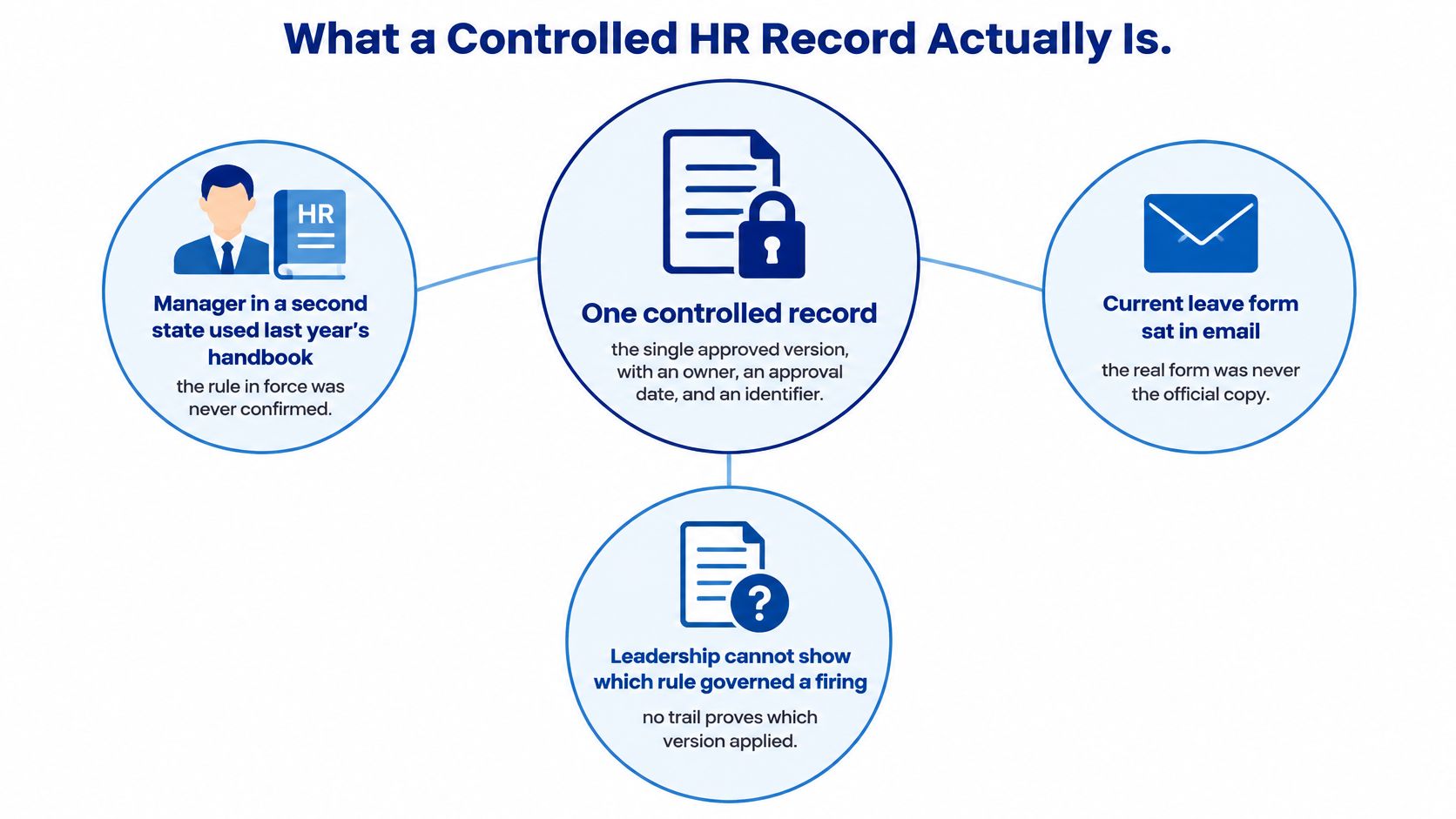
A controlled HR record is one approved version with an owner, an approval date, and an identifier. Around that copy sit the failures owners already live with. A manager applies last year's handbook because nobody confirmed the rule in force. The actual leave form never becomes the official copy because it stayed in email. Leadership cannot show which rule governed a firing because there is no trail.
An independent reviewer can name the official version, its approver, the governing state, who accessed it, and its retention status without relying on memory.
If that reviewer has to call the office manager to reconstruct the file, the control is still a habit, not a standard. Strong HR documentation practices start from that test, then apply it to the records that decide pay, leave, and separation.
Build the set around records that prove a people decision, not around every PDF the company has ever saved.
Public buyers already buy this discipline as a defined service. An on-site records management IDIQ opportunity is scoped work with an owner and a result, not a request to "keep the files tidy." A private employer should be at least that clear.
The Digital Curation Centre briefing on ISO 15489 records that ISO 15489-1:2001 was published in 2001 from Australia's AS4390:1996, that a revised Part 1 was issued in 2016, and that ISO reports adoption in more than 50 countries and translation into more than 15 languages. The framework runs from creation through classification, storage, retrieval, retention, and disposition, and it applies to records created or received by public or private organizations. The useful lesson for a multi-state employer is narrow. Document control is a way to prove what existed, which version was authoritative, who was responsible, and how long the record is kept.
The first working tool is a retention table that classifies each file by what it proves. Years come after that classification, not before it.
Do not pick one company-wide year and apply it to every folder. Classify the file by what it proves, calculate every date the law names, and keep the record through the latest date.
Federal retention floor for core HR records
| Record | Governing law | Minimum retention | Extra control |
|---|---|---|---|
| Form I-9 | Immigration and Nationality Act | Longer of 3 years after hire or 1 year after separation | Separate file; limited access; available for official inspection |
| Payroll registers and core pay records | Fair Labor Standards Act (DOL) | 3 years | Organized so DOL can inspect, copy, and transcribe |
| Timecards, schedules, rate tables, and wage additions or deductions | Fair Labor Standards Act (DOL) | 2 years | Supporting computation records, not the payroll register |
| FMLA dates, notices, premiums, policies, and disputes | Family and Medical Leave Act (DOL) | 3 years | Do not label state-only or company-plan leave as FMLA |
| Applications, personnel actions, pay, training, and accommodations | ADA Title I (EEOC) | 1 year from the record or the action, whichever is later | Charge, demand, or agency notice holds records until final disposition |
| Complaint and investigation files | No single federal retention clock | Through closure, then the longest applicable personnel or charge hold | Immutable history; human sign-off before action |
| Handbook, policy, and state addendum versions | Company control standard | Each approved version for as long as a dispute about it can arise | Version ID, approval date, and link from addendum to master |
The method is the same for every row. Name what the file proves. Write down each date the governing rule uses. Keep the record until the last of those dates. Then check whether a charge, a demand, or an agency notice has frozen destruction.
Take a Form I-9. The Department of Labor's employer eligibility guide states that the Immigration and Nationality Act requires the employer to retain each Form I-9 for the longer of three years after the date of hire or one year after the employment relationship ends. Calculate both dates. Keep the form through the later one. Destroy it only after that date has passed, and only if no hold applies. Store I-9s apart from ordinary personnel files, limit access to people who administer employment eligibility, and keep the forms available for inspection by authorized government officials. A multi-state employer applies that federal rule the same way in every state, then checks state rules on who may see or copy other personnel records.
Payroll is a different proof. Department of Labor guidance on the Fair Labor Standards Act requires employers to preserve payroll records for at least three years, while records that support wage computations generally must be retained for two years. The shorter set includes time cards, piece-work tickets, wage-rate tables, work and time schedules, and records of additions to or deductions from wages. Organize both sets so a Department of Labor representative can inspect, copy, and transcribe them. A payroll register is not a substitute for the timecard that explains the register.
FMLA records follow the same recordkeeping frame, with a labeling rule that multi-state employers break often. The Family and Medical Leave Act, 29 U.S.C. § 2601 and 29 C.F.R. Part 825, requires covered employers to preserve FMLA records for at least three years. Department of Labor FMLA recordkeeping guidance includes dates of FMLA leave, hours taken when leave is in increments of less than a full day, employee notices, written notices from the employer, benefit-premium payments, applicable leave policies, and disputes over FMLA rights or benefits. Leave has to be identified as FMLA leave. A file should not label leave required only by state law, or only by a company plan, as FMLA leave. Track the federal designation separately from the state program, and keep the notices and math behind each label.
Title I of the Americans with Disabilities Act, enforced by the EEOC, sets a shorter general floor and a harder exception. The Department of Labor's overview of ADA Title I states that employers generally must maintain personnel or employment records for one year from the date the record was made or the personnel action was taken, whichever is later. That set includes accommodation requests, applications, hiring records, promotions, demotions, transfers, layoffs, terminations, compensation, and training-selection records. When a discrimination charge is filed, relevant personnel records must be preserved until the charge or proceeding reaches final disposition. That hold overrides an ordinary destruction date.
Write the hold into the policy before anyone needs it. Routine deletion stops as soon as the company receives a charge, a demand, an agency notice, or another event that requires preservation. Complaint and investigation files do not sit on a single federal clock. Keep them through closure, then through the longest personnel period or charge hold that applies, with a history that cannot be rewritten and a person who signs off before action.
Handbook versions are a company control, not a federal year-count. Keep each approved version for as long as a dispute about that version can arise, with a version ID, an approval date, and a link from each state addendum back to the master.
For a termination after a complaint or leave, an open investigation, or leave that overlaps a disability, get expert help before records are destroyed or the action is taken. A retention table does not decide the case. It only stops the company from throwing away the file the decision will rest on. A practical walk-through of employment records retention requirements belongs next to this table, not in a binder nobody opens.
The retention table is useless if managers can still open yesterday's form. Three controls make the table usable: versioning, access, and an audit trail. None of them is a software feature list. Each one stops a specific failure.
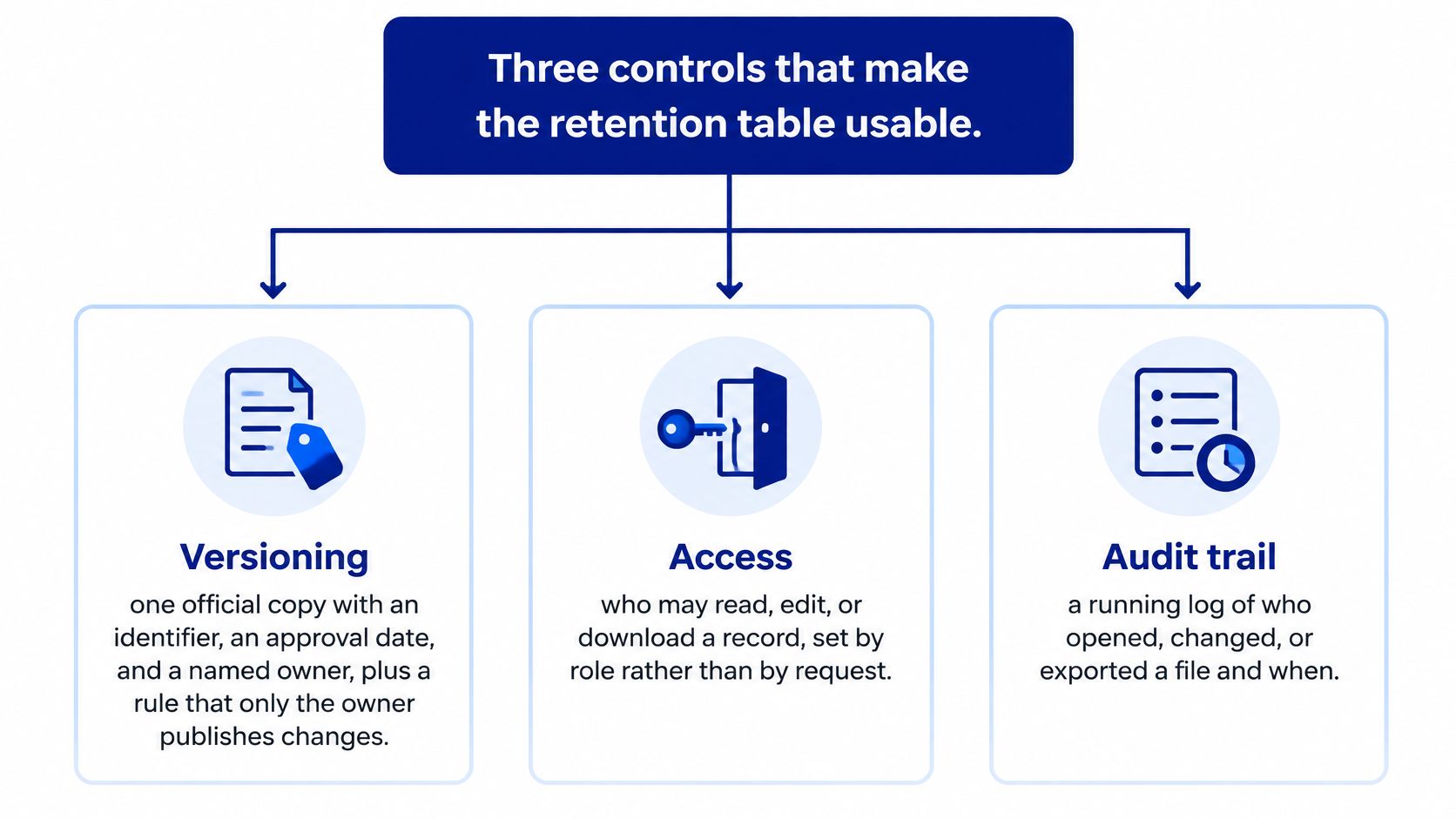
Versioning means one official copy with an identifier, an approval date, and a named owner. Obsolete handbooks, leave forms, and state addenda come out of manager folders. If last year's corrective-action form is still pinned in a team channel, a supervisor will use it and skip a note the current form requires. If the current form is the only one a manager can reach, and a named approver had to release it, the company can show which standard applied on that date.
ISO 9001:2015 guidance on documented information treats this as a risk-based control, not a fixed stack of mandatory documents. Clause 4.4 calls for documented information needed to run the process and for evidence the process was followed. Clause 7.5 requires that documentation to be controlled. For an HR file, the lifecycle is concrete: authorized creation, review, approval, a version ID, controlled distribution, access limits, a change history, retention, and disposition. The organization decides what extra documentation the risk warrants. A 40-person company does not need the same packet on every routine status change that it needs on a termination after a complaint.
Operators with many sites already know that a local edit becomes the "real" policy. Writing on content compliance across franchise locations makes the same point. One approved version has to be the version people use, or the brand on the cover is irrelevant.
Access means named roles, not a shared drive every supervisor can open. Employment-eligibility records, medical and accommodation notes, and investigation files stay with the people who administer those matters. A manager may need the outcome of an accommodation. The manager does not need the medical detail that produced it.
An audit trail shows who approved the file, who viewed or edited it, and what changed. A later reviewer should not be rebuilding that history from inboxes. Metadata worth requiring on a high-risk record is short: a record ID, an owner, a capture date, the employee or matter, the jurisdiction, the status, the retention trigger, and the disposition. A filename is not metadata.
If the official version, the governing state, the access history, and the retention status are not visible in the system of record, the control is still a filing habit.
Tie investigation files to a written path for evidence handling. Notes, messages, and recordings belong in the matter file under the same owner, not in a side folder the investigator keeps "just in case."
The federal table is a floor. Named states change access, the wage-record period, or both. A remote hire can pull in the work state's leave and wage duties even when the company office is somewhere else.
Where named states change the federal file
| State | Rule | What changes for the file |
|---|---|---|
| California | California Labor Code personnel-record inspection | Employees can require inspection and copying on a deadline, not only storage for a federal year |
| New York | New York Labor Law wage records | Generally six years, longer than the federal three-year payroll floor |
| Illinois | Personnel Record Review Act | Employees have a route to review personnel records, so the official file has to be findable |
| Texas | No California-style personnel-file inspection statute | Federal schedule is the baseline; it does not cancel local wage or leave duties |
California's Labor Code gives employees a right to inspect personnel records. The file has to be findable and copyable on a deadline. Keeping it for a federal year, in a folder only one person can open, does not meet that duty.
New York Labor Law generally expects wage records to be kept for six years. That is longer than the federal payroll floor. A New York timecard destroyed on the federal schedule is already a problem, even if the payroll register is still there.
Illinois, through the Personnel Record Review Act, gives employees a route to review personnel records. The official file has to be the file the company can produce, not a pile of emails the manager prefers.
Texas does not impose a California-style personnel-file inspection statute. The federal schedule is the baseline there. That baseline does not cancel Texas wage rules, local leave rules, or any other duty that attaches because someone works in the state.
A handbook has to hold leave, sick time, and policy language together across every state where the company has people. The firm covers that multi-state set as handbooks, leave, sick time, and policies that stay consistent wherever the company has employees. In a remote work case, the firm rewrote the client's remote and hybrid work policy so it defined approved work locations, employee obligations, and who had authority to enforce them. A remote or hybrid policy that skips those three points leaves the work state, and the enforcement question, to whoever answers the chat first. More on remote worker compliance across states belongs in the same pass as the addenda.
The same decision often sits in email, Teams or Slack, a payroll platform, a PEO portal, and a manager's laptop. Tighter file names do not fix that. "Final_v7" on three drives is three copies.
Federal electronic-records rules in 36 C.F.R. § 1236.10 require records to stay reliable, authentic, integral, and usable, and to keep content, context, and structure. They also require records management to be built into how the system is designed, not bolted on after people have already scattered the files. The questions an owner has are operational. Which copy is authoritative? How are duplicates retired? How is a state addendum linked to the master policy? What happens when a manager edits a copy in an uncontrolled workspace?
Name one authoritative home for each record type. Link every state addendum to the master handbook. Write the rule for an uncontrolled edit: the edit is not official, the manager sends it to the approver, and the side copy comes down. A risk-weighted matrix beats identical controls on every document. Investigation files, I-9s, and accommodation notes need immutable history, a second look, formal approval, a hold switch, and fast retrieval. A routine org-chart PDF does not.
Leave that overlaps a disability or an accommodation is the point to stop and get expert help before anyone makes a designation. The label in the file becomes the fact the company later has to defend.
A company this size does not need a senior HR leader to name four seats. It needs each seat to have one job and one boundary. If everyone can edit the policy, nobody can say which version was in force.
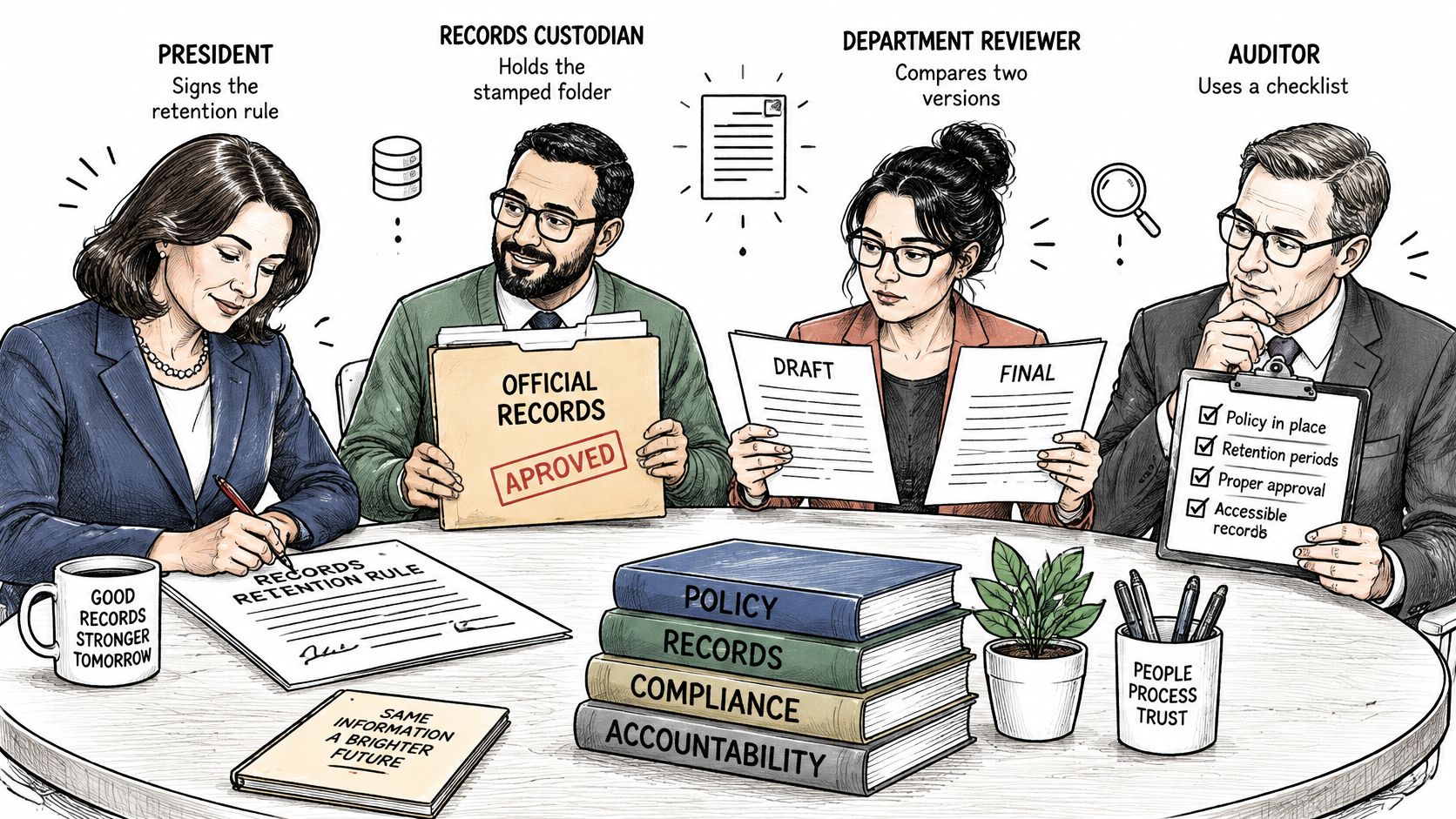
Once a quarter, the executive owner confirms three things. The handbook version in use at each location is the approved version. People who changed roles no longer have access they no longer need. Nothing on hold was deleted. That is a one-hour check, not a transformation project.
Outside employment counsel is for legal judgment. An HR advisor can organize the file and the decision record. Neither role replaces the other. A written HR governance framework should say which seat signs, which seat stores, and which questions go to counsel before anyone acts. The failure this section prevents is simple. When every supervisor can publish a policy, the company cannot later point to the version that governed the decision.
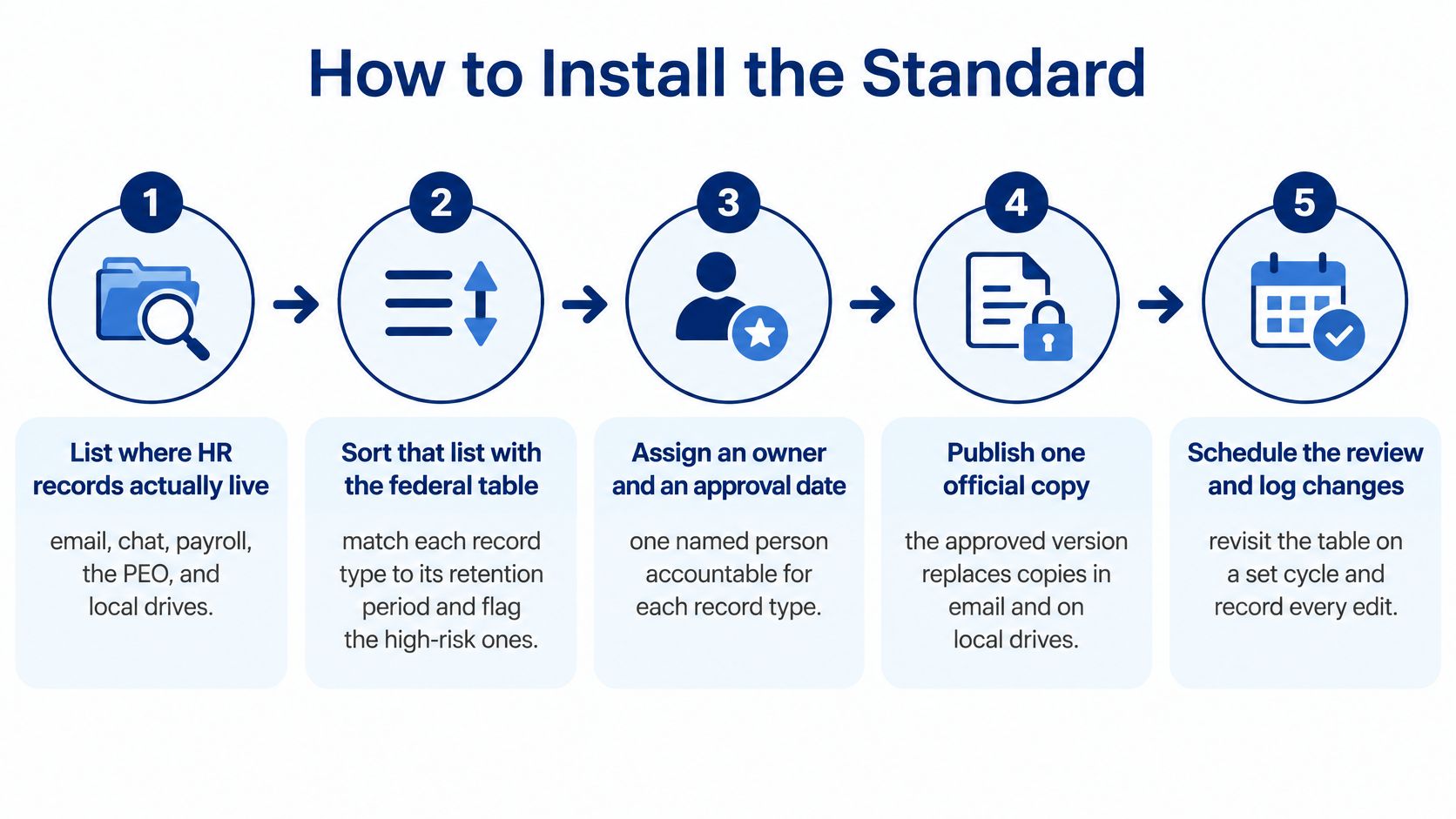
A COO can install this without buying a new system. The sequence matters more than the tool. Discovery comes before templates. The firm starts with a discovery and compliance audit that reviews policies, files, and processes to map risks and gaps. If the list of locations is already messy, that kind of short review is the sensible first pass.
A draft summary can shape a firing and still not be the evidentiary record. A person has to accept it, and the source material has to stay available.
These steps organize the file. They do not decide a high-stakes action, and they are not a promise about how a later dispute will come out. Before a termination after a complaint or leave, before closing an investigation, and before designating leave that overlaps a disability, get expert help.
Pause when the file and the decision are both high stakes. That means a termination after a complaint or a leave, an investigation, or leave that overlaps a disability or an accommodation. The useful ask is a plain recommendation before anyone acts, plus a record of what was reviewed.
The HR consulting firm is not a law firm. Its terminations and separations work gives a plain recommendation before the client acts and documentation that holds up after the decision. The firm can organize that decision record and coordinate with the company's attorney. It does not replace counsel, and it cannot promise an outcome.
Readers who want help applying this to their states, their payroll setup, and the copies already scattered across email and chat can start with a short review of the files they already have.
This article is general information, not legal advice. Employment laws change and vary by state; consult qualified employment counsel about your situation.
The firm helps owners and COOs put document control standards around the records that govern pay, leave, investigations, and separations, including multi-state handbooks and the file behind a high-stakes decision. The work is a structured review of policies, files, and processes, then a clear recommendation before action. Visit Paradigm International Inc. to see how that support is set up for a company that still runs HR from the top.