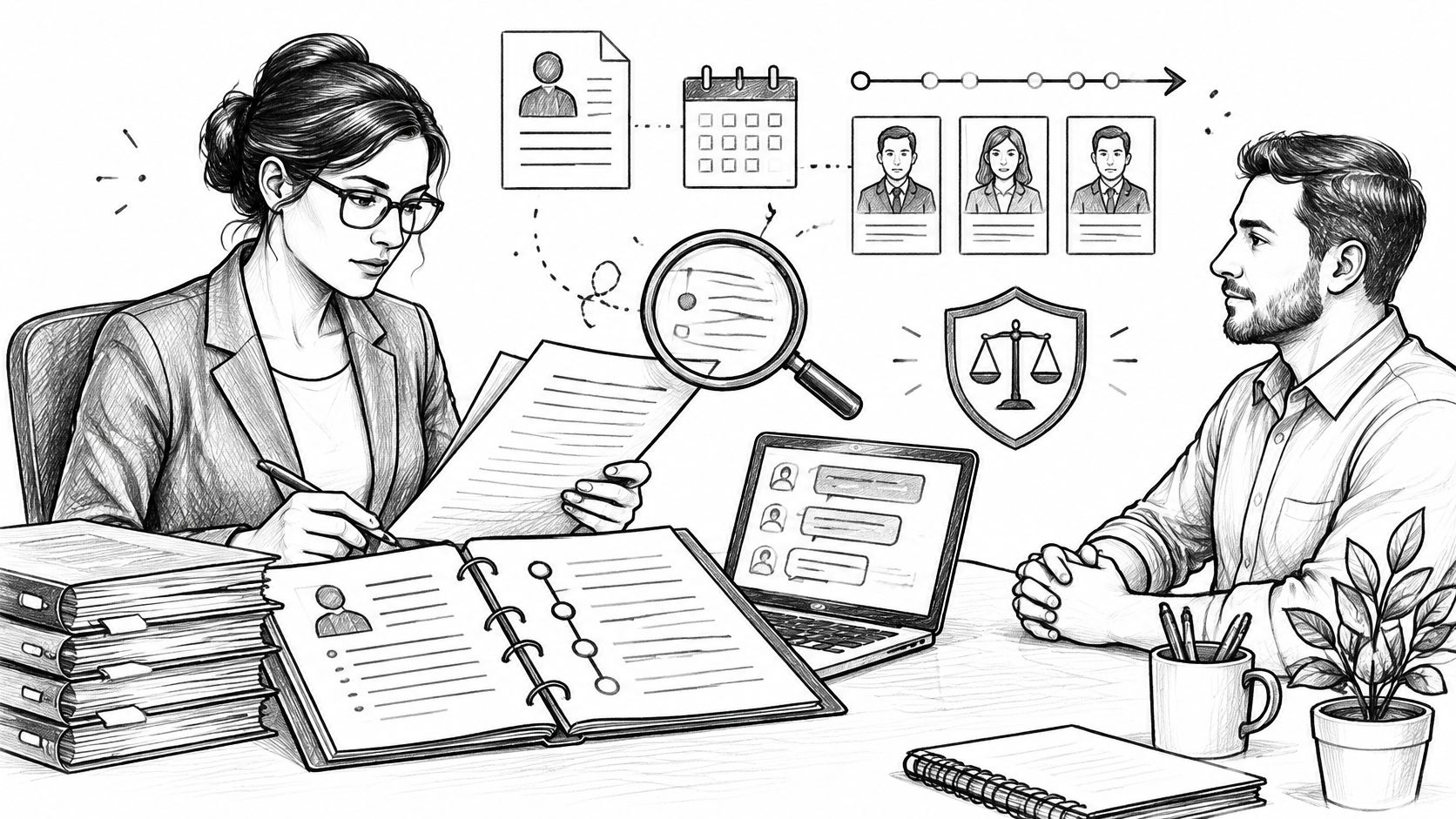
A manager walks into an owner's office on a Thursday afternoon and says a warehouse lead needs to be let go before Monday. When the owner asks for the paper trail, the manager pulls together two vague emails, a sticky note with no date, and a verbal summary of conversations from three months ago. If an agency investigator or opposing attorney reads that file six months later, the record doesn't look like routine discipline; it looks improvised.
For owners, presidents, and COOs running growing multi-state companies without a senior HR leader, documenting employee misconduct has to serve a sharper purpose than filling a personnel folder. Every disciplinary file is a retaliation-screened record that must stand on its own under outside review. Reviewing the file row by row before acting exposes weak spots while there's still time to fix them.
A complete misconduct file connects the allegation, evidence, employee response, and decision. It also lets you check whether the proposed action rests on documented conduct or could be challenged as retaliation. The U.S. Equal Employment Opportunity Commission (EEOC) enforcement guidance provides a framework for handling harassment complaints, including investigation and corrective action.
Check the current file row by row before approving discipline. Mark gaps where records are missing, accounts conflict, or the reasoning depends on an assumption.
| Record element | What it must show | Common gap |
|---|---|---|
| Allegation and policy | Named policy section and specific conduct being reviewed | Vague labels such as attitude problem |
| Timeline | When each event occurred, when it was reported, and its sequence relative to any protected complaint or leave | Dates reconstructed later or relevant timing omitted |
| Evidence | Records collected, their sources, and how each was obtained | Items listed without supporting records |
| Witness accounts | Who was interviewed, what each said, and any refusal | Refusals or conflicting accounts left out |
| Employee response | The employee's account and a record that a response was invited | No record that the employee was asked |
| Decision and rationale | Decision-maker, evidence supporting the reasoning, and comparable cases | Rationale stated only as policy violation |
| Prior discipline | Relevant history and whether comparable conduct received consistent treatment | Undocumented exceptions |
These rows work together. A policy citation identifies the standard, but it does not establish that the employee broke it. Witness accounts and other evidence support or challenge the allegation. The employee's response may explain a discrepancy that would otherwise look like misconduct.
Keep unresolved conflicts visible. Recording a refusal shows that an interview was attempted; it does not establish what that witness would have said. Likewise, an opportunity to respond supports a fair process but does not make every conclusion sound. The decision rationale must explain which evidence supports the finding and how conflicting information was weighed.
File test: An outside reviewer should be able to identify the supported conduct, applicable rule, employee response, and basis for consistent treatment without a follow-up call.
Different allegations need different evidence. Investigations involving threats or violence may require dated witness statements, exact quotes, and available security footage. Drug or alcohol incidents call for documented physical observations and, where testing is involved, chain-of-custody records. Theft, fraud, or misuse of company property may require inventory logs, system access records, or financial audit trails.
Collect what addresses the allegation. A large folder is not necessarily a stronger file, particularly if its contents cannot be traced to their sources.
The recordkeeping discipline discussed in documentation requirements for MSPs offers a useful parallel: timestamps, ownership, and source records make evidence traceable. Apply that discipline to the misconduct file. Identify where each item came from, distinguish supported findings from unresolved allegations, and connect the decision to the applicable policy before acting.
The individual manager note is the piece of a misconduct file challenged most often, because opinion slips into everyday writing almost automatically. A manager writes that an employee "was hostile in the morning meeting" or "is always late," and six months later nobody can prove what happened. Solid HR documentation best practices treat every note as part of a decision-control system: a record where each entry either supports a later employment decision or blocks one, and nothing in the file sits neutral. A vague note doesn't just fail to help. It actively weakens the termination, suspension, or demotion it was meant to justify.
Retaliation exposure is the reason neutral, fact-based notes matter so much. The EEOC's Enforcement Guidance on Retaliation and Related Issues reports that retaliation represented 44.5% of all EEOC charges in fiscal year 2015 and 35.7% of Title VII charges, a sign of how long retaliation has dominated workplace claims. When an employee has complained, taken protected leave, or participated in any investigation, every note written about them afterward gets read as potential evidence of pretext. Follow these practical rules every time someone writes an entry for a misconduct file:
That last bullet deserves emphasis. A note that documents consistent enforcement is the single best defense when an employee claims the write-up was payback for a complaint or a leave request. Without it, the file shows what the employee did but says nothing about whether the company treated anyone else the same way.
Everyone makes a typo or misses a detail occasionally, but editing a record after the fact creates a credibility problem far worse than the original error. Never alter, delete, or backfill an existing note after a disciplinary decision is underway. Instead, leave the original entry intact and append a dated correction note stating exactly what changed, why it changed, and who made the update. A visible correction reads as honesty. An edited file reads as fabrication, even when the edit was innocent.
Timing matters just as much as accuracy. A note drafted after leadership decides to suspend or terminate an employee gets viewed as justification for the decision rather than contemporaneous proof of misconduct. Apply one simple test before signing off on any entry:
Could someone who wasn't in the room see the evidence clearly without relying on your conclusion?
Keep a single template inside every misconduct folder so managers across locations record the same seven fields in the same order:
[YYYY-MM-DD, HH:MM a.m./p.m.][Full name, role][Factual description of events, exact quotes, or records received][Handbook section name and number][Direct observation OR reported by Name, Title on Date][Observable action and frequency, replacing any subjective label][How this policy was enforced in comparable past cases, or note that no prior cases exist]Before your next disciplinary meeting, pull one recent manager note from an active file and rewrite it using those seven fields. The gaps show up fast. Words like "hostile," "unreliable," and "insubordinate" have nowhere to fit in a template that demands a quote, a timestamp, or a count, so every conclusion the manager assumed was a fact becomes visible the moment it fails to fill a field. Rewrite those entries properly, and the file starts screening itself for the retaliation and consistency problems that otherwise surface only after a charge is filed.
Misconduct rarely arrives as a neat paper memo anymore. Managers now receive cropped phone screenshots, forwarded chat excerpts, exported timecards, security camera clips, social media links, and written complaints drafted with artificial intelligence tools. Each digital source carries authentication gaps that can sink an otherwise valid finding if handled casually.
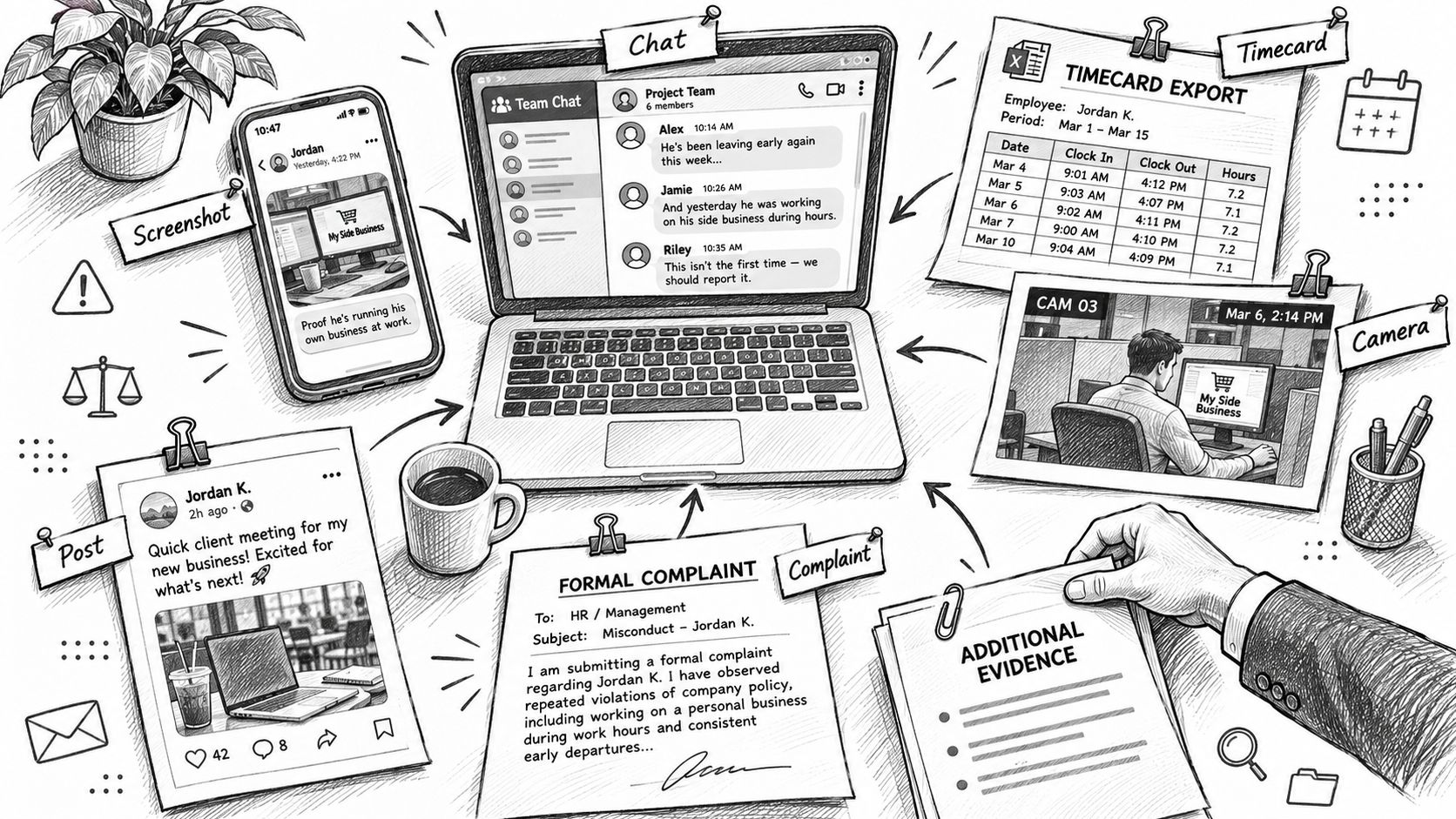
As Inc. reporting on workplace misconduct trends explains, employees increasingly use AI tools to help draft and submit workplace complaints, which adds layers of wording that may not match an employee's direct observations. That same reporting highlights National Labor Relations Board (NLRB) bench-book updates noting that social media platform certification alone may not authenticate an online post without circumstantial evidence tying the account to the individual. Sound evidence handling procedures start by preserving each format in its native, complete state before anything is edited or overwritten.
| Source | What to preserve | Common gap |
|---|---|---|
| Email and chat | Full thread with dates, senders and recipients | Forwarded excerpts with headers removed |
| Screenshots | Complete screen with account name, date and surrounding messages | Cropped images with no source |
| Timecards and badge data | Entries for the dates in question, exported as recorded | Summaries prepared after the decision |
| Camera footage | Footage saved before it is overwritten, with who pulled it and when | Footage requested weeks later |
| Social media posts | The post, account link, capture date and the link to the employee | Account name treated as proof |
| AI-assisted complaint | Original submission, edits, translations and tools used | Reworded text replacing the original |
Treat every digital item as unverified until its origin and completeness are logged. When collecting an email or workplace chat thread, export the complete conversation with original headers and timestamps rather than relying on a single forwarded message stripped of context. For screenshots, capture the entire display showing the account identifier, date, and surrounding messages, then log who took the capture and on which device.
Timecard logs, badge swipes, and camera footage deteriorate quickly when auto-deletion cycles run. Pull raw exports for the exact dates at issue right away and note the name of the administrator who retrieved them. Never rely on a spreadsheet summary compiled weeks later after a termination is already planned.
Social media posts and AI-assisted complaints require extra care. Save the full post, the profile URL, the capture date, and corroborating facts linking the account to the employee, since an account handle alone doesn't prove authorship. For an AI-assisted complaint, retain the exact original submission alongside any translations, follow-up edits, and notes on which tools were used, then ask the reporting employee in an interview to walk through what they personally saw or heard in their own words.
Every exhibit in the folder should carry three short labels:
An improvised investigation order weakens the file even when the final decision is reasonable. Interviewing the accused before the records are secured, or letting an involved manager control the review, gives an outside reviewer reasons to question the result. Disciplined investigation management creates a neutral, documented record of the complaint, the fact-finding, and the decision path.
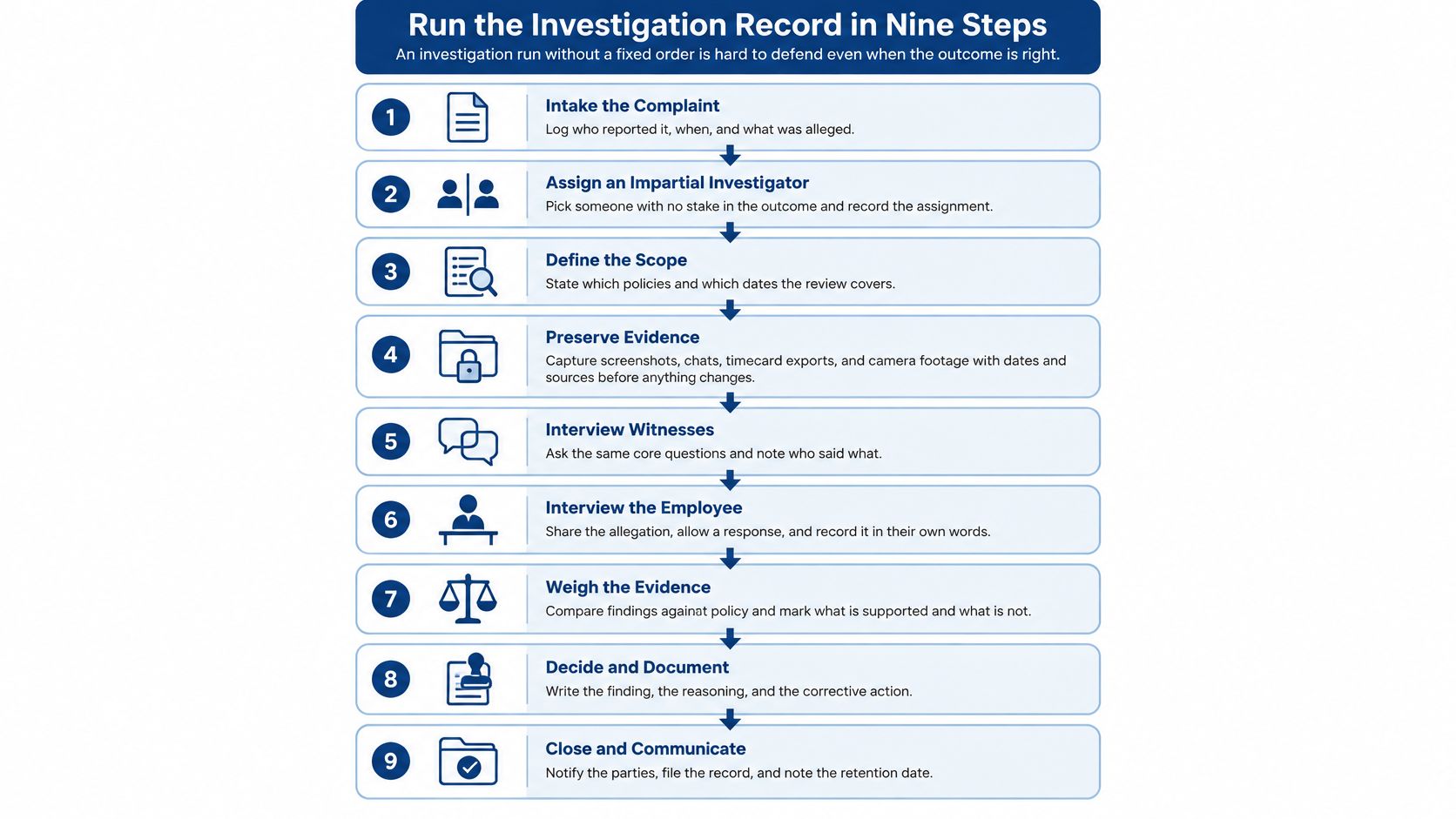
Work through these nine steps in sequence, and tie each step to the decision it will later support. That discipline matters because the file should show not only what was found, but how the employer reached the finding without drift, bias, or retaliation risk.
Define the allegation and applicable policy. Write down the specific conduct alleged and the handbook provision it may breach before taking any other action. A defined standard keeps the investigation focused on conduct that matters to the policy, rather than on personality conflicts or broad character judgments.
Appoint an impartial investigator. Choose someone with no personal stake in the outcome, and separate the investigator from the final decision-maker whenever feasible. If a shift supervisor witnessed an argument on the production floor, that supervisor is a witness, not the person who should run the review.
Draft a scope and witness plan. List the core questions, relevant date range, needed documents, and witnesses before interviews start. The scope should match the allegation, subject to expansion only when new facts create a clear reason to broaden it.
Collect contemporaneous records first. Gather emails, attendance exports, computer logs, phone records, camera footage, and business documents before scheduling interviews. This order lets the investigator test memory against records while the records are still clean and available. The handling rules for those records belong in the evidence section of the file.
Log each source and each refusal. Write down how, when, and why each item was collected, and record any witness or employee refusal to share materials or participate. Investigators should gather evidence from all sides rather than try to prove guilt, and document every request and refusal so the file never shows an unexplained exhibit list.
Conduct separate interviews with open-ended questions. Meet with the complainant, the accused employee, and relevant witnesses individually. Ask neutral questions such as "What happened next?" rather than leading questions that suggest the answer. Give the subject enough detail about the allegation to respond meaningfully.
Preserve signed or confirmed interview notes. Review key points with each interviewee right after the conversation and retain signed or email-confirmed notes. Rewriting summaries from memory days later invites disputes over tone, wording, and who said what.
Apply consistent credibility criteria. Evaluate every witness against the same standards: firsthand knowledge, internal consistency, corroborating records, and plausibility. Applying tougher scrutiny to one side than the other undermines the neutrality of the entire record.
Produce a written findings report. Separate undisputed facts, disputed facts, applicable policy elements, credibility assessments, conclusions, and recommended next steps. The most common slip at this stage is writing conclusions as though they were proven facts without showing how the evidence connects to each policy element.
The EEOC 2017 Promising Practices for Preventing Harassment guidance recommends a prompt, impartial, and thorough investigation followed by proportionate corrective action when warranted, backed by a written report detailing findings, discipline, and preventive steps. Keeping confidentiality clear also matters here: participants should be instructed not to retaliate or interfere with the review, without promising total secrecy that prevents fair questioning. When an allegation involves a senior executive, sharply conflicting witness accounts, or likely termination, bring in qualified HR or legal help before finalizing the report.
A warehouse employee with two documented warnings for insubordination reports harassment by his supervisor on a Tuesday. By Friday, leadership wants him gone. The misconduct file may be solid, and the termination can still collapse into a retaliation claim. In EEOC retaliation guidance distributed by the Nebraska Equal Opportunity Commission, retaliation was alleged in 54,350 of 88,201 EEOC charges in fiscal year 2025, or 61.6% of filings.
Threats, insubordination, dishonesty, abusive conduct, or theft can still warrant discipline after protected activity, provided the record proves the action rests strictly on the conduct. That is why I treat every misconduct file as a retaliation-screened record: before any decision, check each row of the file against the protections the employee may hold. Understanding retaliation risks after an employee files a complaint starts with that screen, because federal and state protections overlap rather than replace one another when a complaint and a leave request land close together.
Work through these checks row by row before acting:
| Protected activity | What the file must show before discipline |
|---|---|
| Complaints under Title VII of the Civil Rights Act of 1964, enforced by the EEOC, covering employees who report discrimination or harassment or participate in an investigation | Documented legitimate business reasons for the action, plus follow-up afterward confirming neither harassment nor retaliation occurred |
| Leave under the Family and Medical Leave Act (FMLA) of 1993, administered by the U.S. Department of Labor under 29 U.S.C. § 2601 and 29 C.F.R. Part 825 | Verified eligibility before acting, the leave file kept strictly separate from the misconduct investigation file, and no confidential medical details in disciplinary notes |
| Disability or an accommodation request under the Americans with Disabilities Act (ADA) of 1990, enforced by the EEOC | A completed interactive accommodation review where behavior connects to a disability, before treating the conduct as willful misconduct |
| Whistleblower or wage complaints, alongside harassment reports and FMLA or ADA leave | A clear chronology showing when the protected activity happened, who knew about it, and how the company disciplined comparable conduct in the past |
Timing rule: A complete misconduct record can still trigger a retaliation dispute if the employer can't show that similar offenses drew the same discipline when no complaint or leave request existed.
That last row is where most files fail. The chronology either exists or it doesn't, and rebuilding it after the fact reads exactly like what it is.
Federal law sets the baseline, and state statutes frequently build on it, expanding employee protections, lowering employer headcount thresholds, or restricting how discipline and leave interact. The California Family Rights Act (CFRA) extends job-protected family and medical leave protections beyond federal FMLA rules, covering smaller employers and broader family relationships.
Growing companies with remote workers often overlook which state's rules govern a disciplinary action. Employment laws generally follow the state where the employee physically performs the work, and headquarters location rarely controls. A manager in Florida disciplining a remote employee in California is working under California's framework whether they planned for it or not. Because termination after a complaint, during protected leave, or amid an accommodation request carries overlapping federal and state exposure, consult qualified HR advisors or employment counsel before finalizing the decision.
An investigation file stays useful only if the records remain available, organized, and tied to the right rules. A file can be complete on decision day and still weaken later if key emails are deleted, camera footage ages out, or leave documents are mixed into a disciplinary folder. Set retention by document type, then check the state where the employee works before applying any destruction date. The same discipline file can be reviewed through a retaliation screen later, so the record should show not only what happened, but also how protected activity, leave, and state requirements were handled along the way. Federal and state timelines should be mapped against the categories in employment records retention requirements.
Four core rules govern how long to hold misconduct and related records:
Managing retention by memory fails once several document types, managers, and state rules are involved. Create one master retention schedule organized by document category and operating state. Then place original investigation files in a single access-controlled repository limited to the investigator, senior leadership, and designated HR personnel. Keep the master investigation file out of personal email folders and local desktop folders. That control matters in a retaliation-screened record because later reviewers need to see one complete chronology, not scattered fragments.
Add a written legal-hold trigger to the process. The moment a formal complaint, agency charge, demand letter, or litigation threat arrives, suspend automatic deletion for related emails, workplace chat threads, camera footage, badge logs, and personnel records. For a misconduct allegation involving theft, fraud, threats, violence, drug or alcohol concerns, or misuse of company property, identify every source that may hold relevant evidence before setting any deletion date. Review each state and federal retention period before relying on a destruction schedule, and record who approved the hold and when it was released.
A supervisor wants the warning letter today. The complaint landed last week, and one witness is on leave. Hold the draft. Before anyone writes discipline or books a termination meeting, the file has to work as a retaliation-screened record: one vocabulary for findings, fixed before interviews start, then a row-by-row check of what is in the folder.
| Finding | Use it when | What the file must show |
|---|---|---|
| Substantiated | Evidence supports each policy element | Evidence list, credibility reasoning and how each element was met |
| Unsubstantiated | Evidence does not support the allegation | Evidence reviewed and why it fell short |
| Inconclusive | Evidence conflicts and cannot be resolved | Steps tried to resolve the conflict and why no finding was reached |
Each label requires specific proof, not a gut instinct. Marking an allegation "substantiated" means every element of the cited policy is backed by corroborated records or credible witness accounts. "Inconclusive" records that conflicting accounts were weighed and could not be resolved. That sentence is what you point to later if the employee says the outcome punished a complaint, protected leave, or a wage report. The same labels on every case also let leadership test whether similar misconduct produced similar results, instead of phrasing that drifts toward a decision someone already wants.
Run this check on the current file before corrective action or a separation meeting:
I would not move a termination while any of those rows is blank, especially after a recent complaint or leave request, or when the subject is a senior leader. Missing comparators, thin witness notes, and leave questions mixed into the misconduct file are the items a reviewer challenges first. A neutral workplace investigation, a written findings report, and corrective-action documentation can close those gaps before leadership commits.
A separation that follows a harassment report, FMLA or other protected leave, or a whistleblower or wage complaint needs qualified HR or legal review before action. The misconduct file should show the conduct, the policy elements, and the comparator. It should not carry the medical story.
This article is general information, not legal advice. Employment laws change and vary by state; consult qualified employment counsel about your situation.
International Inc. supports growing multi-state employers with neutral workplace investigations, structured corrective-action documentation, and termination guidance built around federal and state compliance. Leadership can request a consultation when it needs an impartial investigator, a written findings report, or a review of an active disciplinary file before acting.