You probably don’t need a dress code policy until the day you suddenly do. A manager sends someone home for wearing something “unprofessional.” Another manager allows the same thing. A candidate shows up for an interview in attire one leader shrugs off and another treats as disqualifying. What looked like a small culture issue becomes an inconsistency problem, then an employee relations problem, then a legal risk.
A useful dress code policy sample isn’t really about clothes. It’s about setting standards your managers can explain, your employees can follow, and your business can defend.
A lot of small businesses begin with an unwritten rule set. Everyone copies the founder, follows the office norm, and adjusts based on who’s in the room. That can work when you have a tight team in one location. It usually starts breaking down as soon as you hire across functions, add supervisors, or open another site.

The business risk is bigger than many owners expect. Over 72% of American workers wear casual or business casual attire most days, yet 95% of employers say an applicant’s appearance factors into hiring decisions, according to Gallup’s workplace attire polling. When daily norms are casual but judgment standards stay subjective, companies create avoidable room for bias, inconsistency, and disputes.
A formal policy gives you a common language. Instead of relying on instinct, managers can point to standards that apply across teams. Employees know what’s expected before a problem happens.
That helps in a few practical ways:
Many employers want consistency without forcing everyone into a narrow dress model. That’s a reasonable goal. If your team uses uniforms, event apparel, or optional branded items, resources like branded apparel from Dirt Cheap Product, Inc. can be useful for creating a consistent appearance standard without overcomplicating the policy itself.
Practical rule: If a manager can’t explain the standard in one sentence and point to it in writing, the policy is too vague to enforce safely.
The strongest policy for a growing business is usually simple, specific, and flexible enough to fit real work. It should tell employees what the company needs, explain where standards change by role, and leave room for lawful accommodations.
Many dress code problems start with good intentions. A company wants a polished look, a consistent brand, or a safer work environment. The trouble starts when the policy uses broad words, applies different standards to different people, or restricts appearance without a clear business reason.
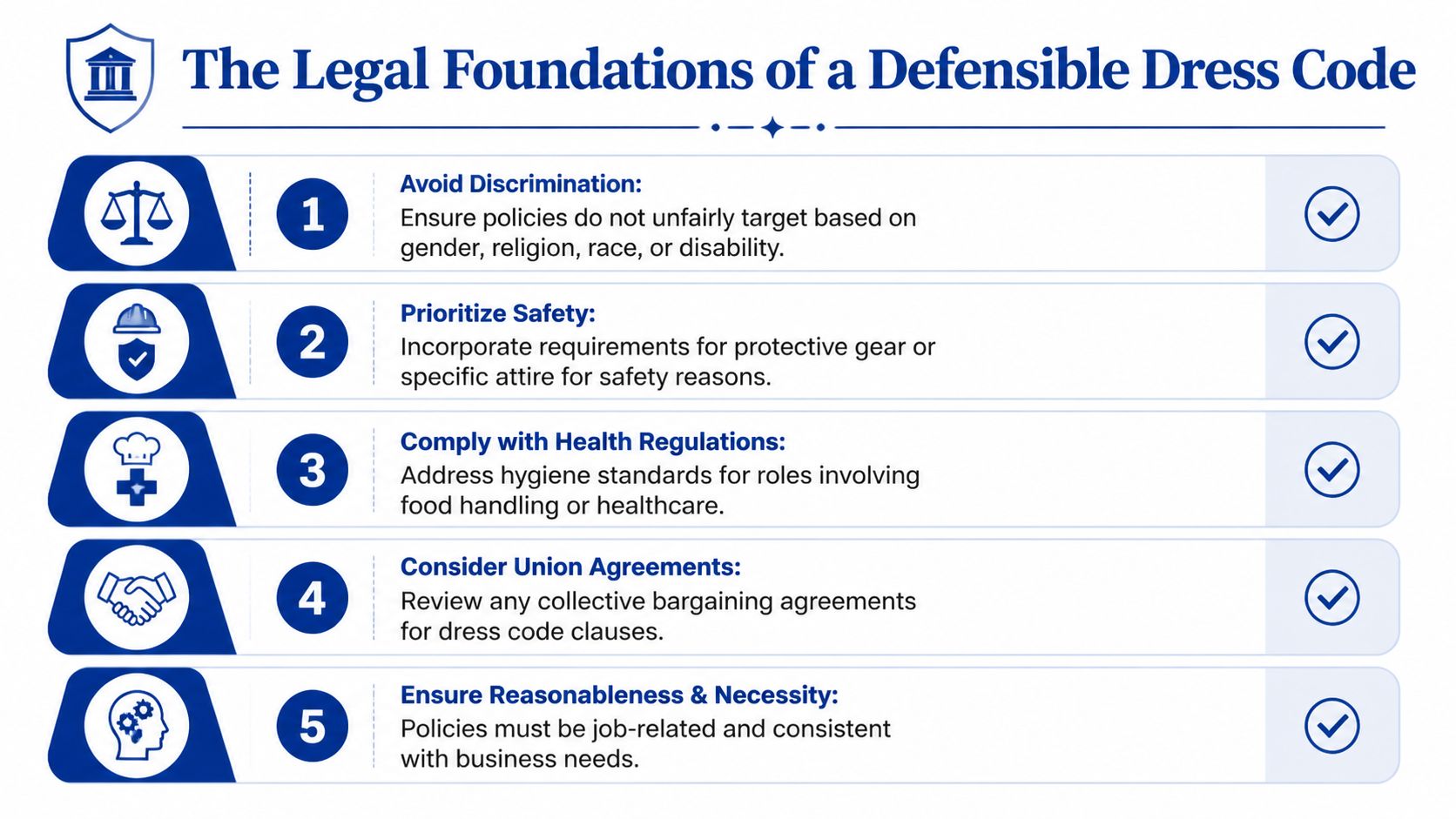
The first legal weakness is imprecision. Policies that use undefined terms like “neat” or “professional” without specific examples trigger subjective enforcement that disproportionately impacts protected class members, as noted in Workable’s dress code policy guidance.
If your policy says “dress professionally,” each manager will fill in the blanks differently. One may focus on cleanliness. Another may focus on fashion. Another may react to hairstyles, cultural dress, piercings, or gender presentation even if none of those issues affect the job.
A better policy names examples. If closed-toe shoes are required, say that. If client-facing staff must wear collared shirts or company-issued scrubs, say that. If graphics on clothing are prohibited, describe the standard.
Most dress code disputes for SMBs fall into a handful of categories:
| Risk area | What goes wrong | Better approach |
|---|---|---|
| Gender expression | Rules require men and women to dress differently in rigid ways | Use equivalent appearance standards, not sex-based clothing mandates |
| Religion and culture | Headwear, jewelry, beards, or garments are restricted without an accommodation path | Include an explicit request process and evaluate exceptions individually |
| Race and hair policies | Grooming standards treat certain hairstyles as unprofessional | Tie restrictions only to real operational needs, not personal preference |
| Disability | Footwear, fabrics, uniforms, or grooming rules conflict with medical needs | Build a documented accommodation process into the policy |
| Safety and licensing | Rules exist but aren’t connected to actual hazards or regulatory obligations | State the specific safety, hygiene, or professional reason for each restriction |
Every restriction in a defensible policy should connect to a legitimate business need. Usually that means one of a few things: safety, hygiene, client-facing presentation, brand consistency in a defined setting, or licensing requirements in a regulated role.
If you can’t describe why a restriction exists in operational terms, it probably doesn’t belong in the policy.
Businesses often overreach by including personal preferences as if they were compliance requirements. That weakens the entire document. A policy is easier to defend when each rule can be traced back to a job-related purpose.
Certain phrases almost guarantee uneven enforcement unless you define them:
Use this review checklist before rollout:
A dress code policy sample becomes legally stronger when it stops trying to describe style and starts describing job-related standards.
The most effective policy doesn’t read like a fashion manual. It reads like an operating document. It tells employees what standard applies, where it applies, who can answer questions, and how to request an exception.
Current practice has already moved in that direction. 55.8% of employers now use flexible, non-contractual guidelines, according to Onrec’s reporting on workplace attire trends. That shift makes sense for SMBs because non-contractual guidance gives structure without locking the company into overly rigid language.
A clean draft usually includes these parts:
Purpose
State why the policy exists. Keep it tied to business needs such as safety, hygiene, client interaction, brand consistency, or workplace appropriateness.
Scope
Identify who the policy covers. Distinguish between office staff, field employees, remote workers, clinical staff, retail staff, or anyone with specialized requirements.
General standard
Set the baseline expectation in plain terms. Focus on cleanliness, condition of clothing, role suitability, and any environment-specific rules.
Role-based requirements
Spell out where expectations differ. A warehouse, medical office, front desk, and remote team shouldn’t always share identical standards.
Prohibited attire or items
List what isn’t allowed, but only where the restriction is needed and explainable.
Accommodation process
State that employees may request exceptions related to religion, disability, or other protected needs, and identify where those requests go.
Enforcement language
Explain that managers will address issues consistently and privately under the company’s standard corrective action process.
Here is a simple framework many SMBs can start with:
Employees are expected to maintain a clean, work-appropriate appearance that supports safety, professionalism, and the needs of their role. Dress expectations may vary based on job duties, work location, customer interaction, and regulatory requirements. Employees who need an exception to this policy for religious, cultural, medical, or disability-related reasons should contact Human Resources or their designated manager to discuss accommodation.
That opening works because it does three things well. It states the reason. It allows role differences. It creates a path for exceptions.
Avoid broad labels unless you define them. “Business casual” means different things in different companies, so explain it in examples.
For example:
Many first drafts become hard to defend because they include subjective or outdated language. Remove items that rely on personal taste, body type judgments, or assumptions about gender presentation.
A stronger approach is to document observable standards:
A policy should describe conduct and conditions managers can observe, not aesthetics managers can debate.
If you’re using a dress code policy sample as a starting point, treat it as a framework. The final version should reflect your roles, your operating environment, and your actual compliance risks.
A template only helps if it fits the work. The samples below are designed to be edited, narrowed, and reviewed against your actual job duties. If you’re also revising broader handbook language, it helps to align this section with your employee handbook compliance structure so standards, discipline language, and accommodation procedures don’t contradict each other.
This version fits law firms, financial services teams, executive offices, and businesses where external presentation is part of the role.
Sample policy
Employees in designated professional or client-facing roles must maintain business-formal attire during scheduled work hours, client meetings, hearings, presentations, and other events where they represent the company externally. Acceptable attire includes suits, blazers, dress shirts, blouses, slacks, professional dresses, skirts of appropriate length, and dress shoes or equivalent professional footwear. Clothing must be clean, intact, and appropriate to the employee’s duties.
Casual wear, athletic wear, clothing with large graphics, distressed denim, and overly informal footwear are not permitted in these settings. Equivalent professional options are permitted regardless of gender identity or expression. Employees needing a modification for religious, medical, disability-related, or cultural reasons should request an accommodation through the company’s designated process.
This is the best starting point for many administrative, professional, and hybrid office teams.
Sample policy
Employees are expected to wear business casual attire appropriate to their role and workday activities. Acceptable clothing includes slacks, chinos, blouses, collared shirts, sweaters, modest dresses, skirts, and other comparable attire suitable for an office environment. Clean, non-distressed denim may be permitted when approved by the company or manager for regular office days that do not involve external meetings.
Clothing with offensive language or imagery, excessively revealing garments, and attire unsuitable for a professional office setting are not permitted. Managers may require a more formal standard for interviews, client meetings, presentations, or special events. Requests for accommodation or exceptions should be directed to Human Resources or the designated company contact.
This works for creative teams, internal operations groups, and businesses that don’t need a polished client-facing look every day but still need guardrails.
| Best fit | Main strength | Main caution |
|---|---|---|
| Creative or internal teams | Supports comfort and culture | Must still define clear limits |
| Low client exposure | Easier employee adoption | Managers may over-personalize enforcement |
Sample policy
The company allows casual attire for employees whose roles do not require formal or customer-facing dress. Clothing should be clean, in good condition, and appropriate for a shared work environment. Casual wear such as jeans, simple shirts, and everyday footwear may be acceptable unless safety requirements or scheduled business activities require a different standard.
Clothing that contains offensive content, creates a safety issue, or is not appropriate for workplace interaction is not allowed. Employees must adjust their attire when attending external meetings, participating in interviews, or entering work areas with different safety or presentation standards. The company will consider requests for religious, medical, disability-related, or cultural exceptions through its accommodation process.
This is for healthcare, manufacturing, labs, food handling, and other regulated or hazard-sensitive operations.
Sample policy
Employees working in clinical, production, laboratory, food-handling, or other safety-sensitive environments must comply with all job-specific dress and protective equipment requirements. Required attire may include scrubs, uniforms, protective footwear, hair restraints, gloves, identification badges, or other role-based equipment. Clothing and grooming must support hygiene, infection control, safety, and regulatory compliance where applicable.
Items that interfere with safety equipment, create contamination risk, or conflict with operational requirements are not permitted in designated work areas. Any appearance-related restriction under this policy is based on job duties and workplace safety, not personal preference. Employees who need a modification for religious practice, disability, or medical need should raise the request promptly so the company can evaluate available accommodations.
Don’t choose the strictest version because it feels safer. That often creates more problems than it solves. Choose the version that matches actual business conditions, then tighten only the parts that have a clear operational reason.
A few editing rules help:
A dress code policy sample is useful when it reduces guesswork. It becomes risky when it copies someone else’s workplace instead of yours.
Most dress code liability doesn’t come from the written rule. It comes from how managers apply it. One supervisor ignores a violation. Another disciplines it immediately. A third comments on someone’s appearance in a way that sounds personal, not policy-based.
That’s why enforcement has to be structured. Inconsistent enforcement is a primary source of dress code litigation, and documented monitoring protocols with dated entries, specific violations, and consistent escalation steps strengthen the employer’s position, according to Qandle’s dress code policy guidance.
Managers need a repeatable process, not improvisation.
Address it privately
Never correct a dress code issue in front of peers unless there is an immediate safety concern.
Reference the policy, not personal taste
The conversation should point to the written standard and the role requirement.
State the needed correction
Be direct about what needs to change today and what applies going forward.
Document the interaction
Record the date, the issue observed, what standard applied, what was said, and the employee’s response.
Escalate consistently
Follow the same corrective action sequence used for similar issues across employees and locations.
A useful script is short and neutral:
“I want to speak with you privately about today’s attire because it doesn’t meet the dress standard for your role. Our policy requires [specific standard]. For today, we need to correct that by [specific action]. Going forward, please follow the written guideline. If there’s a medical, religious, or other reason this standard creates a problem, let me know and we’ll direct that through the appropriate process.”
That script works because it avoids judgment words. It doesn’t mention attractiveness, body shape, or assumptions about intent.
Another version for recurring issues:
“We’ve discussed this standard before, and I need to document today’s conversation. This is about applying the same policy consistently across the team. I’m noting the specific requirement, today’s issue, and the expectation going forward.”
If the issue is worth addressing, it’s worth documenting. A practical checklist includes the same elements you’d want in any corrective record. Teams that need a tighter process often benefit from using the same standards they apply in broader employee discipline documentation practices.
Use a record that includes:
| Mistake | Why it creates risk | Better practice |
|---|---|---|
| Public correction | Feels humiliating and can trigger complaints unrelated to attire | Speak privately unless immediate safety action is required |
| Different rules by manager | Creates disparate treatment arguments | Train supervisors on examples and escalation steps |
| Personal commentary | Turns a policy discussion into a perceived appearance judgment | Stick to observable policy language |
| No documentation | Leaves the business unable to show consistency | Log each conversation promptly |
“Address the policy, not the person’s body, style, or identity.”
If you want a dress code policy sample to be viable in practice, write the manager script at the same time you write the policy. That’s where many SMBs fail. The wording in the handbook is usually not the wording managers use under pressure.
The hardest dress code issues usually aren’t everyday violations. They’re exceptions. An employee needs different footwear because of a medical condition. Another wears religious headwear. Another raises concern that a grooming rule conflicts with state protections tied to hair or cultural expression. These situations need a process, not a quick judgment.
That matters because employers are required to accommodate disabilities that conflict with dress codes, yet many sample policies offer little practical guidance, as discussed in Wolters Kluwer’s overview of dress code policy issues. For SMBs operating in more than one state, that gap becomes a real compliance problem.
Your policy should say where requests go and who evaluates them. It should not force frontline managers to decide legal questions on the spot.
A workable internal process looks like this:
For teams refining that workflow, this overview of reasonable accommodation under the ADA is a useful companion to the policy language itself.
A policy may be lawful in concept and still create trouble across states if local managers add their own interpretations. That’s where growing companies get exposed. One location treats hairstyle restrictions aggressively. Another allows broad flexibility. A third handles medical footwear requests informally with no record.
The safer model is a core policy with limited local addenda. Keep the main standards company-wide. Track any state-specific restrictions, accommodation requirements, or local protections separately and train managers not to improvise.
If your workforce includes employees who read policies in different languages, a resource like this multilingual HR compliance guide can help you think through how policy translation affects understanding and consistency across locations.
Decision point: When a dress standard intersects with religion, disability, hairstyle protections, or local law, slow the process down and document the reasoning before acting.
A good policy reduces ordinary confusion. A strong process protects the business when facts are less routine. That’s where many companies need more than a template. They need judgment, documentation discipline, and consistent manager execution across every state where they operate.
If your team is building or revising a dress code policy and you want a second set of eyes on defensibility, accommodation language, or multi-state enforcement standards, Paradigm International Inc. helps SMB leadership teams make high-stakes HR decisions with more structure and less exposure.