
Misclassifying an employee is one of the most common—and expensive—mistakes a business can make. It often begins with confusion around the duties test for exempt employees. Think of a correctly classified exempt employee as a three-legged stool: it needs a salary basis, a salary level, and the all-important duties test. If any one of those legs is missing, the entire classification can fall, leaving your business exposed to significant risk.
Getting employee classification right is fundamental to running a compliant and financially sound business. The Fair Labor Standards Act (FLSA) sets the rules for who is eligible for overtime pay, and a mistake can have serious consequences. While salary is part of the equation, the real challenge lies in understanding what an employee actually does day-to-day.
Many business owners assume that a "manager" title or a fixed salary automatically makes someone exempt from overtime. However, federal and state laws look past the job title and focus entirely on the nature of the work performed. This is the heart of the duties test and where compliance often becomes complex.
Failing to classify an employee correctly is not a minor paperwork error. Proper classification is a critical piece of regulatory compliance risk management that protects you from major legal and financial headaches. A single misstep can lead to:
The duties an employee performs are the ultimate deciding factor in their exemption status. A job title or salary alone is never enough to create a defensible classification under the FLSA.
This guide will unpack the trickiest part of the compliance equation—the duties test. We will explain why a job title means very little on its own and how a deep understanding of actual job duties is key to building HR practices that can withstand scrutiny.
If you have questions about your current employee classifications, it may be time for an expert opinion. You can contact our team to discuss your specific situation.
At its core, the duties test for exempt employees is the government's method for looking past job titles to determine what an employee actually does daily. It is the Fair Labor Standards Act's (FLSA) reality check, designed to separate employees performing high-level, business-critical work from those handling more routine tasks. It is a qualitative analysis, not a simple checklist.
This is precisely why a job description is only a starting point. The real proof is in the work itself. An employee's exempt status depends on their primary contributions aligning with specific criteria defined by federal and, in some cases, state law.
The duties test centers on an employee’s primary duty—the main, most important work they perform. This is not always determined by what they spend the most time on. For example, a store manager might spend considerable time helping customers or stocking shelves (non-exempt work), but if their most critical contribution is making hiring decisions and setting schedules, their primary duty could still be considered exempt.
You must look at the job as a whole and weigh the importance of different responsibilities. This is a common tripwire for businesses. They see some managerial tasks on a job description and assume the employee automatically passes the test, but that is often a costly mistake.
A key principle of the duties test is that job titles are irrelevant. An "office manager" who primarily performs clerical work does not become exempt just because of their title. The substance of the work is all that matters.
This decision tree shows how the duties test fits into the larger picture, following the salary basis and salary level tests.
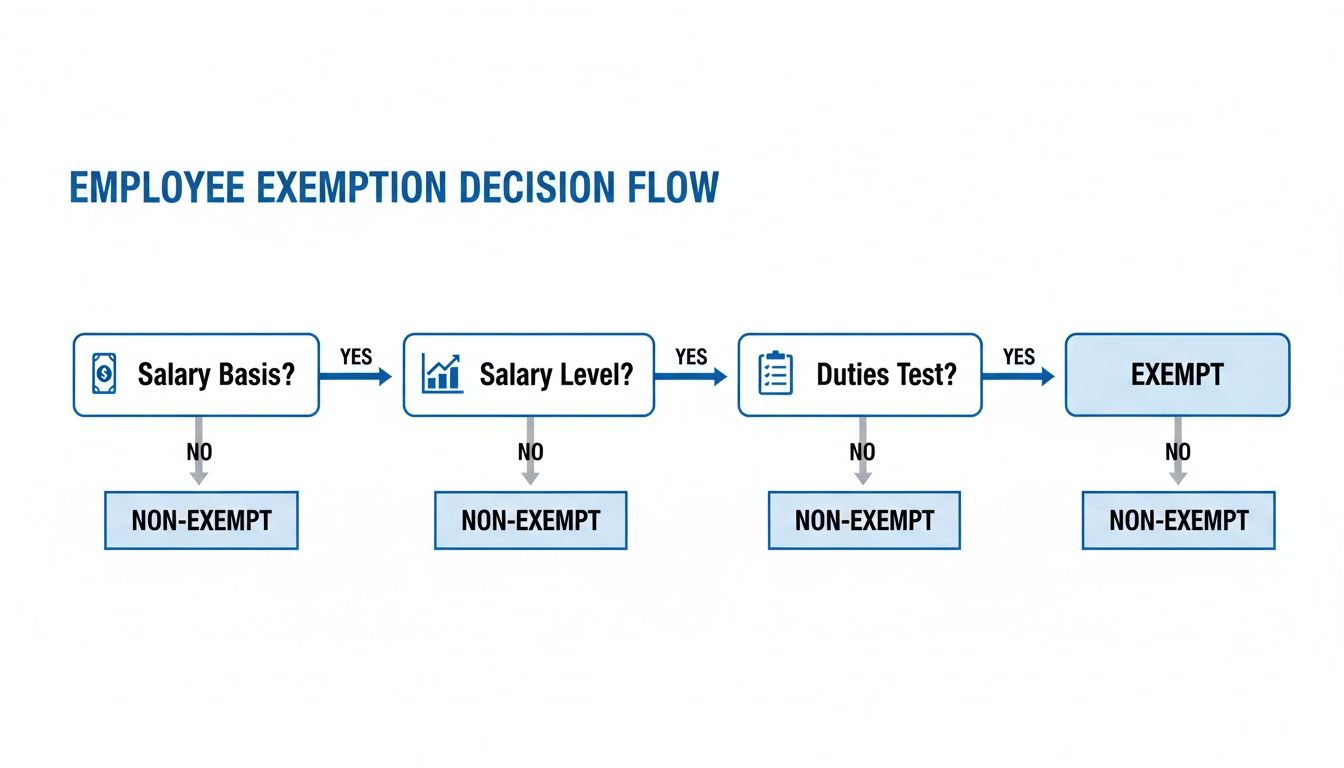
As you can see, the duties test is the final and most subjective step. It requires a careful, honest look at what an employee truly contributes to the business.
The FLSA establishes several "white-collar" exemption categories, each with its own specific duties test. The most common ones you will encounter are:
These exemptions are the foundation for classifying salaried employees under the FLSA, ensuring that only those in genuine executive, administrative, or professional roles are exempt from overtime pay. Federal law also requires a minimum salary; as of early 2024, the standard threshold is $684 per week (about $35,568 annually). For a deeper dive, you can review details about the duties test on bamboohr.com.
Each of these categories comes with a detailed list of requirements that must be met. Getting these classifications right is essential for making defensible decisions and avoiding compliance errors.
Navigating these detailed rules can be a challenge. If you need a second set of eyes on your employee classifications, our team is available to help.
To successfully apply the duties test for exempt employees, you must become familiar with the specific rules for each major exemption. While the Fair Labor Standards Act (FLSA) has several classifications, most businesses primarily deal with a handful. Each has a unique set of criteria that requires you to look beyond the job title and focus on what the employee actually does daily.
Think of these categories as different blueprints for an exempt role, each with non-negotiable requirements. If an employee's job does not perfectly match the specific blueprint, classifying them as exempt will not hold up under scrutiny. The key is to match the reality of the job to the letter of the law.
This table summarizes the primary duties required for an employee to qualify under the main federal exemption categories.
Remember, this is just a high-level summary. The real test is in the details, so let's break down what each of these means for your business.
The Executive Exemption is intended for true managers but is one of the most commonly misapplied categories. It is often assigned to senior employees or "team leads" who lack genuine managerial authority. To qualify, an employee’s primary duty must be managing the business or a recognized department.
The employee must also meet two additional critical tests:
A "working foreman" who spends most of their time doing the same tasks as their team, while occasionally handing out assignments, almost never qualifies. Management must be their most important duty.
The Administrative Exemption is arguably the most nuanced and is at the center of countless lawsuits. It applies to employees whose main job is performing office work directly tied to the management or general business operations of the company. This is a critical distinction—the work must be about running the business itself, not producing the product or service the company sells.
The second part of the test is equally important: the employee’s primary duty must include exercising discretion and independent judgment on matters of significance. This means they are evaluating different courses of action and making a decision after weighing the options, not simply following a manual or needing constant supervision. For more context, you can learn more about exempt vs nonexempt status in our detailed guide.
An employee who exercises discretion and independent judgment can often bind the company on significant matters, even if their decisions are later reviewed. This authority to act on behalf of the business is a hallmark of the administrative exemption.
The Professional Exemption splits into two distinct paths: the Learned Professional and the Creative Professional. Each has its own duties test, and it is crucial not to confuse them.
This category covers jobs that demand advanced knowledge in a field of science or learning, typically gained through a prolonged course of specialized study.
This exemption is for employees whose primary job requires invention, imagination, originality, or talent in a recognized artistic or creative field.
While the three main exemptions cover most office roles, a few others are vital for specific industries.
Each of these categories provides the framework for the duties test. A clear-eyed, honest assessment against these standards is the only way to ensure your classifications are defensible.
Even with the best intentions, employee classification is tricky, and misclassification happens far too often. The first step to avoiding costly mistakes is understanding where businesses commonly go wrong. Errors in applying the duties test for exempt employees can expose your company to serious financial and legal risk, often stemming from simple assumptions about job titles or an employee's perceived independence.
These are not minor paperwork errors; they are financial landmines. The Department of Labor recovered $274 million in back wages in fiscal year 2023 alone from misclassification and other wage violations. When a duties test audit fails, the fallout—back pay, penalties, and legal fees—can be severe. You can read more about these wage recovery findings to understand the scope of this issue.

One of the most common traps involves the executive exemption. A company promotes a high-performing employee to a "manager" role with a salary increase, but their actual day-to-day responsibilities barely change. They gain a title but little real managerial power.
A classic red flag is a manager who cannot make meaningful personnel decisions. To qualify for the executive exemption, an employee’s recommendations on hiring, firing, or promotions must be given significant weight. If they lack influence over these critical decisions, their "manager" title is meaningless for classification purposes.
Another warning sign is a manager who spends most of their time doing the same tasks as their non-exempt team. A retail "shift supervisor" who primarily runs the cash register and stocks shelves will almost certainly not meet the primary duty requirement for management.
The administrative exemption is notoriously ambiguous, and most mistakes come from misunderstanding what "discretion and independent judgment" truly means. It is not just the freedom to decide how to perform a task; it is the authority to make significant business decisions without immediate approval.
Common red flags for this exemption include:
The heart of the administrative exemption is distinguishing between employees who help run the business and those who perform its day-to-day operational or clerical tasks.
The "Office Manager" title is another frequent source of misclassification. While it sounds administrative, the reality of the role is often very different. Many office managers spend most of their time on routine tasks that, while essential, are not exempt.
An office manager whose primary duties are ordering supplies, answering phones, processing payroll data, and coordinating office maintenance is performing clerical and support functions. These tasks do not involve the discretion and judgment on significant matters needed to satisfy the administrative exemption. To ensure you handle extra hours correctly for any employee, you can learn more about overtime vs comp time.
Avoiding these traps means looking past job titles and digging into what your employees actually do every day. A proactive audit of your classifications is the best way to protect your business.
If any of these red flags sound familiar, it may be time to review your classifications with an expert. Our team is here to help you navigate these complex rules. Please reach out to us to schedule a consultation.
For businesses operating across state lines, federal FLSA compliance is only the beginning. When federal and state laws overlap, you must follow the rule that offers the greatest protection to the employee. This adds significant complexity to the dutes test for exempt employees, transforming a single set of federal rules into a patchwork of local requirements.
This is especially true for companies with remote teams or physical locations in multiple states. An employee classification that is perfectly defensible in one state could be a clear violation in another. These differences often appear in two key areas: higher salary thresholds and stricter duties requirements.
While the federal duties test focuses on an employee's "primary duty" without a strict time percentage, some states define a specific threshold. California is a prime example. To qualify for most white-collar exemptions there, an employee must spend more than 50% of their work time on exempt-level duties, a much more rigid standard than the federal rule.
This means a manager in Texas might be properly exempt even if they spend considerable time on non-exempt tasks, as long as management is their most important function. That same manager in California would likely be misclassified if their managerial tasks do not occupy the majority of their week. Our article on managing remote worker compliance offers more insights on this topic.
In addition to stricter duties tests, many states and even some cities have set their own minimum salary thresholds for exempt employees, which are often substantially higher than the federal level. New York, for instance, has different salary minimums based on location, with higher requirements for New York City and its surrounding counties.
For businesses operating in multiple states, compliance is about adhering to the strictest applicable rule for each employee, whether it’s a higher salary floor in New York or a more demanding duties test in California.
For small and mid-sized businesses, these multi-state risks are amplified. California, for example, requires exempt employees to earn at least double the state minimum wage for full-time work, which is roughly $66,560 in 2024. Missteps can lead to Department of Labor audits and significant penalties. For a closer look at these state-specific challenges, you can discover more insights about the duties test on bamboohr.com.
Successfully managing a distributed workforce means moving beyond a federal-only mindset. You need a localized compliance strategy to ensure every employee classification is defensible, no matter where they are located.
If you are navigating the complexities of multi-state employment law, our team can provide the expert guidance needed to maintain defensible HR practices. Contact us to learn how we can help protect your business.
A proactive audit is your best defense against a misclassification claim. Regularly reviewing your exempt positions ensures your classifications remain accurate and defensible. Think of it as a necessary health check for your compliance practices, allowing you to spot and fix issues before they become costly liabilities.
The goal is to create a clear, logical, and documented trail that proves you have done your due diligence. By systematically evaluating each exempt role against the relevant duties test, you build a powerful record that can withstand scrutiny from the Department of Labor or in a legal challenge. This turns compliance from a reactive scramble into a proactive strategy.

A successful duties test audit follows a structured, step-by-step process. This framework ensures you gather the right information, analyze it correctly, and document your conclusions thoroughly.
Your job descriptions are more than just recruiting tools; they are foundational documents in a compliance audit. However, they are only useful if they reflect reality. A common pitfall is writing aspirational job descriptions that list ideal duties rather than the tasks an employee actually performs.
During your audit, update these documents to be as accurate as possible. Focus on:
A well-documented classification decision should tell a clear story. An auditor should be able to read your notes and understand exactly how you concluded that a role met—or failed to meet—the duties test for exempt employees.
Documentation is your best protection. A verbal explanation after a claim has been filed is far less powerful than a contemporaneous record showing your careful analysis. A classification worksheet is an excellent tool for this purpose.
For each exempt position, your worksheet should include:
By building this audit and documentation process into your regular HR functions, you create a system of ongoing compliance. This not only protects your business from risk but also demonstrates a commitment to fair and lawful pay practices.
Navigating a full compliance audit can be a detailed process. If you need support in reviewing your exempt classifications, our team is ready to help. Contact us to learn more about strengthening your HR practices.
Even with a good handle on the rules, applying the duties test for exempt employees brings up specific, real-world questions. Getting the details right on primary duties, salary rules, and audit frequency is what keeps your classifications defensible. Let's address some of the most common questions from business leaders and HR professionals.
No. This is one of the most dangerous and widespread myths in wage and hour law. Paying a salary only satisfies the "salary basis" requirement. To be properly classified as exempt, an employee must also meet the minimum salary threshold and pass a specific duties test. You can pay a non-exempt employee a salary, but you still owe them overtime for any hours worked over 40 in a workweek.
An employee's primary duty is their main, most important function—the core reason the job exists. While the time spent on certain tasks is a factor, it is not a simple numbers game under federal law. The focus is on the nature and importance of the work itself.
To determine an employee's primary duty, weigh the importance of their exempt duties against their other tasks. Also consider their level of freedom from direct supervision and how their salary compares to what non-exempt employees earn for similar, routine work.
Getting this wrong can be financially devastating. If an employee is found to be incorrectly classified as exempt, the business is liable for up to two years of unpaid overtime—or three years if the violation is deemed willful. On top of that, you will likely have to pay an equal amount in liquidated damages, which effectively doubles the back pay owed. This kind of mistake can easily trigger wider government audits and class-action lawsuits.
As a best practice, you should review employee classifications at least annually and anytime a job’s duties change significantly. Roles are not static; they evolve with business needs. A position that was correctly classified a year ago might not meet the duties test today. Regular audits are your best defense, especially when your company is growing or reorganizing.
Staying ahead of compliance challenges requires proactive, expert guidance. If you need a trusted partner to help you build a stronger, more compliant organization, we invite you to learn more. The team at Paradigm International Inc. specializes in helping business leaders navigate high-stakes employment decisions and maintain defensible HR practices. Contact us today to see how we can help.