Crafting an employee handbook is more than an HR task; it's a critical business strategy. This document serves as a roadmap for your team, outlining expectations, policies, and procedures that define your workplace culture. For businesses operating in multiple locations, however, navigating the complex web of employee handbook requirements by state can be a significant challenge. Federal laws provide a baseline, but state and even city regulations often add layers of specific rules that demand careful attention.
A well-constructed, state-compliant handbook is your first line of defense against legal risks and a cornerstone of a fair and consistent work environment. It ensures every team member understands their rights and responsibilities, creating clarity and minimizing disputes. This guide breaks down the essential components, helping you build a handbook that is both compliant and effective, no matter where you do business.
Relying on a generic employee handbook is a common but risky approach. While federal laws set the minimum standard for compliance, many states have enacted stricter and more detailed requirements for employers. If your business has employees in more than one state, understanding this fragmented legal landscape is essential for mitigating risk.
Several states, including California, New York, and Illinois, have passed specific laws detailing what policies must be included in an employee handbook. To add another layer of complexity, some cities have their own local mandates. These requirements often cover everything from at-will disclaimers to mandatory training topics. You can learn more about handbook requirements and compliance standards that frequently impact multi-state businesses.
Ultimately, a state-compliant handbook serves three core purposes:
It’s important to note that handbook policies are distinct from mandatory notices you must display in the workplace. For information on those requirements, see our guide on labor law posters by state. This guide, however, focuses on the policies you must write into your handbook.
Navigating the web of state-specific employee handbook requirements can feel daunting, but a solid set of core policies creates an essential foundation. Think of these as the backbone of a legally sound handbook—the foundational statements that regulators and courts expect to see. They spell out your company's core principles and set clear, consistent expectations for every person on your team.
Getting these policies right is more than just a compliance checkbox. It's a critical step in minimizing legal exposure and establishing a professional, well-defined employment relationship. These are the non-negotiable building blocks of your entire HR compliance strategy.
Two of the most critical policies are your Equal Employment Opportunity (EEO) statement and the at-will employment disclaimer. The EEO policy is your public commitment to maintaining a discrimination-free workplace. It should affirm that you follow all federal, state, and local anti-discrimination laws and state that employment decisions are based on merit, not protected characteristics.
Just as critical is the at-will employment disclaimer. This clause clarifies that either the employer or the employee can end the relationship at any time, for any lawful reason, with or without notice. Including this language is a universal best practice that helps defend against wrongful termination claims, though some states have specific rules for how it must be phrased.
A well-defined at-will disclaimer is crucial. It prevents the handbook from being misinterpreted as an employment contract, which could unintentionally create promises of job security that do not exist.
Beyond legal disclaimers, your handbook needs to clearly outline the standards of behavior expected in your workplace. These policies provide straightforward guidance to employees and give you a defensible basis for disciplinary action if needed.
Key conduct policies should always include:
These policies are not just about establishing rules; they are about cultivating a secure, ethical, and productive environment. When assembling your handbook, using a quality employee handbook template can be a significant help in structuring these essential sections. For a deeper look at what policies are considered non-negotiable, you can also review our guide to mandatory employee policies.
By clearly articulating these core policies, you create a handbook that serves as both a practical guide for your team and a powerful risk management tool. These foundational elements are the starting point for building a comprehensive and state-compliant document.
Policies on harassment and workplace safety are among the most heavily regulated parts of any employee handbook. While federal law sets a baseline, many states have introduced their own detailed rules. These often dictate specific policy language, reporting procedures, and even mandatory training, making this a high-stakes area for any employer.
Complying with these state-specific rules is non-negotiable. States like California, New York, and Illinois have established stringent requirements that have become best practices nationwide. Falling short not only exposes your business to serious legal risk but also undermines efforts to build a safe and respectful work environment.
A strong anti-harassment policy is more than a legal formality; it's a foundational commitment to your team's safety and well-being. To be both compliant and effective, your policy must be clear, accessible, and actionable. There should be no ambiguity about what is expected of every person in your organization.
To meet legal standards in most states, your policy must include several key components. These are the core elements of a defensible and practical anti-harassment framework.
Your policy must include these essentials:
Simply having a policy is not enough. Courts and government agencies will examine whether you took reasonable steps to prevent and correct harassing behavior. A well-communicated and consistently enforced policy is your best defense.
While a good policy is the foundation, states are increasingly demanding more. A clear trend shows states are making harassment prevention and workplace conduct requirements more rigorous, especially regarding training.
For instance, some jurisdictions now require annual sexual harassment prevention training for managers and employees. Other states have mandated workplace violence prevention plans and training. You can get a better sense of how workplace safety standards are evolving to stay ahead of the curve.
This shift proves that your handbook cannot be a "set it and forget it" document. It must be a living guide that adapts to new laws. Understanding these employee handbook requirements by state is the first step, but follow-through with effective training is what truly builds a compliant and safe workplace.
Leave and time-off policies are a significant challenge for multi-state employers. While federal laws like the FMLA create a baseline, a rapidly growing number of states and cities have passed their own laws on paid sick leave, family leave, and other protected time off. This creates a complex environment where a policy that is compliant in one state could be illegal in another.
Understanding these distinct employee handbook requirements by state is absolutely critical. A generic, one-size-fits-all PTO policy often fails to meet the specific accrual rates, usage rules, and documentation standards that different jurisdictions demand.
The number of states with paid sick leave (PSL) requirements continues to grow. These laws generally require employers to provide a certain amount of paid leave, often accrued at a rate like one hour for every 30 or 40 hours worked. This time can typically be used for an employee's own illness, to care for a sick family member, or for issues related to domestic violence.
Take New York, for example. The state has a mandatory paid sick leave law and also requires paid breaks for lactation. Beginning in 2025, it will also provide paid prenatal leave. You can find more details in our guide on NY paid sick leave requirements.
This chart shows how some states are now adding specific training mandates on top of their policy requirements, which adds another layer of complexity.
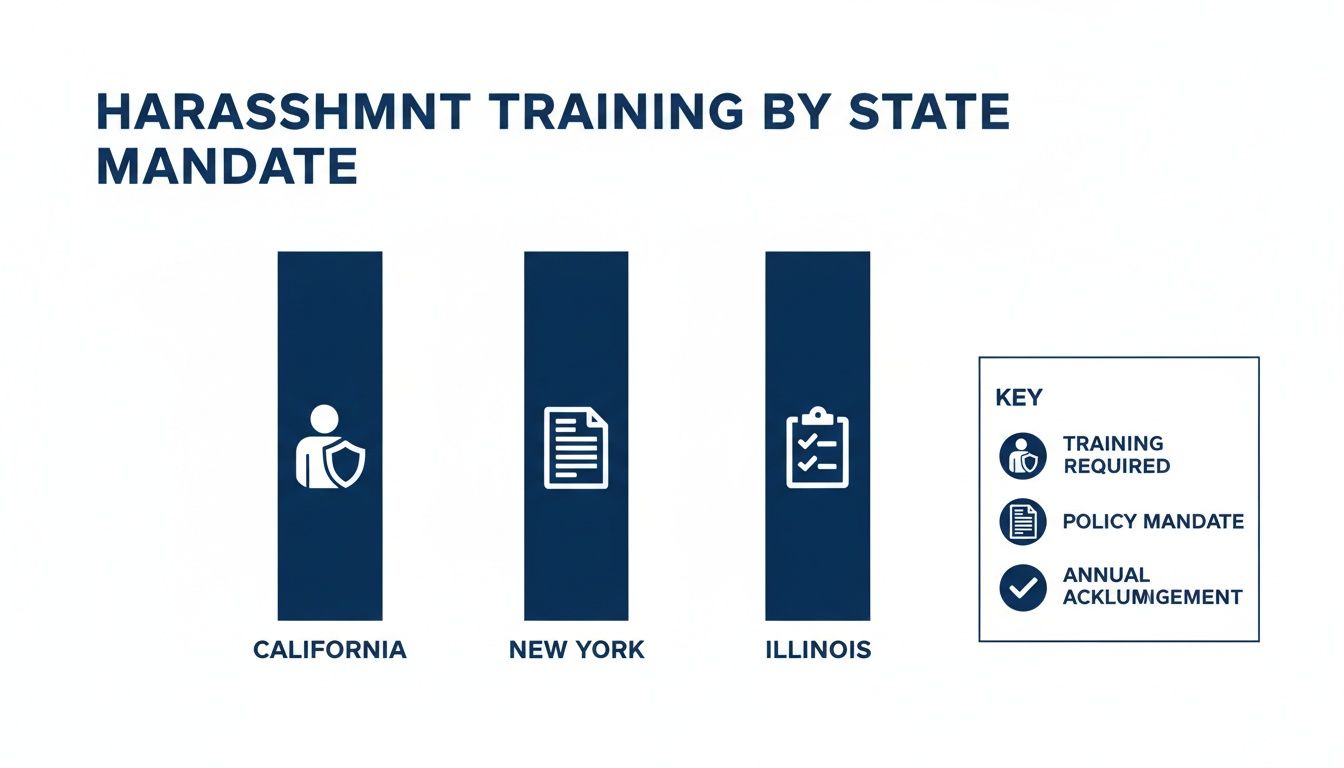
As you can see, states like California, New York, and Illinois have gone beyond just having written policies and now require employers to conduct active training and keep records.
Beyond sick leave, a significant number of states have also rolled out paid family and medical leave (FML) programs. As of today, ten states and Washington, D.C., have mandatory paid FML programs in place, with several more preparing to launch. These are state-run insurance programs that provide partial wage replacement for extended periods.
A critical takeaway: Your company's general PTO policy might not satisfy the specific rules of state-mandated paid sick leave laws. You'll often need a separate, compliant PSL policy or a state-specific addendum in your handbook to stay out of trouble.
To help you keep these requirements straight, here’s a quick-reference table summarizing the key details for states with mandatory paid sick leave.
This table provides a snapshot of key provisions in states with mandatory paid sick leave laws, helping you quickly identify your core obligations.
This table is a starting point, but always be sure to check the full state and local regulations, as details like usage reasons, carryover rules, and documentation requirements can vary significantly.
The requirements don't stop with sick and family leave. States mandate several other types of protected time off that must be included in your employee handbook. Overlooking these can easily lead to compliance violations.
Here are some of the most common state-mandated leave policies:
Each of these leave types has its own rules for eligibility, duration, pay, and notice. It is essential for business leaders to carefully review the local laws for every location in which they operate.
Ensuring your handbook’s wage and hour policies are compliant across different states is critical for avoiding expensive lawsuits. While federal law provides a baseline, many states have their own specific rules for pay frequency, final paychecks, and meal breaks that go beyond the Fair Labor Standards Act (FLSA). This is a common area where employers make mistakes, leading to litigation.
Think of this section as a practical guide to staying compliant. A clear, well-documented policy is your first line of defense if an employee ever questions their pay or hours.
Pay frequency is a fundamental issue. You cannot simply decide to pay all employees monthly. Many states dictate how often employees must be paid, such as weekly, bi-weekly, or semi-monthly. Your handbook must clearly state your pay schedule and ensure it is legal in every state where you operate.
An even more urgent matter is the final paycheck. When an employee leaves the company, many states have strict deadlines for providing their final wages. For example, in California, a terminated employee is generally owed their final pay on their last day of work. Other states may give you until the next scheduled payday.
Failing to meet these deadlines can result in significant penalties, sometimes amounting to a full day's wages for each day the final payment is late. Your handbook policy should reflect the strictest state law you are subject to.
Here's a major compliance trap: federal law does not require employers to provide meal or rest breaks. Consequently, many multi-state businesses assume a single, company-wide policy is sufficient. It often isn't. A large number of states do mandate breaks, with specific rules about duration and whether the break is paid or unpaid.
Let's look at a few examples to see how much they vary:
Because these rules are so different, you have two primary options. You can either create state-specific addendums for your handbook or adopt a single policy that meets the requirements of the most demanding state you operate in. Simply stating that "breaks are provided" is not enough to ensure compliance with these detailed employee handbook requirements by state.
The modern workplace is changing rapidly, and your employee handbook must keep pace. Topics like remote work, data privacy, and artificial intelligence now demand clear, well-thought-out policies to manage risk and set expectations. Addressing these issues proactively is no longer optional—it's essential for today's businesses.

Emerging issues like AI usage and remote work have created a new set of compliance considerations. Handbooks should now address artificial intelligence with clear guidelines. If you use AI for hiring or performance reviews, your policies must explicitly require human review and bias mitigation. To stay ahead, discover more insights on what to update in your employee handbook.
If you offer flexible work arrangements, a formal remote work policy is a necessity. This policy should offer specific guidance on what is expected from off-site employees. A solid policy is your best defense against inconsistency and productivity issues, regardless of where your team is located.
Your remote work policy should clearly define:
In our digital world, protecting company and employee data is a top priority. Your handbook needs a strong acceptable use policy governing how employees use company technology. This should prohibit unauthorized access to sensitive information and outline cybersecurity best practices.
A well-defined data privacy policy is not just an IT issue; it’s a core component of your risk management strategy. It helps you comply with growing data protection regulations and reinforces a culture of security.
Additionally, the rise of artificial intelligence brings new challenges. An AI policy should establish clear rules for using automated tools, especially in hiring and performance management. The policy must emphasize the importance of human oversight and fairness to mitigate bias and uphold ethical standards.
Integrating these modern policies ensures your handbook reflects the realities of today's work environment. It shows your commitment to protecting both your business and your people while adapting to new technologies.
Creating a compliant employee handbook is a huge step, but the job isn't finished until it is properly implemented. An excellent handbook that goes unread offers no legal protection. Effective implementation is what transforms that document into a genuine risk management tool.
The first step is distribution. You must ensure every employee receives a copy, whether it's delivered via email, posted on a company portal, or provided as a physical document. Universal access is the goal.
Simply distributing the handbook isn't enough; you need proof that employees received it. The employee acknowledgment form is essential for this purpose. This signed document confirms the employee received the handbook and understands their responsibility to read and adhere to its policies.
While not every state legally requires a signature, it is a universal best practice you should never skip. That signature can be a key piece of evidence in a legal dispute, such as a wrongful termination claim where an employee alleges they were unaware of a specific policy.
A solid acknowledgment form should include these key points:
If you have a multilingual workforce, consider translating the acknowledgment form. Ensuring employees fully understand what they are signing is critical for the document's effectiveness.
Once you have the signed forms, they should be stored securely in each employee's personnel file for their entire tenure and for a specific period after they leave, according to state record retention laws. This is a critical compliance step.
Finally, remember that your handbook is a living document. Laws change, and your policies must keep up with the latest employee handbook requirements by state. Plan to review and update your handbook at least annually with legal counsel. This ongoing maintenance ensures your handbook remains relevant, compliant, and a valuable asset to your business.
When dealing with employee handbook requirements across different states, several common questions often arise. Business owners and HR leaders frequently face similar compliance hurdles, especially when their operations span multiple jurisdictions. Getting clear, practical answers is the first step toward building a protective HR framework.
This section addresses some of the most frequent questions about handbook compliance, providing straightforward answers to help you make informed decisions.
You should review your employee handbook at least once a year. Consider it an annual check-up, ideally conducted with legal counsel, to ensure your policies align with the latest federal, state, and local laws. However, don't wait for the annual review if a major new law passes or you expand into a new state—act immediately.
A proactive approach is always best. Significant legislative updates can happen at any time, and an outdated handbook poses a compliance risk you cannot afford.
Not necessarily. Many multi-state employers find it more manageable to use a single core handbook with state-specific addendums. This strategy allows you to maintain consistent company-wide policies while isolating unique state mandates into separate, easy-to-update sections.
Another effective approach is to adopt the rules of the most restrictive state you operate in and apply them across the entire company. The best choice depends on the complexity of the state laws and what your team can reasonably manage.
For example, if you operate in both California and a less-regulated state, you might adopt California’s stricter meal and rest break policy for all employees. This simplifies administration, though it may increase operational costs slightly.
While only a few states technically require a signed acknowledgment, it is a universal best practice that should be non-negotiable for any business. The signed form serves as your proof that an employee received the handbook and was aware of the company's policies and expectations.
This simple document can become critical evidence if you are defending against a wrongful termination, discrimination, or unemployment claim. It establishes that the employee knew the rules, which is vital for demonstrating that your actions were based on clearly communicated policies.
Navigating the complexities of multi-state compliance is a core challenge for growing businesses. A well-crafted employee handbook is an essential tool, but it's just one piece of a comprehensive HR strategy. Ensuring your practices are defensible across state lines requires ongoing diligence and expertise.
At Paradigm International Inc., we act as a decision partner for leadership teams, helping them maintain defensible HR practices. Learn more about how we help reduce employment risk.