Misclassifying an employee as an independent contractor is a common mistake, but one with severe consequences. This is not just a simple administrative error; it can trigger a cascade of back taxes, steep fines, and even criminal charges, turning a small oversight into a significant liability. The true cost of employee misclassification penalties creates a ripple effect, impacting your operations, reputation, and bottom line for years to come.

Employee misclassification occurs when you label a worker as a 1099 contractor, but they legally function as a W-2 employee. This triggers a host of serious consequences. The distinction is not a matter of preference or what an agreement says; it is a matter of law. It governs everything from payroll taxes and unemployment insurance to workers' compensation and wage laws.
Regulators like the IRS and the Department of Labor (DOL) are increasing their scrutiny, especially for businesses operating across multiple states. With this heightened enforcement, the odds of facing an audit are higher than ever. Some states now impose fines up to $50,000 for repeated violations, making it clear that understanding these rules is no longer optional.
At its core, the issue comes down to control. If you dictate a worker’s schedule, methods, and daily tasks, you are almost certainly treating them as an employee, regardless of what their contract says. Regulators will always look past the paperwork to the reality of the working relationship.
While some businesses see misclassification as a way to cut overhead, the potential penalties far outweigh any short-term savings. A single mistake can create risk on multiple fronts. An audit can trigger liabilities across several areas at once:
It is critical for businesses to understand the risks of engaging employees as sham contractors. Courts consistently prioritize the substance of a working relationship over contractual language. Simply having a signed independent contractor agreement offers no real protection if your day-to-day practices demonstrate an employer-employee dynamic.
This guide will break down the specific employee misclassification penalties and offer clear, actionable strategies to keep your business compliant. If you manage a growing team, especially one that spans state lines, being proactive about worker classification is one of the most important steps you can take to protect your bottom line.
When it comes to classifying workers, federal agencies can impose significant penalties. A mistake opens your business to scrutiny from two directions: the Internal Revenue Service (IRS) and the Department of Labor (DOL).
These agencies look at the issue through different lenses. The IRS focuses on tax revenue, while the DOL is concerned with fair wages. For a business leader, this means a single misclassification error can trigger a painful and expensive combination of penalties from both. Understanding what each agency looks for is the first step in building a defense.
The IRS makes one critical distinction: was the misclassification an unintentional mistake or was it willful? The answer determines whether you face a costly correction or a potentially business-ending penalty. The fines for an honest mistake are steep, but they are minor compared to what happens when the IRS believes you acted deliberately.
If an audit finds you made an unintentional error, you are still responsible for significant costs. These often include:
This is the best-case scenario, assuming you filed a Form 1099 for the worker. If you did not file any forms at all, those penalty percentages can double, making an expensive mistake even more catastrophic.
The situation becomes much worse if the IRS decides your misclassification was willful or fraudulent. This implies you knew you were violating the law and intentionally tried to evade your tax obligations. In these cases, the penalties are designed to be punitive and can even lead to criminal charges.
If an employer willfully misclassifies an employee, they may be subject to criminal penalties, including up to $1,000 in fines and one year in prison per violation. The employer is also held responsible for all back taxes, and the fines from the IRS can be crippling.
Penalties for willful misclassification can include:
Entirely separate from the IRS, the Department of Labor (DOL) enforces the Fair Labor Standards Act (FLSA). The DOL’s main purpose is to ensure workers receive minimum wage and overtime pay. Since independent contractors are not protected by the FLSA, misclassifying an employee almost always results in wage and hour violations. You can explore the specific criteria defining employee status by reviewing the duties test for exempt employees.
If the DOL finds a violation, its penalties add another heavy layer of financial burden on top of what the IRS imposes. An estimated 10-20% of employers misclassify at least one worker, and government agencies are cracking down. The IRS now actively shares audit data with state agencies to coordinate enforcement, exposing businesses to multiple penalties at once.
A DOL audit can result in:
Dealing with federal misclassification risk requires a proactive approach. With the dual threat from the IRS and the DOL, a single mistake can set off a chain reaction of compounding financial penalties.
While federal rules set the baseline for misclassification penalties, the real minefield for multi-state businesses is at the state level. State enforcement is often more aggressive, inconsistent, and unpredictable. What may be a minor issue in one state can be a major violation with crippling fines in another.
Each state has its own tests, rules, and penalties for worker classification. These rules directly impact state unemployment insurance (SUI), workers' compensation, and income tax withholding. This creates a daunting compliance puzzle where one misstep can trigger a domino effect of consequences, from stop-work orders to personal liability for company leaders.
Certain states are notoriously strict, deploying legal frameworks like the "ABC test" that make it very difficult to classify a worker as an independent contractor. California is a prime example, where Assembly Bill 5 (AB5) established a high bar for proving contractor status. Getting it wrong there can lead to staggering penalties that can easily destabilize a growing business.
For example, FedEx was forced to pay a $228 million settlement in California for misclassifying over 2,000 drivers. This case is a stark reminder of the serious financial risks involved, as detailed in this comprehensive guide on international worker classification.
Other states, like New Jersey, are following suit by increasing their enforcement budgets, resulting in more audits and steeper fines. New Jersey also uses a stringent ABC test, presuming a worker is an employee unless the business can prove all three conditions of the test are met. A repeat violation there can cost up to $1,000 per employee, plus a penalty of up to 5% of the worker’s gross earnings from the past year.
The following visual breaks down the two main federal agencies that handle misclassification—the IRS and the DOL—and the penalties they can impose.
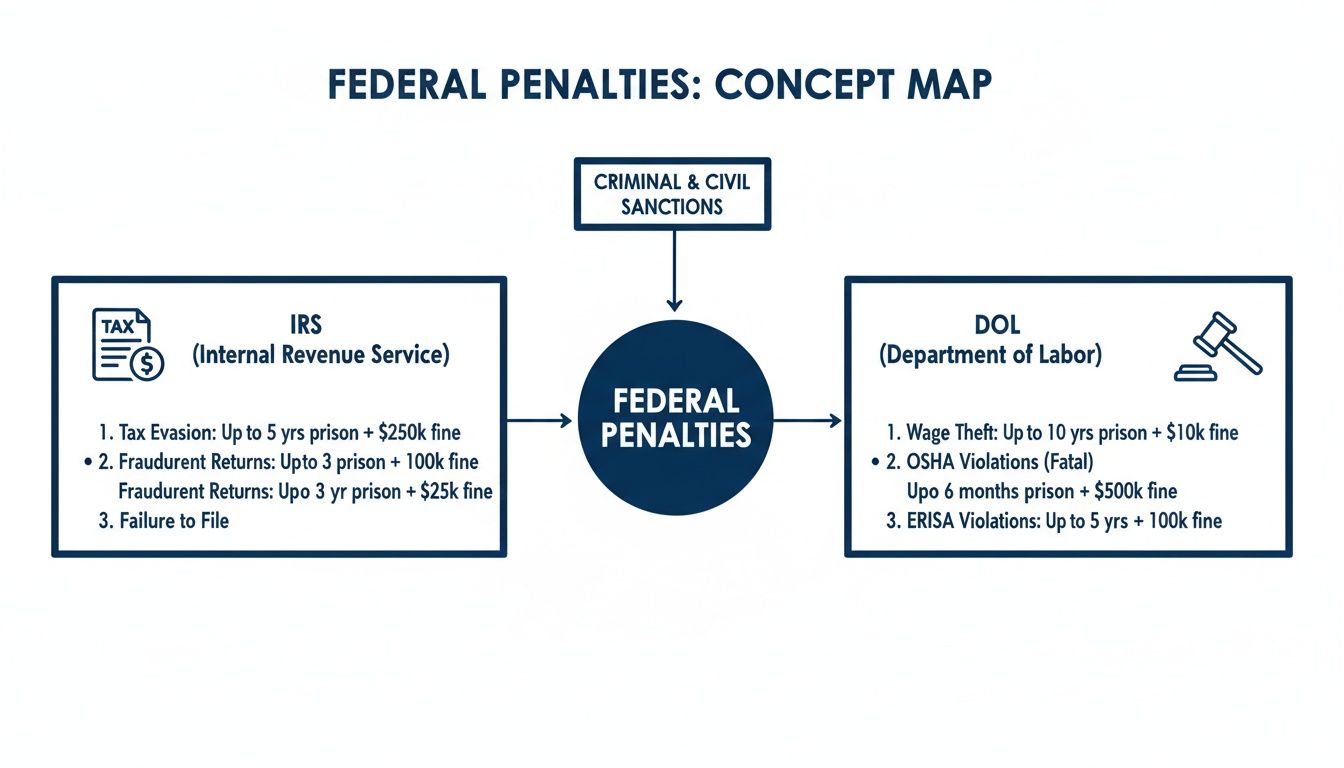
While this map shows the federal layer, remember that states add their own enforcement on top, creating an even more tangled web of potential liability for your business.
To understand the full scope of your risk, it is helpful to see how federal and state enforcement priorities differ. The table below contrasts the primary focus areas for the key agencies involved.
This comparison shows that compliance is not an either/or proposition. A single misclassified worker can trigger parallel investigations at both the federal and state levels, each with its own set of costly penalties.
State-level penalties are not just about writing a check; they can bring your entire operation to a grinding halt. A common misconception is that complying with federal rules automatically ensures safety at the state level. This is incorrect. Many states have stricter definitions of an "employee" and impose harsher penalties that go far beyond federal requirements.
Here are some of the most common state-level penalties to watch out for:
Getting this right from the start is non-negotiable. For a deeper look into the nuances, this guide on Classifying Workers The Right Way offers crucial insights. The patchwork of state laws is a major compliance headache for any business with a distributed team. For hands-on support in managing your state-specific risks, reach out to our advisory team.

While businesses often worry about fines from the IRS or Department of Labor, the true financial fallout from misclassification frequently comes from other places. These secondary consequences can be far more disruptive than government penalties. They pose a very real threat to your company’s stability, operations, and future growth.
The most immediate danger is private litigation. A single misclassified worker can file a lawsuit to recover unpaid overtime, missed meal breaks, or unreimbursed business expenses. Even a modest individual claim can become a major financial headache once you factor in attorney's fees.
The true financial nightmare for any business, however, is the class-action lawsuit. When one worker’s claim is validated, it can open the door for every other person in a similar role to join the suit. Suddenly, you are not dealing with one claim—you are facing dozens or even hundreds of plaintiffs at once.
A class-action lawsuit does not just multiply the potential payout for back wages; it transforms the entire dispute. It becomes a massive, resource-draining battle that can take years to resolve and diverts leadership’s attention away from running the business. These lawsuits often end in multi-million dollar settlements, and the legal fees alone can be crippling.
The fallout from a labor violation is rarely kept private. A government citation or a high-profile lawsuit can inflict severe and lasting harm on your company’s reputation. This creates a new set of business challenges that are difficult to measure but impossible to ignore.
A damaged reputation can appear in several ways:
Even if you avoid a major lawsuit, an agency-ordered reclassification can throw your internal operations into chaos. Correcting payroll, benefits, and HR records for a large group of workers is a massive administrative undertaking. This process involves recalculating back wages, setting up workers in new systems, and correcting past tax filings.
The internal fallout can be just as damaging. Current employees may grow resentful that contractors are now receiving benefits they were previously denied, leading to a decline in morale. Trust between leadership and the workforce can erode, creating a tense and unproductive environment. To learn how to structure your workforce compliantly and avoid these costs, contact us.

When it comes to employee misclassification, a proactive strategy is your best defense. Waiting for a government audit notice means you are already playing from behind. A proactive approach puts you in control, allowing you to build a defensible workforce structure and operate with confidence. This is not just about avoiding fines; it is about building a sustainable and scalable business.
The first step is to audit yourself before the government does. An internal audit is like a health checkup for your business, giving you the chance to spot and fix potential classification issues before they become crises. During this review, you must look at each contractor relationship through the lens of the correct legal tests for every location where you operate.
Key tests to consider in your audit include:
For a deeper dive into these frameworks, it is helpful to understand the core differences between an employee and a contractor. You can learn more in our detailed guide on employee vs contractor classification.
Your independent contractor agreements are a critical line of defense, but only if they reflect how you work together in practice. A contract that calls someone a contractor is worthless if your daily actions treat them like an employee. Your agreement should be a mirror, not a mask, reflecting the genuine independence of the contractor.
A strong agreement will explicitly state that the contractor is responsible for their own taxes, provides their own tools, and is not eligible for employee benefits. The key is to avoid language that dictates how the work gets done and focus instead on the desired outcome or deliverable.
Auditors live by a simple rule: if it is not documented, it did not happen. Keeping meticulous records that prove a contractor’s independence is non-negotiable. This goes beyond just having a signed contract; you need to build a file for each contractor that tells a clear and convincing story.
Effective documentation includes:
The time to get your house in order is before you expand or scale your contingent workforce. Taking these proactive steps gives you a defensible compliance posture and drastically reduces the risk of facing severe employee misclassification penalties.
Receiving an audit notice from the IRS or a state labor agency can be alarming. Your first instinct might be to panic, but a calm, structured, and immediate response is critical. Ignoring the notice is the worst possible move; it signals bad faith and will only escalate the penalties you face. Instead, view the notice as a call to action to demonstrate good faith and take control.
Upon receiving an audit notice, your first step is to assemble your response team. This should include legal counsel specializing in employment law, your accountant, and key internal leaders. Do not attempt to handle the audit alone or communicate directly with the auditor without professional guidance.
Next, gather all relevant documentation for the workers in question. A complete and organized file shows the auditor you are cooperative and transparent. This file should include:
For a deeper dive into what this entails, you might find our HR audit checklist helpful.
Many agencies offer programs that allow businesses to correct misclassification issues while avoiding the harshest penalties. These programs are designed to encourage voluntary compliance, and it is crucial to evaluate if your business is eligible as part of your early strategy. A key example is the IRS’s Voluntary Classification Settlement Program (VCSP), which allows eligible businesses to reclassify workers while paying a substantially reduced penalty.
Participating in a program like the VCSP shows regulators you are committed to fixing the issue. It is a powerful tool for mitigating financial damage. If an internal review uncovers clear misclassification, it is time to launch a formal remediation project.
This proactive step involves several key actions:
Navigating an audit is a high-stakes process where every decision matters. Professional guidance is invaluable in protecting your business from the severe disruption that employee misclassification penalties can cause. If you find yourself in this situation, contact us to discuss how we can support you.
Let's tackle some common questions we hear from business leaders about worker classification. Getting these fundamentals right is the first step toward building a compliant workforce and avoiding the costly pitfalls of misclassification.
Yes, absolutely. A worker’s business structure—like an LLC or S-Corp—does not create a shield against misclassification. While it may suggest independence, regulators look past the paperwork to the reality of your working relationship. If you exert significant control over how, when, and where the work gets done, that individual will likely be seen as an employee. The degree of control you exercise is the deciding factor.
No, you are not. A worker’s preference to be paid on a 1099 form does not override federal and state labor laws. Regulators are clear: the facts of the relationship determine a worker's status, not a mutual agreement. As the hiring business, you carry 100% of the legal and financial responsibility for classifying workers correctly, regardless of what the worker wants. An agreement to misclassify is not a valid defense in an audit.
The IRS and the Department of Labor (DOL) use different primary tests to determine a worker's status. It is critical to understand this distinction because a worker can pass one test and fail the other.
The IRS 'Right to Control' Test: This test centers on the level of control you have over the worker. It examines behavioral control (how the work is done), financial control (who manages the business aspects), and the nature of the relationship.
The DOL 'Economic Reality' Test: This broader test asks a different question: is the worker economically dependent on your business? It looks at factors like the worker’s opportunity for profit or loss, their investment in tools, and the permanence of the relationship.
Even if you meet the IRS's standard for a contractor, the DOL could still classify them as an employee if their livelihood is economically tied to your company.
Managing a multi-state workforce introduces layers of complexity where a single misstep can create significant risk. At Paradigm International Inc., we act as a decision partner for leadership teams, providing the expert judgment needed to navigate high-stakes employment issues. If you need help building defensible HR practices, let's connect.