A lot of business owners are dealing with the same uneasy moment right now. A manager wants software that tracks activity on company laptops. HR is revising a social media policy after an employee complaint. Someone asks whether the company can review Slack messages, personal devices used for work, or off-duty conduct that starts affecting team dynamics.
That's where employee privacy rights stop being an abstract legal topic and become an operating issue. The challenge isn't only deciding what you can monitor. It's deciding what you should collect, why you need it, how long you'll keep it, and whether you can defend those decisions later if an employee, regulator, or plaintiff's lawyer asks hard questions.
For multi-state employers, that pressure compounds fast. One policy written for a single office often won't hold up when you have remote staff, shared systems, outside vendors, and different state rules touching the same employee record. Leaders who want a practical baseline should start with the broader employment law basics for growing employers, then build a privacy framework that fits how their workforce operates.
Employee privacy rights sit at the intersection of supervision, trust, and compliance. Most employers aren't trying to invade privacy. They're trying to protect data, manage productivity, investigate misconduct, and reduce risk. Problems start when those goals are pursued with weak notice, vague policies, inconsistent manager behavior, or no clear limit on what gets collected and retained.
Remote and hybrid work made those gaps harder to ignore. The same employee may work from a home office, use collaboration platforms, access cloud systems, and communicate through channels that blur the line between business records and personal space. That means old assumptions about workplace privacy often don't match current reality.
A defensible approach starts with one simple principle. Privacy risk is usually a governance problem before it becomes a legal problem. If your company can explain its purpose, show what notice was given, limit collection to what is needed, and handle records consistently, you're already in a stronger position.
Practical rule: If a monitoring or data practice would be difficult to explain in writing to the employee, it probably needs to be redesigned before rollout.
Many leaders make the mistake of treating privacy as a handbook paragraph. That doesn't work anymore. Employee privacy rights now touch vendor management, HR workflows, investigations, manager training, and recordkeeping. The employers that handle this well don't rely on guesswork. They build a framework that can survive scrutiny.
In the United States, employee privacy law works less like a single code and more like a patchwork quilt. Different pieces come from different sources, and they don't always fit together neatly. That's why business owners often hear conflicting answers to what sounds like a simple question.
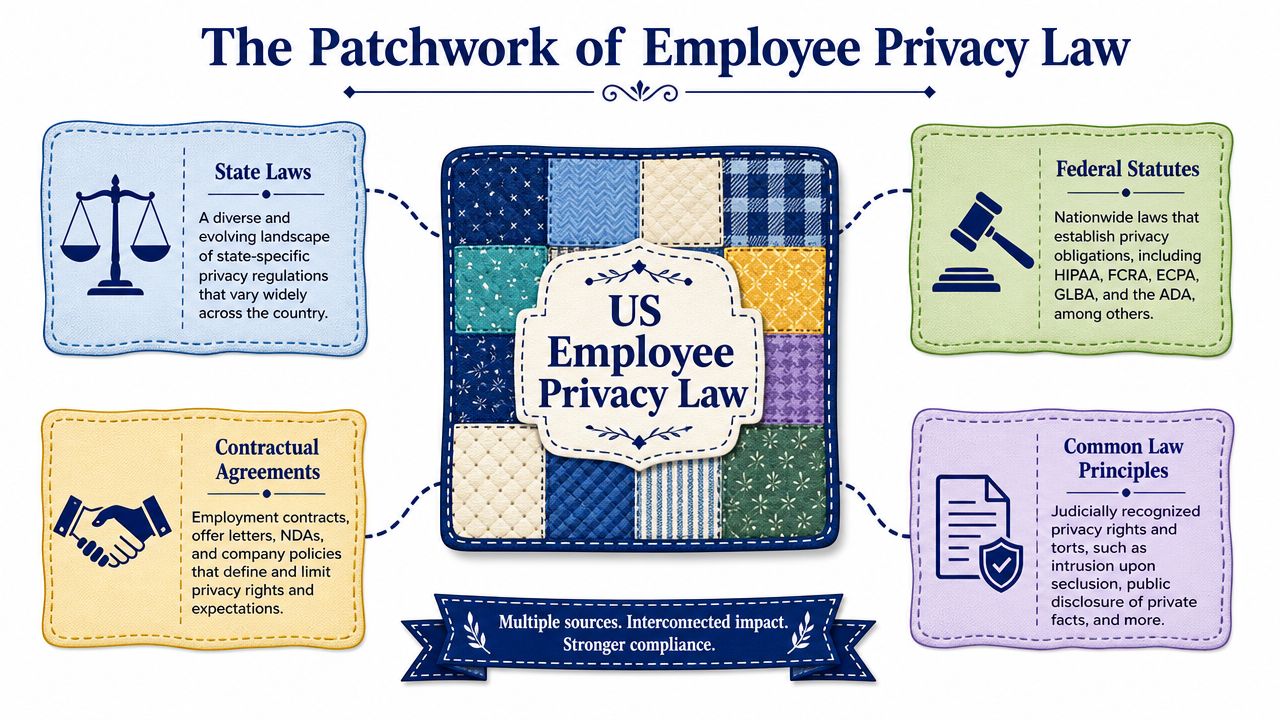
A key legal reality is that employee privacy law in the United States grew from a patchwork of common-law claims and older federal statutes rather than a single unified privacy code, with federal protections including the Electronic Communications Privacy Act of 1986, while state privacy regulation had expanded sharply by 2024, including California, Virginia, Connecticut, and Utah according to this workplace privacy law review.
That matters in practice because employers are rarely dealing with only one source of obligation. Depending on the issue, the analysis may involve:
If your team wants a quick contrast between the U.S. approach and a more unified framework, this GDPR guide for security teams is a useful primer on how a detailed privacy regime is structured.
Europe took a more centralized route. A foundational milestone was the EU's General Data Protection Regulation, which took effect on 25 May 2018 and established strong workplace data rights, including access, correction, deletion in some cases, and restrictions on processing, as summarized in this HR guide to employee data protection. Canada's privacy guidance similarly recognizes that employees have a right to know how information is collected and used, and to access and challenge its accuracy and completeness, as noted in that same source.
For U.S. employers, the lesson isn't that GDPR applies everywhere. It's that privacy expectations have shifted. Employee privacy rights now extend well beyond medical files or private offices. They reach digital personnel records, monitoring practices, data sharing, and the internal logic behind collection decisions.
U.S. employers get into trouble when they manage privacy as a surveillance question only. The bigger issue is often data governance.
That's why privacy disputes increasingly turn on process. Did the employer identify a legitimate purpose? Was the employee told what would happen? Did the company collect more than it needed? Could it locate the data later? Those aren't theoretical questions. They're the backbone of a defensible response.
Most privacy problems don't begin with a dramatic incident. They begin with ordinary business decisions made without enough guardrails. A tool gets installed, a manager asks the wrong question, or an investigation expands into areas that were never clearly authorized.
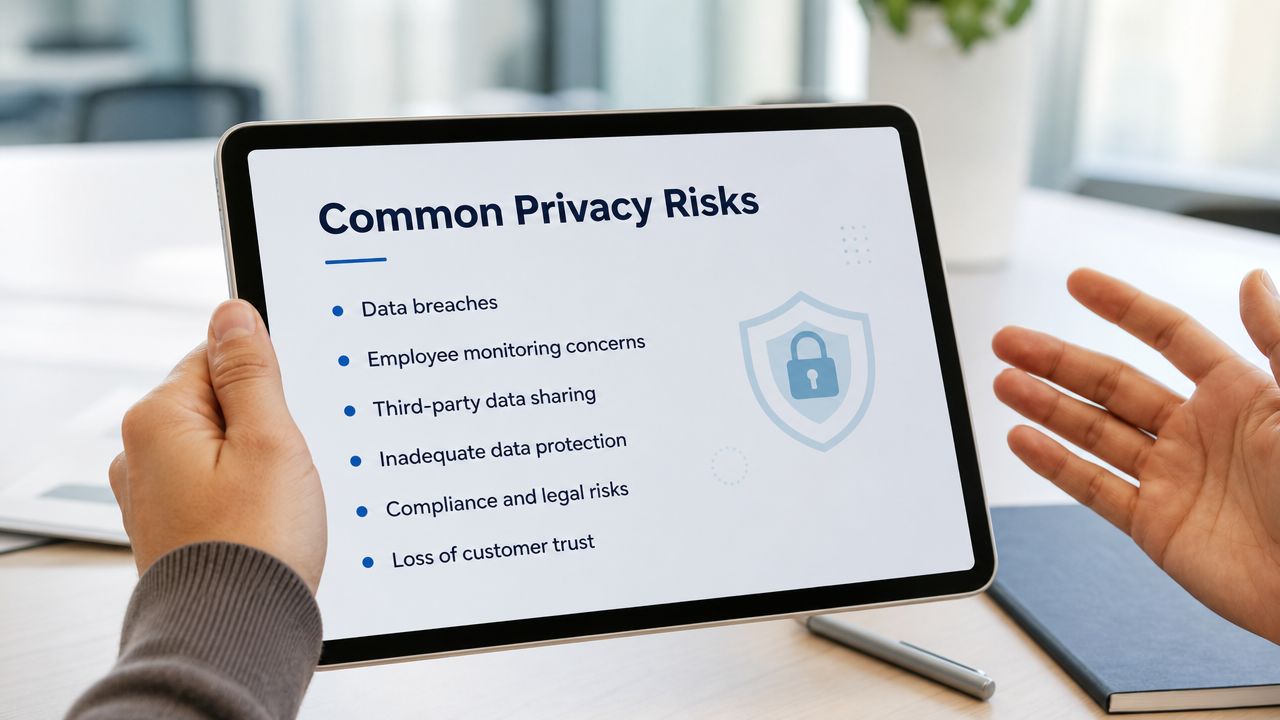
The most common risk areas usually include the following:
Electronic monitoring on company systems. Employers generally have more room to monitor activity on company-owned devices and systems, but that doesn't eliminate notice, retention, or state-law issues. Email review, Slack exports, internet activity logs, screenshot tools, GPS features, and productivity software all need a documented business purpose.
Video surveillance and recordings. Cameras in public or operational areas may serve a valid security purpose. Trouble starts when recording becomes excessive, poorly disclosed, or drifts into areas where employees have a stronger expectation of privacy.
Workplace searches. Searches of desks, lockers, company vehicles, and employer-issued devices should never be improvised. If the company's policy doesn't clearly reserve access rights and define the business reason, a search that felt routine to management can look arbitrary later.
Background checks and screening. Screening decisions often involve highly sensitive information. The privacy issue isn't only what you receive. It's whether you limited collection to what was relevant and handled the results in a controlled, need-to-know way.
Medical and HR records. Accommodation records, leave documentation, investigation files, and discipline records should not float loosely across email inboxes and shared drives. Sensitive data needs tighter handling rules than ordinary personnel administration.
One of the least understood areas is off-duty and off-platform privacy. The ACLU notes that privacy protections in the private sector are limited in most U.S. states, and that employers are often restricted from discriminating based on off-duty conduct only when it does not affect job performance, as discussed in its workplace privacy overview.
Leaders often act too early or too late. They either ignore conduct that has started to create workplace disruption, or they overreact to lawful private behavior that isn't connected to performance, safety, conflict of interest, or policy.
A more defensible standard asks:
| Question | Why it matters |
|---|---|
| Is the conduct connected to job performance? | It separates discomfort from a real business issue. |
| Has it affected safety, operations, or team functioning? | It helps show a legitimate workplace reason. |
| Is the concern based on verified facts? | It reduces the risk of acting on rumor or bias. |
| Does policy already address this scenario? | It supports consistent treatment across employees. |
If an employee posts confidential information online, the issue may involve both privacy and reputational exposure. For teams working through response steps, this guide on protecting reputation from employee data exposure can help frame the operational response.
A lawful off-duty activity doesn't automatically become a business issue because leadership dislikes it. The company needs a clear workplace connection.
In my experience, employers create the most exposure when they rely on broad language like “the company may monitor anything at any time” and assume that solves the problem. It doesn't. Broad wording without specific notice, role-based limits, and actual implementation standards often creates false confidence.
What works better is narrower and more deliberate:
That kind of structure won't remove every privacy risk, but it will make your decisions much easier to defend.
A single privacy policy rarely works cleanly across a multi-state workforce anymore. Even if the business runs one HR system and one collaboration stack, state law can still change what notice is required, what rights an employee can exercise, and how broadly personal information is defined.
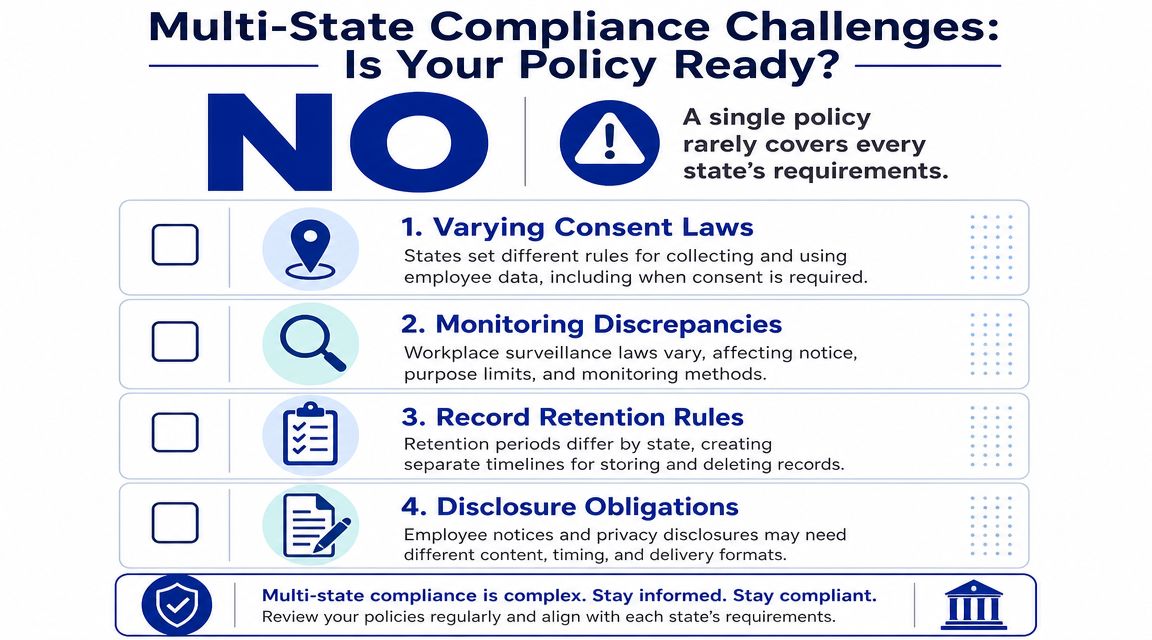
California is the clearest example of why multi-state compliance gets technical fast. For California-linked operations, the CCPA and CPRA extend privacy protections to employees, contractors, and applicants. Employees can request the categories and specific pieces of personal information collected, the business purpose for collection, and related retention or deletion details from unstructured data such as emails and Slack messages, according to this guide to employee data requests.
That last point catches many employers off guard. It's one thing to produce information from an HRIS. It's another to identify responsive data across inboxes, chat systems, shared drives, case management notes, and vendor platforms.
Once you operate across state lines, you usually end up choosing between two models:
| Model | Benefit | Risk |
|---|---|---|
| Apply a higher common standard across the workforce | Easier administration and more consistency | May create added operational burden in lower-regulation states |
| Use state-specific rules and workflows | Better tailoring to local requirements | More complexity, more training needs, more room for mistakes |
Neither model is automatically right. The better choice depends on your systems, workforce footprint, and internal discipline. Businesses with lean HR teams often underestimate how hard it is to maintain multiple rule sets consistently.
For remote employers, the compliance challenge overlaps with location management, payroll, leave rules, and supervision. This overview of remote worker compliance across multiple states is a helpful companion because privacy rarely sits alone.
Most privacy obligations become unmanageable when the company doesn't know where employee data lives. Start with a working inventory that answers these questions:
If you can't answer those points, rights requests and investigations become slow, inconsistent, and expensive. More important, leadership loses the ability to verify whether the company's written policy matches actual practice.
The strongest employee privacy programs don't try to eliminate monitoring or data collection. They make those activities intentional, limited, and documented. That's what gives an employer something solid to stand on when a complaint, audit, or dispute appears.
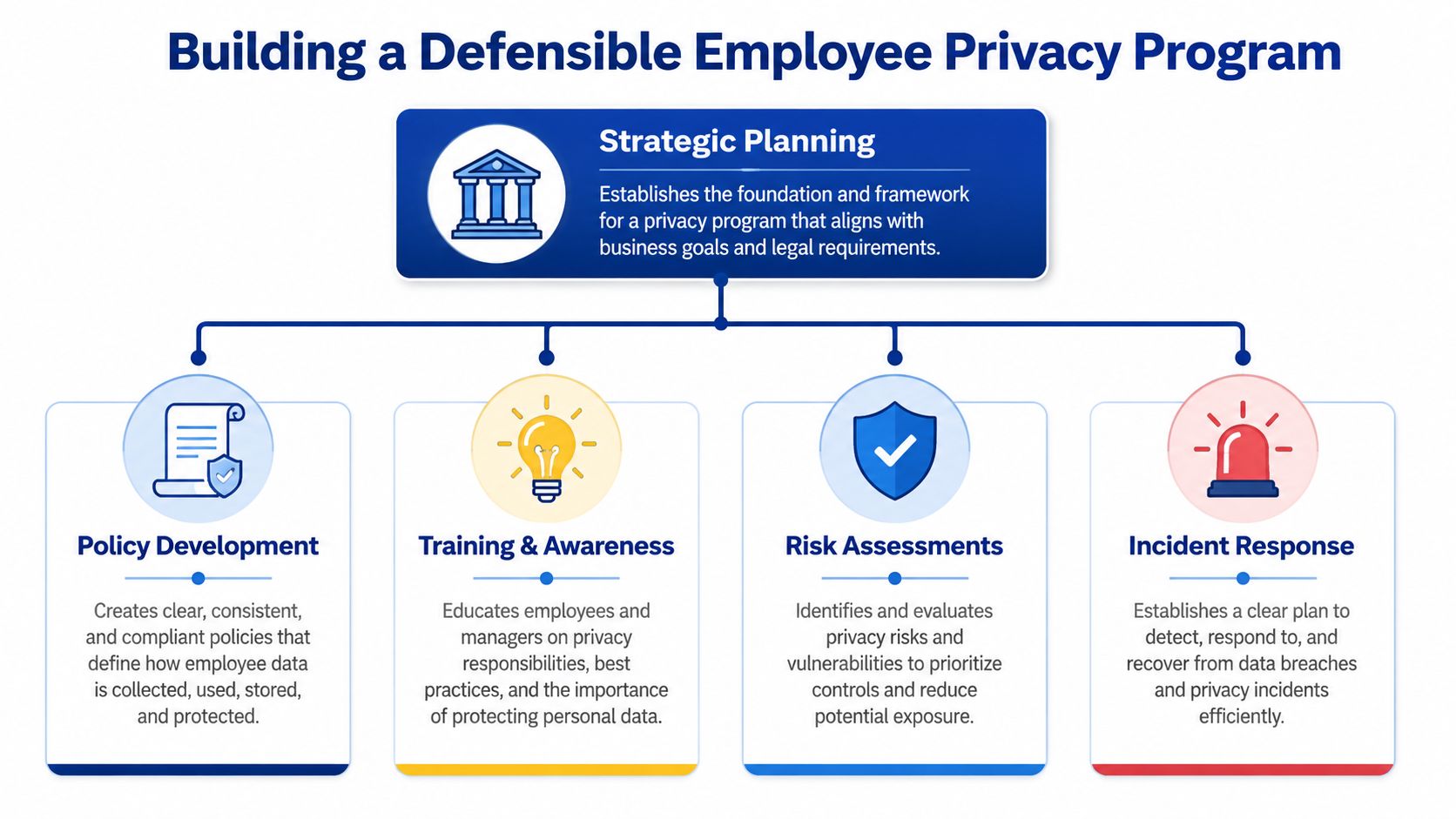
For SMBs, the practical control point is policy architecture: periodic audits of privacy policies, manager training on permissible inquiries, and explicit review of monitoring tools against applicable privacy frameworks. Privacy exposure is not only about surveillance itself, but about whether the employer can show a legitimate business purpose, adequate notice, and compliant handling of retained data, as explained in this employer privacy risk analysis.
A good privacy program usually has five working parts.
Clear notice to employees
Employees shouldn't have to infer what the company monitors. Tell them which systems are subject to review, what business reasons justify that review, and whether the company retains logs, recordings, or message content.
Defined collection limits
Don't gather data merely because a tool makes it available. Decide what the company truly needs for security, supervision, quality control, or investigations, then disable or avoid unnecessary collection where possible.
Manager training
Many privacy failures come from frontline supervisors, not technology. Managers need practical guidance on personal questions, medical information, social media issues, complaint handling, and when to involve HR or counsel instead of acting alone.
Periodic audits
If the handbook says one thing and the software does another, the software wins in litigation. Teams that use formal review cycles often borrow methods from broader compliance functions. For example, organizations building a repeatable review process may look at tools used in EnvManager audit compliance to structure accountability, ownership, and follow-up.
Response procedures
The company needs a playbook for complaints, data access requests, accidental disclosures, and questionable monitoring practices. Fast escalation with clear ownership is far better than ad hoc decisions made under pressure.
Leadership test: Could your company explain, for each monitoring tool, who approved it, why it exists, what it collects, who can access it, and when the data is deleted?
Advisory support can assist. A firm such as Paradigm International Inc. works with leadership teams on policy architecture, documentation standards, manager decision-making, and multi-state employment risk, which are the areas where privacy frameworks usually fail in practice.
What doesn't work is treating privacy as an IT issue alone. HR, operations, legal decision-makers, and managers all influence the outcome. If those groups don't share the same rules, the written program won't survive contact with day-to-day reality.
Privacy issues become highest risk when emotions are high and facts are incomplete. An employee claims a manager accessed private messages. A confidential file was shared too broadly. A complaint about surveillance reaches senior leadership. At that point, the quality of your investigation matters as much as the underlying issue.
The first step is to define what you are investigating. Not every complaint justifies a full review of every communication or device. Set the allegation, identify the relevant time period, list the systems involved, and decide who needs to know.
That discipline protects both sides. It helps the company preserve evidence without turning the investigation into an unnecessary sweep through unrelated personal or sensitive information.
A useful practice is to create a short written scope memo that covers:
Employers often make one of two mistakes here. They either fail to preserve key records, or they preserve everything and create a second privacy problem. The better approach is targeted preservation based on the issue, the systems involved, and your existing retention structure.
If your retention practices are weak, investigations become much harder to manage. This guide to employment records retention requirements is useful because privacy disputes often expose deeper recordkeeping problems.
Good investigations don't collect the maximum amount of information. They collect the minimum amount needed to reach a defensible conclusion.
Interviews should follow a common structure. Ask what happened, what the witness observed directly, what records may exist, and whether similar conduct occurred before. Avoid making promises you can't keep, especially around confidentiality.
The written record should reflect more than conclusions. It should show how the company got there. That usually means documenting:
| Investigation element | What to capture |
|---|---|
| Complaint intake | Date received, reporting party, issue raised |
| Scope decision | Why certain systems or records were reviewed |
| Interviews | Who was interviewed, when, and summary of key facts |
| Evidence review | What documents or logs were examined |
| Findings | What was substantiated, unsubstantiated, or inconclusive |
| Action taken | Corrective steps, policy changes, or follow-up training |
A defensible result is one that fits the facts, the policy, and past practice. If similar conduct produced coaching in the past, a sudden termination needs a clearly documented reason for different treatment. If the policy is ambiguous, fix the policy rather than pretending it was clear all along.
That's also why investigation closure should include a process review. Ask whether the issue exposed a training gap, an unclear monitoring practice, a system access problem, or a retention failure. Privacy complaints often point to structural weaknesses that won't be solved by disciplining one person.
Employee privacy rights aren't a reason to stop supervising the workforce. They're a reason to supervise with more discipline. The employers that manage this well don't rely on vague handbook language or informal manager judgment. They use clear notice, limited collection, workable retention rules, and consistent documentation.
For SMBs operating in multiple states, the key advantage comes from building one defensible framework that leadership can effectively follow. That means knowing where employee data lives, understanding which practices create the most exposure, and documenting why the company collects and reviews information in the first place.
The core trade-off is straightforward. You can move fast with scattered policies and hope no one challenges them, or you can build a system that holds up when someone does. Only one of those approaches protects the business over time.
Privacy compliance also isn't a one-time project. Tools change. managers change. State rules change. Workforce expectations change. Your framework has to be reviewed often enough to keep pace with the way your company operates.
If your team is dealing with multi-state operations, employee complaints, monitoring tools, or weak policy alignment, outside guidance can help turn a patchwork of practices into a defensible operating model.
If your leadership team wants practical guidance on employee privacy rights, multi-state HR risk, or documentation standards that can stand up under scrutiny, Paradigm International Inc. can help you assess the gaps and build a more defensible framework.