An HR investigation is one of the most high-stakes situations a business leader will ever face. Every step, every conversation, and every decision can have a significant impact on careers, team morale, and your company's legal standing. For leaders, understanding employee rights during an HR investigation isn't just a compliance task—it's the core of smart risk management. A fair, defensible investigation is what stands between your organization and a world of legal and reputational trouble.
An internal investigation is your company's formal response to a workplace complaint, such as harassment, discrimination, or another serious policy violation. Think of it less as a courtroom trial and more as a fact-finding mission. The goal is to gather information impartially to understand what happened. For employers, running this process correctly is a fundamental obligation.

Ignoring a complaint or mishandling an investigation is one of the fastest ways to expose your company to legal risk. Failing to act can easily be interpreted as condoning the behavior, which dramatically increases your liability. This is precisely why a structured, fair process is so critical to protecting your organization and your people.
A truly defensible investigation is built on a genuine commitment to fairness and consistency. This means every person involved—the complainant, the respondent, and any witnesses—is treated with respect and given a real opportunity to share their side of the story. The integrity of your entire employee relations framework hinges on this principle.
A well-managed investigation should always aim to:
A poorly managed investigation does more than create legal exposure; it shatters the trust between your leadership team and your employees. When your people believe the process is biased or unfair, it can harm morale, reduce productivity, and damage your company's credibility. Ultimately, mastering the investigation process helps build a healthier, more accountable organization.
An HR investigation is a structured fact-finding mission, not a courtroom trial. As a leader or HR professional, your role is not to be a judge but an impartial administrator piecing together what happened. To do that well, you must respect the fundamental rights of every employee involved. This isn't just about compliance; it's the bedrock of a fair and defensible process.

This focus has sharpened as workplace allegations have become more complex. In 2021 alone, employees filed 61,331 discrimination charges with the EEOC, with about 60% including claims of retaliation. This data points to a deep-seated fear workers have about the consequences of speaking up. Respecting core rights is the only way to build the trust needed for the process to function. You can dive deeper into these numbers by reading the full EEOC performance report.
To clarify how these rights translate into action, here is a simple breakdown of the corresponding obligations for employers. Fulfilling these responsibilities is essential for a fair, compliant, and effective investigation process.
An employee should not walk into an interview completely blindsided. Whether they are the complainant, the respondent, or a witness, they have a right to know the general nature of the inquiry. This doesn't mean you share every confidential detail. It means providing enough context for them to understand why they are there and what to expect. This simple framing sets a respectful and professional tone from the start.
This is perhaps the most critical right of all. Every person directly involved, especially the person responding to the allegations, must have a fair chance to present their version of events. This requires asking open-ended questions and listening without judgment. Failing to provide this opportunity can invalidate the entire investigation, as it suggests the outcome was predetermined.
Retaliation is any negative action taken against an employee for participating in an investigation, and it is illegal. This protection is absolute and covers the complainant, the respondent, and any witnesses. Retaliation can be subtle, such as being excluded from important meetings, receiving an unfairly negative performance review, or being moved to a less desirable team.
As an employer, you have a duty to proactively prevent retaliation. This means clearly communicating your zero-tolerance policy to everyone involved and checking in with participants after the investigation concludes. While most private-sector employees do not have a right to legal counsel in an internal meeting, their rights under the National Labor Relations Act (NLRA) to discuss working conditions require a careful balancing act with confidentiality rules.
When an employee comes forward with a complaint, your organization is legally and ethically obligated to investigate. A legally defensible investigation rests on three core principles: it must be prompt, thorough, and impartial. Getting these right is about showing a real commitment to fairness, which is the bedrock of trust in any workplace. These are the exact standards a court or agency will use to judge your actions.
A prompt investigation means you act without unnecessary delay. Letting a complaint sit can be incredibly damaging, as memories fade, evidence gets lost, and key witnesses might leave the company. Worse, a delay sends a message that you do not take employee concerns seriously, which can harm morale and increase legal risk. Being prompt means getting the process started immediately, not rushing the investigation itself.
A thorough investigation digs deeper than a few surface-level questions. It is a diligent effort to uncover all relevant facts. A superficial inquiry that skips key witnesses or ignores relevant documents can render your findings useless.
To ensure your investigation is thorough, you must cover a few key bases:
A thorough process ensures your final decision is based on a complete picture, not just a few convenient pieces of information. This diligence is what makes an investigation stand up to scrutiny.
Impartiality may be the most important pillar of all. An impartial investigation is free from bias or any conflict of interest. The investigator must be—and must be seen as—a neutral fact-finder. If the person leading the inquiry has a personal relationship with the accused or a stake in the outcome, the entire process is compromised from the start.
Choosing the right investigator is critical. It could be a trained HR professional, an external expert, or a leader in the company with no connection to the situation. Their job is to listen to everyone, weigh the evidence objectively, and make a determination based only on the facts they have gathered. This commitment to neutrality is what makes the process one that employees can trust.
A workplace investigation is a structured journey, not a chaotic event. Understanding the key stages is essential for ensuring fairness and protecting everyone's rights. This step-by-step approach helps ensure that every investigation is handled with consistency and integrity from the moment a concern is raised to the final resolution.
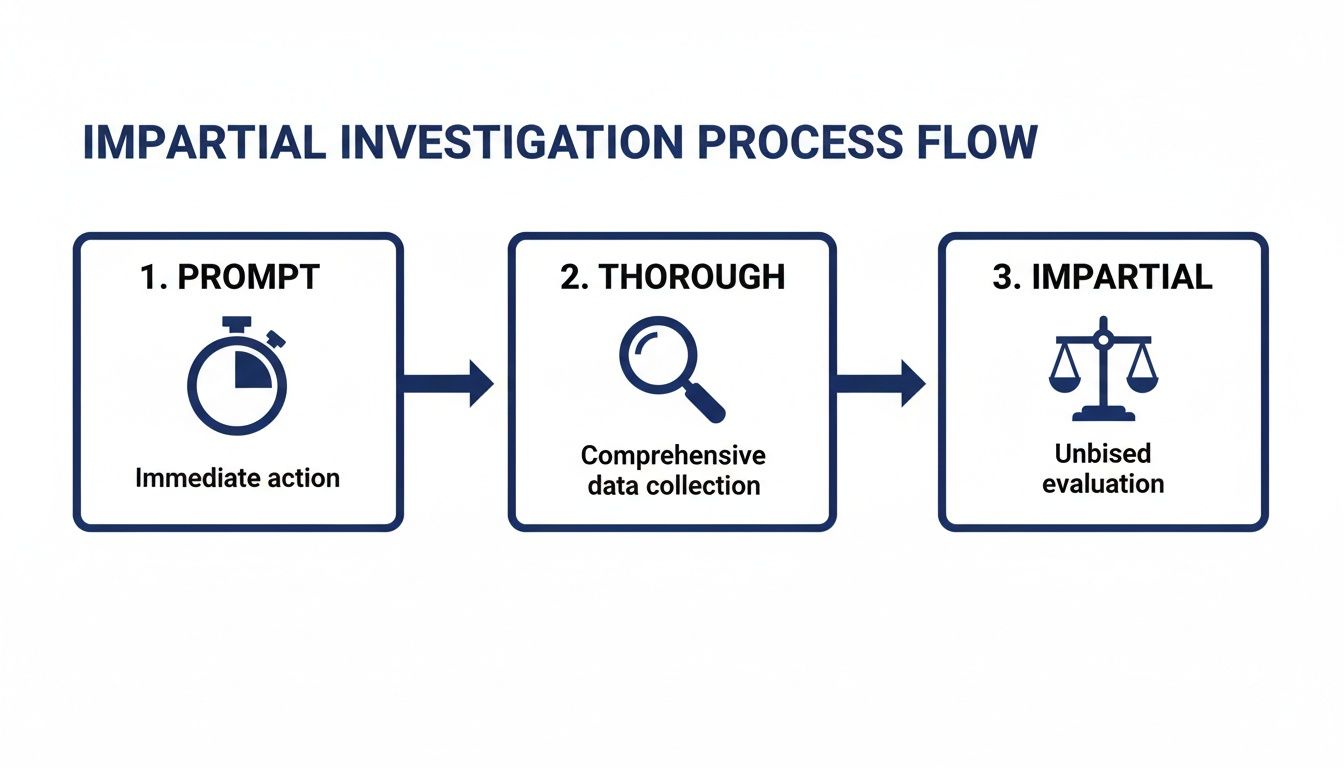
As this diagram illustrates, a defensible investigation is built on being prompt, thorough, and impartial. These principles must be applied at every step of the process. Let’s walk through what that looks like in practice and what employees can expect along the way.
The investigation officially begins the moment a complaint is received. The first step is to acknowledge it and determine if immediate action is needed, such as separating employees to prevent further issues. After that, a clear plan is required. This means defining the specific allegation, identifying which company policies may have been violated, and listing who needs to be interviewed. For more on this initial setup, see our guide on how to conduct workplace investigations.
Interviews are the heart of the fact-finding mission. The goal is to gather firsthand accounts from the complainant, the respondent, and any relevant witnesses. A well-structured interview process gives every person a fair opportunity to share their side of the story without bias or interruption. Employees should expect a professional and respectful environment where they are asked open-ended questions designed to elicit detailed responses.
Beyond interviews, the investigator will collect and review all relevant physical and digital evidence. This can include emails, text messages, security footage, timecards, and performance reviews. Each piece of evidence is used to either support or challenge the statements made during interviews. This stage demands meticulous organization and a completely objective perspective, focusing only on facts directly related to the complaint.
Once all interviews are complete and the evidence is gathered, the investigator analyzes everything they have collected. This is not about determining "guilt" in a legal sense. Instead, the investigator weighs the credibility of all evidence and testimony to determine whether it is more likely than not that a policy violation occurred. This is known as the "preponderance of the evidence" standard. The finding must be based only on the facts from the investigation.
The final stage is about action. The findings are documented in a formal report, and any necessary corrective measures are implemented. These actions can range from coaching and training to formal disciplinary measures. A crucial step is to communicate the outcome. While the full report remains confidential, the complainant and respondent should be informed that the investigation is closed and that appropriate action has been taken. This step is vital for showing that the organization takes complaints seriously.
In any investigation, if it wasn't documented, it didn't happen. Meticulous record-keeping is the backbone of a defensible process, creating a clear, factual account of every step you took. Just as critical is how you communicate with everyone involved. Balancing transparency with confidentiality ensures employees feel heard, respected, and treated fairly throughout the process.

This dual focus on documentation and communication is what elevates a standard inquiry into a structured, credible investigation. It’s how you build a record that not only supports your final conclusion but also proves your commitment to a fair and impartial process.
Every interaction, piece of evidence, and decision needs to be recorded with care. Think of your documentation as the official record that shows you conducted a thorough and impartial inquiry. Sloppy or incomplete notes can undermine even the most well-intentioned investigation.
Your documentation checklist should always include:
When it comes to interviews, precision is paramount. Understanding how to accurately transcribe investigation interviews can be a game-changer for ensuring your records are exact and reliable. This level of detail makes your findings truly defensible.
How you communicate during an investigation is as important as what you document. Your main goal is to keep all parties informed without compromising the integrity or confidentiality of the process. This starts with setting clear expectations from the beginning. Explain each employee's role, stress the importance of honesty, and make the company’s strict anti-retaliation policy clear.
Providing updates is another crucial piece of the puzzle. While you cannot share confidential details, you should let participants know the investigation is ongoing and that you will inform them when it concludes. This prevents employees from feeling their concerns have disappeared. Once the investigation is over, close the loop by informing the complainant and respondent that the process is complete and appropriate action has been taken. The last step is compiling your findings into a defensible document using a workplace investigation report template.
Modern workplace investigations are rarely simple. As a leader, you must navigate a minefield of legal issues where one wrong move can expose your organization to serious risk. Getting these things right is about showing your team you are committed to a fair, trustworthy process. When you understand the boundaries, you protect both your people and your company.
One common instinct is to tell everyone involved in an investigation to keep things quiet. While this often comes from a desire to protect the integrity of the process, the rules around confidentiality have become more complicated. You can no longer issue blanket gag orders. Recent legal shifts, such as the NLRB's Stericycle decision, clarify that broad confidentiality rules must be justified on a case-by-case basis. You can find more insights on these investigation trends and best practices to stay current.
This means you need a specific, legitimate business reason for demanding confidentiality, such as:
Employee privacy is another delicate balance, especially when reviewing digital evidence. While company-owned devices and email accounts are generally subject to review, the lines can blur quickly. Your best defense is a clear, consistently enforced policy stating that there is no expectation of privacy when using company systems. This provides the authority you need to access relevant information during an investigation. When dealing with sensitive data, strict protection, similar to that used in HIPAA-compliant transcription services, is a must.
For businesses operating across state lines, compliance becomes exponentially more complex. What is legal in one state may be forbidden in another. For example, some states are “one-party consent” jurisdictions for recording interviews, while others require “two-party consent.” State laws also vary widely on an employee’s right to access their personnel file. Staying on top of these state-specific details is a core part of modern risk management.
Respecting employee rights during an HR investigation is the bedrock of a sound, defensible process. When you conduct investigations that are prompt, thorough, and impartial, you are doing more than just staying compliant. You are actively building a culture where people trust leadership and feel safe raising concerns. This commitment to fairness is what separates a resilient organization from one facing unnecessary risks.
A fair process holds everyone accountable and proves that your policies are principles the company actually lives by, applied consistently to everyone. While these core principles provide a strong framework, high-stakes situations often demand an objective, expert eye. Bringing in a trusted advisor can provide the unbiased perspective needed to protect both your organization and your people.
If you need support managing these critical moments, our team is here to help. Contact us to learn more about how we partner with leaders to build stronger, more resilient organizations.
When an HR investigation begins, it’s natural for leaders to have questions. The process can feel complex, and the stakes are high. Here are straightforward answers to the most common questions about employee rights and employer duties during an investigation.
Generally, no. Most employees are required to cooperate with internal workplace investigations as a condition of their employment. A refusal to answer questions can be seen as insubordination, which could lead to disciplinary action, including termination. It is vital to communicate this expectation clearly to everyone involved.
In a typical internal HR investigation at a private company, employees do not have a legal right to have their lawyer present. These interviews are internal fact-finding meetings, not court proceedings. The main exception is for unionized employees, who may have the right to request a union representative be present during an investigatory interview under their Weingarten Rights.
There is no set timeline. The duration of an investigation depends on its complexity. A straightforward issue might be resolved in a few days, while a more complicated case with multiple witnesses and extensive evidence could take several weeks. The goal is to be prompt and thorough, not rushed. If there are delays, be sure to document the reason.
A fair, defensible investigation process is your best defense against legal claims and cultural damage. For expert guidance on navigating high-stakes workplace issues, Paradigm International Inc. provides the partnership leaders need.
To learn how we can help you manage these critical moments, contact us today.