
You're probably dealing with this already. A manager wants to terminate someone who has been underperforming, another employee has asked for time off for a medical issue, and payroll is trying to sort out how to handle a remote hire in another state. None of those decisions feels unusual on its own. The risk comes from making them without a clear legal framework and without a process that holds up when someone later asks, “Why did you handle it that way?”
That's why employment law basics matter. Not because business owners need to become lawyers, but because every hiring, pay, discipline, leave, and termination decision creates a record. If the record shows consistency, documentation, and a legitimate business reason, the business is in a much stronger position. If it shows improvisation, mixed messages, and exceptions no one can explain, exposure grows quickly.
A lot of owners first encounter employment law in a reactive moment. Someone raises a complaint, a payroll issue surfaces, or a manager says, “We're an at-will employer, so we can just move forward.” That's usually the point where leaders realize employment law basics aren't abstract rules. They shape daily operating decisions.

Modern employment law grew into a layered system over time. The Fair Labor Standards Act was enacted in 1938, the Age Discrimination in Employment Act in 1967, the Occupational Safety and Health Act in 1970, the Americans with Disabilities Act in 1990, and the Family and Medical Leave Act in 1993. Today, the U.S. Department of Labor says it administers and enforces more than 180 federal laws covering about 165 million workers across 11 million workplaces according to the Department of Labor's major laws overview.
That matters because an employer's role isn't limited to paying people and managing performance. You're operating inside a framework that touches wages, safety, discrimination, accommodations, leave, records, and termination standards all at once. A decision that looks simple from an operations standpoint can trigger several legal issues at the same time.
Practical rule: Employment law basics are less about memorizing statutes and more about recognizing when a people decision affects multiple legal duties at once.
Leaders reduce risk when they stop treating compliance as a side task and start treating it like an operating discipline.
A practical baseline includes:
The businesses that handle this well don't overcomplicate it. They build repeatable decision rules, require documentation, and escalate edge cases before they become disputes.
It helps to think of employment law basics as four operating pillars. If one pillar is weak, the problem rarely stays isolated. A wage issue can turn into a recordkeeping issue. A discipline issue can become a discrimination claim if managers apply standards unevenly. A leave request can trigger accommodation questions.
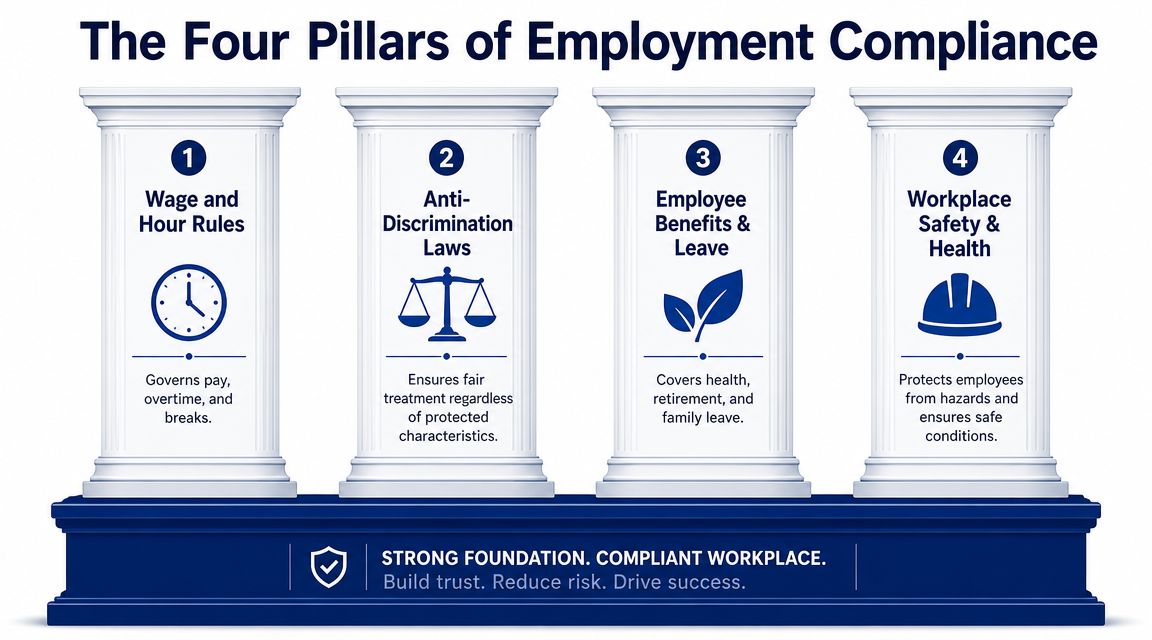
This pillar governs how employees are paid and how work time is tracked. It includes minimum wage, overtime, payroll timing, and classification decisions. These issues are highly technical, which means they often create liability through routine mistakes rather than bad intent.
If timekeeping is loose, if off-the-clock work is ignored, or if exempt status is assigned casually, the business can create a chain of avoidable problems.
This pillar applies across the full employment relationship. Hiring, promotions, discipline, layoffs, and termination all need legitimate, job-related reasons supported by records. Consistency matters as much as intent.
A business gets into trouble when one manager coaches an employee for conduct that another manager ignores, or when similar performance issues produce very different outcomes without a documented reason.
Fair treatment is not a slogan. It's a management system built on consistent criteria, comparable documentation, and review before adverse action.
Leave law is where many SMBs underestimate complexity. Requests rarely arrive labeled with the legal category that applies. An employee might mention a medical issue, pregnancy-related limitation, family care need, or workplace stress. That single conversation can raise leave, accommodation, retaliation, and documentation questions.
The safest approach is to train managers to recognize a potential protected request and route it into a standard review process.
Safety compliance is often treated as industry-specific, but every employer has workplace obligations. A hazard report, an injury response, or a complaint about working conditions can carry legal significance beyond the immediate event. The operational takeaway is simple. You need reporting channels, response procedures, and records.
When leaders need a practical structure, this short checklist works well:
The beginning and end of employment create some of the clearest legal exposure. Hiring decisions shape your documentation from day one. Termination decisions get tested against everything that happened before. If those two points are inconsistent, the business usually feels it later.
Most hiring problems aren't dramatic. They start with uneven practices. One manager uses structured interview questions. Another has an informal conversation and asks about topics that shouldn't drive the decision. One candidate gets a documented scorecard. Another gets a gut-level assessment with no written support.
That inconsistency creates two business problems. First, it makes selection harder to defend. Second, it weakens later decisions because the file never shows a disciplined process.
A stronger hiring process usually includes:
Many owners hear “at-will” and assume it solves termination risk. It doesn't. At-will status generally means employment can end by either party, but it doesn't override discrimination laws, retaliation protections, leave rights, accommodation duties, wage claims, or contractual promises.
That's why a termination should never rest on a single sentence such as “we're moving on.” It should rest on a file that shows what happened, what expectations were set, what the employee was told, and why the final decision was made.
The question in a termination review is rarely “Could the company end employment?” It's usually “Can the company show a legitimate reason and a fair process?”
A solid termination process isn't about creating paperwork for its own sake. It's about being able to explain the decision calmly, consistently, and with evidence.
Use a basic decision screen before ending employment:
| Review question | Why it matters |
|---|---|
| Is the business reason clearly stated? | Vague reasons invite challenge |
| Is the record current? | Old or missing documentation weakens the decision |
| Were similar cases handled similarly? | Inconsistency creates discrimination risk |
| Is there any recent complaint, leave request, or accommodation issue? | Protected activity can change the risk profile |
| Has final pay and offboarding been reviewed? | Payroll mistakes often compound termination disputes |
For many SMBs, the practical improvement isn't adding legal jargon. It's requiring a short pre-termination review and refusing to skip it. If your team needs a process reference, how to fire an employee legally is a useful operational starting point.
A supervisor approves timecards on Friday, payroll runs on Monday, and the issue looks minor. Then a former employee claims they regularly answered messages after hours, missed meal periods, and received late final pay after termination in another state. What looked like a small payroll miss becomes a wage claim built from repeated process failures.
Wage and hour risk usually comes from repetition. If a company classifies one role incorrectly, allows off-the-clock work, or applies the wrong final-pay timing rule, that mistake can repeat across pay periods, locations, and managers.
Federal law sets the floor. Under the U.S. Department of Labor's FLSA guidance, covered nonexempt employees must receive overtime at 1.5 times their regular rate for hours worked over 40 in a workweek, and federal minimum wage requirements still apply under the Department of Labor's FLSA overview. For SMBs, that is only the first screen.
State rules often drive the harder decisions. California, for example, imposes detailed pay stub requirements, timing rules for pay, and strict final-pay obligations, as outlined by the California Labor Commissioner's Office. A multi-state employer cannot rely on one payroll habit and assume it works everywhere.
That is where many growing companies get exposed. Payroll is centralized, but wage-hour obligations are local.
Wage claims often start with routine breakdowns, not dramatic misconduct. Common examples include:
These are controllable problems. They come from weak approval paths, unclear manager instructions, and missing audits.
A workable wage-hour process should answer a simple question. If a regulator, plaintiff's lawyer, or state agency asked how pay is calculated and verified, could the company show the steps clearly?
Use a control model like this:
Payroll problems look small one paycheck at a time. The exposure grows when the same error affects multiple employees or crosses state lines.
In practice, owners do not need a more complicated policy. They need tighter execution. Firms like ours often help leadership teams review classification, payroll documentation, and multi-state decision paths where HR process and legal exposure meet.
A supervisor is ready to terminate an employee for attendance problems. During the meeting, the employee mentions a recent diagnosis, asks for time off, and says a manager has treated her differently since she became pregnant. What looked like a straightforward discipline decision now raises disability, leave, pregnancy accommodation, and retaliation issues at the same time. That is where many SMBs get into trouble, especially when managers in different states follow different instincts.

Coverage changes by law and by state. Federal discrimination and accommodation laws do not all start at the same headcount, and state statutes often reach smaller employers. California is a common example. Its discrimination and accommodation rules can apply well before a business reaches the federal thresholds.
For owners, this is a staffing and workflow issue, not just a legal footnote. A company can move from low exposure to much broader obligations after a few hires, an acquisition, or one remote employee in a more protective state. Headcount should be tracked by legal entity, work location, and applicable law before a manager makes a high-stakes call.
In practice, these issues overlap. An attendance problem may involve a disability. A pregnancy-related restriction may require a temporary job change. A request for time off may trigger leave rights even if the employee never uses legal terms.
The safest process is a single intake path for situations involving:
Managers do not need to decide which statute applies on the spot. They do need to recognize a trigger, pause the employment decision if needed, and route the matter to HR or counsel for a coordinated review. That is especially important in multi-state operations, where state accommodation, paid leave, and pregnancy protections may go beyond federal law.
Handbook language helps, but decision quality turns on execution. If one employee gets a discussion, interim options, and documented follow-up, another employee with a similar issue should go through the same process unless there is a clear business reason for different treatment.
The trade-off is real. Slowing down a termination or attendance response can frustrate managers who want immediate action. It is still usually the better business decision. A short pause to assess accommodation, leave, and retaliation risk is far less expensive than defending a claim built around poor timing, inconsistent treatment, or a missed state-law requirement.
For employers with teams in more than one jurisdiction, these decisions also connect to scheduling, pay treatment during leave, and final pay rules. Resources on understanding multi-state wage laws can help leaders see how compensation rules intersect with discrimination, accommodation, and leave decisions.
When a business gets challenged, memory won't save it. Documentation might. Good records show what the company knew, what it did, when it acted, and whether it treated people consistently.
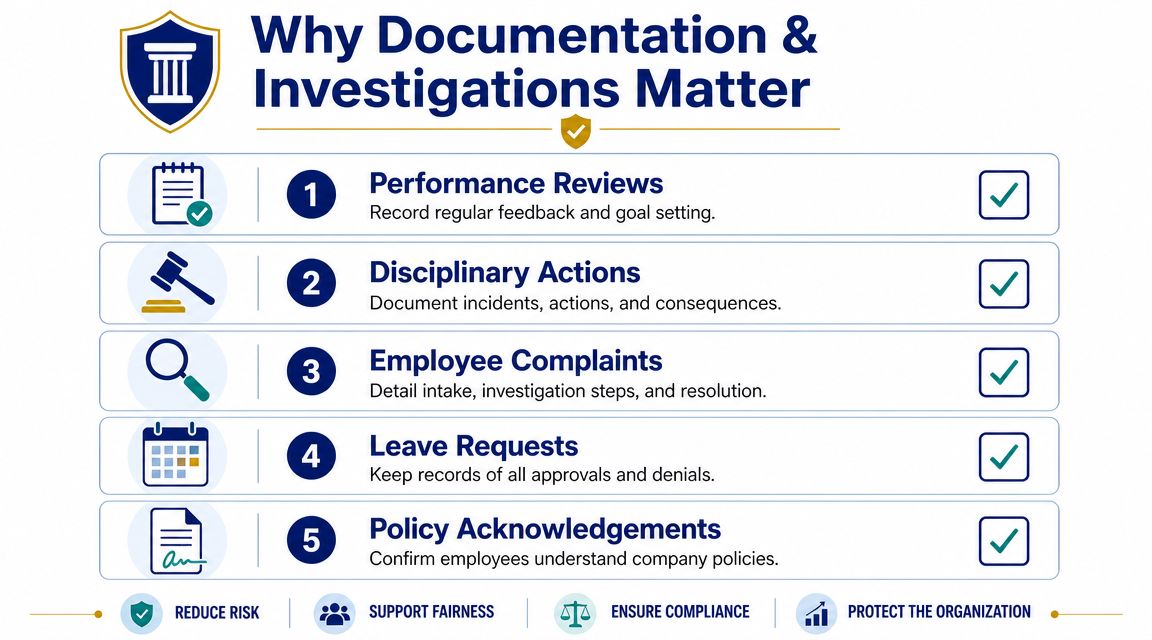
The most useful documentation is specific, timely, and tied to actual business expectations. “Bad attitude” is weak. “Interrupted patients during intake, refused documented workflow steps, and ignored two written coaching directives” is much stronger because it connects conduct to work requirements.
Strong records usually include:
An investigation doesn't need to be elaborate to be effective. It does need to be prompt, fair, and documented. That applies to harassment complaints, policy concerns, retaliation concerns, and some performance disputes where the facts are contested.
A basic investigation process often looks like this:
| Step | What good practice looks like |
|---|---|
| Intake | Record the complaint and identify the issue |
| Planning | Decide who should investigate and what documents matter |
| Interviews | Speak with the complainant, respondent, and relevant witnesses |
| Findings | Assess facts, consistency, and corroboration |
| Response | Take action, document it, and communicate appropriately |
Manager advice: If a complaint could affect discipline, termination, or a protected right, slow the decision down long enough to establish the facts.
This matters even more because the legal environment keeps evolving. Laws like the PWFA add accommodation responsibilities, and the practical challenge for leaders is bigger than “knowing the law.” The more valuable skill is building a consistent evidence standard for manager conduct and adverse-action decisions that can survive review, as discussed in this small business employment law overview.
A single-state handbook usually starts to break down the moment a company hires remotely across borders or opens another location. The problem isn't just more laws. It's conflicting laws, different thresholds, and managers applying the wrong rule to the wrong employee.
The key multi-state principle is simple. Employers must follow the rule most beneficial to the employee when federal, state, and local standards conflict, as explained in this multi-jurisdiction employment law resource. That's why one national policy with no state overlays usually fails in practice.
A better structure is a core policy set with state-specific addenda and review controls.
Use a short implementation list:
Employment law basics become strategic. The businesses that handle growth well don't wait for a complaint to discover their systems are inconsistent. They build compliance architecture early so managers can make better decisions under pressure.
If your team is expanding, managing remote employees, or facing difficult people decisions that need to be legally defensible, Paradigm International Inc. works with SMB leadership teams to build the structure, documentation standards, and decision processes that reduce preventable employment risk.