
If you operate in more than one state, break compliance probably feels simpler than it is. That’s the trap. Many owners assume breaks are either required everywhere or optional everywhere, then discover too late that the risk sits in the gap between federal rules, state mandates, written policy language, and what managers allow on the floor.
Employment law breaks aren’t just a scheduling issue. They’re a wage-and-hour issue, a documentation issue, and in some cases a wrongful termination issue. If your business runs healthcare clinics, professional offices, field teams, or distributed operations, you need a system you can defend, not a handbook paragraph you hope no one challenges.
A manager in Illinois auto-deducts 30 minutes for lunch because that is how your Nevada location does it. Payroll closes the week. Two months later, you are defending a wage claim with inconsistent timecards, a generic handbook, and no proof the employee was fully relieved of duty. That is how break cases start.
The federal rule is narrower than many owners expect. The Fair Labor Standards Act does not require employers to provide meal or rest breaks. But if you offer short breaks, they are generally paid, and a meal period can be unpaid only if the employee is fully relieved of duty, as outlined in this break law guide for employers.
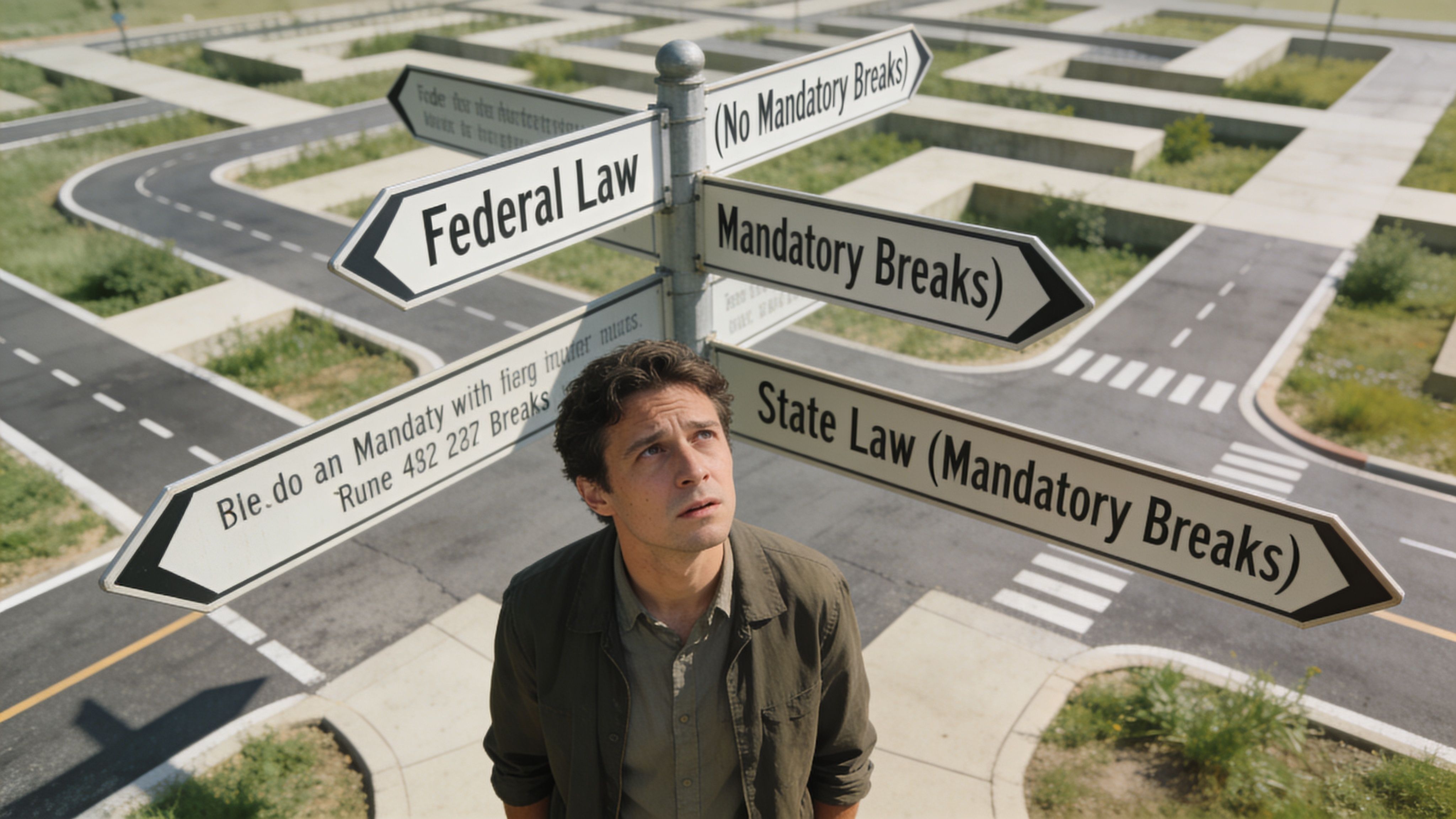
That federal baseline will not protect a multi-state employer by itself. State law often adds timing rules, length requirements, industry carveouts, premium pay exposure, and recordkeeping expectations. A single sentence in the handbook cannot carry that load.
A national policy usually fails for one reason. It treats break compliance as a legal summary instead of an operating system. If your written rule does not match scheduling practices, timekeeping codes, and manager instructions in each state, you have built evidence against yourself.
Start with job classification, because break handling often gets muddled when employers also misclassify pay status. If your team still mixes up exempt and hourly rules, fix that first with a clear review of exempt vs nonexempt employee classifications. Then build break rules on top of that foundation.
Here is the defensibility framework that works better for small and mid-sized employers operating across state lines:
The primary compliance tension is not whether the law exists. It is whether your company can prove that its policy language, daily practice, and payroll treatment line up. Owners lose these disputes when one location follows the handbook, another follows habit, and payroll follows neither.
Break rules also affect overtime exposure. Paid break time can increase hours worked, which matters even more in states with stricter wage rules. That is why state-specific guidance such as overtime laws in California belongs in your compliance buildout, not as an afterthought.
If you want a policy that survives a claim, stop aiming for broad consistency alone. Aim for documented, state-specific consistency that managers can execute and HR can prove.
A store manager tells an employee to clock out for lunch but keep the phone nearby in case the front desk gets busy. Payroll treats the time as unpaid. That is how a routine shift turns into back pay exposure.
The core rule is simple. Under the FLSA, short rest breaks of 20 minutes or less count as paid working time and must be included in hours worked for overtime purposes, according to the U.S. Department of Labor’s break time rules. If your system strips out that time because someone labeled it a break, your records are creating the liability.
Short breaks are usually easy. If the break is brief, pay it.
Meal periods often lead to disputes. An unpaid meal period only works when the employee is fully relieved of duty. If they are answering calls, watching a reception area, monitoring a chat queue, staying on radio, or being interrupted for work, you should treat that time as suspect and review it for payment.
Use a manager test that holds up under scrutiny:
| Question | If the answer is no | Risk result |
|---|---|---|
| Was the period long enough to function as a real meal break? | The time may be compensable | Wage claim exposure |
| Was the employee fully relieved of all work duties? | The period likely becomes paid time | Back pay and overtime risk |
| Does the time record match what happened on the floor? | Your documentation weakens your defense | Audit and litigation risk |
This issue gets messier when classification is wrong. Before you finalize break coding, confirm who is properly treated as exempt and nonexempt by reviewing this guide to exempt vs nonexempt employee classifications.
One small interruption can be enough to create a problem. If a supervisor uses an unpaid meal period for even minor work, the safest assumption is that the time needs review and may need to be paid.
Bad break practices usually come from shortcuts, not from policy intent.
These are the mistakes that create inconsistent pay treatment across locations:
For a multi-state employer, defensibility matters as much as the rule itself. You need policy language that defines paid rest breaks, unpaid meal periods, interrupted meals, and on-duty situations in plain terms. Then your timekeeping system has to mirror those definitions. If the handbook says one thing, managers do another, and payroll applies a third rule, you will not have a credible defense.
Do not leave compensability decisions to shift-by-shift judgment calls.
Set up controls your company can defend:
That is how you reduce risk. You do not get there by telling people to follow the law. You get there by writing clear rules, matching them to payroll codes, and training managers to stop creating unpaid work time.
Multi-state compliance gets real when you compare actual rules side by side. A policy that works in Texas may fail in California. A manager transferred from Florida may create risk in New York without realizing it.
Here’s a simple comparison based on the state examples requested.
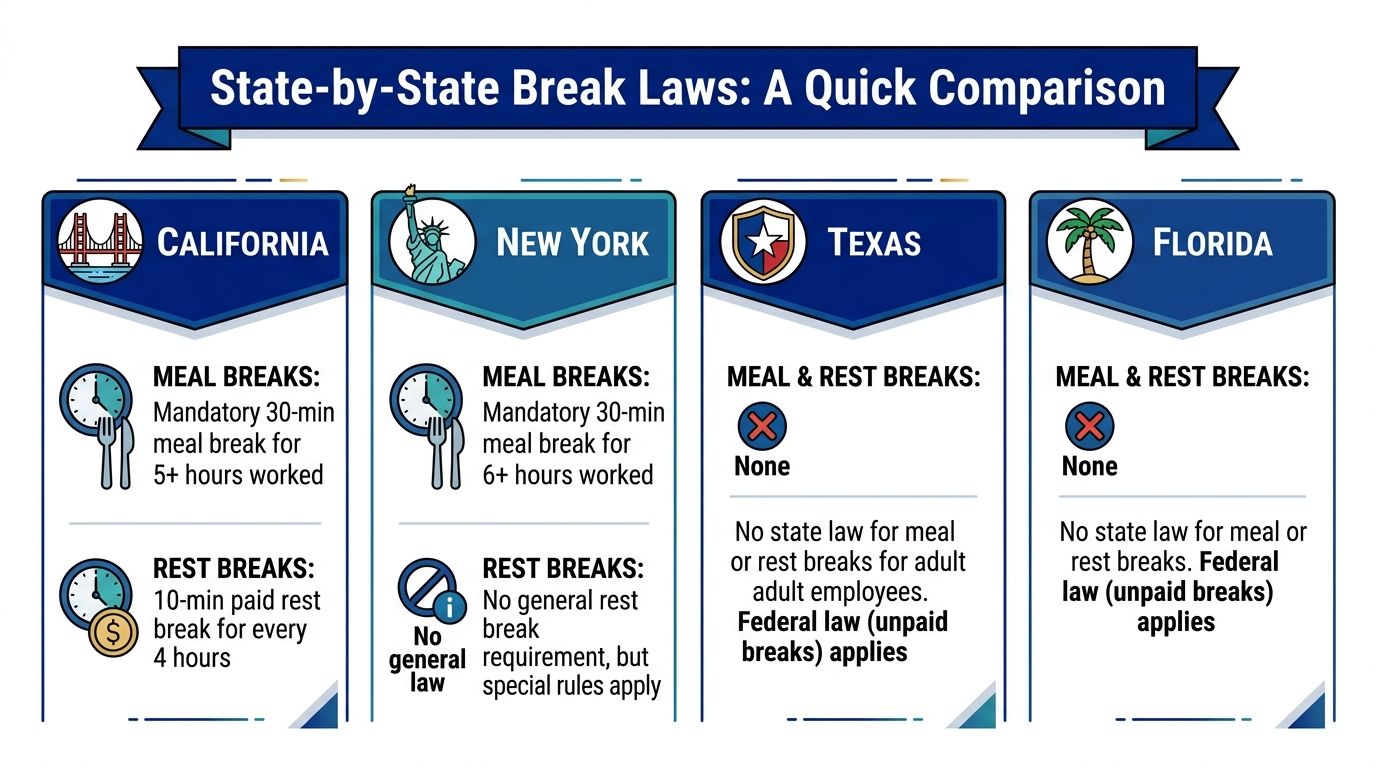
| State | Minimum Shift Length to Trigger Break | Required Break Duration | Is the Break Paid? |
|---|---|---|---|
| California | 5+ hours worked | 30-minute meal break | Can be unpaid if duty-free |
| New York | 6+ hours worked | 30-minute meal break | Can be unpaid if duty-free |
| Texas | No general adult state mandate | None required by state law | Federal rules apply if breaks are offered |
| Florida | No general adult state mandate | None required by state law | Federal rules apply if breaks are offered |
This table is intentionally basic. That’s the point. Even at a high level, the variation is obvious.
California is a poor candidate for generic handbook language. Employers there need precise timing rules, rest break administration, and payroll practices that can withstand review. If your team has California employees, this guide to California meal break laws is the kind of state-specific reference your HR and operations leaders should keep close.
California is where vague instructions like “take lunch when you can” become dangerous. Managers need exact direction on when breaks must be made available, how missed breaks are reported, and who approves staffing coverage.
New York is a good example of why “close enough” fails. Many employers assume New York follows a broad federal-style approach. It doesn’t.
If your shift planning ignores state timing rules, your issue won’t be lack of intent. It will be lack of execution. Courts and agencies care about whether the employee received what the law required, not whether a supervisor meant well.
Texas and Florida often lull employers into complacency because adult employees generally don’t have broad state meal and rest break mandates. But “no state mandate” doesn’t mean “no risk.”
You still have to:
A low-regulation state is not a free pass. It just shifts the legal analysis from state mandate to wage payment and policy enforcement.
The practical answer is not to write four totally separate handbooks unless your workforce structure requires it. The better approach is controlled variation.
Use one company-wide break framework, then localize the parts that must change:
That’s the only realistic way to manage employment law breaks across multiple states. Centralize policy ownership. Localize execution rules. Audit both.
A manager denies an extra break request on the spot, payroll docks time, and HR never sees the issue until a claim arrives. That is how break disputes turn into wage, disability, and retaliation problems at the same time.
Special-case breaks need a tighter control process than ordinary scheduling. For multi-state employers, the primary risk is inconsistent handling across locations. One site approves a lactation room immediately. Another improvises with a storage closet. One manager routes a medical break request to HR. Another treats it as a personal preference. That inconsistency damages your defense.
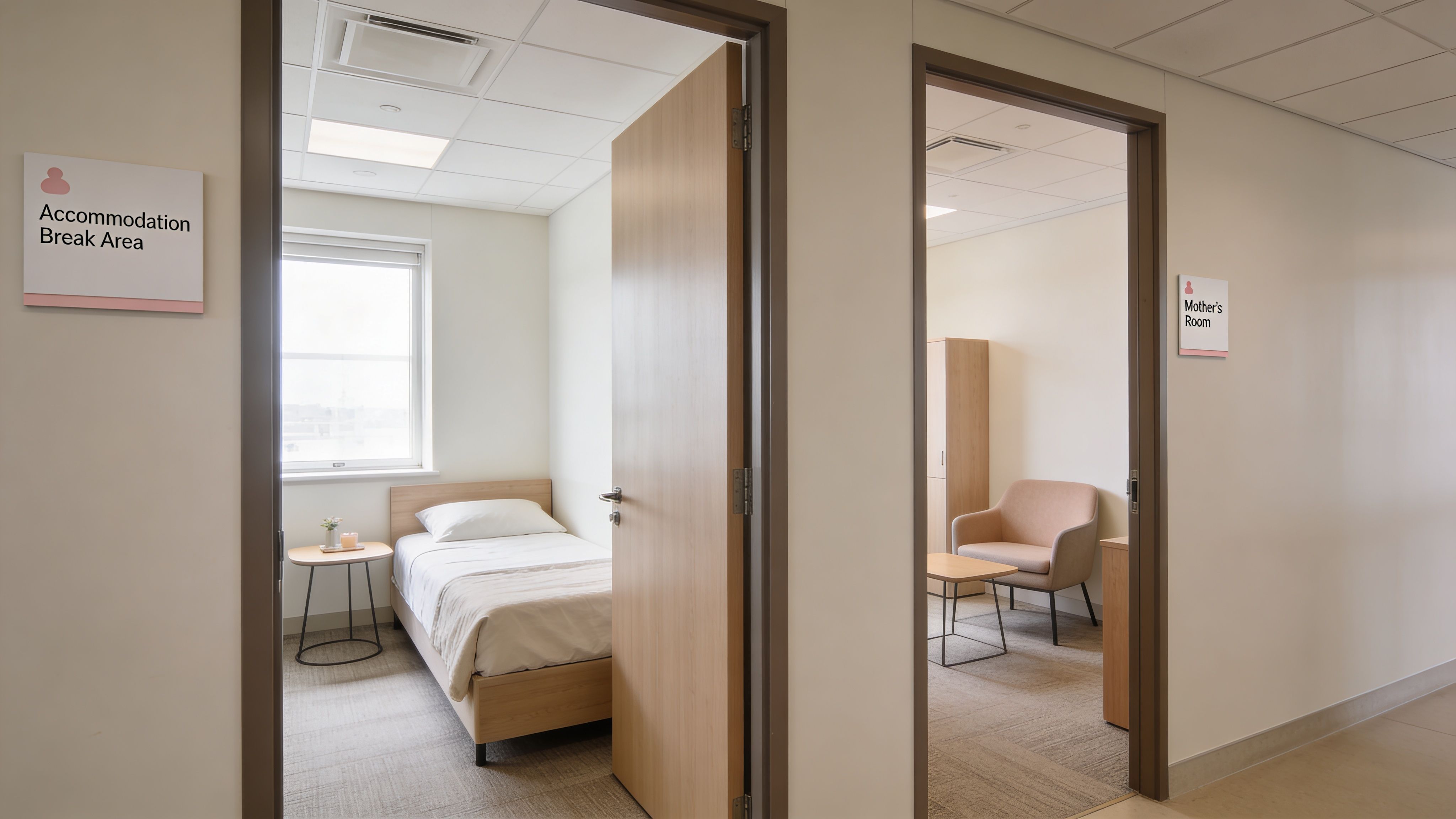
Federal law requires reasonable break time for an employee to express breast milk and a private space that is not a bathroom, as summarized in this workplace break accommodation overview. Smaller employers may try to rely on an undue hardship exception, but that argument needs facts, records, and a site-specific analysis. Size alone proves nothing.
Treat lactation requests as an operations issue with a paper trail. Assign ownership. Identify approved spaces by location. Document how privacy is maintained, who can access the room, how scheduling works, and what happens when the primary space is unavailable. If you run several sites, standardize the form and workflow, then localize the room list and escalation path.
State law may impose stricter rules than the federal floor. Your policy should say who checks local requirements before denying, delaying, or modifying any lactation arrangement. Do not leave that call to front-line supervisors.
A request for extra breaks, changed break timing, or relief from certain duties can trigger the ADA. Managers who handle those requests casually create avoidable liability. Use a documented intake and review process every time.
If your team needs a baseline on the legal standard, this guide to reasonable accommodation under the ADA is a practical starting point. Then build your own decision framework around defensibility, not convenience.
Use this sequence:
Capture the request immediately
The employee does not need legal terms. If the request suggests a medical limitation or protected need tied to breaks, route it to HR at once.
Define the work limitation clearly
Identify the actual barrier. The issue may be break frequency, break length, timing, access to a private space, or relief from active duties during the break period.
Test workable options by location and role
A warehouse, clinic, retail store, and office will not solve the same problem the same way. Document the options considered and why each one does or does not work.
Record the decision and payroll treatment
If the accommodation affects paid time, timekeeping, or meal-period deductions, HR and payroll must apply the same rule.
Revisit the arrangement when facts change
Schedule changes, transfers, staffing levels, and medical updates can all affect what remains reasonable.
This is basic HR risk assessment. Identify the trigger, assign ownership, document the reasoning, and keep the record where you can produce it later.
The pattern is familiar. The written policy says one thing, local managers do another, and the file contains almost nothing useful.
Watch for these failure points:
The strongest defense is consistency you can prove. Write policy language that requires escalation. Train managers on trigger words and routing. Keep location-specific documentation for rooms, staffing constraints, and approved alternatives. If you cannot show who decided what, when, and why, you are relying on memory after the dispute has already started.
A manager in Texas lets staff eat at their desks. A manager in California auto-deducts 30 minutes even when calls keep coming. Your handbook says both locations follow the same break policy. That policy is now part of your risk.
Once you publish a break rule, you need a version the business can follow. If the handbook promises more than operations can deliver, you have created a clean exhibit for a wage claim. That problem gets worse for multi-state employers because a vague national policy invites local improvisation, and local improvisation is what plaintiffs' lawyers look for.
As noted in this North Carolina break policy analysis, handbook language can matter well beyond general guidance. Treat break policy drafting as a control document, not a handbook filler page.
Write the policy so payroll, managers, and employees would all reach the same answer on the same facts.
Include these points:
That last point matters more than many owners realize. A single national policy can work, but only if it clearly says stricter state rules control and your location practices indeed reflect that.
Bad language creates factual disputes. Good language creates a record.
This sentence is weak: “Employees receive lunch breaks based on business needs.” It tells managers they can improvise and tells employees nothing useful.
Use language that drives documentation:
Employees must accurately record meal periods and promptly report any meal period that is missed, shortened, interrupted, delayed, or taken while performing any work duty.
That wording does real work. It tells employees what to do, tells managers what must be escalated, and gives payroll a basis to correct pay before a claim hardens.
A break policy should survive an HR risk assessment, not just a legal review. The question is not whether the sentence sounds right. The question is whether your company can apply it consistently across locations, document exceptions, and defend the result later.
Use three tests before rollout:
| Question | Why it matters |
|---|---|
| Can payroll apply this rule exactly as written? | If not, time records and handbook language will conflict |
| Can front-line managers follow it during busy shifts? | If not, they will create their own version |
| Can HR produce proof when a complaint arrives? | If not, the policy has little defensive value |
If one of those answers is no, rewrite the policy before you publish it.
Every multi-state break policy should contain a small set of control clauses that reduce discretion and force issues into a documented process.
Many SMBs encounter a loss of defensibility. They write a legal rule, but they do not assign ownership. Your policy should name who approves exceptions, who reviews missed-break reports, who updates state supplements, and who audits manager compliance. If those roles are fuzzy, your policy is fuzzy.
If you need outside help, use advisors who can build documentation standards, manager instructions, and a multi-state compliance framework that matches your actual staffing model. The handbook should function as an enforceable business rule, backed by training and records, not as generic HR language copied from a template.
It starts the same way in a lot of small businesses. A manager says everyone is free to take lunch. Payroll assumes the time records are fine. Six months later, a former employee claims they worked through meals, answered messages during breaks, and never had a real chance to step away. If your records are thin, your policy is just paper.
A 2022 study found that 39% of U.S. employees occasionally, rarely, or never take breaks, according to these workplace break statistics. For employers, that matters because skipped or interrupted breaks usually happen in ordinary, predictable ways. Workload spikes. Managers ask for quick help. Employees stay available to avoid falling behind. Once that becomes routine, your legal risk is no longer about what the handbook says. It is about what the business allowed in practice.

You need evidence that holds up under scrutiny.
That means records showing the company scheduled breaks, relieved employees of duty when required, captured exceptions, fixed mistakes, and trained managers on what they were allowed to ask people to do during meal and rest periods.
Strong proof usually includes:
It does.
Supervisors control whether employees are relieved of duty, whether coverage exists, whether someone is expected to remain reachable, and whether time records reflect what really happened. A weak manager can undo a well-written policy in a single week.
Train managers on situations that create claims fast:
Give managers plain rules. If the employee is still answering calls, watching a station, monitoring messages, or staying on standby, the company may still owe pay. If a break is missed, shortened, or interrupted, the manager must report it through the company process instead of letting it slide.
Multi-state SMBs need a system that creates evidence before a claim appears.
Use this framework:
Plan break coverage in advance
Build break windows into staffing, scheduling, and shift handoffs. Coverage failures are compliance failures.
Record actual practice
Use timekeeping and attestations that capture what happened, not what was supposed to happen.
Review exceptions by location and manager
Repeated missed breaks in one team usually point to a supervisor problem, understaffing issue, or both.
Fix pay and fix the root cause
Correct wages fast. Then address the scheduling, workload, or manager conduct that caused the problem.
Keep documentation centralized
Scattered emails and inconsistent local files weaken your defense and waste time during a claim response.
The goal is not just legal awareness. The goal is a record trail you can defend. For multi-state employers, that depends on three things working together: policy language that leaves little room for discretion, documentation that captures exceptions and corrections, and manager training that matches the actual work environment.
If your team still treats break compliance as “tell people to take lunch,” correct that now. That approach fails when employees work through meals, managers discourage reporting, or payroll relies on assumptions instead of verified records.
If your leadership team needs to tighten break policies, manager practices, or multi-state documentation standards, Paradigm International Inc. can help assess where your current approach is exposed and what a more defensible structure should look like.