


Payroll is asking for year-end approvals, a manager wants to end someone's employment, and a remote employee has moved to another state. The owner handling HR between operational decisions needs more than a list of filing dates. A useful employment law compliance calendar for 2027 identifies who acts, which employees are affected, and what evidence proves the work was completed.
Payroll, benefits, and safety owners can use the dates below to build a working calendar. These are projected federal filing dates, subject to final agency instructions. They are planning dates, not confirmed deadlines. Each 2027 row needs a named reviewer, a dated check, and a record of the final agency guidance.
| Projected date | Filing or notice | Owner | Review and evidence |
|---|---|---|---|
| February 1, 2027 | Forms W-2 and W-3, Forms 1099-NEC, Form 941 for Q4 2026, and Form 940 | Payroll lead | Planning date. Verify the final IRS calendar in January 2027 and record the confirmation. January 31 falls on a Sunday; later dates may apply when all relevant taxes were timely deposited. |
| February 1 to April 30, 2027 | OSHA Form 300A posting | Safety or HR owner | Planning period. Confirm coverage and applicable OSHA instructions by January 2027; retain the posting record. |
| February 10, 2027 | Form 940 or Form 941 under the timely deposit rule | Payroll lead | Planning date. Confirm eligibility against current IRS instructions in January 2027 and retain the deposit reconciliation. |
| March 2, 2027 | OSHA electronic injury and illness data submission | Safety owner | Planning date. Confirm establishment coverage and the final OSHA instructions by January 2027; retain the submission confirmation. |
| March 2, 2027 | Affordable Care Act information return distribution | Benefits owner | Planning date. Confirm applicable employer status and current furnishing instructions by January 2027; retain delivery records. |
| March 31, 2027 | Affordable Care Act electronic IRS filing | Benefits owner | Planning date. Confirm the filing deadline and current IRS instructions by February 2027; retain the accepted filing receipt. |
| April 30, 2027 | Form 941 for Q1 2027 | Payroll lead | Planning date. Verify the final IRS calendar in March 2027 and record the confirmation. |
| July 31, 2027 | Form 941 for Q2 2027 | Payroll lead | Planning date. Verify the final IRS calendar in June 2027 and record the confirmation. July 31 is a Saturday; confirm whether the filing deadline moves to Monday, August 2. |
| November 1, 2027 | Form 941 for Q3 2027 | Payroll lead | Planning date. Verify the final IRS calendar in October 2027 and record the confirmation. October 31 is a Sunday; confirm the applicable deadline. |
| January 31, 2028 | Form 941 for Q4 2027 and 2027 Forms W-2 and W-3 | Payroll lead | Planning date. Verify the final IRS calendar in December 2027 and record the confirmation. |
The February payroll cluster needs advance reconciliation. The payroll lead should check employee names, tax identifiers, annual totals, contractor records, and account access before approving submission. A scheduled task in the payroll platform does not establish that an agency accepted the filing.
The OSHA posting period starts in the same window, but it requires a separate owner and proof. The safety owner should confirm establishment coverage, reconcile injury records, arrange any required certification, and record where the summary was posted. Keep the posting record separate from the electronic submission confirmation.
The timely deposit rule is conditional. Before using a later filing date, the payroll lead should retain the deposit reconciliation that supports eligibility. Escalate an unresolved discrepancy to the payroll tax specialist instead of marking the calendar item complete.
Before distributing Affordable Care Act statements or approving an IRS file, the benefits owner should reconcile enrollment and employment information. Employee delivery and agency filing are separate tasks, even when one administrator handles both. Assign corrections to an owner and track them to completion.
For quarterly payroll filings, schedule preparation reminders as well as the projected deadlines. Weekend and holiday adjustments, deposit-based extensions, and revised agency instructions can change the working schedule. The approving owner should record whether each task covers preparation, submission, or acceptance.
Keep the accepted return, transmission receipt, correction history, and approval record in a controlled folder. Before acting on a projected date, the assigned owner should check current IRS or OSHA instructions and record the review date.
Dated filings don't address what happens between deadlines. Under its federal anti-discrimination enforcement responsibilities, the EEOC reported 88,201 new private-sector discrimination charges and 90,743 resolutions in fiscal year 2025. Those figures support treating complaint readiness as continuing work rather than an annual handbook exercise.
The DOL's Wage and Hour Division budget materials describe wage-and-hour administration as a broad worker-protection responsibility. Operationally, payroll complaints deserve a documented response process, not just a corrected paycheck. A repeated deduction or off-the-clock problem should trigger a wider review.
The following is a recommended internal schedule, not a statutory notice rule:
A shared task register works better than reminders scattered across inboxes. Fluidwave's guidance on how to delegate and automate overdue work offers a useful framework for routing missed tasks without making the owner chase every update. Automation should identify overdue work, not mark substantive compliance reviews complete.
Escalation rule: A deadline never substitutes for judgment about a high-risk employment decision.
A termination after a complaint or leave, an active investigation, or leave overlapping a disability issue warrants expert help before action. Relevant federal frameworks can include EEOC-enforced anti-discrimination laws, the Americans with Disabilities Act, and the DOL-administered Family and Medical Leave Act. Qualified employment counsel should assess how those laws and applicable state protections interact in the particular situation.
A dated row is not ready for an operating calendar until its legal status, coverage, owner, and evidence are clear. Treat the dates below as planning prompts, not confirmed deadlines. The California employment-law update identifies measures and restrictive-covenant milestones to review; confirm each item against current legal and agency materials before implementation.
| State | Change to review | Date shown in planning materials | Status and source to verify | Owner and evidence to retain |
|---|---|---|---|---|
| California | Identify each measure that may affect policy or payroll; do not treat this as a single law | January 1, 2027 | Measure-specific status not established here. Verify the enacted law and current agency guidance | HR owner; retain the law or agency guidance reviewed and the policy or payroll change record |
| California | Workplace surveillance involving emotion inference or neural data | January 1, 2027 | Scheduled date requires confirmation against the applicable law and agency guidance | Operations and HR; retain the tool inventory and review record |
| Connecticut | Paid sick leave coverage expansion | January 1, 2027 | Scheduled date and coverage require confirmation against the enacted law and current agency guidance | Leave owner; retain the coverage analysis, policy version, and payroll test |
| Maryland | FAMLI contribution obligations | January 1, 2027 | Scheduled date requires confirmation against current program guidance | Payroll lead; retain the guidance reviewed and contribution setup test |
| Colorado | AI-related employment requirements | January 1, 2027 | Scheduled date and implementation requirements require confirmation against the applicable law and agency guidance | HR and technology owners; retain the tool inventory and review record |
| Washington | Fair Chance Act coverage expansion to smaller employers | January 1, 2027 | Scheduled date and employer coverage require confirmation against the law and current agency guidance | Recruiting owner; retain revised screening steps and application materials |
| Washington | Noncompete restrictions and related notice requirements | June 30, 2027; notice date shown as October 1, 2027 | Verify the law, affected agreements, and each date against current agency guidance before taking action | Executive sponsor and counsel; retain the agreement inventory and review record |
| California | Identify each measure that may take effect in July; do not use an umbrella label for implementation | July 1, 2027 | Measure-specific status not established here. Verify the enacted law and current agency guidance | HR owner; retain the law or agency guidance reviewed and the policy or payroll change record |
| New Jersey | Family Leave Act employer-coverage threshold | July 2027, month only | Specific scheduled date is not established here. Confirm the effective date and coverage with current state guidance before scheduling work | Leave owner; retain the coverage analysis and guidance reviewed |
| Connecticut | Plain-language disclosures and pre-decision notices for certain automated tools | October 1, 2027 | Scheduled date and covered tools require confirmation against the applicable law and current agency guidance | HR owner; retain the tool assessment, notice workflow, and approved materials |
A California row labeled only by state and month cannot direct implementation. Identify the particular measure, who it covers, and the policy, payroll, or process it changes. Before assigning a deadline, verify each listed date and requirement against current agency guidance and the underlying law.
Leave changes need a coordinated workflow. The leave owner determines which employees and requests are covered; payroll tests any accrual or contribution settings; managers receive instructions for handling requests. The guide to state family leave laws can help distinguish state programs from one another.
Washington's screening and restrictive-covenant items need separate owners. Recruiting should review application and screening steps for the Fair Chance Act change. The executive sponsor should assemble affected agreements for qualified counsel to assess, including agreements with former workers or independent contractors where applicable.
For each verified change, retain the legal or agency guidance reviewed, the affected employee group, the approved policy or notice, system settings, and completion records. A payroll screenshot shows a setting; a test calculation helps show what the setting produces. A notice template does not prove that employees received it.
Keep unconfirmed dates out of the live implementation calendar. Once the responsible reviewer confirms a date and its coverage, assign the work and preserve the evidence supporting the decision.
A uniform national policy can create more risk than a missed headline date when managers apply it to employees whose state rules require different administration. The answer isn't automatically to adopt the most generous provision nationwide. Different laws can use different coverage tests, definitions, notices, and payroll mechanics.
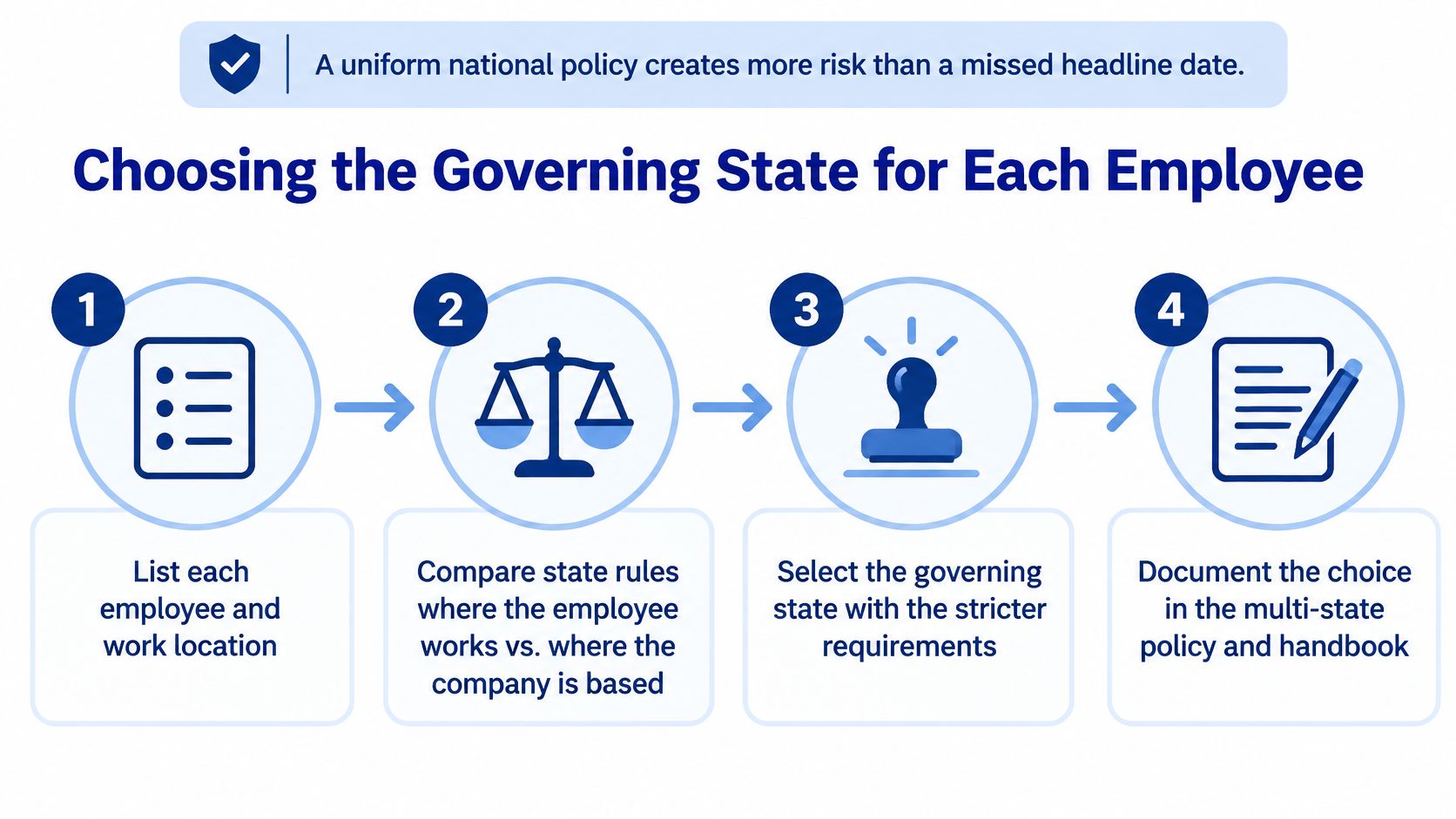
The graphic is a planning aid, not a legal choice-of-law test. Selecting a stricter rule doesn't, by itself, resolve which laws apply. The employee's actual work arrangement and each law's jurisdictional requirements still need review.
List every employee and work location. Include remote employees, new-state hires, and temporary work arrangements. An address in the payroll system may not describe where work takes place.
Identify where the employee physically works. Headquarters location alone isn't a sufficient basis for selecting the policy. The remote-employee state-law guide helps frame the location questions that operations should resolve before approving a move.
Check how each law counts employees. Company-wide headcount, employees within a state, and establishment counts aren't interchangeable. For 2027 planning, the Gunderson Dettmer fall employment-law update identifies New Jersey Family Leave Act coverage using at least 15 employees worldwide, a scheduled expansion to 10 employees in July 2027, and Connecticut paid-sick-leave expansion to all employees on January 1, 2027.
Confirm eligibility and administrative requirements. Record hours-based eligibility, the leave type, and applicable notice requirements for the employee's situation. Coverage of the employer doesn't necessarily establish an individual employee's eligibility.
Map the required changes in order. Identify the policy, payroll code, manager workflow, and employee notice that must change. Configure the tracking mechanism before managers begin approving requests under a revised policy.
Test affected employee records. Run sample calculations and request scenarios before activating the change. Include a new hire, an employee with an existing leave balance, and an employee whose location recently changed where relevant.
Escalate disputed locations. The owner should resolve inconsistent records with the employee and manager, then obtain qualified counsel's input where jurisdiction remains uncertain. Assumptions shouldn't become permanent payroll settings.
The roster should connect each employee to the applicable policy version and system configuration. HR or the designated administrator should update it when a location change is approved, not after a payroll discrepancy appears. Access should be limited to people who need the information.
A PEO or payroll platform can administer transactions, but it doesn't remove the employer's responsibility to confirm scope, notice delivery, leave tracking, and manager execution. The executive sponsor should request evidence of those checks rather than accepting a broad assurance that the system handles state compliance.
For 2027 planning, the federal Fair Labor Standards Act, administered by the DOL, supplies a $7.25-per-hour floor for covered, nonexempt employees unless Congress changes the law; the DOL consolidated minimum-wage table also reports the jurisdiction groupings below. Under the FLSA, 29 U.S.C. § 206, a federal baseline doesn't displace a higher applicable state wage requirement.
Minimum wage rules to apply by jurisdiction group
| Jurisdiction group | Rule | Count or example | Action |
|---|---|---|---|
| Federal FLSA | $7.25 per hour for covered, nonexempt employees unless Congress changes the law | Baseline floor | Apply the higher applicable rate |
| States above the federal rate | Higher applicable state rate applies | 30 states plus DC, Guam, Puerto Rico, and U.S. Virgin Islands | Confirm local rules and tipped rates |
| States matching the federal rate | Federal baseline applies to covered employees | 13 states plus the Northern Mariana Islands | Check local ordinances |
| States with no rate or a rate below federal | Federal baseline applies to covered employees | 7 states and American Samoa | Track for changes |
| Michigan | Scheduled increase to $15.00 per hour | January 1, 2027 | Run a pre-year-end payroll review |
The DOL state minimum-wage table identifies Michigan's scheduled $15.00-per-hour rate beginning January 1, 2027 and explains that employees covered by both federal and state wage laws receive the higher applicable rate. The payroll lead should verify later state guidance before loading the scheduled increase.
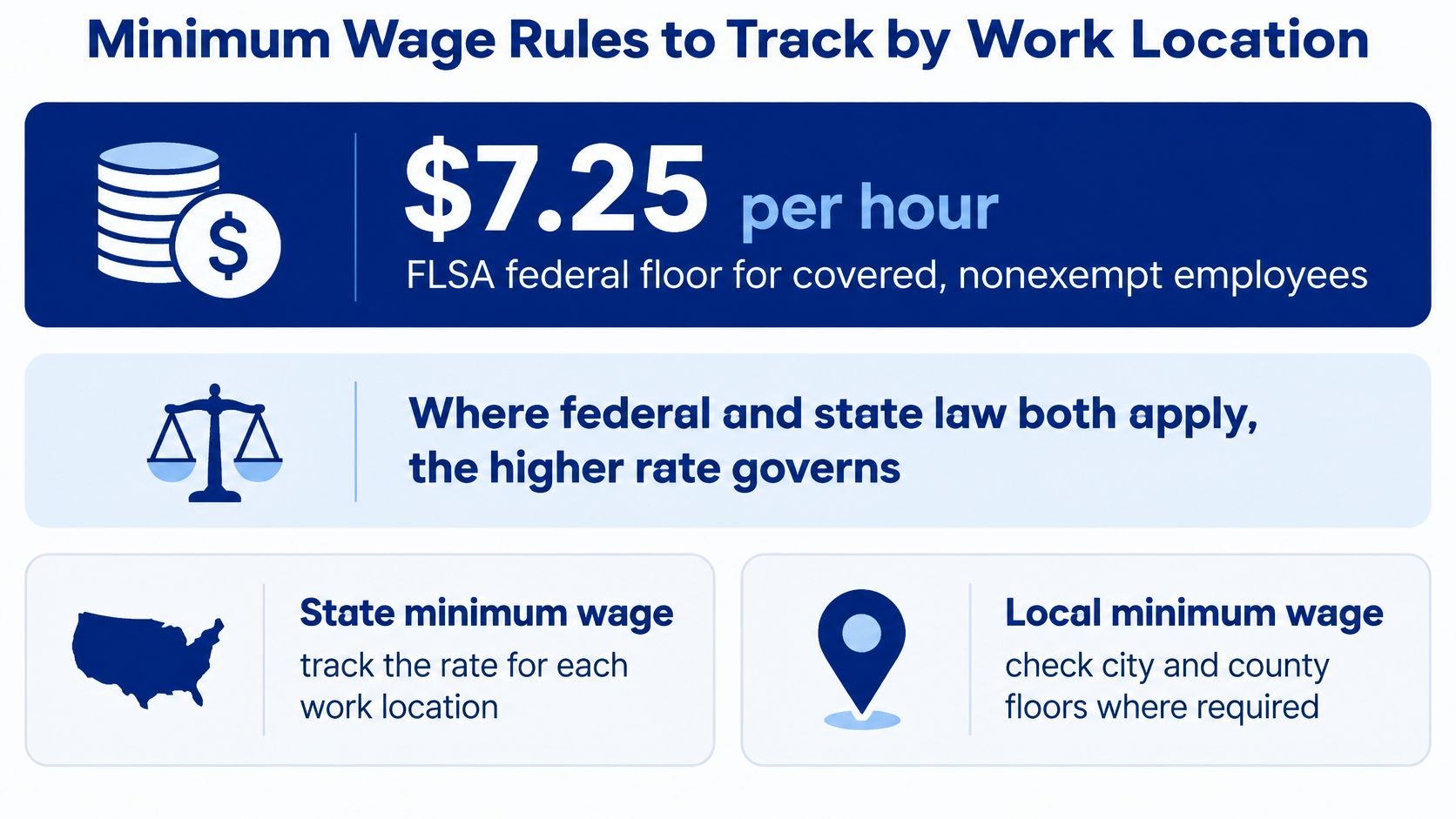
A list of state rates isn't enough when employees work in cities or counties with separate requirements. The matrix should connect the employee's work location to the applicable wage rule and its effective date. Occupation and tipped status need their own fields rather than an assumption that every employee uses the standard rate.
A correct hourly rate can still produce an incorrect paycheck if payroll uses the wrong location or effective date. The payroll lead should compare the employee roster against the wage matrix and inspect sample calculations after configuration changes. Managers also need a route for reporting unrecorded work or unexpected deductions.
The broader wage-and-hour compliance guide helps connect rate tracking with timekeeping and payroll administration. These controls should operate together rather than as separate annual projects.
Payroll check: Apply the highest applicable federal, state, or local rate, then confirm the result on every payroll run.
Payroll inputs need a final check before the first pay run. Keep projections marked as provisional, and match state notices to the correct employer account before loading account-specific rates.
The Social Security Administration's projected 2027 taxable maximum is $192,300, with employee and employer OASDI rates remaining 6.2%, according to Thomson Reuters' payroll year-end report. The payroll lead should record the projection for planning, then use the final published wage base for production.
California EDD lists Schedule F+ and a $7,000 taxable wage limit per employee for calendar year 2027 on its rates and withholding page. EDD's employer news guidance projects that employers will receive their 2027 Notice of Contribution Rates and Statement of Unemployment Insurance Reserve Account by December 31, 2026. Treat that delivery date as an agency projection until the notices arrive.
An automatic software update does not replace a named review or retained approval record.
Who owns the employment decision when a vendor's tool ranks an applicant or flags an employee? The employer needs an answer before using the output. Whether a tool counts as a covered automated employment decision system requires review of its actual function, not just its product description.
The inventory should cover recruiting platforms, video-interview analysis, scheduling systems, productivity monitoring, and algorithmic performance tools. A feature embedded in an existing system can matter as much as a separately purchased tool. The employee monitoring laws guide provides context for reviewing monitoring alongside employment decisions.

For planning purposes, the Gunderson Dettmer spring employment-law update identifies January 1, 2027 for Colorado's amended AI framework and California's limits on workplace surveillance involving emotion inference or neural data, and October 1, 2027 for Connecticut's covered automated-technology disclosures and certain pre-decision notices. Counsel should confirm current statutory coverage and implementation requirements before deployment.
A major risk pattern is undocumented human reliance on a vendor recommendation. A manager may say the final decision was human while the record contains nothing beyond an automated score. The decision file should explain what the tool produced, what the reviewer independently considered, and why the final action followed.
Ownership should be explicit for every notice, accommodation, audit, and documentation task. The vendor may supply materials, HR may administer the process, and a manager may review the output. The employer still needs a written allocation of responsibility and counsel's input on duties that cannot be delegated.
Start with a contract and headcount check, not just the payroll calendar. Some reporting duties arise from employer status, establishment characteristics, or a particular federal contract. A business can cross a coverage threshold without changing its payroll provider.
EEO-1 Employer Information Report. The DOL FirstStep Employment Law Advisor describes covered federal contractors and subcontractors with at least 50 employees and a qualifying contract, subcontract, or purchase order of $50,000 or more, as well as specified government-fund depository and savings-bond roles. For 2027 planning, the executive responsible for contracts should verify current coverage and agency instructions rather than assuming historical contractor rules remain unchanged.
Contractor status isn't the only possible route to EEO-1 coverage. The responsible executive should confirm the applicable reporting category with the relevant federal agency, identify the reporting establishment structure, and preserve demographic and job-category records. The EEO-1 reporting guide can help organize the information needed for that review.
Affordable Care Act reporting. For 2027, the benefits owner should assess the IRS applicable-large-employer test, generally involving 50 or more full-time and full-time-equivalent employees, and any other applicable reporting obligations. The calculation isn't necessarily the same as the active employee count shown on a payroll dashboard. Controlled-group and workforce questions warrant specialist review before a coverage conclusion.
OSHA electronic submissions. For 2027, coverage under OSHA's injury and illness recordkeeping rules, 29 C.F.R. Part 1904, requires an establishment-size and industry review. A company-wide headcount doesn't answer every establishment-level question. The safety owner should document the classification and the reporting determination for each relevant location.
The calendar should contain the reasoning behind inclusion or exclusion, not merely a filing reminder. Acquisitions, new locations, contract awards, and workforce changes should trigger another review. A prior-year determination isn't permanent.
Each condition needs a named owner and a review date. Filing windows and instructions should be confirmed when the agency publishes them, rather than guessed from a previous cycle.
The calendar should be assigned before the year begins, with enough lead time for unresolved coverage questions. An owner means a named person who can approve the work or escalate it. A department label such as payroll or operations isn't enough when several people assume someone else submitted the return.

For every item, record the owner, next due date, evidence to keep, and last review date. A backup should have access to the necessary records and submission systems. Sensitive employee information should remain outside the general task register.
A task is complete when the required work is verified, not when someone sends an email saying it was handled.
Calendar gaps become especially difficult when a filing deadline coincides with a harassment complaint, leave decision, or proposed termination. Those situations need expert input before action, particularly where a complaint or protected leave precedes the decision. Administrative urgency shouldn't determine the employment response.
Owners seeking a second review can learn more about International Inc., an HR consulting firm, not a law firm. It acts as the HR and compliance function for companies with 25–500 employees across several states and designs partnerships around each company's size, structure, and operating locations.
Its Core HR Compliance plan includes unlimited phone or email HR consulting, a federal and state handbook build or audit, core policy templates and documentation guidance, an HR file and I-9 audit, onboarding and offboarding checklists, and an annual compliance review. Those services can support the work behind the calendar when no senior HR leader owns it internally.
This article is general information, not legal advice. Employment laws change and vary by state; consult qualified employment counsel about your situation.
Paradigm International Inc. offers multi-state HR compliance support and structured guidance for owners managing employment decisions alongside operations. Its approach can help turn a calendar into assigned policy, documentation, and review workflows. Book a Free HR Risk Review.


