
You're not usually looking for employment law guidance on a calm morning. You're looking for it after a manager has fired someone too fast, an employee has raised a complaint that now needs a paper trail, or a new state hire has exposed gaps in your policy set. That's the moment leadership gets tested, because the problem is rarely the rule itself, it's the decision made without a defensible process.
Most SMBs still treat employment law like a checklist. That's too small a frame. The better question is whether your team can explain, document, and defend a high-stakes people decision after the fact, under pressure, with multiple legal regimes watching at once. If you can't do that, you don't have a compliance problem only, you have a leadership risk.
The call comes in late afternoon. A department head wants a termination handled before the next shift. An employee has emailed a complaint that sounds messy, and the founder wants it “kept internal.” Or the company just hired in a new state and the old handbook suddenly feels thin.
That's where employment law guidance stops being an HR topic and becomes an operating discipline. The mistake most leaders make is assuming the issue is whether the rule is written down somewhere. The key issue is whether the company can show that it made a careful decision, based on facts, through a process that doesn't fall apart later.
Practical rule: if a decision would look awkward in an email thread or deposition, it wasn't ready to be made.
This is why manager accountability matters so much in the workplace. A CEO can't be in every room, but the CEO can insist that every high-risk personnel action follows the same logic, the same review path, and the same documentation standard. That's how you reduce the odds of a bad call turning into a legal mess, and why a structured model like manager accountability belongs in the same conversation as policy compliance.
The U.S. Department of Labor says it administers and enforces more than 180 federal laws covering about 165 million workers and 11 million workplaces (U.S. Department of Labor major laws). That scale tells you something simple. Employment decisions don't live in one lane, they move across wages, discrimination, leave, safety, and classification at the same time.
A strong compliance floor starts with the areas that touch daily decisions. The Department of Labor's framework spans wages and overtime, leave, discrimination, labor, workplace safety, and workers' compensation (U.S. Department of Labor major laws). That list is broad on purpose, because the same personnel move can trigger more than one issue.
The first question is always pay. If someone is classified wrong, paid late, or not tracked correctly, the company is exposed before anyone starts arguing about intent. The second is leave and accommodations, where leaders need to know when an absence request, pregnancy-related limitation, or disability issue requires a process instead of a quick denial.
Then comes anti-discrimination. Title VII, the ADA, the ADEA, and the PWFA all create different layers of risk, and the coverage thresholds matter. The Civil Rights Act's Title VII protections apply to employers with 15 or more employees, the ADEA dates to 1967 and protects workers age 40 and older, the ADA was enacted in 1990 and applies to employers with 15 or more employees, and the PWFA took effect on June 27, 2023 and also covers employers with 15 or more employees (U.S. Department of Labor major laws, Baker Donelson federal guide).
The law is fragmented because the workforce is fragmented. Federal rules set the base, states add detail, and local rules can tighten the screws further. For an SMB leader, that means the compliance floor is not a binder on a shelf. It's a set of decision questions that should fire every time someone hires, disciplines, moves, or separates a worker.
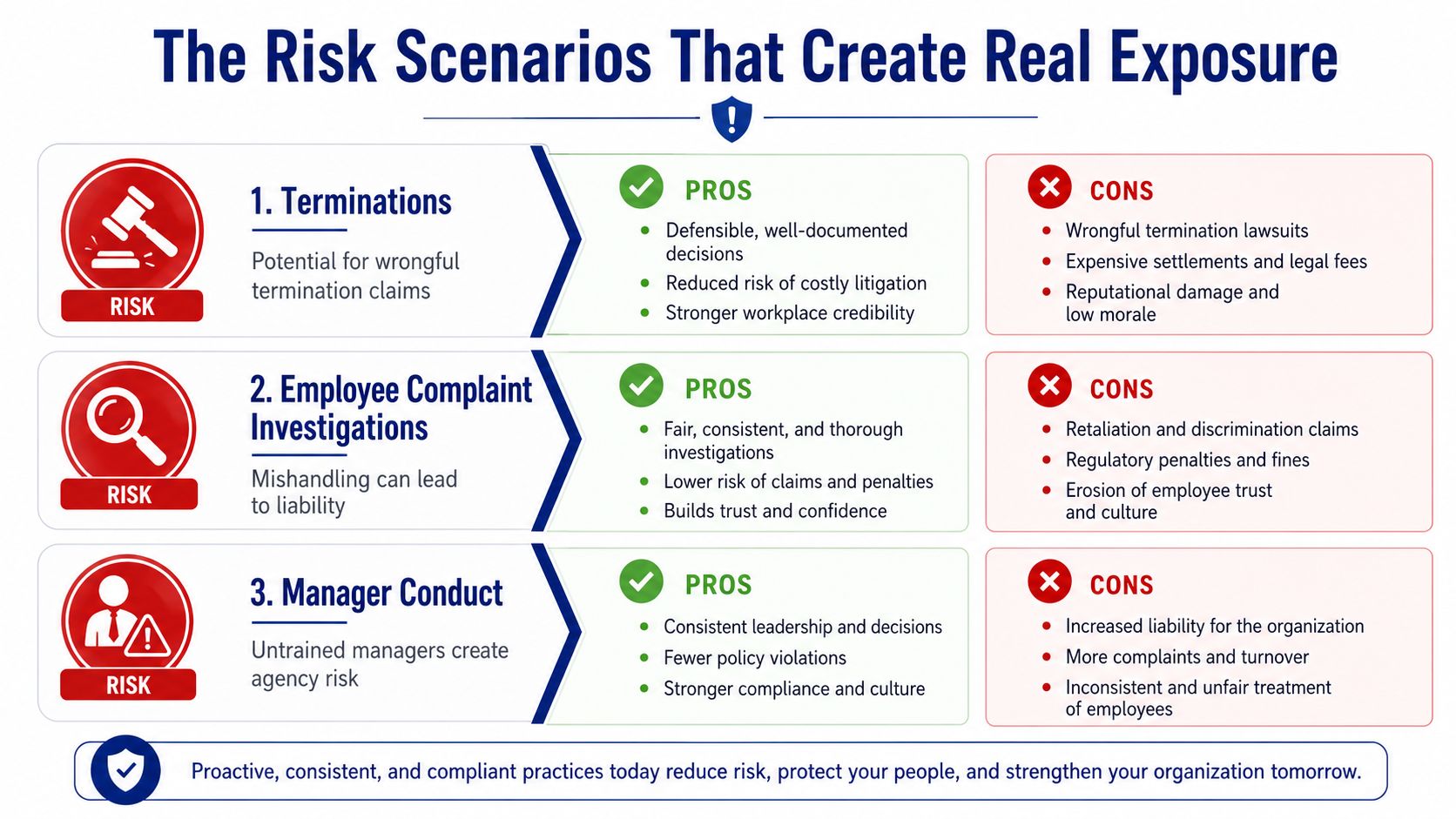
The highest-risk moments are boring until they're not. A termination. A complaint investigation. A manager who keeps improvising. Those are the events that turn a policy into evidence, and evidence into liability if the process was sloppy.
Termination decisions fail when the rationale lives only in a manager's head. If the company can't show the business reason, the performance history, the review path, and the final-pay handling, it invites trouble. California's final-pay rules show how concrete this can get, with wages due immediately upon termination for fired or laid-off employees, within 72 hours if the employee quits with less than 72 hours' notice, and on the last day if the employee quits with 72 hours' notice (Legal Aid at Work fact sheet).
Unused vacation matters too. In California, accrued vacation is treated like wages and must be paid out at separation, not forfeited (Legal Aid at Work fact sheet). That's the kind of issue leaders miss when they think only about the exit conversation and not the aftermath.
Employee complaints don't have to be perfect to deserve a serious response. The risk is in how the company handles them. If the investigator cherry-picks witnesses, skips notes, or lets the business owner steer the outcome before facts are gathered, the record becomes weak.
A UK government-commissioned report found that roughly 1 in 10 workers in the wider workforce experienced at least one work-related issue, harm, or violation in the last two years (UK working lives report). That's not a niche problem. It means employers should expect recurring complaints, not treat them as rare disruptions.
A company can have a strong policy and still create exposure through everyday leadership behavior. Favoritism, off-the-record comments, inconsistent discipline, and social media behavior all become legal problems when managers act like their judgment is the company's legal position. That's why leaders need a standard for coaching managers early, before conduct calcifies into a pattern.

When the process is strong, even a hard decision can be defended. When the process is weak, the “right” decision can still look arbitrary.
A defensible record is not a stack of screenshots and frantic notes. It's a clean story of what happened, who reviewed it, what was decided, and why. If the record can't answer those four questions, it won't help when the dispute arrives.
Keep the written record tied to observable events. Document dates, witnesses, policy references, compensation actions, performance concerns, accommodation requests, and the specific reason a decision moved forward. Leave out labels that don't help the case, like “bad attitude,” “not a culture fit,” or “everyone knows the issue,” because those phrases invite the wrong questions later.
For terminations and discipline, write the decision memo as if someone outside the company will read it. State the timeline, the policy or performance standard involved, the review steps taken, and the final decision maker. If an investigation was involved, note who interviewed whom, what records were reviewed, and what facts were accepted or rejected.
The rationale is the protection. A short, clear decision record should show:
That structure matters because it shows the company made a deliberate choice rather than a reflexive one. It also helps later reviewers spot inconsistency before the issue escalates. For a practical retention and record-keeping lens, see employment records retention requirements, because the best memo in the world is useless if no one can find it.
Cross-state growth is where a lot of SMBs get careless. They keep one handbook, one offer template, one termination checklist, and one manager script, then act surprised when a new state changes the answer. That's not scaling, that's copy-pasting risk.
Some rules are relatively steady across the business, like the need for neutral criteria, disciplined documentation, and manager escalation. Other rules change with geography, especially final pay timing, leave entitlements, and non-compete restrictions. The company's job is to build a register that tells leaders which issues are fixed, which ones vary by state, and which ones require local review before action.
The California final-pay rule is a good example of why this matters. If your termination checklist assumes a single national timing rule, you'll miss a state obligation that changes the entire exit workflow (Legal Aid at Work fact sheet). The same logic applies to vacation payout, leave handling, and any policy that touches separation.
Leadership rule: one handbook can guide culture, but it can't override jurisdiction-specific pay or leave obligations.
The DOL's employee-versus-independent-contractor analysis also shows why location-agnostic thinking fails. The agency looks at economic dependence, using factors such as profit or loss opportunity, investments, permanence, control, integration into the business, and skill and initiative (DOL employment relationship fact sheet). If your workforce includes contractors in multiple states, classification needs a separate review track, not a one-line label in a spreadsheet.
For teams managing pay practices across jurisdictions, a structured wage and hour compliance review is the right way to keep decisions aligned as the workforce expands. The point is not to memorize every rule. The point is to know which rulebook governs which decision, and to document that choice every time.
Many leaders still think the main AI risk is whether the tool is impressive. It isn't. The risk is whether the tool is making or shaping decisions without enough human review, context, or auditability.
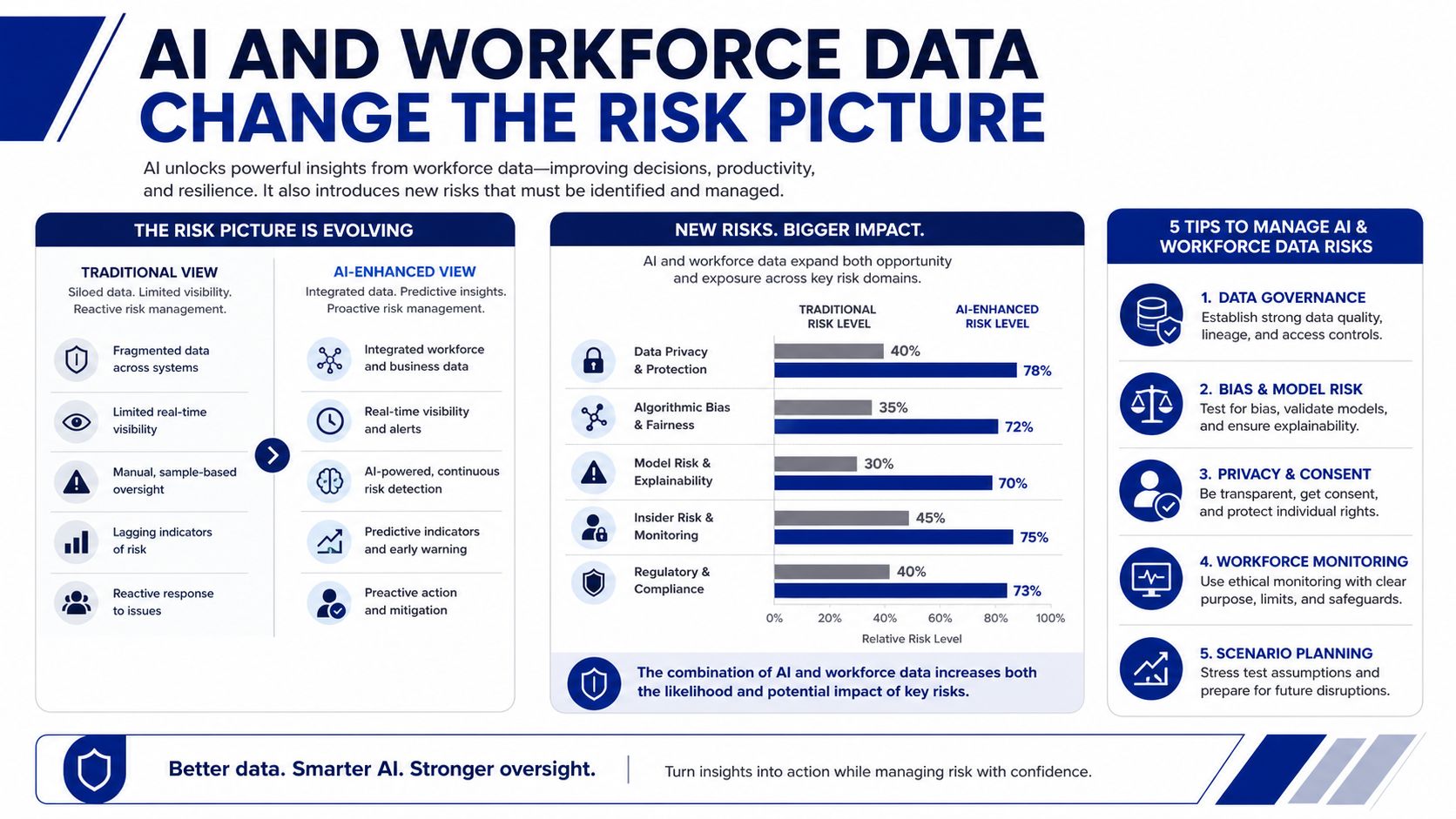
The Berkeley Labor Center argues that employers should not rely exclusively or mainly on electronic monitoring for consequential decisions, and instead should use independent human-driven assessments, with limits on intrusive monitoring in breakrooms, restrooms, and off-duty settings (Berkeley Labor Center). That's the right posture. Monitoring tools only capture a partial view of work, and that partial view can be misleading if it becomes the sole basis for discipline, hiring, promotion, or termination.
The smarter model is process governance. Tell people what data you collect, why you collect it, and who can use it. Then require a human review before any consequential decision is finalized.
A practical data standard is simple. Collect only what is necessary and relevant to the employment relationship. Use a lawful basis other than employee consent when the power imbalance makes consent unreliable. Secure records with encryption, access controls, and audit logs, and treat health or biometric data as high risk that needs added safeguards (HR guide to employee data protection).
That matters because employee records usually run across payroll, leave, benefits, performance, and compliance systems. If those systems are loose, one bad access practice can create privacy, breach, and wrongful-processing exposure at the same time. AI didn't create that problem, it just made it easier to scale.
The wrong time to call for help is after the decision has already been announced. The better time is when the facts are still messy and the company needs a clean path through them. That's when an external advisor changes outcomes, because they can slow the process down just enough to make it defensible.
Use outside support before decisions involving protected categories, senior departures, cross-state moves, investigations with retaliation risk, and any action that will need a documented legal rationale under time pressure. If the answer affects a manager, a director, or a visible employee, get review before you speak.
That's also true when your internal team is seeing the same issue from too close up. A defensive review checks whether the paperwork is complete and the decision is supportable. A strategic engagement helps leadership choose the process itself, which is the better use of counsel when the stakes are real.
For leaders who also run structured goal systems, a guide to OKR consulting is useful because it shows how disciplined goal-setting depends on clear ownership and review cadence. Employment decisions need the same discipline. If the company can't name the reviewer, the standard, and the escalation path, it's not ready to act.
International Inc. fits this advisory model because it works on employment practices, wage and labor issues, and HR audit work that reviews hiring practices, employee handbooks, payroll classifications, and termination procedures. That kind of review is useful when a leadership team wants structure before a crisis, not just cleanup after one.
Come prepared with the facts, the policy, the timeline, the manager's notes, the draft decision, and the question you need answered. Don't ask for a vague blessing. Ask whether the process, the documentation, and the rationale will hold up if challenged.
The best teams don't treat advisors as cleanup crews. They use them as a control point before the risk hardens.
The simplest model is also the hardest one to fake. Keep a current compliance map, a written documentation standard, a multi-state decision register, an escalation path for high-risk events, and a clear threshold for when outside review is required. That's the core of employment law guidance that helps a leadership team.
This is not about building a giant legal binder. It's about making sure managers, HR, and executives can make the next hard call the same way every time, with records that show their work. If you want a practical conversation about how to build that into your company, start with the contact page and talk through the decisions that are most likely to go sideways.
A CTA for Paradigm International Inc.. If you want help turning your people decisions into a defensible operating model, contact Paradigm International Inc. to talk through the specific risks in your workforce and what to put in place next.