Navigating the world of employee files can feel like a low-priority task, but those records are one of the most powerful legal shields your company has. Getting employment records retention requirements right is not just about staying organized; it is a critical business function. A smart, well-defined strategy protects you from expensive legal battles and regulatory fines, serving as your best defense.

A solid record retention plan is more than a compliance checkbox—it is a core part of your risk management framework. When faced with a claim like wrongful termination or a wage dispute, organized records provide the objective evidence needed to defend your actions. Without them, you are left relying on memory, which rarely holds up in legal proceedings.
Think of your employee files as the official story of the employment relationship. Each document, from the application to the final pay stub, builds a factual narrative. This paper trail can resolve disputes quickly, often before they escalate into costly litigation.
Failing to produce a required document during an investigation can have serious consequences. Courts may assume the missing record would have hurt your case, a legal concept known as an "adverse inference." This can cripple your defense before you even begin.
Regulatory bodies like the Department of Labor or the EEOC can also levy steep fines for non-compliance. These penalties, combined with potential legal settlements, can be a major blow to a business. To better understand these risks, it is wise to learn how to protect your company from HR lawsuits and build defensible practices.
Maintaining a clear, consistent, and compliant retention policy is not just an HR function—it is an essential safeguard for your company's financial health and reputation. It demonstrates a commitment to fair practices and operational integrity.
A systematic approach to records management brings consistency and makes your actions defensible. This means knowing how long to keep documents, how to store them securely, and when to destroy them properly. A formal policy removes guesswork and ensures everyone handles sensitive records the same way.
Effective management also means keeping data privacy rules in mind. For businesses with international ties, using GDPR compliant HR software can add another crucial layer of legal protection. A sound retention strategy gives you several key advantages:
A strong retention policy is a proactive shield against preventable risks. The following sections will detail specific federal and state requirements to help you build a compliant and effective plan.
Navigating federal employment laws can feel complex. Multiple government agencies have their own set of rules, which can seem overwhelming. However, breaking them down reveals a clear pattern, making it easier to build a compliant employment records retention requirements strategy.

The key is to focus on the major federal agencies, primarily the Department of Labor (DOL) and the Equal Employment Opportunity Commission (EEOC). Each has a distinct focus, which dictates the documents you must keep and for how long.
The Fair Labor Standards Act (FLSA) is the foundation of federal wage and hour law. Enforced by the DOL, it sets the rules for minimum wage, overtime pay, and recordkeeping. These regulations are designed to ensure employees are paid correctly, with a clear paper trail to prove it.
The FLSA mandates that employers keep basic payroll records for at least three years. This is one of the most fundamental requirements every business must follow. These records must include key details such as:
These documents serve as the financial history of an employee's time with your company. They are the definitive proof that you have met your payment obligations.
While the FLSA covers how you pay people, the EEOC focuses on ensuring fairness and preventing discrimination in hiring, promotion, and termination. Its recordkeeping rules help the agency investigate claims of discrimination effectively.
The EEOC requires employers to keep all personnel and employment records for one year from the date the record was made or the personnel action was taken, whichever is later. This includes performance reviews, promotion records, and termination files.
For businesses with 100 or more employees that file an annual E-1 Report, that retention period extends to two years. This longer requirement reflects the increased oversight for larger employers.
If an employee files a discrimination charge against your company, you must preserve all relevant records until the case is fully resolved.
For many industries, workplace safety is a major operational focus, and the Occupational Safety and Health Administration (OSHA) sets the standards. Its recordkeeping rules are among the most stringent. Managing these files properly is a key part of your OSHA recordkeeping compliance.
A couple of key OSHA retention periods stand out:
The length of these retention periods underscores the need for a solid system for long-term document storage and retrieval.
To make sense of these overlapping timelines, it helps to see them side-by-side. This table breaks down the key federal requirements from major agencies.
Federal Law/AgencyTypes of Records CoveredMinimum Retention PeriodFLSA (DOL)Basic payroll records, timecards, wage rate tables3 YearsEEOCHiring, promotion, demotion, termination, EEO-1 data1 Year (or 2 Years for employers with 100+ employees)ADEAPersonnel records, benefit plans, seniority systems1 YearADAReasonable accommodation requests, personnel records1 YearFMLALeave requests, dates of leave, employee notices3 YearsOSHAInjury & Illness Logs (Form 300, 301, 300A)5 YearsOSHAEmployee medical records & exposure recordsDuration of Employment + 30 Years
Remember, these are the minimums at the federal level. Your state or local laws might require you to hold onto these records for even longer.
Staying on top of these varied timelines is a challenge. The potential for error is why 42% of HR professionals named record retention non-compliance as a top litigation risk. With average defense costs soaring past $125,000 per case, the stakes are incredibly high.
Understanding these core federal rules provides a strong foundation. But federal law is just the starting point. State and local laws often impose even longer retention periods, which we will cover next.
Relying solely on federal rules for your employment records is a common and costly mistake. While federal laws create a baseline, state and local governments often impose stricter obligations. For any business operating in more than one state, this patchwork of regulations can become a compliance challenge.
This multi-layered legal landscape means your retention policy cannot be a one-size-fits-all document. A record you might legally discard after three years under federal law could need to be kept for six or more years to satisfy a state mandate. Ignoring these local rules can expose your company to fines and legal action.
When faced with overlapping federal, state, and local laws, the guiding principle is simple: you must follow the rule that provides the greatest protection to the employee. For record retention, this almost always means holding onto a document for the longest required period.
This logic ensures you stay compliant everywhere you operate, eliminating dangerous gaps in your strategy. For instance, the federal FLSA requires you to keep basic payroll records for three years. However, California state law mandates a four-year retention period for those same records. A compliant company-wide policy must adopt the four-year standard for all payroll documents.
The differences between state laws can be substantial and extend beyond payroll. Many states have their own retention periods for records related to hiring, termination, and workplace injuries that go beyond federal minimums.
Consider these examples:
A failure to account for these variations can put a growing business in a tough spot during a state-level audit or a lawsuit filed in a state court.
Beyond geography, your industry can add even more stringent requirements. Certain sectors are governed by regulatory bodies with their own distinct rules for keeping employment-related records. These are legally enforceable standards, not optional guidelines.
The most prominent example comes from the Occupational Safety and Health Act (OSHA), which mandates that U.S. employers retain employee exposure and medical records for the duration of employment plus 30 years.
This long retention period is designed to track long-term health effects from workplace hazards. OSHA conducts thousands of inspections annually, and many penalties are linked to recordkeeping violations. Recent data shows that multi-state businesses frequently face retention-related legal disputes, costing an average of nearly $100,000 in legal fees. To explore this topic further, discover more about employee retention statistics and their financial impact.
Developing a comprehensive policy means understanding all three layers of compliance: federal, state, and industry-specific. By building your retention schedule around the strictest applicable rule, you create a single, defensible standard for your entire organization.
Turning knowledge of the rules into a practical, working system is a critical step. A formal retention policy is the blueprint for how your company manages, stores, and disposes of sensitive employee information. This is the most important step in building a process that can stand up to legal scrutiny.
A solid policy gives everyone clear rules, creating the consistency that serves as your best defense in a dispute. It proves you handle every record according to a pre-set, neutral schedule, removing any suggestion of improper motive.
First, define what the policy covers and why it exists. Your policy's opening statement should be direct. Explain its purpose: to ensure compliance with all laws, protect company assets, and manage records efficiently from creation to destruction.
Next, be clear about the scope. Your policy must apply to all records, regardless of their format. This includes paper files, digital documents, emails, and data within your HR software. Stating this upfront closes potential loopholes. A great policy is part of broader information governance strategies, treating records as valuable assets that require strategic management.
The heart of your policy is the retention schedule. This master list specifies exactly how long to keep every type of document. Building one involves a simple three-step process: identify federal rules, identify state rules, and apply the strictest requirement.
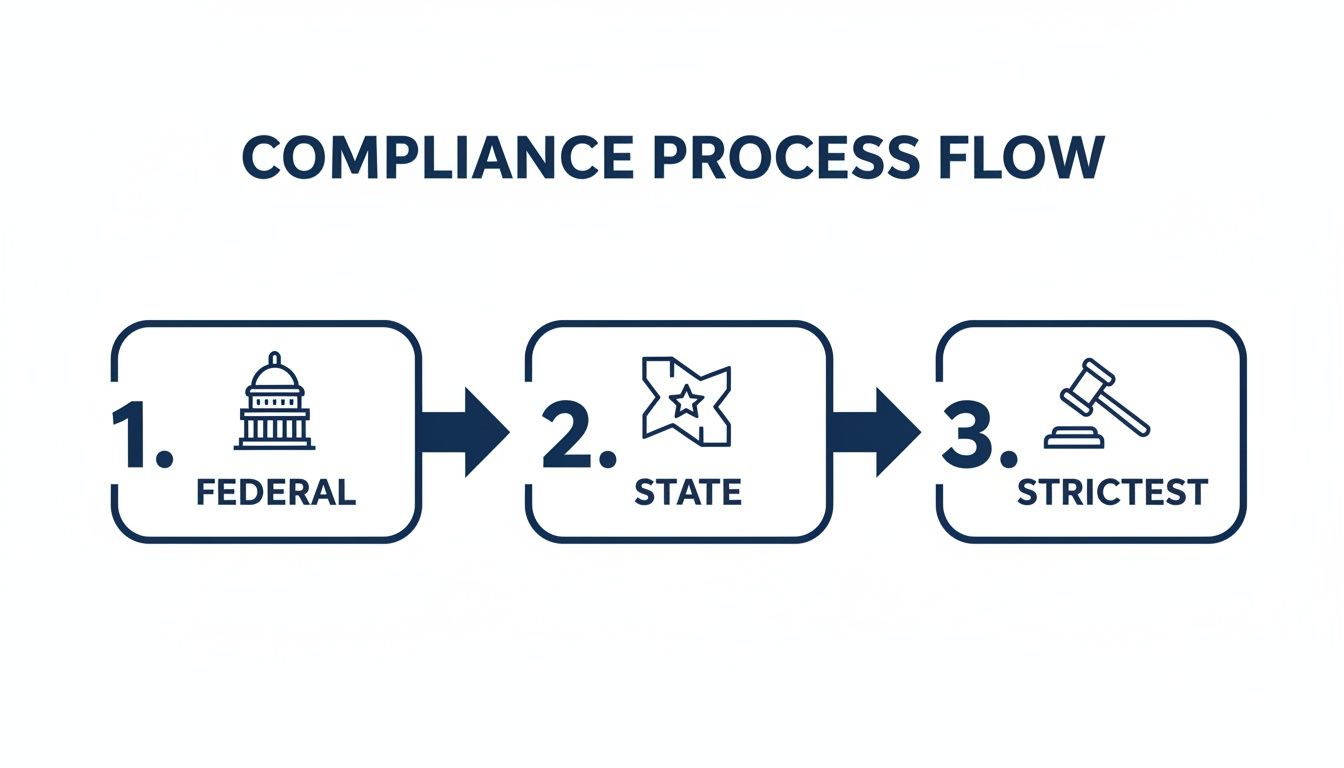
This flowchart illustrates the golden rule for any multi-state employer: stick to the strictest requirement, and you will always be protected.
To build your schedule, start by categorizing every type of document you handle. Be specific. Instead of "Hiring," break it down into applications, resumes, and background check results. For each document, list a few key details:
Here is a model schedule designed to satisfy a strict combination of federal and state laws, making it a great starting point for multi-state businesses.
Record CategorySpecific Document ExamplesRecommended Retention PeriodHiring & RecruitingApplications, resumes, interview notes, job postings, background checks4 years from hiring decisionPayroll & CompensationPay stubs, timesheets, payroll registers, wage rate tables, work schedules7 years from date of recordEmployee Personnel FilesJob descriptions, performance reviews, promotion/demotion records, training records7 years after terminationBenefits & LeaveFMLA records, benefit plan documents, beneficiary forms, COBRA notices6 years from plan filing date or 7 years after terminationSafety & HealthOSHA logs (Form 300), injury reports, hazardous exposure records30 years after termination for exposure records; 5 years for logsEmployment EligibilityForm I-93 years from date of hire or 1 year after termination (whichever is later)Taxes & GarnishmentsW-4 forms, state tax forms, wage garnishment orders4 years from date tax was due or paid
This table provides a robust framework, but always cross-reference it with your specific state and local laws to ensure complete coverage.
A policy is not complete without a clear process for legal holds. A legal hold is a directive to stop the normal destruction of records due to pending or anticipated litigation, a government audit, or an investigation. Failing to preserve evidence once a hold is in place can lead to serious penalties.
Your policy must spell out these critical steps:
Having this procedure defined means you can react quickly and correctly when legal risk appears, preventing accidental destruction of needed evidence.
Knowing how long to keep records is only half the battle; you also need to know how to destroy them securely. Tossing old employee files in the trash is a data breach waiting to happen and a violation of privacy laws.
Your policy must require secure destruction methods. For paper, that means using a professional shredding service or a cross-cut shredder. For digital files, it means ensuring they are permanently deleted or wiped, not just moved to the recycle bin. This practice is so important that it should be referenced in your company guide. For more ideas, see these essential employee handbook sections for compliance.
By carefully outlining these components—scope, schedule, legal holds, and destruction—you will build a robust and defensible policy.
A well-written policy is useless if it is not implemented. The real test of your employment records retention requirements begins when you roll it out, turning a document into a living process. Success depends on clear communication, defined roles, and consistent follow-through.
The transition from policy to practice is where many businesses falter. It requires a hands-on approach to weave these procedures into your company culture and daily operations. Every team member must understand their role in protecting the business.
First, you must assign ownership. A policy without a clear owner will likely be ignored. Designate a specific person or department, usually HR, to be the champion for the records retention program. This central authority is accountable for its success.
Individual managers also play a huge role. They create and handle many day-to-day records like performance reviews and timecards. Your implementation plan must include training that spells out their specific duties, so they know what to keep, where to store it, and for how long.
Once everyone knows their role, you need a way to verify that the policy is being followed. Regular audits are the answer. Frame them as a constructive way to find gaps and areas for improvement before they become serious legal risks.
An audit can be as simple as:
Ongoing training is just as critical. New managers need to be brought up to speed, and all staff will need periodic refreshers. Consistent education reinforces the importance of the policy and keeps best practices current.
A common mistake is treating policy implementation as a one-time event. True compliance is a cycle of continuous training, auditing, and refinement that keeps your practices sharp and legally defensible.
Even with a great plan, some traps can emerge. Being aware of these common mistakes is the best way to maintain a compliant program.
One of the biggest errors is record hoarding. It can feel safer to keep everything forever, but holding onto documents beyond their required retention period creates unnecessary risk. Old records can be pulled into legal discovery, potentially containing outdated information that could be used against you.
Another pitfall is inconsistent application. If you follow the policy for some employees but not others, you invite claims of discrimination. Your policy must be applied uniformly across every department and level of the organization, without exception.
Finally, insecure destruction methods are a disaster waiting to happen. Tossing sensitive employee files into a standard recycling bin is a direct path to a data breach. Your policy must demand secure, documented destruction, like cross-cut shredding for paper and permanent digital wiping for electronic files.
By actively managing the rollout, training your team, and watching for these traps, you can ensure your policy works as intended.
Even with a solid policy, tricky situations arise. Business leaders and HR professionals often face challenges that do not have a simple answer. This FAQ addresses some of the most common questions, offering direct guidance for navigating those gray areas.
It might feel safer to keep everything forever, but this practice—known as "record hoarding"—actually creates significant legal risk. During a lawsuit, all of those old documents are discoverable. Outdated information or casual email exchanges could be twisted and used against your company. It also drives up data storage costs and makes you a bigger target for a data breach.
A formal, consistently applied destruction schedule is your best defense. It ensures documents are securely destroyed once they no longer have a legal or legitimate business purpose.
The answer is simple: your retention policy must apply equally to both. The law makes no distinction between formats. An email in a digital archive is subject to the same rules as a piece of paper in a filing cabinet. The key is ensuring your digital storage is secure, organized, and set up to systematically delete records according to your schedule.
For paper records, you need secure storage and a documented shredding process. This is why many businesses are moving to digital-first systems—it is easier to automate and manage retention rules correctly.
A legal hold is an emergency brake for your destruction schedule. It is a formal directive to stop destroying records when you have a reasonable expectation of a lawsuit, audit, or government investigation. Once a legal hold is issued, you must preserve every relevant document, even if its scheduled destruction date has passed.
Failing to do this is a serious mistake known as "spoliation of evidence," and it can lead to severe penalties. A defensible retention policy must include a clear, step-by-step procedure for issuing, managing, and releasing legal holds to avoid these costly errors.
Navigating high-stakes people decisions requires structure and expert judgment. At Paradigm International Inc., we act as a decision partner for SMB leadership teams, helping you maintain defensible HR practices and reduce employment risk. Learn how we can support your organization's responsible growth.