
Handling an employee's departure is a high-stakes moment that requires both sensitivity and legal foresight. A well-crafted employment separation agreement template is one of the most important tools for navigating this transition. It ensures a clean, final, and legally sound conclusion to the employment relationship. Think of it as a strategic asset for protecting your company’s resources and reputation.

Employee offboarding is far more than a simple farewell. The process is filled with potential compliance pitfalls and legal risks. Without a clear and defensible separation agreement, your business is left exposed. This guide provides business owners and HR leaders with a practical, actionable approach to this challenge.
Here, we'll break down the essential components and deliver the insights you need to protect your organization. While our focus is on employment separation, you can find a wide range of other contract templates to fit various business needs.
A properly drafted agreement offers mutual closure and legal protection. For the departing employee, it typically provides financial consideration in exchange for releasing claims. For your business, it secures that release, effectively preventing future lawsuits. For guidance on more complex situations, you can always contact our team. Getting this process right is non-negotiable for ensuring your company's long-term stability.
A separation agreement is more than a formal goodbye and a final paycheck. It is a binding legal contract designed to protect your organization from future legal risk. To make it defensible, you must include specific, non-negotiable clauses that form its foundation. Think of these components as the structural beams of the agreement.
The single most important part of any separation agreement is the general release of claims. This is the core bargain: in exchange for something of value (known as "consideration"), the departing employee gives up their right to sue your company. The release covers claims related to their employment or its termination.
This clause must be broad, specifically listing the types of claims being waived, such as those under Title VII or the Age Discrimination in Employment Act (ADEA). However, you cannot ask an employee to waive certain protected rights. For example, they retain the right to file a charge with the Equal Employment Opportunity Commission (EEOC) or collect a whistleblower award.
For the release of claims to be valid, you must offer the employee consideration—something of value they are not already entitled to. This must be in addition to their final wages, earned commissions, or accrued vacation pay.
Common forms of consideration include:
There is no magic formula for how much to offer, but a common starting point is one to two weeks of pay for every year of service. The goal is to provide a meaningful incentive that makes signing the agreement a clear and logical choice for the employee.
While the release is the main event, other clauses add critical layers of protection. A confidentiality provision legally prevents the former employee from disclosing the terms of the agreement. It can also bar them from sharing sensitive company information they accessed during their employment.
A non-disparagement clause goes a step further by stopping the employee from making negative statements about the company, its leaders, or its products. In an era where a single online post can damage your brand, this is invaluable. These are often mutual, meaning the company also agrees not to speak ill of the former employee.
The legal landscape is always shifting. For instance, recent warnings from Beijing's HR Bureau against "trap clauses" in termination agreements reflect a global trend toward protecting employee rights. This mirrors predictions of a 22% rise in wrongful termination suits in the U.S. tied to ambiguous release language, making clarity in your employment separation agreement template more critical than ever. You can find more details about these global employment law trends and their implications.
For any business, ensuring these foundational components are correctly drafted is essential risk management. If you need expert guidance, you can always get in touch with our team for a consultation.
Using a pre-made separation agreement template is a smart start, but it's just a start. A one-size-fits-all document is a recipe for legal risk. Real protection comes from meticulously tailoring the agreement to the specific employee, their role, and the web of state and federal laws that apply. This is a strategic process of weighing risk and responsibility.
The first layer of customization depends on the employee’s role. The terms you need for an executive with access to trade secrets will differ dramatically from those for an hourly employee. This is about matching the agreement to the level of risk the role carries.
Consider these common scenarios:
The decision tree below helps visualize how to classify clauses based on the specific role.
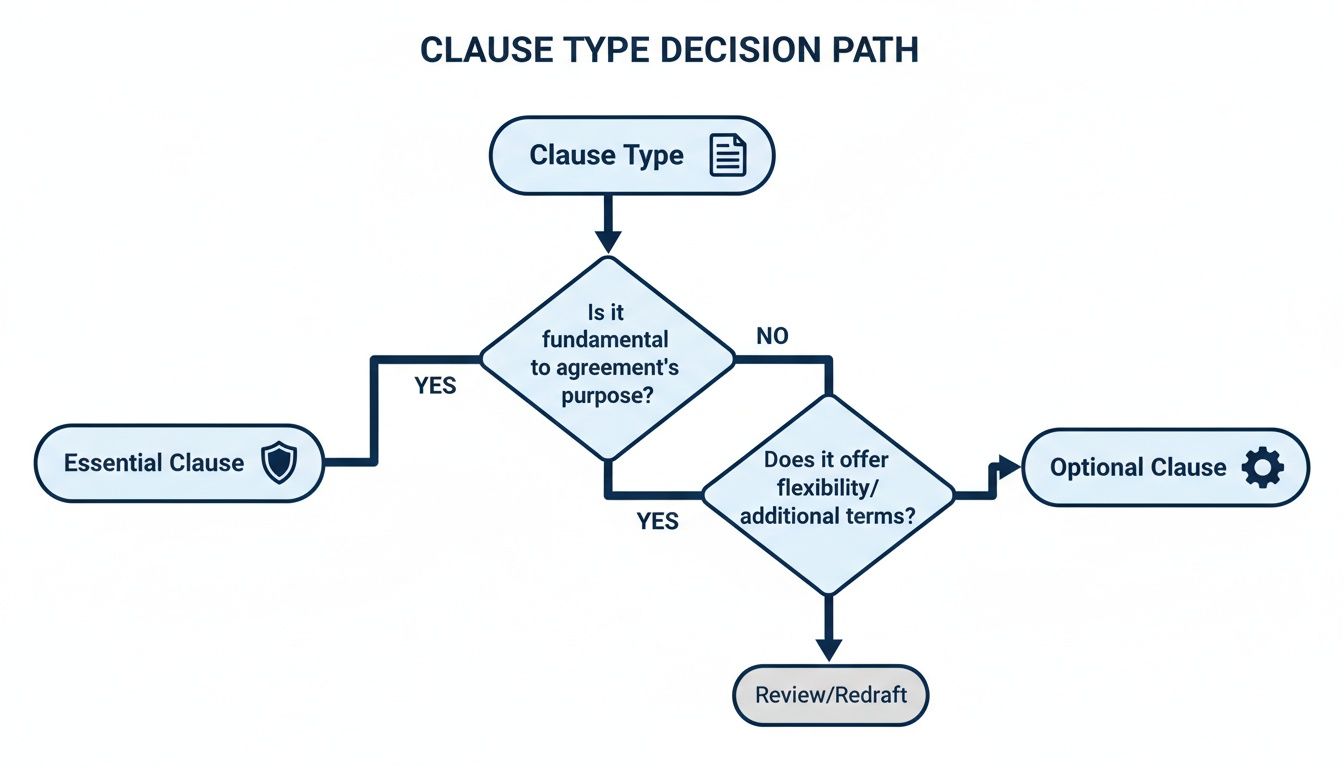
This flowchart shows how every agreement starts with core protections but can be built out with optional clauses to tackle unique risks tied to a particular job.
Jurisdiction is the most complex factor when customizing a separation agreement. State laws—and sometimes even city ordinances—have the final say on what you can and can’t include. A clause that’s enforceable in one state might be invalid just across the border. An agreement that is not compliant with the specific laws of the state where the employee worked is at high risk of being invalidated.
For example, non-compete clauses are a classic flashpoint for state-by-state differences. A state like Texas might enforce a reasonably drafted non-compete, while California has a near-total ban on them. Using a non-compete in California won't just fail—it could get your company sued. The same goes for rules around final pay, vacation payouts, and even the specific language required in a release of claims.
For businesses with operations in multiple states or countries, the complexity multiplies. You cannot use a single, standardized separation agreement. Your HR and legal teams need to maintain jurisdiction-specific addendums or separate templates for each location.
This global compliance landscape is also in constant flux. For instance, in 2026, severance arrangements are undergoing a profound transformation worldwide, forcing multi-state operators to audit their contracts. Mexico's draft Labour Assistance Fund (FAL) is set to centralize severance payouts and cut down on litigation. You can read more about these and other global employment law updates for 2026.
Given these complexities, customizing your separation agreement is not optional. It is a fundamental requirement for creating a document that is both fair and legally defensible. If you need expert help tailoring agreements for complex roles or multi-state operations, our team is here to help.

How you present and finalize a separation agreement is just as important as the clauses inside it. A clumsy or rushed execution can create legal risks that undermine the entire point of a clean separation. This final phase ensures the agreement is voluntary, enforceable, and defensible. Navigating this stage successfully boils down to careful planning, transparent communication, and strict adherence to legal procedure.
Failing to give the employee enough time to review the agreement is a major legal landmine. This is not just a professional courtesy; it is a legal mandate to prove their signature was knowing and voluntary. Pressuring an employee to sign on the spot is a surefire way to have an agreement thrown out in court.
A key federal law, the Older Workers Benefit Protection Act (OWBPA), dictates specific timeframes for employees aged 40 and over. These rules protect older workers from being coerced into waiving their rights under the Age Discrimination in Employment Act (ADEA).
The OWBPA also requires you to advise the employee, in writing, to consult with an attorney. It is best to include this clause in your template for all employees, regardless of age, as it strengthens the argument that their signature was fully informed.
Do not be surprised if an employee or their attorney requests changes to the agreement. This is a normal part of the process. Your goal is to manage these negotiations professionally and document every detail. Review proposed changes with your legal counsel. Some requests, like a small bump in severance, may be reasonable to accept.
If you agree to any changes, they must be reflected in a revised version of the document. Both parties should initial the changes and sign the final, updated agreement. Relying on verbal promises or informal emails is a mistake that only creates ambiguity and invites future disputes. Our article on how to fire an employee legally offers more context on this process.
The meeting where you present the agreement should be handled with care and professionalism. The objective is to present the document, briefly explain its purpose, and outline the next steps. It is not the time to debate the decision or rehash the reasons for the separation.
Checklist for the Presentation Meeting:
Properly executing the agreement is the final, critical step in securing its legal power. By managing this process with diligence and respect, you protect your business and bring a difficult situation to a professional close.
Handling an employee separation is a high-stakes moment that can define a leader's effectiveness. This checklist is your high-level guide to navigating the process, turning a risky situation into a managed, low-risk business function. It ensures your leadership team follows a structured and defensible process every time.

Think of this as your quick-reference tool. It covers critical checkpoints, from locking down the business reason for a termination to preserving all relevant documents. The goal is to help you move deliberately, document correctly, and sidestep preventable legal exposure.
Before drafting an employment separation agreement template, you must clearly document the legitimate, non-discriminatory business reason for the separation. This documentation is your first and best line of defense if a termination is challenged. Whether it’s due to poor performance, a policy violation, or a layoff, the reason must be solid and consistent with company records.
A vague or shifting rationale is a massive red flag in court. For instance, if you claim termination for performance but the employee has a file full of great reviews, your position is immediately compromised. The reason has to be clear, factual, and on paper before the termination meeting happens. The business rationale is the foundation of a defensible separation.
For leaders who want to be more proactive, implementing strategies like predictive analytics in HR can help identify underlying issues before they escalate. This data-driven approach can significantly reduce termination risks.
Next, conduct a thorough risk assessment. Step back and view the separation from an outsider's perspective, looking for red flags related to discrimination or retaliation. Has the employee recently engaged in protected activity, like filing an HR complaint or requesting medical leave?
Ask yourself these critical questions:
This analysis helps you gauge the risk level. If you find any red flags, offering a well-crafted separation agreement with meaningful severance is a crucial risk-mitigation tool.
Once you decide to offer an agreement, you must determine the "consideration"—the value offered in exchange for the release of claims. While no federal law dictates a specific severance amount, consistency is your best friend in avoiding discrimination claims.
A standard formula, like one to two weeks of pay per year of service, is a common and defensible practice. However, you might need to adjust that amount based on your risk assessment. A higher-risk termination may warrant a more generous package to create a stronger incentive for the employee to sign. The key is to document your reasoning for any deviation from your standard formula.
If a legal challenge arises, your documentation will be your best defense. Before, during, and after any separation, you must preserve all relevant documents and communications. This includes performance reviews, disciplinary actions, email exchanges, and notes from key meetings.
Instruct managers and HR to retain these records securely. In high-risk situations, you may need to issue a "litigation hold," a formal directive to preserve all potentially relevant information. Deleting emails or shredding documents after a termination decision looks like an attempt to destroy evidence and can have severe legal consequences.
The final piece of the puzzle is the execution of the separation agreement itself. Fumbling this step can invalidate the entire document. As covered, there are strict timelines to follow, especially for employees aged 40 and over under the OWBPA.
Your final checklist for this phase should include:
By following this executive checklist, you can systematically reduce risks tied to employee separations. This structured approach is about more than just compliance; it's about protecting your company’s resources and reputation.
Even with a solid template, applying a separation agreement can bring up tough questions. Getting the right answers is non-negotiable for managing risk and ensuring your offboarding process is smooth and defensible. Here are the most common questions we get, along with practical clarity.
No, an employee can never be forced to sign a separation agreement. Signing is entirely voluntary. You, the employer, are offering something of value—like severance pay—that the employee is not already entitled to. In exchange for this "consideration," the employee agrees to release their right to bring legal claims. If they decide not to sign, they simply do not get the severance package.
There is not a single U.S. federal law that dictates a specific amount of severance, unless promised in an employment contract. A common and defensible starting point is to offer one to two weeks of pay for each year of service. However, the right amount depends on the situation.
You should weigh several factors:
More than anything, consistency is key. Sticking to a standard formula is your best defense against potential discrimination claims.
Running a business across multiple states makes things exponentially more complex. Using a one-size-fits-all agreement is a recipe for disaster. What’s enforceable in one state might be void in another. For instance, some states have put strict limits or outright bans on non-compete clauses. You must ensure your agreement complies with the laws of the state where the employee actually worked.
Tread very carefully here. Non-compete clauses are under intense legal fire from state and federal agencies. States like California have banned them almost entirely for most workers. Even where permitted, a non-compete must be narrowly tailored in time, geography, and scope of work. In most scenarios, a well-drafted confidentiality and non-solicitation clause can provide strong protection with far less legal risk.
Crafting and executing a defensible separation agreement requires careful attention to legal detail and strategic foresight. For business owners and HR leaders at multi-state or regulated companies, getting these high-stakes decisions right is non-negotiable. Paradigm International Inc. acts as a decision partner for leadership teams, providing the expert guidance needed to navigate complex terminations, reduce employment risk, and maintain defensible HR practices.
If you need a trusted advisor to help you move deliberately and protect your organization, we invite you to learn more by visiting us at https://paradigmie.com/contact.