
You're probably trying to hire one person to solve three different problems, and that's where most event managers job description drafts go wrong. The role looks simple on paper, then the first vendor issue, budget overrun, or safety question lands on your desk and you realize the posting never said who owned what.
Treat this as a risk document, not a recruiting flyer. A defensible posting tells candidates whether they're running logistics, protecting the company, supporting marketing, or carrying all three, and that distinction matters more than clever wording.
A lot of SMB owners start with a familiar mistake. They ask for an “event manager” and picture someone who books venues, keeps the run sheet moving, and makes attendees happy. Then the title turns out to mean something different across the company, the industry, and the amount of operational control the role carries. In real postings, event work often absorbs marketing, sponsorship, communications, or internal operations, so the job can drift fast if the posting stays vague.
The problem is bigger than wording. A loose description creates a loose hire. If you do not say whether success means attendance, pipeline, brand visibility, or flawless delivery, you will evaluate the wrong things and frustrate the person you hired.
The labor market also shows this is a real profession, not a side task. The U.S. Bureau of Labor Statistics classifies these roles under Meeting, Convention, and Event Planners, reports a median annual wage of $59,440 in May 2024, and projects 5% employment growth from 2024 to 2034. That makes the posting a benchmark-setting document as much as a recruiting one.
Practical rule: if you cannot explain who owns the risk, budget, and outcome, the role description is still unfinished.
If you are validating references before you post, verify people online with PeopleFinder can be part of a cleaner screening process. It will not fix a weak job design, but it can help you confirm the background behind a candidate who claims broad event experience.
For owners in multi-state or regulated environments, outside support starts to make sense. Paradigm International Inc. works with leadership teams that need event-related roles written with clearer accountability, especially when state lines, vendors, and public-facing risk are all in play.
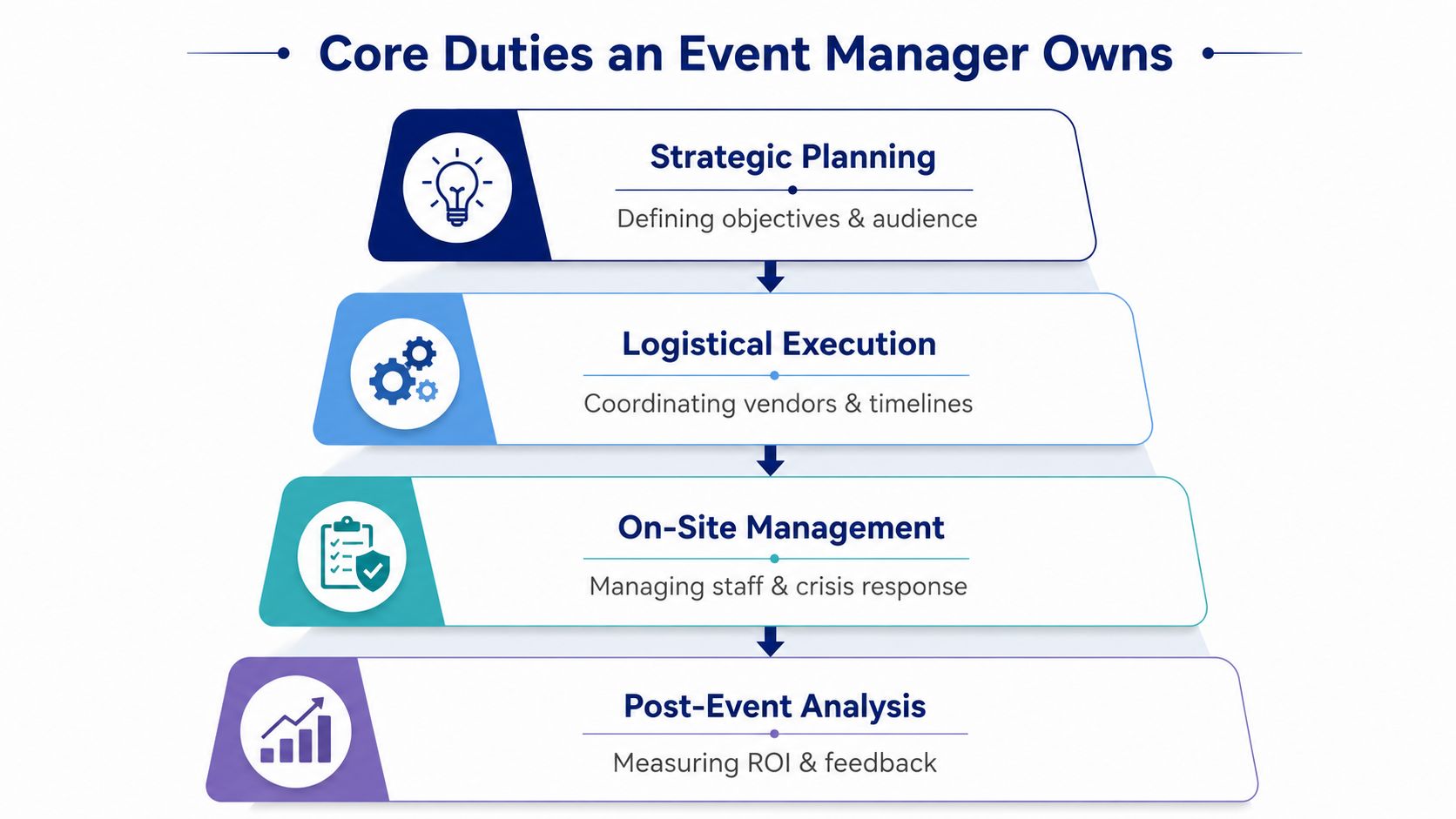
A defensible posting starts with the work, not the title. If you want a strong hire, list the duties in the order the work happens, then strip out anything that belongs in marketing, sales, or a separate operations role.
Start with event strategy and objective-setting. That means defining the audience, the purpose, and the success criteria before anyone starts booking vendors. For a trade event, that might mean launch support and lead capture. For a nonprofit, it may mean donor engagement and repeat attendance.
Next comes vendor and venue selection, plus the calendar discipline that keeps everything moving. Write that the manager coordinates timelines, confirmations, and change management, because “organizes events” is too soft to be useful.
Use this same clarity for on-site production control. That covers registration flow, staffing, load-in, run-of-show, and the person who makes decisions when the room changes. For technical events, this should also include AV, hybrid platform coordination, and temporary staff oversight.
A complete job description also includes attendee experience, stakeholder communication, and post-event reporting. If you expect debriefs, survey summaries, or invoice reconciliation, say so. If the role also owns budget control, say that too, because budget ownership is a core mechanic of the position in common role standards.
If the title is doing too much work, the posting is hiding scope. Call out what's included and what isn't.
If you're deciding whether the role also absorbs sponsorship or promotional work, use a clear comparison with your current marketing team. That same judgment applies to a later interview conversation and is worth keeping consistent with the posting.
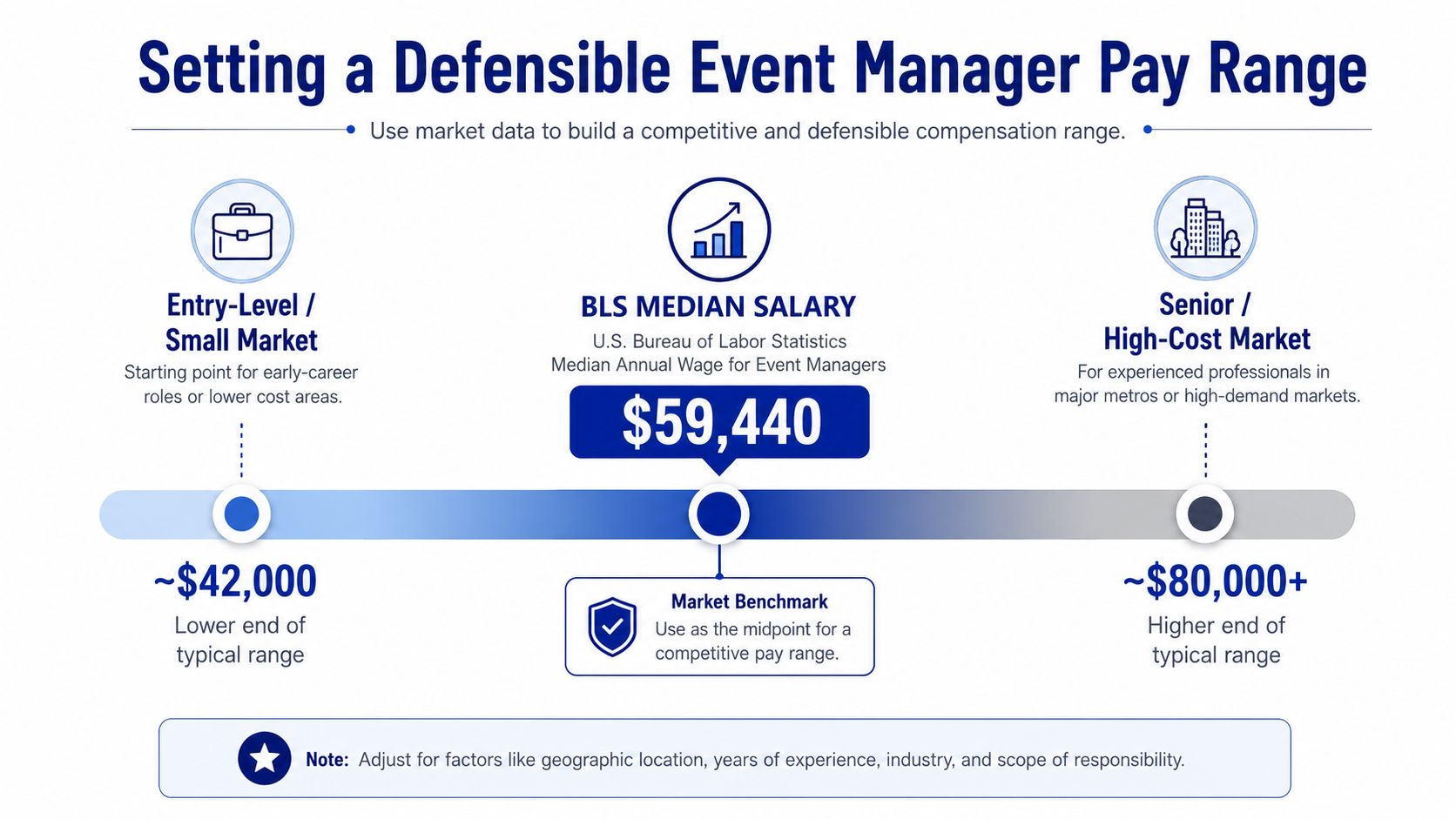
Start with the labor-market anchor, then adjust for scope. The BLS median annual wage of $59,440 gives you a defensible baseline for the role, while current market signals also point to a wider spread depending on responsibility and market size. Industry summaries note that entry-level coordinators may be around $35,990 a year, while senior roles can exceed $101,000 in larger cities or more complex environments.
If you want a current market check, Indeed lists an Event Manager estimate of $61,400, and Robert Half puts the national range at $56,000 to $84,500. Those figures don't tell you exactly what to pay, but they do tell you that a single flat number is a bad idea.
Use the pay band to match scope, not to reward optimism. An in-house role that manages one recurring annual event should not sit in the same range as a role that handles multi-location programs, hybrid production, or direct budget accountability.
If you need a more technical comparison point for how hourly work can vary by market and job type, traffic controller hourly wage NSW is a useful reminder that regulated, live-event-adjacent roles are often priced by risk and responsibility, not by title alone.
Practical rule: post a range, tie the top end to responsibility, and revisit it every year.
For SMBs, that also means watching internal equity. If the event manager is doing work that touches operations, compliance, or revenue, the range should not be based on a generic assistant-level posting. That's where pay transparency and retention problems start.
Strong event manager postings separate must-haves from nice-to-haves. That keeps qualified candidates engaged and stops unqualified applicants from treating the role like a catch-all title.
Start with the baseline. The BLS notes that meeting, convention, and event planners typically need a bachelor's degree, which tells you this role usually sits in structured professional territory. That does not mean you need a degree in event management specifically. It does mean you should expect real administrative judgment, the ability to prioritize under pressure, and enough maturity to run details without constant supervision.
Hire for the experience that predicts success in your setting.
Certifications such as CMP or CSEP can help, but they belong in the preferred column unless you run a mature event program with repeat complexity. The same applies to advanced hybrid-event platforms or industry-specific experience. Those qualifications matter when the role needs them, but they should not clutter the posting if they are not required to do the job well.
If your screening process includes background screening or credential verification, keep it organized and consistent with your hiring process. A clear reference and background check policy matters more than a clever interview question, and you can align that process with industry guidance on background investigation practices.
Write the posting so the candidate can tell whether they are being hired to coordinate, manage, or lead. That clarity saves you from overbuying talent you do not need, or underbuying talent who will leave as soon as the role expands.
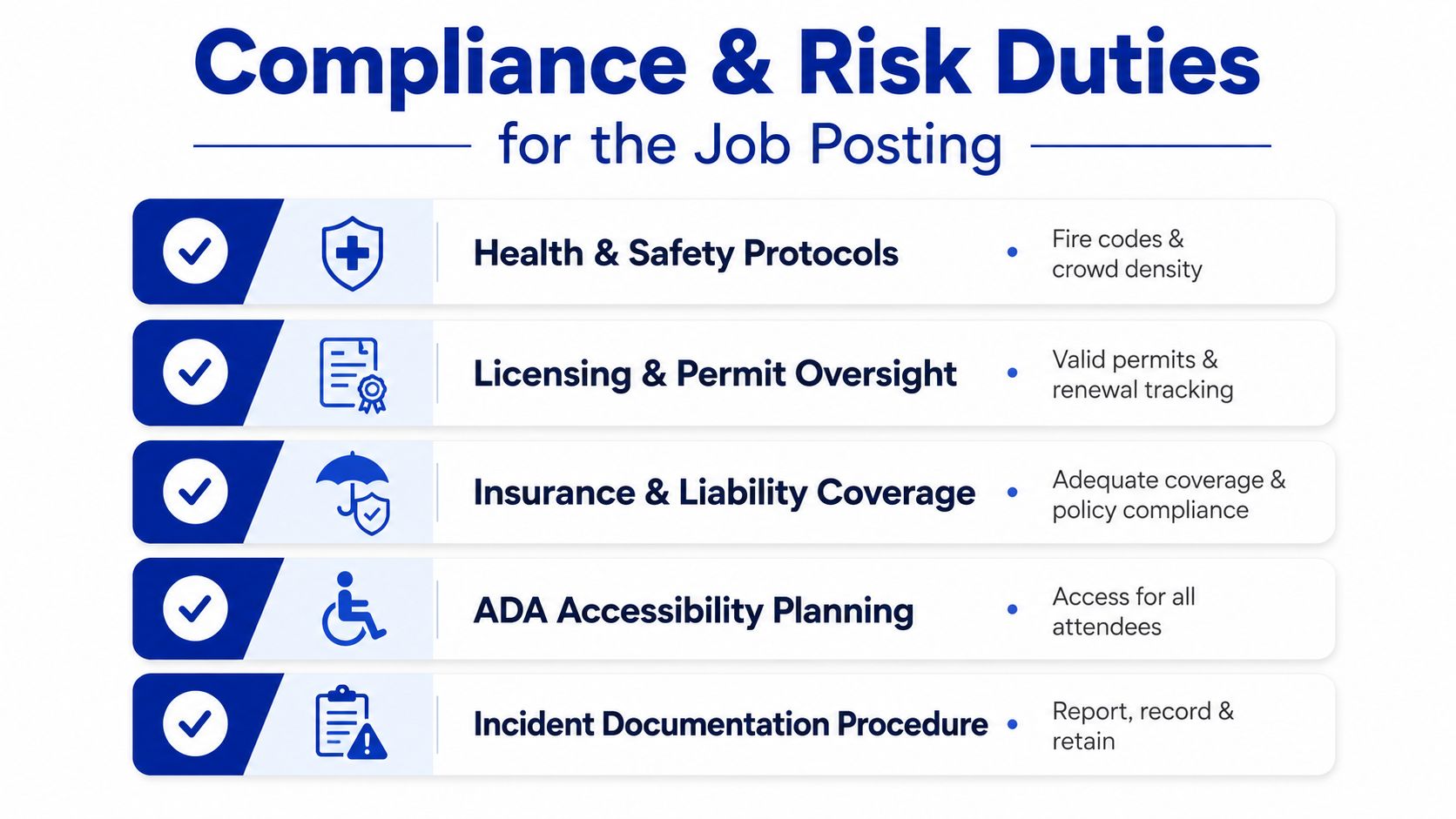
This is the part most SMBs underwrite and then regret later. If the event manager is coordinating public events, hybrid experiences, or anything across state lines, the posting should name health, safety, licensing, insurance, accessibility, and incident documentation as real duties, not leftovers.
Independent recruiting guidance says the role is responsible for keeping events aligned with insurance and health-and-safety requirements while also handling budgets, vendor coordination, staffing, and on-site issue resolution. That is a control function. It is not just planning with a friendly tone.
If you run public-facing events, say who owns these items:
The multi-state piece matters because requirements change by location, venue, and event type. A role that works in one state can face different permit, insurance, or accessibility obligations in another. If you leave those details out of the posting, you will attract candidates who think the job is mostly logistics and miss the compliance load entirely.
Use a clear accountability statement in the job description. Say who owns the decision when something goes wrong on-site or during a virtual event, and who escalates legal, safety, or vendor issues.
If you need a model for how proof and coverage language should be documented, proof of coverage guidance for vendors and events is the kind of reference that helps SMBs avoid vague vendor files and incomplete records.
The strongest event leaders don't just keep things moving. They know what to document when things don't go right.
That is the standard worth writing into the role. It protects the company, it protects the manager, and it gives interviewers a cleaner way to test real judgment.
A good manager should be measured on what they control. That means the KPI set needs to be small, practical, and visible in the event workflow, not something assembled from unrelated company dashboards.
| KPI | Measurement Source | Review Cadence |
|---|---|---|
| Budget variance | Final event budget and expense reconciliation | Per event, then quarterly |
| Vendor on-time delivery | Vendor confirmations and delivery logs | Per event |
| Registration-to-show rate | Registration system and attendance count | Per event |
| Attendee feedback | Post-event survey results | Per event |
| Incident count | Post-event incident log | Per event |
| Stakeholder satisfaction | Debrief notes from internal owners | Monthly or quarterly |
Use leading indicators first. Budget variance, vendor timeliness, and registration-to-show rate tell you whether the event was controlled before the final recap is written. Lagging indicators, like attendee feedback and incident count, tell you whether the manager delivered a stable experience.
Avoid tying bonus pay to raw attendance alone. That can push the wrong behavior, especially if the event runs over budget or ignores safety and accessibility. If you reward performance, reward the combination of delivery, control, and documentation.
A monthly dashboard should be simple. It should show upcoming events, budget status, open vendor issues, active compliance items, and any unresolved post-event follow-ups. That gives the owner a clean management rhythm without turning the role into a reporting theater exercise.
Job Summary
We're hiring an Event Manager to plan, coordinate, and deliver events that support our business goals and brand standards. This role owns event logistics, vendor coordination, budget tracking, and on-site execution, with clear responsibility for compliance, documentation, and post-event review.
Core Responsibilities
Qualifications
Preferred Qualifications
Compensation
Include a salary range that matches scope, market, and accountability. If the role also owns marketing, sponsorship, or cross-functional event strategy, state that clearly so candidates can self-select. For organizations that blend event delivery with outreach, coordinating nonprofit events and marketing is a good reminder that scope needs to be explicit, not implied.
Place your EEO statement and pay transparency language where candidates can find it fast. Then customize the posting for your industry, event type, and reporting line before you publish it.
Interview for judgment, control, and follow-through. If your event manager cannot make sound calls under pressure, the job will expose it quickly.
Ask, “Tell me about a time a vendor missed a deadline and the budget was already tight. What did you do first?” A strong answer gives you a sequence of decisions, not a story about frustration. Listen for escalation, fallback options, and the candidate's ability to protect the event without making the cost problem worse.
Ask, “Walk me through what you documented after an event-day issue.” That question shows whether the candidate treats incident notes as part of the job, not as extra paperwork. If they can explain who was informed, what was recorded, and how the issue was closed, that is a good sign.
Ask, “How do you keep internal teams aligned when the event plan changes late?” This tests whether the candidate can brief people clearly, set realistic expectations, and keep confusion down under pressure. Weak answers stay vague. Strong answers mention timing, ownership, and written follow-up.
Ask, “Tell me about a time you had to adjust a plan for accessibility, safety, or compliance reasons.” You are not looking for a polished speech. You are looking for evidence that the person treats those issues as core work, not last-minute obstacles.
Use a second-round structure from structured second interview questions for candidates if you need to separate polished confidence from real operating judgment.
Event roles often get blended with marketing, sponsorship sales, and communications. Interviewers should confirm where the candidate believes the job stops. A person who expects brand-growth ownership may not fit a role built around delivery control.
Practical rule: ask for a real example, a decision path, and the result. If you get only enthusiasm, you still do not know enough.
Keep interview notes. File them with the posting and the scorecard so you can defend the hire if the role later expands or changes.
A solid event managers job description does more than bring in applicants. It sets scope, names the risk the role owns, gives you a pay structure that can hold up in a conversation, and creates a cleaner basis for performance management after hire.
The common mistake is still the easiest one to make, posting a generic coordination role and expecting the right person to infer the rest. If your events touch compliance, vendor liability, public safety, or multi-state requirements, say that plainly. The posting should match that reality, and the interview process should test for it.
Treat the job posting as a control document. Treat the pay range as a seriousness check. Treat the KPIs as part of management, not just recruiting.
If your event program crosses states, includes public attendees, or mixes delivery with marketing and operations, get the structure right before you post. A disciplined advisory review can help you tighten role scope, reporting lines, and hiring language before the role goes live.