
Understanding the difference between exempt and nonexempt employees is crucial for any business owner or HR leader. The distinction boils down to one critical factor: overtime pay. Getting this classification wrong can lead to significant financial penalties and legal issues, making it a foundational element of wage and hour compliance.
Under the Fair Labor Standards Act (FLSA), nonexempt employees are entitled to overtime pay for hours worked over 40 in a week, while exempt employees are not. Your decision on how to classify each role directly impacts your payroll costs and legal exposure. This isn't a choice based on preference but a strict legal requirement based on an employee's salary and job duties.
Proper employee classification is the bedrock of wage and hour compliance. It’s not something you can decide based on a job title or what seems easiest. Instead, classification is strictly determined by federal and state tests that analyze an employee’s salary and specific job duties.
Getting it wrong can result in liability for back pay, hefty fines, and expensive legal battles. A clear understanding of these rules is non-negotiable for protecting your business. As you define roles, it's also a good time to ensure you know how to write compliant job descriptions that accurately reflect an employee's responsibilities.
For a quick reference, here’s a high-level look at the core differences between the two classifications.
Think of this table as a starting point. The real work is in correctly applying the specific salary and duties tests to each individual role within your organization, which we’ll dive into next.
Determining if an employee qualifies for exemption is a rigorous process. It goes far beyond a job title or salary alone. To classify correctly, you must follow the Department of Labor's (DOL) framework, which uses three specific criteria: the Salary Basis Test, the Salary Level Test, and the Duties Test.
Here is the most important takeaway: an employee must meet all three tests to be considered exempt. Failing even one means they are nonexempt and must be paid overtime. The Duties Test is often the trickiest and the source of most misclassification errors, as it requires you to look at what an employee actually does, not just what their job description says.
This decision tree helps visualize how the first few steps of the classification process work.
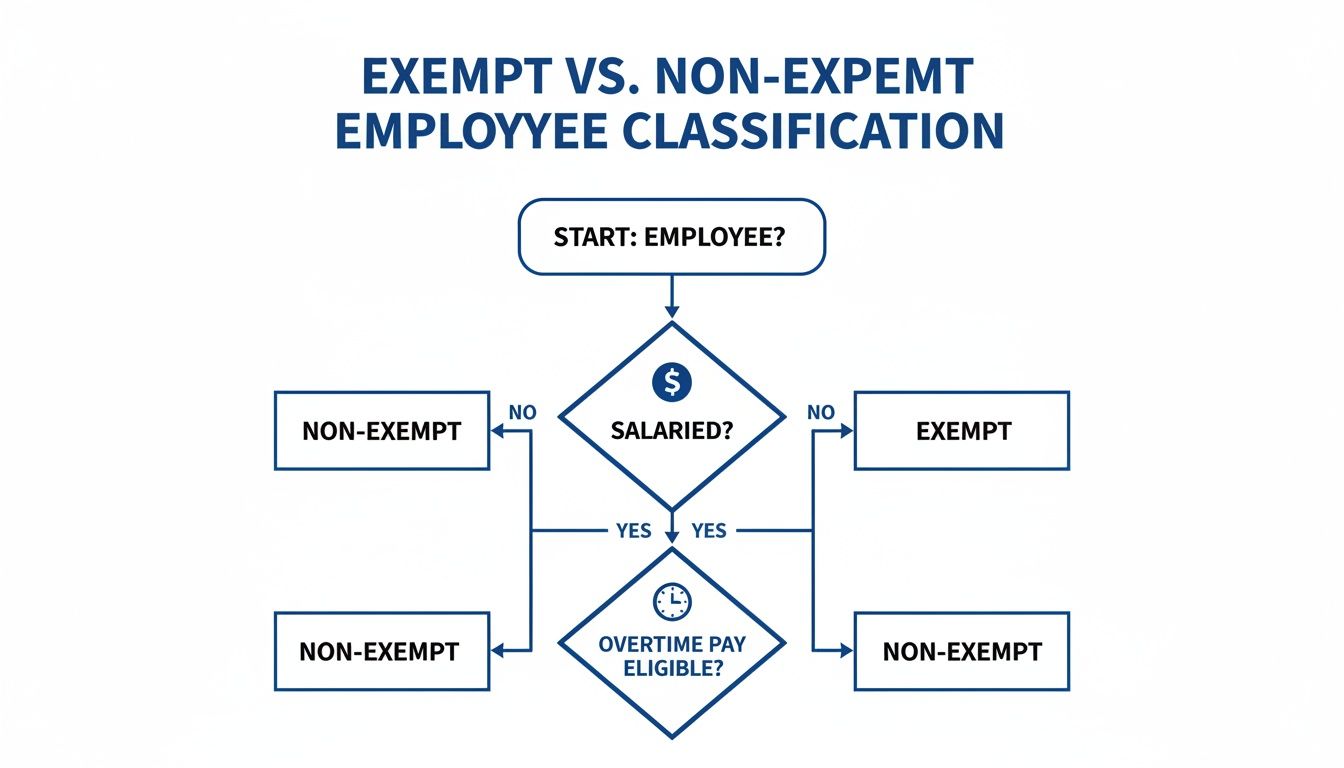
As you can see, salary acts as an initial filter, but the analysis doesn't—and can't—stop there.
Applying the FLSA tests is about what an employee actually does every day, not their job title. A title like "Assistant Manager" or "Lead IT Specialist" can be misleading. The law only cares about the real-world work being performed when determining exempt vs nonexempt status.
Let's move past theory and look at how this plays out in two common roles. By comparing a correctly classified exempt employee with a frequently misclassified one, we can highlight the key differences. Looking closely at primary duties, independent judgment, and authority will help you spot the subtle but critical distinctions that keep your business compliant.

Misclassifying an employee is one of the most expensive compliance mistakes a business can make. It can lead to significant liability for back pay, penalties, and legal fees. Experience shows that certain roles are magnets for these disputes, so paying close attention to them is essential.
Positions like assistant managers, administrative staff with limited independent judgment, and some IT support roles are classic examples. These jobs are frequently misclassified as exempt, but their day-to-day duties often fail the strict tests required by the FLSA.
The regulatory landscape is always shifting, which raises the stakes even higher. For instance, the DOL’s new overtime rule, effective July 1, 2024, significantly increases the salary thresholds for exemption. This change alone will reclassify millions of workers from exempt to nonexempt, making regular audits more important than ever. You can learn more about the DOL’s focus on overtime rules to see how these changes unfold.
Proper classification also has a direct ripple effect on your payroll and financial reporting. For example, employers must accurately account for any tax deductions related to hourly and overtime pay for service workers. It all connects back to getting that initial exempt vs nonexempt decision right.
If your business operates across state lines, consider the federal FLSA as just the starting point. States like California and New York have their own, often much stricter, wage and hour laws. This creates a tangled web of compliance obligations that can easily trip up even the most careful employers.
This is especially true when it comes to exempt vs nonexempt status, where state-specific rules can completely change your obligations. For instance, some states require a much higher salary to qualify for exemption than the federal minimum. Others have unique meal and rest break requirements for nonexempt staff that do not exist at the federal level. Understanding these jurisdictional differences is critical, and our guide to remote worker compliance dives deeper into handling these challenges.
An employee must meet the exemption requirements under both federal and state law. If the laws conflict, the standard that provides greater protection to the employee always applies.
When it comes to exempt vs nonexempt status, a proactive approach is the best defense. Regular internal audits are necessary to shield your business from misclassification claims and ensure your decisions are backed by clear, consistent records. This isn't a one-time task; it requires ongoing review to make sure job descriptions match the reality of daily work.
To maintain strong compliance, using structured compliance audit forms during your internal reviews is a smart move. These tools help create a documented trail showing your due diligence.
This isn't just theoretical. Workforce trends show how quickly roles can shift, creating risk. In higher education, for example, the full-time non-exempt workforce shrank by 9% between 2017 and 2023. That kind of change puts more pressure on remaining staff, often leading to evolving duties that can blur classification lines. A documented audit process is your best tool to stay ahead of these changes.

If you need a solid place to start, our HR audit checklist template can give your review process the structure it needs.
When it comes to exempt vs nonexempt status, the gray areas often trip up even the most experienced business leaders. The rules can feel counterintuitive, especially when applying them to real-world management scenarios. Here are direct answers to the questions we hear most often.
Yes, you can. It is a common practice for companies to track time for project costing, client billing, or to monitor attendance and productivity.
The critical thing to remember is that you cannot use that time-tracking data to dock an exempt employee's pay. If they leave a few hours early, you cannot reduce their salary for it. Their pay is fixed for the week, regardless of the quantity or quality of their work. Making partial-day deductions would violate the salary basis test and could put their exempt status at risk.
No. A job title means nothing in the eyes of the law. For an employee to qualify for the executive exemption, their actual day-to-day responsibilities must meet the specific duties test.
This test is strict. Their primary duty must be managing the business or a key department. They have to regularly direct the work of at least two full-time employees. And they must have the authority to hire or fire, or have their recommendations on those decisions given significant weight. Many roles with "manager" in the title do not meet all of these criteria.
Misclassifying an employee can be incredibly expensive. If you incorrectly classify a nonexempt employee as exempt, your business could face serious penalties if discovered during an audit or lawsuit.
You could be ordered to pay:
These costs add up quickly, especially if the issue becomes a collective action lawsuit involving a group of employees.
No, they cannot. An employee cannot waive their rights under the Fair Labor Standards Act (FLSA). Protections like the right to overtime pay are non-negotiable.
It does not matter if an employee prefers a salary or signs an agreement stating they are exempt. The classification must be based entirely on whether their role meets the legal salary and duties tests. Any other arrangement is unenforceable.
Navigating the complexities of employee classification requires careful analysis and a proactive approach to compliance. These rules protect your business and ensure fair treatment for your team. Taking the time to get it right is one of the most important investments you can make in your company's stability.
For expert guidance on managing high-stakes HR decisions and reducing employment risk, connect with the advisory team at Paradigm International Inc. today. We can help you build a defensible and compliant HR framework.