


A resignation rarely arrives at a convenient time. You still need to protect operations, transfer knowledge, recover devices, process pay correctly, and decide what to do with whatever the departing employee is willing to tell you on the way out. In many companies, the exit interview gets squeezed into that rush and turns into a short, forgettable conversation.
That's a mistake. Exit interviews are used by about 75% of companies, yet many employers still treat them as a check-the-box exercise instead of a decision tool. For SMBs, especially those operating across multiple states, that leaves value on the table and can create avoidable risk when departures reveal manager misconduct, wage concerns, safety issues, or inconsistent handling across locations.
Handled well, an exit interview isn't just an HR formality. It's a structured source of business intelligence, a way to spot repeat problems before they become legal claims, and part of a defensible separation process. Harvard Business School guidance, cited in the same SHRM resource above, supports a semi-structured approach so leaders can identify patterns while still surfacing unexpected issues.
The exit interview best practices below are built for operators who need consistency, documentation, and follow-through. Keep the process simple. Keep it neutral. And treat every departure as a chance to learn something you may not hear any other way.
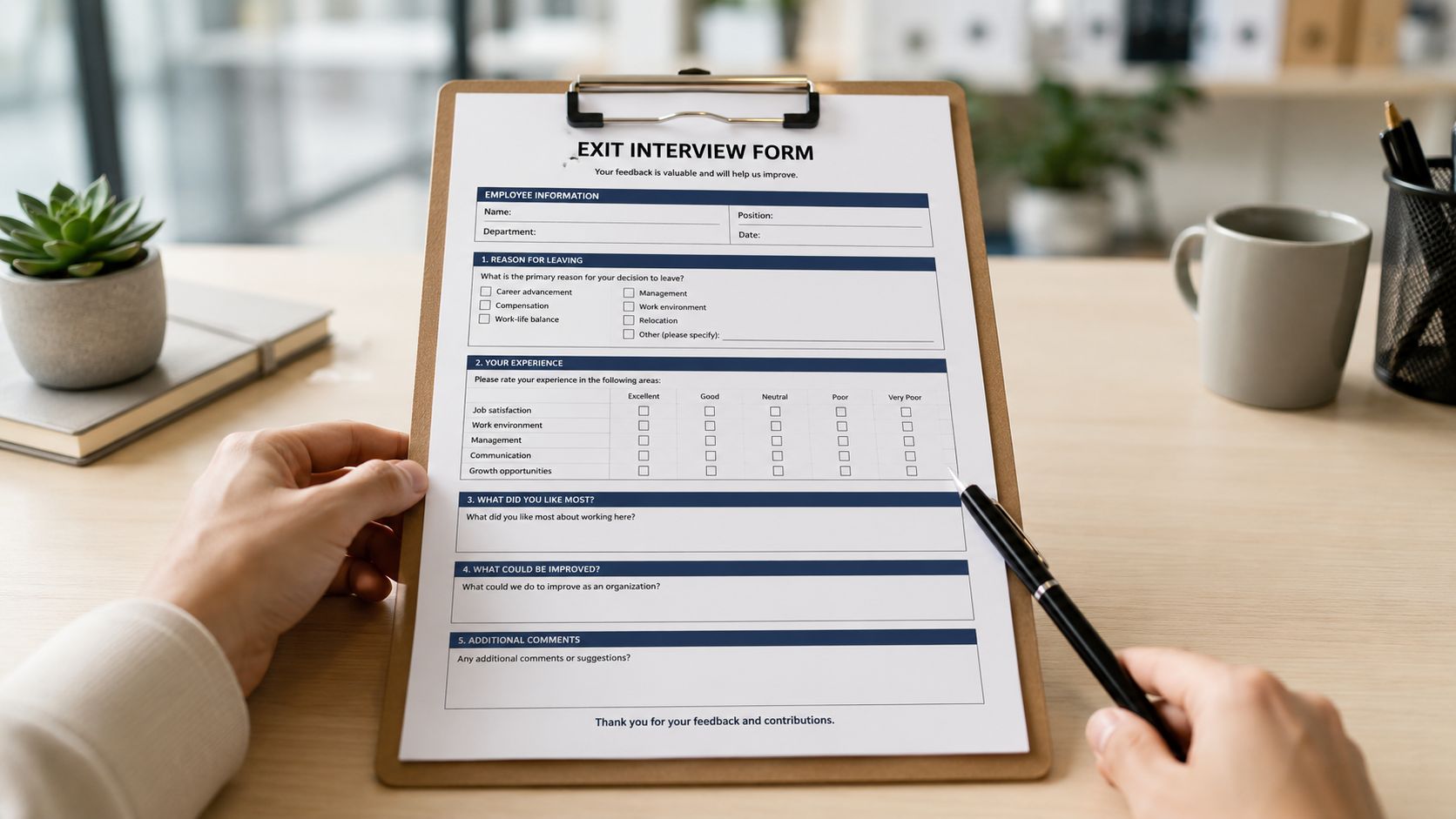
A defensible process starts with consistency. If one departing employee gets a thoughtful conversation and another gets a rushed, informal chat, you create uneven records and weaker data. Use the same core question set for every voluntary departure, then add a few targeted follow-up questions only when the employee's role or situation calls for it.
That structure matters for two reasons. First, it helps you compare feedback over time. Second, it reduces the appearance that one employee was treated differently than another during separation.
A healthcare practice with several clinics, for example, might discover that employees leaving different locations keep raising the same concern about one clinic manager's communication style. A professional services firm might hear repeated comments from junior staff about unclear advancement expectations. Those patterns only become visible when every interviewer starts from the same baseline.
High-value programs use a standardized core questionnaire with a short open-ended section, and guidance recommends keeping the instrument to roughly 10 to 15 questions or under 15 minutes, as noted by Perceptyx on exit program design.
Use that limit well:
Practical rule: Standardize the questions, not the conversation. Every employee should get the same core prompts, but the interviewer should still ask careful follow-up questions when something important surfaces.
If you want your interviewers to ask sensitive questions cleanly and consistently, align your script with broader interviewing best practices. And if you need a starting template for a simple digital form, these ready-to-use exit forms for e-commerce show how a structured format can be organized.
Don't let the departing employee's direct manager run the exit interview. Even if that manager means well, the power dynamic changes what the employee is willing to say. People are less likely to be candid about favoritism, poor supervision, pressure tactics, or ignored complaints when they're sitting across from the person involved.
Neutrality improves candor and gives the process more credibility. It also protects your organization from the argument that feedback was filtered through someone with a stake in the outcome.
An SMB with no formal HR team can still create neutrality. A COO, an owner outside the reporting line, outside HR counsel, or a retained advisor can handle the conversation if they aren't tied to the employee's evaluations or department politics. A multi-state operator may find that this approach surfaces issues local managers never escalated, especially when location leaders have strong informal influence.
Exit interview best practices consistently favor a direct-manager-free process. AIHR notes that interviews should be scheduled close to departure, and Gallup guidance cited there supports in-person, phone, or web-based formats depending on scale. The same AIHR analysis of exit interview data also points to third-party handling as a way to protect confidentiality and improve candor.
That recommendation has business impact. Gartner's analysis, cited in that industry reporting, estimates the average cost of each voluntary exit at $18,591 in the same source. That makes better exit data useful for cost control, not just employee relations.
Use a neutral interviewer with clear rules:
A neutral interviewer hears things a line manager won't.
A healthcare organization, for instance, may learn through a neutral interviewer that employees have been reluctant to report provider conduct concerns locally. A manufacturing company may find that workers in one plant are describing scheduling or wage issues differently once local supervision is out of the room.
An exit interview should never float outside the broader separation process. If offboarding lives in email threads and memory, the company misses steps, handles employees inconsistently, and struggles to prove what happened later. Build one separation checklist that ties the interview to every other required task.
That checklist should cover the full departure sequence, from resignation notice through final pay, benefits notices, access removal, property return, restrictive covenant review, and any legal hold decisions. It should also identify who owns each task and when it must be completed.
A multi-state employer needs even more structure. Different jurisdictions can change the timing of final pay, leave payout rules, and notice obligations. If the checklist doesn't prompt the right actions at the right time, the organization may process the departure incorrectly before anyone notices.
Keep the checklist practical and assigned. Don't create a policy document nobody uses.
Include items such as:
A healthcare practice might discover through a checklist audit that final pay communication has been inconsistent across clinics. A professional services firm might use the checklist to ensure client files, devices, and confidentiality reminders are all handled before access ends.
If your team needs a model for a more disciplined offboarding flow, use a structured termination checklist resource to tighten ownership and documentation.
Don't combine candid feedback with paperwork, benefits notices, final pay review, and property return in one meeting. Those are different conversations with different purposes. When you blend them together, employees often become guarded because they don't know whether they're being asked for honest feedback or being walked through legal and administrative steps.
Split the process into two meetings whenever possible. Hold the exit interview as a feedback conversation. Hold the final administrative meeting as a compliance and logistics review. That separation makes each interaction clearer and more useful.
This matters even more in regulated settings. A departing clinician may say more about operational concerns when they aren't also being asked to verify billing wrap-up or return credentials. A manufacturing supervisor may speak more openly about safety culture when the conversation isn't bundled with key return and wage paperwork.
Timing affects data quality. Practitioner guidance summarized by People Element on exit interview best practices recommends collecting feedback in the employee's final week or on the final day, while some organizations allow a narrow window from about two weeks before departure to two weeks after departure. That same guidance notes the tradeoff: later collection may help logistics, but candor can drop as disengagement rises.
Use that timing intentionally:
When feedback and paperwork happen in the same meeting, paperwork usually wins.
A cleaner split also protects the employee. They know when they're being invited to speak candidly and when they're being asked to confirm administrative details. It protects the employer too, because the record of each interaction is easier to interpret later.
The biggest failure in most exit programs isn't the interview itself. It's what happens afterward, which is often nothing. If leaders collect feedback but never review themes, assign follow-up, or fix repeated problems, employees stop trusting the process and the business keeps losing people for the same reasons.
Exit interviews are only valuable when they feed a repeatable review cycle. One resignation can be an isolated event. Several similar departures usually signal something worth investigating.
A healthcare administrator might hear one complaint about a manager and note it. If three later exits describe the same pattern of dismissive behavior, poor handoffs, or favoritism, that's no longer anecdotal. A regional operator might spot that one location keeps producing similar comments about scheduling, safety communication, or inconsistent policy enforcement.
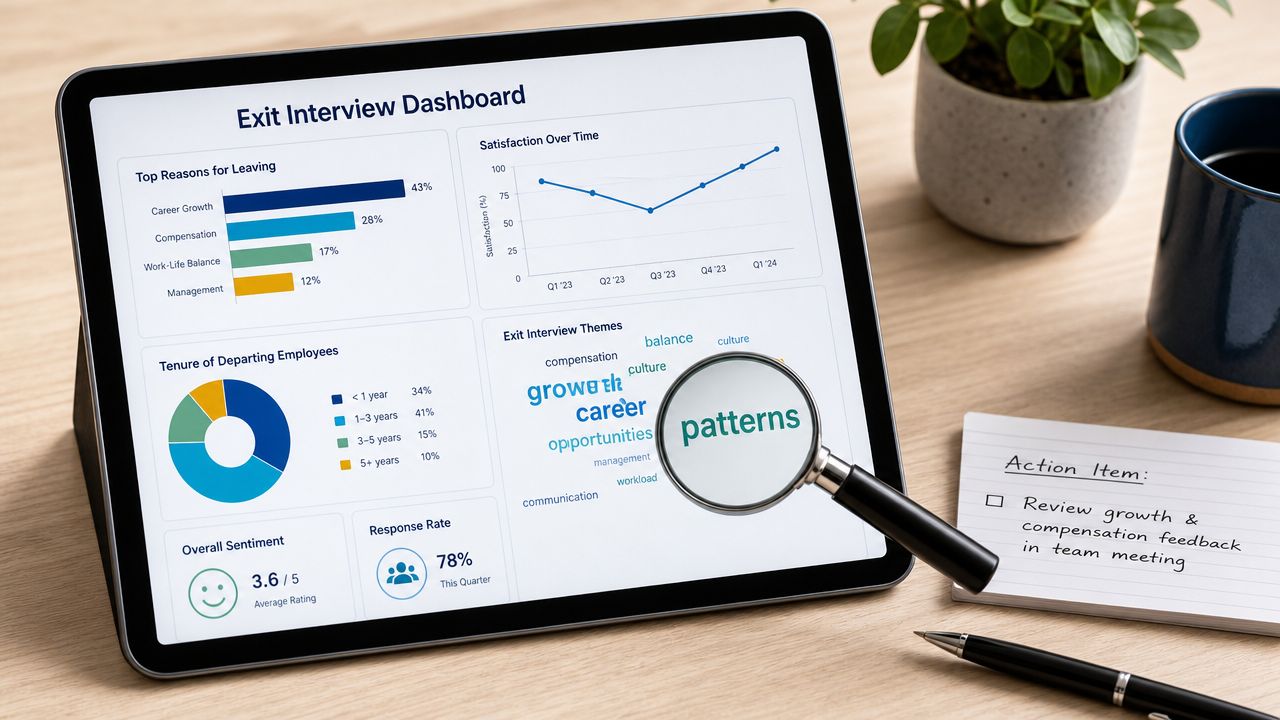
Independent guidance aimed at SMBs emphasizes that the true issue isn't whether to ask questions. It's whether the company converts feedback into action. The ExtensisHR overview of exit interview best practices highlights standardized questions, quarterly theme review, leadership follow-through, and the value of combining surveys with interviews when scale matters.
Make follow-up operational:
A professional services firm might summarize exits into themes such as manager conduct, compensation fairness, growth, and ethics pressure. That kind of categorization gives leaders something they can act on, rather than a stack of disconnected interview notes.
If you operate in more than one state, generic offboarding creates avoidable risk. Final pay timing, leave payout rules, notice obligations, and post-employment restrictions don't work the same way everywhere. Your exit interview process has to sit inside a state-aware separation workflow, or the business may gather useful feedback while still mishandling the departure itself.
Start every separation by identifying the governing state or states for employment law purposes. Don't leave that question until the end. Payroll, legal, HR, and operations need to work from the same jurisdictional assumption.
A multi-location manufacturer may have one resignation in a state with strict final pay timing and another in a state with different leave payout treatment. A healthcare group may have providers with agreements that are handled differently depending on where they practiced. If the separation process ignores those differences, you invite inconsistency.
Your process should force the team to check state-specific obligations before the interview is conducted and before final documentation goes out.
Focus on items such as:
For multi-state SMBs, exit interview best practices function as risk management. A location-specific checklist protects the organization from treating every departure as if one state's rules apply nationwide. It also creates a cleaner record if a wage claim, restrictive covenant dispute, or agency inquiry appears later.
Keep legal review current when you enter a new state or materially change your workforce model. Expansion tends to break old assumptions faster than leaders expect.
Employees won't speak freely if they think their comments will be handed back to the manager they're criticizing. Confidentiality has to be more than a verbal promise. It needs process, limited access, and thoughtful handling of what gets shared, with whom, and in what form.
That doesn't mean every interview should be fully anonymous. It means the company should decide, in advance, when it needs named documentation, when it should aggregate themes, and when a separate anonymous survey makes more sense. This is especially important when sensitive allegations may require investigation.
A manufacturing company can destroy trust quickly by circulating raw notes that identify the departing employee and quote criticism verbatim. A healthcare practice can create more risk if misconduct allegations are stored casually or shared too broadly. Treat exit records like sensitive employment documents, because that's what they are.

Contemporary guidance increasingly favors hybrid programs that mix structured interviews, anonymous surveys, and post-departure follow-up. The HR Cloud discussion of exit interview best practices notes that anonymous questionnaires or third-party interviews can produce more candid responses than face-to-face meetings, while other guidance recommends scrubbing identifying details before broader sharing.
Put simple controls in place:
Confidentiality should be explained at the start, protected in storage, and enforced in sharing.
That approach helps employees speak more candidly without sacrificing the documentation discipline your organization may need later.
Exit interviews are most useful when they don't live in an HR silo. If the data never reaches leadership, legal review, or operational planning, the business misses early warnings. Tie exit themes to turnover patterns, manager oversight, and risk assessment so the organization can intervene before a problem hardens into a claim or a wave of resignations.
Gallup guidance cited earlier recommends combining exit data with KPIs to identify root causes by employee segment and convert findings into targeted retention actions. That's the right standard. You want to know whether departures are clustering around a manager, a role, a location, a compensation issue, or a compliance concern.
A professional services firm might realize departing associates are raising similar concerns about workload distribution and partner behavior. A healthcare practice might see culture-related departures concentrated in one office. A multi-state operator might find one location has repeat complaints tied to scheduling fairness or supervisor conduct. Those signals deserve review before they become formal complaints.
Build a simple review method leadership will use. It doesn't have to be fancy.
Track and compare themes such as:
A disciplined review also supports broader HR risk assessments for legal risks. When exit interviews are integrated into that process, leadership gets a clearer picture of where employment risk is building and where intervention needs to happen first.
| Approach | Implementation complexity | Resource requirements | Expected outcomes | Ideal use cases | Key advantages |
|---|---|---|---|---|---|
| Structured Interview Process with Standardized Questions | Moderate, design templates and compliance checkpoints | HR time for template development, training, documentation systems | Comparable data, defensible records, reduced inconsistency claims | Multi-location or regulated organizations seeking consistent data | Consistency, analyzable feedback, legal defensibility |
| Neutral Third-Party Interviewer Assignment | Low–Moderate, identify/train neutral interviewers or vendors | Trained internal/external interviewer, possible consultant fees, scheduling | Greater candor, reduced retaliation perception | Sensitive departures, allegations, organizations without impartial HR | Perceived neutrality, improved disclosure of sensitive issues |
| Comprehensive Separation Checklist and Exit Documentation | Moderate–High, create multi-step, role-specific checklists | Cross-functional input, maintenance, tracking tools, regular updates | Fewer compliance oversights, clear audit trail | Multi-state employers, regulated sectors, high-volume separations | Prevents legal/regulatory failures, ensures consistent completion |
| Distinction Between Exit Interview and Final Administrative Meeting | Low, process and scheduling change | Staff coordination, separate documentation templates | Improved feedback quality, clearer separation of duties | Organizations where admin tasks suppress candid feedback | Preserves candidness, clarifies purpose and records |
| Documentation of Feedback and Systematic Follow-Up Process | Moderate–High, build review cadence and escalation paths | Analysts, periodic review meetings, tracking and investigation resources | Pattern detection, actionable improvements, documented remediation | Companies wanting continuous improvement and risk mitigation | Converts feedback into action, early detection of systemic issues |
| Multi-State Compliance Considerations in Exit Interviews | High, incorporate jurisdiction-specific rules per state | Ongoing legal review, state-specific checklists, targeted training | Reduced state-law violations, tailored separation handling | Multi-state SMBs and enterprises operating across jurisdictions | Prevents jurisdictional mistakes, reduces penalties and exposure |
| Confidentiality and Data Protection in Exit Interview Records | Moderate, implement access controls and retention policies | Secure storage, IT controls, legal/HR policy enforcement, training | Protected records, increased candor, maintained chain of custody | Healthcare, regulated industries, sensitive misconduct disclosures | Protects privacy, supports litigation defensibility, encourages candor |
| Integration of Exit Interview Data with Retention and Litigation Risk Assessment | High, integrate systems and analytics with HR processes | Data systems, analytics capability, legal and leadership involvement | Early risk detection, targeted interventions, better retention strategies | Organizations tracking turnover patterns and proactive risk management | Strategic insights linking departures to retention and legal risk |
Exit interviews deserve more respect than they usually get. They sit at the intersection of retention, compliance, documentation, manager accountability, and legal risk. If you treat them as a rushed courtesy, you'll collect weak information and miss the patterns that matter. If you treat them as part of a structured separation system, they become one of the clearest feedback channels your business has.
The strongest approach is straightforward. Use standardized questions. Put a neutral interviewer in charge. Separate feedback from administrative offboarding. Document carefully. Review themes on a regular schedule. Escalate sensitive issues fast. And for multi-state employers, make sure every departure is handled through a state-aware compliance lens.
That discipline gives you more than cleaner HR operations. It creates a defensible record of how the company listens, how it responds, and how it handles employee departures consistently. That matters when you're trying to reduce avoidable turnover. It also matters when a resignation later connects to a wage claim, a discrimination allegation, a manager conduct issue, or a dispute over what the company knew and when it knew it.
Many SMBs don't need a complex exit interview program. They need a reliable one. In practice, that often means a short structured survey for lower-risk exits, a live interview for roles with higher visibility or higher risk, and a documented escalation path whenever feedback touches compliance, safety, retaliation, discrimination, or misconduct. The process should fit the business, but it should never be improvised.
Many growing organizations struggle not with knowing that exit interview best practices exist, but with building a version that leaders can execute consistently across locations, managers, and departure types without creating unnecessary legal exposure. That's especially true for healthcare groups, professional services firms, and other regulated or multi-state employers where inconsistent offboarding creates risk quickly.
If your team needs help building a more defensible separation process, contact Paradigm International Inc.. It works with SMB leadership teams that need structure, judgment, and risk-aware HR processes during high-stakes employment moments.
If you want a practical way to strengthen your exit interviews, offboarding steps, and documentation standards, a conversation with Paradigm International Inc. can help you build a process that fits your operating model and reduces preventable risk.

