A fitness for duty evaluation is a job-specific, evidence-based check on whether an employee can safely perform essential duties without risk to self or others. It's not a general medical or wellness exam, and the distinction matters when a workplace concern has moved from ordinary performance management into safety, legal, or accommodation territory.
A manager notices that a longtime employee is missing steps on tasks they used to handle easily. A supervisor sees a pattern of unusual behavior, a safety lapse, or a return from leave that doesn't feel straightforward. In that moment, the question isn't, “What's wrong with this person?” It's, “Can this employee safely do the essential functions of the role, with or without accommodation?”
That question is the center of a defensible fitness for duty evaluation. StatPearls describes it as an assessment that combines medical assessment, psychological evaluation, functional capacity evaluation, and job analysis to match worker capacity to job demands, with the goal of determining whether the person can perform duties without risk to self or others (NCBI StatPearls chapter). A strong evaluation doesn't guess from personality, rumor, or diagnosis. It links observed facts to the actual work.
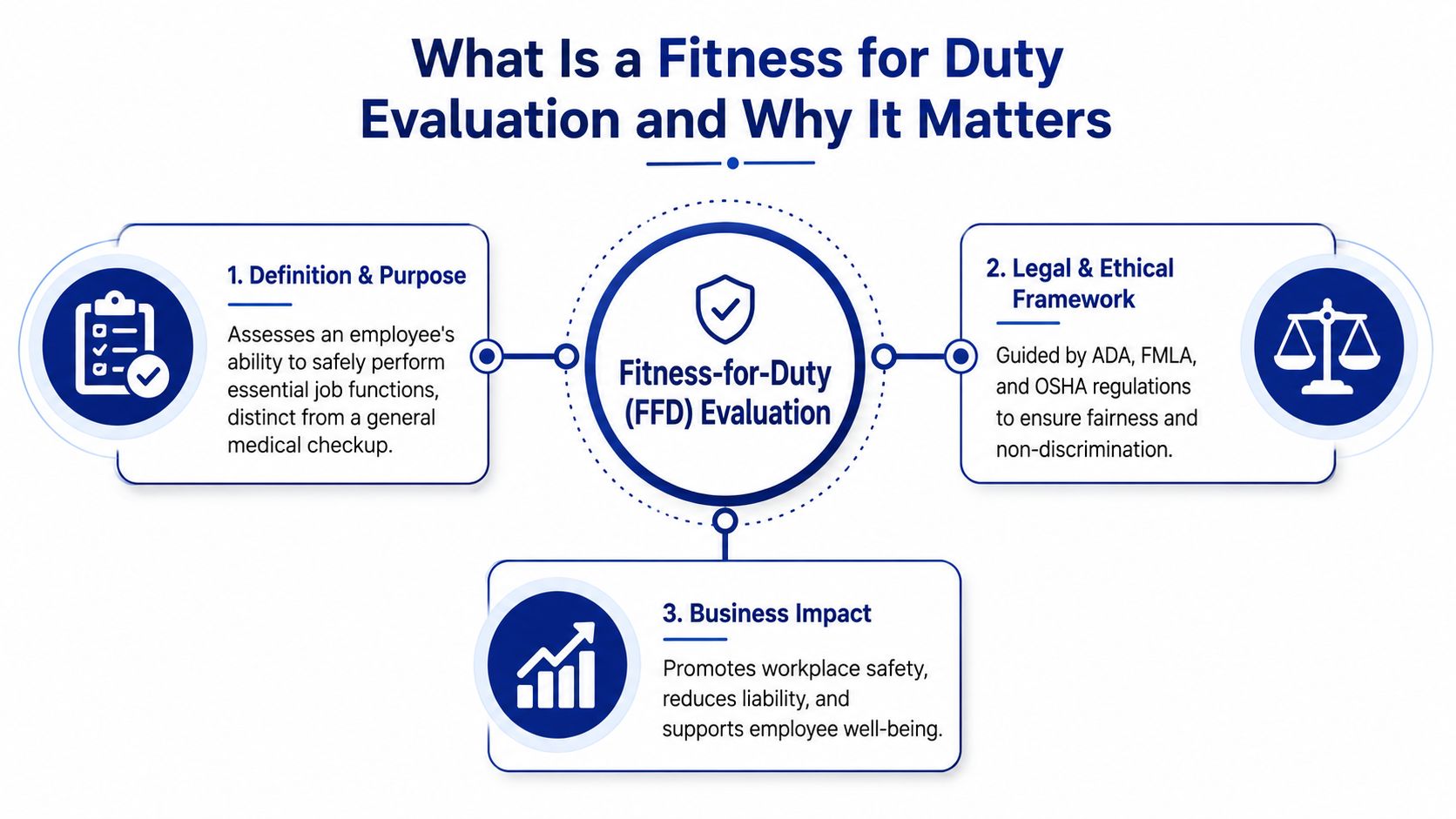
In practice, that means the employer is looking for a defensible answer about capability, not trying to run a broad health review. A useful way to think about it is the difference between “Is this person healthy?” and “Can this person do the job safely, in this workplace, with these tasks?” That second question is the one that supports discipline, leave decisions, accommodation analysis, and return-to-work decisions.
If you want a practical explanation of the underlying capacity side of the process, the Cartwright Fitness FCE overview is a helpful companion resource because it shows how functional capacity fits into this kind of assessment.
The easiest way to understand a fitness for duty evaluation is to picture an employer who has already tried the usual tools. Coaching hasn't fixed the problem. A supervisor's concern isn't just about attitude, it's about whether the employee can safely handle the role. At that point, the evaluation becomes a structured decision-making tool, not a punishment.
A defensible FFDE starts with the job, not the diagnosis. That matters because an employee might have a medical condition, a stress reaction, or a psychological concern and still be fully capable of doing the work. The assessment has to connect the concern to the actual essential functions of the role, which is why job analysis is part of the modern framework (NCBI StatPearls chapter).
Practical rule: if you can't describe the work demand clearly, you can't evaluate fitness clearly.
That's also why generic wellness thinking falls short. Fitness-for-duty practice is built around capacity, tolerance, and risk. It is not a casual check-in, and it is not a substitute for ordinary HR performance management.
A responsible employer also keeps the process grounded in observable facts. The reason for the referral should come from what was seen, heard, or documented, not from personality assumptions or office gossip. That distinction protects both the employee and the business.
The value of the process is that it creates a defensible record for a hard decision. If the result supports return to work, the employer can move forward with more confidence. If it supports restrictions or removal, the employer can explain why the decision was tied to essential functions and safety.
That's also why objective process matters so much. A structured checklist for employers recommends recording what they saw or heard, involving a second observer when needed, removing the employee from duty if there's an immediate safety concern, and sending the clinician an updated position description with a specific capability question (fitness-for-duty checklist). Those steps turn a vague concern into a documented, job-related referral.
A useful way to think about the evaluation is this, it's a bridge between a workplace concern and a workplace decision. That bridge only holds when the facts are specific enough to support it.
For current employees, the ADA standard is the first gate employers need to clear. A fitness-for-duty exam can't be a general wellness review. It must be job-related and consistent with business necessity, and employers typically need objective evidence such as documented, observable performance or safety problems before ordering the exam (ADA fitness-for-duty guidance).
Objective evidence is the difference between “I have a bad feeling” and “here is the conduct, task failure, or safety issue I can point to.” That can include a documented incident, repeated observable errors, a direct safety concern, or conduct that clearly ties to essential job functions. The legal risk starts when an employer acts on assumptions rather than facts.
A useful mental check is whether you can explain the referral without mentioning a diagnosis at all. If the answer is yes, you're probably closer to the right standard. If the answer is no, the referral may be too speculative.
The ADA also makes reasonable accommodation part of the decision path. Before assuming a person is unfit, employers should consider whether the issue is one of modified duties, schedule, equipment, or another accommodation. For a plain-language overview of that step, see what reasonable accommodation means under the ADA.
The FMLA has its own conditions. Under 29 CFR 825.312, an employer may require a fitness-for-duty certification only when it has a uniformly applied policy or practice requiring certification for employees returning from leave, and the certification can be limited to the employee's ability to perform the essential functions of the job if the employer gave the employee a list of those functions before leave began (29 CFR 825.312).
That creates a practical compliance point. If your organization wants a return-to-work certification, the policy has to be in place before you need it, and the job functions have to be documented early enough to support the request. In other words, you don't build the paper trail after the leave has started.
Employers get into trouble when they treat every concern as a medical issue. The safer approach is to ask whether the issue is observable, job-related, and tied to a documented business need.
For workplace safety framing, DynamicsHub workplace safety guidance is a useful reminder that duty of care is not abstract. It becomes real when a role creates risk for the employee, co-workers, customers, or the public.
A fitness-for-duty evaluation starts to make sense when the employer can point to a work-related concern, not just a general feeling that something seems off. A late arrival, a missed deadline, or a difficult personality conflict usually belongs in normal management. The referral question strengthens when facts point to a possible safety, capacity, or psychological issue affecting essential functions.
A concrete event is the clearest trigger. A safety incident, an unexplained behavioral shift, erratic decision-making, or a pattern of conduct that raises concern about safe performance can justify referral when the employer can describe exactly what happened.
Keep the record factual. Note the words used, the actions taken, the date, and the people who saw it. If the event affected safety, get a second witness statement when possible, because contemporaneous confirmation gives the employer a steadier record if the decision is later questioned.
For employers trying to sort out whether the situation belongs in an investigation or a health-related referral, a structured review can help separate those paths. Guidance on when to start a workplace investigation is useful because it helps distinguish fact-finding from a referral based on job performance concerns.
For employers who need help identifying behavioral red flags, consulting a private investigator can provide an objective perspective on workplace concerns.
The standard becomes stricter in safety-sensitive jobs. A transportation worker, machine operator, clinician, armed guard, or other person in a high-risk role needs closer scrutiny because small warning signs can create larger consequences. Canadian transportation guidance says the exam is appropriate when there is objective evidence that the employee may be unable to safely or effectively perform a defined job and a reasonable basis to suspect a psychological condition or impairment (Transport Canada fitness-for-duty guidance).
That same logic reaches beyond transportation. If the role affects patient care, public safety, equipment operation, or security, the employer should connect the concern to the actual job demands before making a referral.
A simple checklist helps keep the decision grounded:
Privacy discipline matters at this stage. The evaluator does not need the full HR backstory or broad commentary about personality. They need the essential job demands, the specific concern, and the work facts that led the employer to consider a referral.
A defensible process starts before the employee ever meets the evaluator. The employer has to create a clean record, narrow the question, and make sure the referral is tied to the job. If those pieces are weak, the rest of the process gets harder to defend.
Start with the specific concern. Write down what was observed, who observed it, and why it matters to the work. If the issue came from a supervisor, incident report, or safety event, preserve that documentation and keep it consistent.
The next step is the job itself. Give the evaluator an updated position description that reflects current essential functions, not an outdated title sheet. The assessment has to be matched to actual task demands, and that's why job analysis sits at the center of the process (occupational FFDE chapter).
The evaluator should receive a specific referral question. The best version sounds like this, “Can this employee safely perform the essential functions of this role with or without accommodation?” That keeps the focus on capability rather than diagnosis.
A useful checklist also recommends a structured workflow that can include a clinical interview, a focused physical exam, targeted laboratory testing when relevant, standardized questionnaires, and a job-demand analysis (occupational FFDE chapter). Those tools matter because they help separate job-relevant limitations from background health history that doesn't change the work decision.
Confidentiality rule: share only what the evaluator needs to answer the referral question, not the full internal debate around the employee.
When the evaluation comes back, management should make the return-to-work or restriction decision based on the findings and the essential functions of the role. If accommodation is possible, build it into the plan and document it clearly. If it isn't, the employer should document why the person can't perform the job safely and what alternatives, if any, were considered.
For employers who want a stronger paper trail around records and evidence, the guidance in evidence handling procedures is worth reviewing. Fitness-for-duty files often become part of a wider employment record, so the quality of the documentation matters long after the decision is made.
That process is what turns a tense situation into a managed one.
A single generic policy rarely works well across multiple states or highly regulated operations. The federal baseline may be consistent, but state and industry rules can add notice steps, documentation requirements, or examiner expectations that change how the process is handled.
For leave-related return-to-work certification, the federal FMLA rule at 29 CFR 825.312 is the anchor point, but it only works cleanly when the employer has a uniformly applied policy or practice and has already provided the employee with the essential functions list before leave started (29 CFR 825.312). That means the policy has to be built before the situation arises.
Multi-state employers need to think in layers. The baseline policy should cover the federal rules, but local counsel may need to layer on state-specific notice forms, timing rules, or privacy obligations. That's especially important when managers in different states use the same HR template without realizing the local requirements don't match.
Transportation, healthcare, and similar sectors often work with more specific safety expectations than ordinary office settings. The Florida Department of Law Enforcement's 2015 survey shows how structured fitness programs often correlate with job descriptions and performance expectations, while fewer organizations actively monitor compliance after hire (FDLE fitness-for-duty report). That gap is a reminder that written policy alone isn't enough.
The Federal Transit Administration guidance cited in that same report recommends limiting duty time for train operators, controllers, and dispatchers to no more than 12 hours in a 24-hour period and no more than 60 hours in a 7-day week (FDLE fitness-for-duty report). That's a good example of how regulated industries use quantified thresholds to manage fatigue and safety.
In regulated work, policy drift is a risk. The strongest practice is a baseline policy with jurisdiction-specific add-ons, not one universal template used everywhere.
For employers with employees in several states, the safest path is to standardize the core decision logic, then review the outlier jurisdictions separately. That keeps the process consistent without pretending every location is governed by the same rules.
A lot of employers assume a fitness-for-duty referral is a step toward removal. That assumption skips the core question, which is whether the employee can safely perform the job's essential functions with or without accommodation. In practice, referrals can lead to return-to-work, remediation, restrictions, or further support, not just separation.
One ten-year physician fitness-for-duty study found that physicians referred for alleged disruptive behavior were found fit for duty 90% of the time, even though 90% had abnormal personality diagnoses and 48% had Axis I psychiatric disorders (physician FFDE study). That finding matters because it separates the reason for referral from the final workplace decision.
The broader lesson is simple. An evaluation is a decision tool, not a verdict in advance. If employers assume the referral must end in discipline, they can create unnecessary conflict and miss the chance for remediation or return with support.
Another common mistake is treating diagnosis as the answer. A job-based model works differently. The question is whether the condition, whatever it may be, interferes with the specific essential functions of the role.
That is why a meaningful evaluation focuses on functional ability, observed behavior, and job demands. A person may have a documented condition and still be fit for duty. Another person may have no formal diagnosis on paper and still be unable to safely do the job. The evaluation has to follow the work, not the label.
The same study found that many physicians with fitness-for-duty issues eventually return successfully to practice (physician FFDE study). That is a useful reminder for business leaders who want a binary answer but need to work with restrictions, support, or a phased return instead.
Takeaway: the purpose of the process is to separate safety risk from ordinary performance friction, then choose the least disruptive defensible response.
If you keep that frame in place, the evaluation becomes less intimidating and more useful. It stops being a guess about a person's health and becomes a structured answer to a job question.
A strong fitness for duty evaluation process rests on a few consistent habits, objective documentation, a current job description, a clear referral question, and a careful return-to-work decision. If your current process doesn't answer those points cleanly, it probably needs tightening.
Before you use the process again, ask four questions. Did we record what we saw or heard? Did we tie the concern to essential functions? Did we limit the medical question to capability? Did we protect confidentiality at every step?
A structured system does more than reduce risk. It helps managers act earlier, document better, and treat employees more fairly when a high-stakes concern comes up. For employers who want help pressure-testing their current approach or handling a specific situation, Paradigm International Inc. works with leadership teams on defensible people decisions, and you can visit Paradigm International Inc. to learn more about their advisory support.