


Creating a single holiday schedule that makes everyone on a diverse team feel seen and valued can be challenging. With only the standard federal calendar to work with, it's nearly impossible. This is where understanding the floating holiday meaning becomes critical for modern employers seeking to build an inclusive and flexible workplace. A floating holiday is a paid day off that isn’t tied to a specific public holiday, giving employees the flexibility to observe cultural, religious, or personal events that matter most to them.

A floating holiday is a tool for flexibility and, more importantly, inclusion. Unlike fixed holidays such as Independence Day or Thanksgiving, which occur on the same date for everyone, a floating holiday "floats" to a day chosen by the individual employee. This benefit empowers your team to create a holiday calendar that truly reflects their own lives, backgrounds, and beliefs.
For instance, an employee might use a floating holiday to observe a religious event like Yom Kippur or Diwali. Another might use it for a cultural celebration such as the Lunar New Year, or even a personal milestone like their child's birthday. It’s a formal way of acknowledging that a one-size-fits-all holiday schedule is no longer sufficient for today's diverse workforce. Typically, companies offer one or two floating holidays per year as part of their benefits package.
It is easy to group all time off together, but it is crucial to distinguish floating holidays from other types of paid leave. They serve different strategic purposes and often have different legal and financial rules. Understanding these differences is key to building a solid benefits strategy and ensuring clear communication with your employees.
To get a better handle on how standard paid holidays work, check out our guide on holiday pay. The table below breaks down the key differences between floating holidays, PTO, and fixed federal holidays.
As you can see, each leave type has a distinct role. Fixed holidays provide predictable, company-wide days of rest. PTO is a flexible bank of hours for personal use that employees earn over time. Floating holidays are typically granted as a full day (or two) at the start of the year and do not accrue like PTO, which often allows for a "use-it-or-lose-it" policy where the days do not roll over or require payout upon termination—though this always depends on your state's laws.
A floating holiday is more than just an extra day off; it's a clear signal to your team that you value and respect their individual identities. It transforms your benefits package from a standard offering into a statement of inclusion.
Understanding these distinctions helps business owners and HR leaders make smarter decisions when designing a time-off program. A well-structured plan can fit your company culture, budget, and compliance needs while directly supporting work-life balance and building a more equitable workplace.

Offering a floating holiday is much more than giving an extra day off; for modern businesses, it’s a powerful strategic move tied to core organizational goals. As workplaces grow more diverse, a one-size-fits-all federal holiday calendar is no longer adequate, as it often overlooks the variety of cultural and religious events that are deeply meaningful to employees. A floating holiday policy is a direct and practical way to bridge that gap.
By implementing this benefit, you send a clear message that your company values the individual identities of its people beyond their job titles. This simple policy can transform your benefits package from a standard offering into a genuine statement of inclusion, demonstrating that you see and respect your team members.
A well-crafted floating holiday policy is one of the most direct ways to support your company's Diversity, Equity, and Inclusion (DEI) initiatives. It moves beyond words and turns your commitment into a tangible benefit. When you offer a floating holiday, you empower employees to observe events that matter to them on their own terms.
This might include cultural or religious celebrations that fall outside the traditional U.S. holiday calendar, such as:
Instead of making employees use limited PTO for these important days, a floating holiday provides a designated, respectful option. This simple shift acknowledges the diverse fabric of your workforce and creates a more equitable environment where no one has to choose between their culture and their career.
In a tight job market, a thoughtful benefits package can be the deciding factor for top candidates. Offering floating holidays gives your company a distinct advantage in attracting and retaining talent, signaling that you are a forward-thinking employer who understands the modern workforce. This benefit shows you are attuned to the evolving expectations of today’s professionals.
While not a new idea, floating holidays are gaining significant momentum. Surveys suggest that a growing percentage of businesses offer at least one floating holiday, a notable increase from just a decade ago. This shift is partly a response to the rise in legal challenges related to inflexible time-off policies. For example, EEOC data shows a notable increase in religious accommodation requests in recent years, with many tied to time-off policies. You can explore more about these trends and their legal implications to better understand the evolving benefits landscape.
When employees feel their personal and cultural lives are respected, their morale and engagement naturally increase. A floating holiday policy is a low-cost, high-impact benefit that builds loyalty and goodwill. It reduces the stress of asking for time off for non-traditional observances and demonstrates trust by giving employees autonomy to manage their time responsibly.
This sense of ownership and mutual respect are cornerstones of a highly engaged and productive team. As you look for ways to improve your HR practices, a floating holiday is a smart step toward building a more resilient and inclusive culture.
If you’re looking to build a more defensible and strategic HR framework for your business, our team can help you design policies that align with your goals. Connect with us by scheduling a consultation.
When you introduce a floating holiday, understanding the legal side of things is essential for protecting your business. While no federal law requires private employers to offer paid holidays, a well-designed floating holiday policy is a powerful, proactive tool for managing risk. It helps you navigate complex employee relations and stay compliant with the law.
The primary legal benefit is reducing the risk of religious discrimination claims. Title VII of the Civil Rights Act requires employers to provide reasonable accommodations for an employee's sincerely held religious beliefs, so long as it does not cause an "undue hardship." Offering a floating holiday is often a simpler and fairer solution than juggling one-off accommodation requests, which can become an administrative burden and lead to inconsistencies.
For businesses operating in multiple states, local laws add another layer of complexity. While federal law sets a baseline, some states are much stricter. A uniform floating holiday policy can help standardize your approach, but it must meet the highest legal standard across all your locations.
For example, California’s Fair Employment and Housing Act (FEHA) has strong protections requiring reasonable accommodation for religious holidays, and a floating holiday is widely seen as a straightforward way to comply. It's critical to understand these state-by-state differences. You can dive deeper into these details in our guide on employee handbook requirements by state.
Even in at-will employment states, you are still subject to federal Title VII lawsuits. A consistently applied floating holiday policy builds a strong defense by demonstrating a fair and structured process for all employees to observe important days.
A documented, consistently applied floating holiday policy is your first line of defense. It transforms a potential legal liability into a structured, manageable benefit that demonstrates good faith and equitable treatment.
Handling accommodation requests reactively is a minefield, opening the door to inconsistent decisions and claims of favoritism or discrimination. This ad-hoc approach consumes administrative time and increases legal exposure. A formal floating holiday policy changes this dynamic by standardizing the process and creating fairness for everyone.
This proactive stance is more important than ever as workforce diversity increases. You can find more insights about these compliance trends on joinwarp.com. A formal policy offers key compliance benefits:
Ultimately, navigating the legal aspects of a floating holiday means creating a system that is both defensible and equitable. A thoughtfully designed policy not only supports your team but also shields your organization from preventable legal headaches.
If you are a multi-state employer concerned about employment risk, our experts can help you develop defensible HR policies. Contact us to learn more about our advisory services.
Creating a floating holiday policy is manageable when you break it down into clear, logical steps. A well-designed policy gives your employees valuable flexibility while establishing clear boundaries to protect business operations. The goal is to build a framework that is fair, easy to understand, and legally sound, especially if you operate in multiple states.
A strong policy becomes a single source of truth, minimizing confusion and ensuring every team member is treated equally. It also gives managers the guidance they need to approve requests fairly. Let's walk through the essential components for building a solid policy.
First, decide who is eligible for floating holidays and how many they receive. Clarity from the start is crucial for preventing misunderstandings. Most companies offer this benefit to full-time employees, but you can extend it to part-time staff, often on a prorated basis.
Next, decide when employees become eligible. Some businesses grant floating holidays immediately upon hire, while others use a waiting period, such as 90 days. For new hires joining mid-year, prorating the days is a common and fair approach. For example, your policy might state that anyone hired before July 1 receives two floating holidays, while those hired after get one. Finally, the standard is typically one or two floating holidays per year.
Once you know who is eligible, you need to outline how employees can request and use them. A standard, documented procedure is key to fairness and helps managers ensure adequate staffing levels. Your policy should clearly spell out the exact steps an employee must follow.
Key elements of a good request process include:
A documented approval process isn't just about logistics; it's a critical part of managing people equitably. It ensures all requests are weighed against the same business needs, which helps reduce any perception of favoritism or discrimination.
The diagram below shows how these core considerations come together to create a policy that’s both compliant and effective.
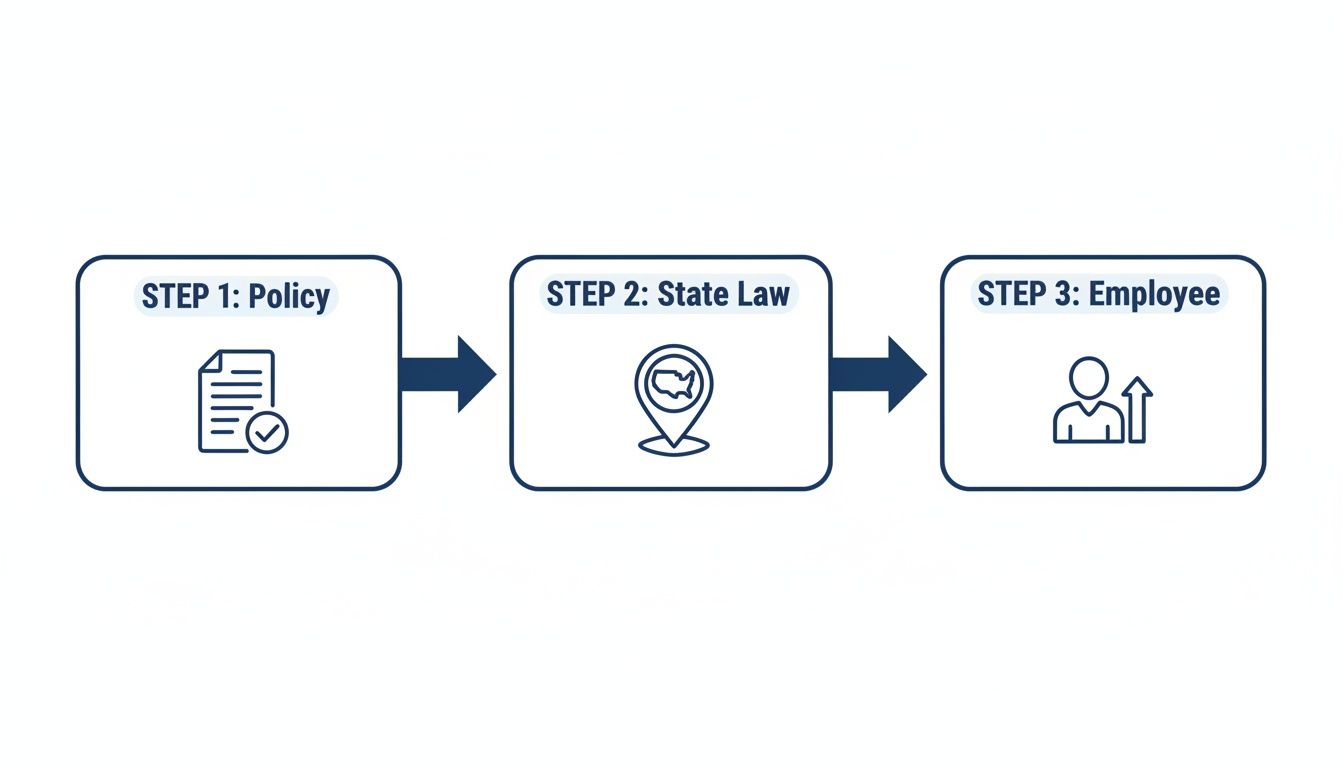
This simple flow highlights how a well-documented policy, informed by state law, ultimately leads to fair and consistent application for every employee.
One of the most important decisions is what happens to unused floating holidays at the end of the year. Unlike accrued PTO—which many states view as an earned wage—floating holidays can often be structured with a "use-it-or-lose-it" rule. This means if an employee does not use their floating holiday by year-end, they forfeit it.
This approach helps manage financial liability, as you typically do not have to pay out unused days. However, state laws vary. In California, a floating holiday with no strings attached might be treated like vacation time and require payout upon termination. You can learn more about these nuances when building a broader paid time off policy. Your policy must be explicit about your rules on rollover and termination.
While the point of a floating holiday is flexibility, it is reasonable to set limits to protect your business. Blackout dates are specific periods when employees may not be allowed to take time off due to predictable, critical business needs. These periods might include your busiest sales season, the time before a major project launch, or the end of a fiscal quarter.
Any restrictions must be clearly defined in your policy and applied consistently to everyone. This transparency helps manage expectations and ensures employees plan their time off accordingly. A clear, defensible policy requires careful consideration of business needs, employee desires for flexibility, and the legal landscape.
Using this checklist will help ensure your policy is clear, comprehensive, and compliant. By addressing each of these components, you can create a benefit that employees value and your business can manage effectively.
Moving from policy theory to a practical, written document can feel like a significant leap. To help you bridge that gap, we've provided sample language you can adapt for your employee handbook. Consider this a solid starting point, but always have your legal counsel review it to ensure compliance with all relevant state and local laws.
This language covers the essential elements of a floating holiday policy, from its purpose and eligibility to scheduling rules and year-end procedures. It provides a professionally sound foundation for drafting a clear and fair policy.
This section explains the "why" behind your policy, connecting the benefit to your company’s commitment to diversity and flexibility.
Purpose of Policy: [Company Name] provides eligible employees with [Number] floating holiday(s) each calendar year. We offer this benefit to give our team the flexibility to observe holidays, celebrate events, or handle personal matters that are important to them. Floating holidays are a key part of our commitment to building an inclusive and supportive work environment.
A clear purpose statement sets a positive tone, framing the benefit as a tool for inclusion rather than just another day off. This helps your team understand its true value.
Your policy must be crystal clear about who receives this benefit and how it is allocated. Ambiguity here can lead to issues later.
This section details how to use the days and what happens to any that go unused, which is critical for managing business operations. Discover more insights about floating holiday trends and usage.
Using clear, direct language helps manage employee expectations and ensures your policy is applied consistently. Building defensible HR policies is about more than using a template; it's about applying it correctly to your unique business.
Contact our team today to discuss your HR risk management needs.
As a business owner or HR leader, rolling out a new benefit always brings practical questions. To help you build and manage your policy with confidence, here are clear, direct answers to common points of confusion regarding floating holidays.
The answer hinges on your state's laws and the specific wording of your employee handbook. In some states, like California, an unrestricted floating holiday might be considered an earned wage that must be paid out upon termination. This can create a significant financial risk for employers.
However, most companies structure their policies to prevent this. By implementing a clear "use-it-or-lose-it" clause and stating that days are forfeited upon separation, you can usually avoid this payout liability. Your policy language is your best defense, so it is essential to consult with legal counsel to ensure compliance in every state where you operate.
Consistency is key. The most straightforward approach is to offer floating holidays exclusively to full-time employees. As long as "full-time" is clearly defined in your policy, this is an acceptable and legally defensible practice.
If you choose to offer the benefit more broadly, a compliant option is to provide it on a prorated basis. For example, if a full-time employee receives an 8-hour floating holiday, a part-time employee working half the hours could receive a 4-hour floating holiday. This maintains fairness by tying the benefit to hours worked. Whichever path you choose, document it clearly and apply it uniformly.
The goal here is fairness and predictability. Whether you limit the benefit to full-time staff or prorate it, the rule must be written down and applied to everyone without exception.
Yes, prorating floating holidays for new hires is a very common and fair practice. It aligns the benefit with an employee's actual time at the company, preventing a situation where someone hired in December receives the same number of days as a long-term employee. This approach is easy to administer and is generally viewed by employees as logical and equitable.
A simple prorating structure could be:
The key is to have a written policy that is applied automatically to every new hire, ensuring fairness and clarity from day one.
This choice depends on your company's strategic goals. While both options provide more time off, they send different messages and have different financial implications. Adding days to a general PTO bank offers maximum flexibility but increases your financial liability, as accrued PTO is often considered an earned wage that must be paid out upon termination.
Offering a floating holiday, on the other hand, gives you more control and predictability. Key advantages include:
While more PTO is always appreciated, a floating holiday is a more strategic tool for businesses focused on enhancing their Diversity, Equity, and Inclusion (DEI) efforts. It signals that you are an employer who understands and respects the modern workforce.
Navigating the complexities of employment policies, especially across multiple states, requires expertise. If you need guidance on building policies that protect your business and support responsible growth, our team can provide valuable insights. To learn more about how we can help you create defensible HR practices, contact us to learn more about our advisory services.


