
A regional operations director in Tampa approves a termination after an hourly warehouse employee violates a safety policy. Two weeks later, the director learns that the employee recently filed a workers' compensation claim. Then another detail surfaces: the employee's spouse is the lead witness in an EEOC charge involving the company, and the separation occurred three days after the employee requested FMLA paperwork for an elderly parent.
The director may have believed Florida's at-will rule made the decision straightforward. It didn't. Florida at-will employment exceptions turn a termination into a question of timing, headcount, protected conduct, contracts, and documentation. The offer letter matters, but it isn't the complete risk analysis.
The director's stated reason was a policy violation. That reason might be legitimate. The problem is that a legitimate reason becomes harder to defend when the decision sits next to several protected events.
The workers' compensation claim creates a direct statutory issue. Florida law prohibits an employer from discharging, threatening to discharge, intimidating, or coercing an employee because the employee filed, or attempted to file, a valid workers' compensation claim under section 440.205. The relevant question isn't whether the employee violated a policy. It's whether the claim activity influenced the decision, which makes the timing and rationale essential. Florida's workers' compensation retaliation protection explains why employers must separate ordinary discipline from claim-related conduct.
The spouse's role in an EEOC charge creates a different concern. The director must determine whether the employee participated in, supported, or possessed information about a discrimination matter, and whether the company treated comparable employees consistently. The FMLA paperwork request also requires careful review of leave eligibility and interference risk, rather than an assumption that the request can be ignored because Florida is an at-will state.
Practical rule: At-will status answers whether the employer needs just cause as a general matter. It doesn't answer whether the employer acted for an unlawful reason.
The director should pause the separation, preserve the relevant records, identify every decision-maker, and compare the policy violation with discipline imposed on similar employees. A decision made without that review may look retaliatory even if the underlying violation occurred.
Florida's at-will doctrine is the default rule, not a clean exit. Exposure depends on the statute or agreement connected to the decision, the employer's size, and the filing clock that begins after the adverse action.
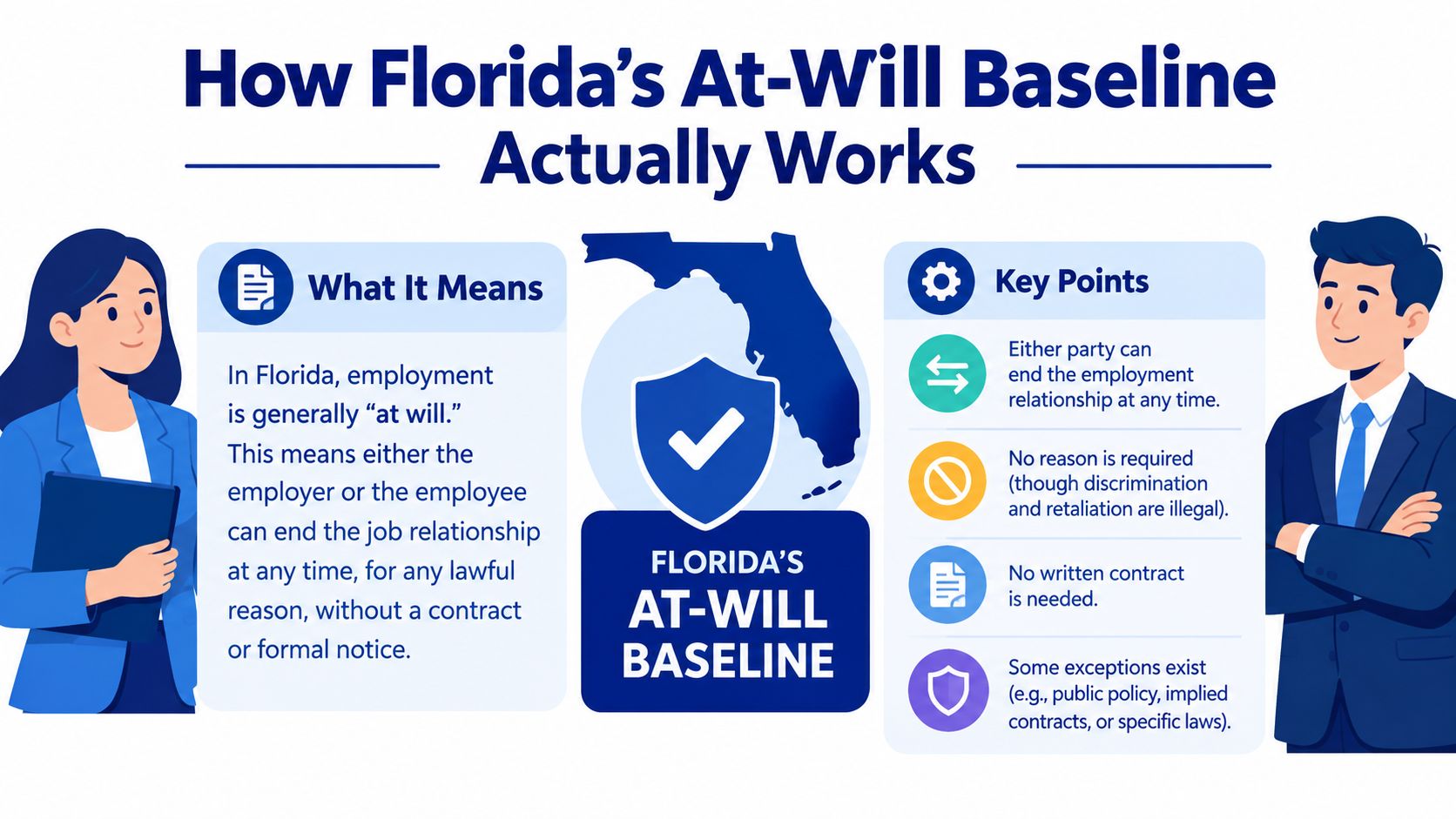
Florida generally follows a strong at-will baseline. In plain English, either the employer or employee can end the employment relationship at any time, with or without cause, as long as the reason isn't unlawful and no enforceable agreement says otherwise.
Florida is unusual because it's among the small group of states that don't recognize the three major common-law exceptions to employment at will: public policy, implied contract, and covenant of good faith. A Bureau of Labor Statistics review listed Florida alongside Alabama, Georgia, Louisiana, Nebraska, New York, and Rhode Island as states that didn't recognize the public-policy exception. The Bureau of Labor Statistics review also reflects the historical durability of Florida's strongly at-will approach.
That narrower judge-made framework gives Florida employers more room than employers in states that recognize broader common-law wrongful-discharge doctrines. But it doesn't remove statutory restrictions. Florida courts have repeatedly declined to create broader public-policy protections without legislative authorization, so the practical analysis starts with statutes, contracts, and documented facts.
Use this sequence before treating at-will status as decisive:
The Paradigm International guide provides additional context on the employment-at-will doctrine and its common exceptions. For Florida leaders, the essential point is simple: the baseline is the floor, not a shield.
The most important Florida at-will employment exceptions arise from statutes that protect specific conduct or characteristics. They don't create a general requirement that employers prove just cause. They restrict the reasons an employer can use when a protected right, report, claim, or category is involved.
Florida's private-sector whistleblower law appears in Chapter 448, Part II. It can create a retaliation claim when an employer takes adverse action after protected disclosures or refusals covered by the statute. A termination, demotion, suspension, or other adverse action following a complaint deserves immediate review, particularly when the decision-maker knew about the report.
Workers' compensation retaliation is more targeted. Section 440.205 prohibits discharge, threats, intimidation, or coercion because an employee filed, or attempted to file, a valid claim. The key issue is causation. A company can discipline an employee for a legitimate, independently documented violation, but it must be able to show that the claim activity didn't drive the action.
The Florida Civil Rights Act applies to employers with 15 or more employees and mirrors federal Title VII protected categories. A termination decision can create exposure when it's connected to discrimination based on protected characteristics or retaliation for protected participation.
Employers must also account for job-protection rules that don't depend on the public-policy exception. Florida requires employers to provide at least one day of jury-duty leave for a summoned employee, with longer leave when the juror is assigned to a trial lasting more than a day. The leave is unpaid unless local law requires payment. Florida also provides reemployment rights for Florida National Guard members after state active military duty, along with discrimination protections for Florida National Guard and Reserve members. This Florida employment law guide describes those mechanics.
| Statute | Protected Conduct | Termination Decision Constrained |
|---|---|---|
| Florida Private-Sector Whistleblower Act, Chapter 448, Part II | Covered disclosures, objections, or refusals | Firing or discipline motivated by protected whistleblower activity |
| Florida workers' compensation law, section 440.205 | Filing or attempting to file a valid claim | Discharge, threats, intimidation, or coercion because of claim activity |
| Florida Civil Rights Act | Protected characteristics and related protected activity | Decisions motivated by discrimination or retaliation |
| Jury-duty protections | Responding to a jury summons or serving on a trial | Termination or adverse attendance action because of jury service |
| Military-related protections | Florida National Guard or Reserve service and qualifying duty | Discrimination or failure to provide applicable reemployment rights |
| Written employment agreement | Contractual termination terms | Separation that violates promised notice, process, or cause standards |
The practical test is not whether a manager can write a plausible reason. It's whether the file shows that the same reason would have produced the same result without the protected event. Leaders considering firing someone who just complained should treat the decision as a heightened review, not an ordinary separation.
Florida's at-will employment system functions like a clock-driven compliance system. The employer's size determines which protections apply, while the employee's protected activity starts filing windows that can close quickly.
The Florida Civil Rights Act applies at the 15-employee threshold. The Florida Private-Sector Whistleblower Act applies at the 10-employee threshold. Those thresholds force leaders to answer basic operational questions before a dispute arises, including who counts as an employee, which entity employs the worker, and whether related operations belong in the analysis.
The filing windows add urgency. The Florida Commission on Human Relations generally provides a 365-day filing window for covered discrimination matters, while federal discrimination charges in a deferral state like Florida typically have a 300-day deadline under Title VII, the ADA, and the ADEA. The Florida-focused termination summary also identifies a civil action deadline of 1 year after a reasonable-cause determination or EEOC notice, whichever comes first. The Florida termination-law summary outlines these thresholds and agency timelines.
Whistleblower matters move faster. The Florida Commission on Human Relations states that private-sector whistleblower complaints must be filed within 60 days of the adverse personnel action, and the deadline is strictly enforced. The Florida Commission on Human Relations whistleblower statute makes that short window a concrete administrative risk.
| Protected Category | Employer-Size Threshold | Agency Filing Window | Agency Route |
|---|---|---|---|
| Florida Civil Rights Act | 15 or more employees | 365 days | Florida Commission on Human Relations |
| Federal Title VII and ADA claims | Federal coverage applies, with the relevant employer analysis | 300 days in a Florida deferral state | EEOC |
| ADEA claims | Federal coverage applies, with the relevant employer analysis | 300 days in a Florida deferral state | EEOC |
| Florida private-sector whistleblower claims | 10 or more employees | 60 days | Florida Commission on Human Relations |
Don't wait for a charge to organize the file. Assign responsibility for headcount tracking, agency notices, preservation, and response deadlines before a termination occurs.
A defensible termination file tells the story in the order events happened. It doesn't begin with a lawsuit and work backward to create a rationale.
Start with the underlying problem. Record the policy, performance expectation, attendance issue, or business condition involved. Add the dates of coaching, written warnings, performance reviews, investigations, and prior decisions involving comparable employees. If the company uses progressive discipline, apply the stated process consistently or document why a different step was appropriate.
The decision-maker's rationale memo should be contemporaneous and specific. It should identify:
Timing deserves separate attention. A termination close to a workers' compensation claim, FMLA paperwork request, or internal discrimination complaint doesn't automatically prove retaliation, but it creates a fact pattern the employer must explain. A manager's later recollection won't substitute for a clear record created at the time.
Documentation standard: If the reason would be difficult to explain to a neutral reviewer using only the personnel file, the decision isn't ready.
Apply the same discipline standard to protected and unprotected employees. Selective enforcement can undermine an otherwise valid policy rationale. Also preserve relevant emails, messages, interview notes, and approval records once a complaint or investigation is reasonably foreseeable.
A high-risk separation needs a readiness test. The leadership team should be able to answer each question before preparing the notice letter.
Review the performance and conduct record with someone who wasn't responsible for creating the original rationale. That second reviewer should test whether the evidence predates the proposed separation, whether the policy applies consistently, and whether the decision-maker's explanation has changed.
Check the calendar. Compare the decision date with complaints, claims, leave requests, agency activity, investigations, and other protected events. The company should know which filing windows could apply and who will preserve the records.
Then review the separation mechanics:
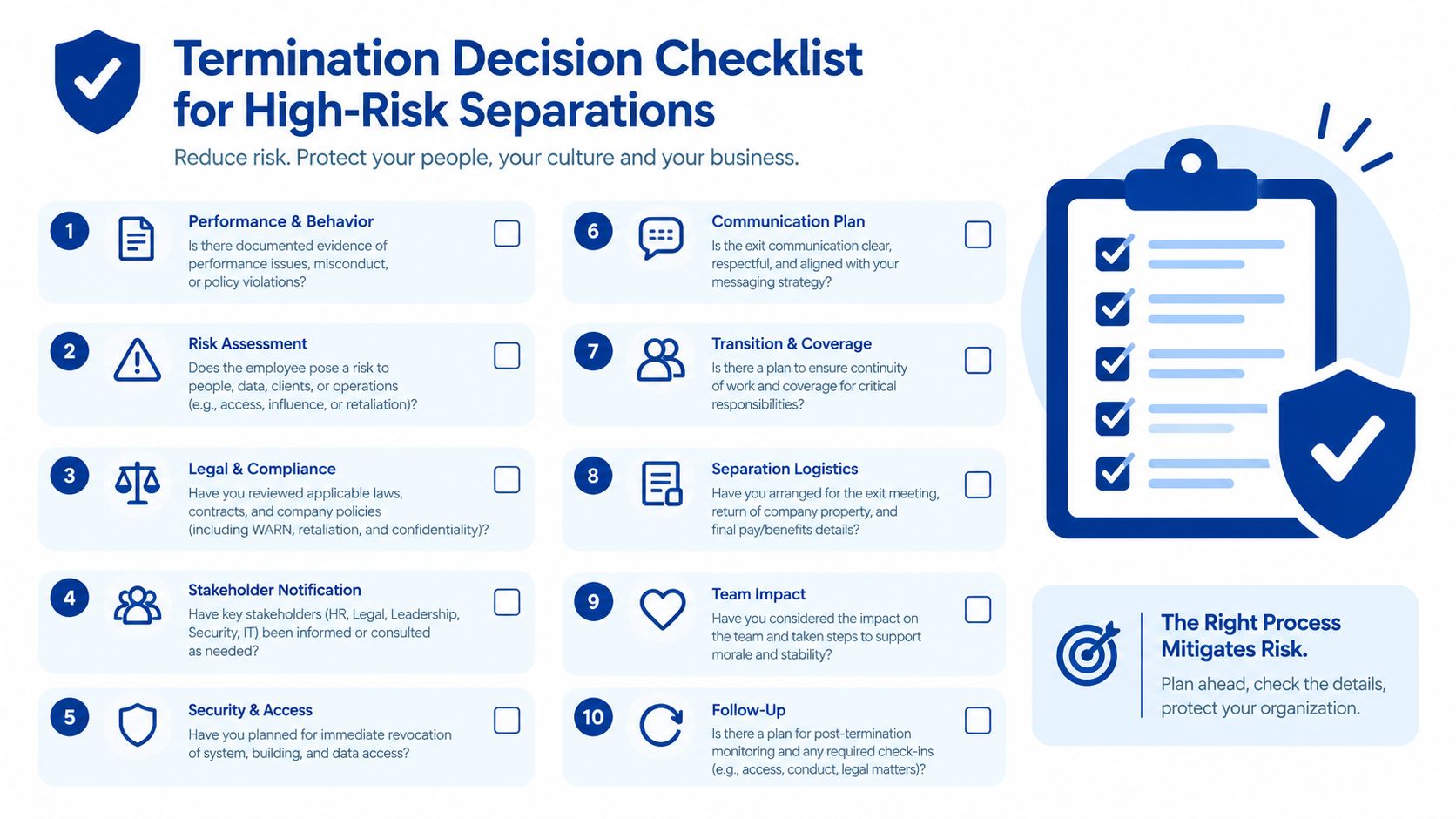
The 10-point termination checklist can help leadership teams standardize this review. If the file contains unexplained timing, inconsistent discipline, missing investigation records, or an unresolved complaint, pause the termination and escalate it.
Florida's rule is often the floor for a multi-state employer, not the complete standard. A company may have a defensible Florida termination and still create exposure when the employee works from another state, reports to a different location, or performs duties across state lines.
The first control is location accuracy. Keep the employee's actual work location current in the personnel record, not just the payroll or corporate address. Remote work can change the applicable state rules, agency route, and documentation expectations.
For a multi-state decision, compare:
Neighboring and deferral-state rules can raise the documentation burden. California, New York, and Montana are examples of jurisdictions where the at-will analysis can differ from Florida's narrower common-law posture. A handbook disclaimer that works in one state may not resolve implied-contract concerns in another.
| State | At-Will Default | Key Common-Law Exception | Relevant Size Threshold | Shortest Filing Window |
|---|---|---|---|---|
| Florida | Strong at-will default | No major common-law public-policy, implied-contract, or good-faith exception recognized | 10 employees for the Florida private-sector whistleblower law, 15 for the Florida Civil Rights Act | 60 days for covered private-sector whistleblower complaints |
| California | At-will default | Broader statutory and common-law limits may apply | Varies by statute | Varies by claim |
| New York | At-will default | Limited common-law protections, with statutory protections controlling many disputes | Varies by statute | Varies by claim |
| Montana | At-will default with distinct statutory structure | Statutory limits apply after the applicable probationary framework | Varies by statute | Varies by claim |
The table shows why a single national termination policy is often insufficient. Use the strongest applicable protected category, shortest filing window, and highest documentation standard before issuing the separation.
I recommend outside counsel or a qualified HR advisor before any separation involving a recent complaint, protected leave, workers' compensation activity, whistleblower report, discrimination concern, contract language, or multi-state work location. This doesn't need to become a long litigation engagement. A focused review of the decision file can identify a timing problem, missing comparison, or inconsistent rationale while the company can still correct course.
An advisor should receive the complete record, not a summary written to justify the outcome. Provide the proposed termination rationale, performance and discipline history, relevant policies, complaint and leave timeline, employee location, decision-maker notes, and the applicable state-by-state filing analysis.
When facts are ambiguous, get trained eyes on the file before the action is documented. The next priority is disciplined documentation and consistent multi-state compliance, because a strong at-will baseline can't repair a weak decision record.
International Inc. helps owners, COOs, and HR leaders review high-stakes terminations, investigations, manager conduct, and multi-state compliance decisions before preventable exposure grows. If your team needs a structured pre-decision review of a Florida separation, visit Paradigm International Inc. to discuss the facts, timing, and documentation with an advisory partner.