
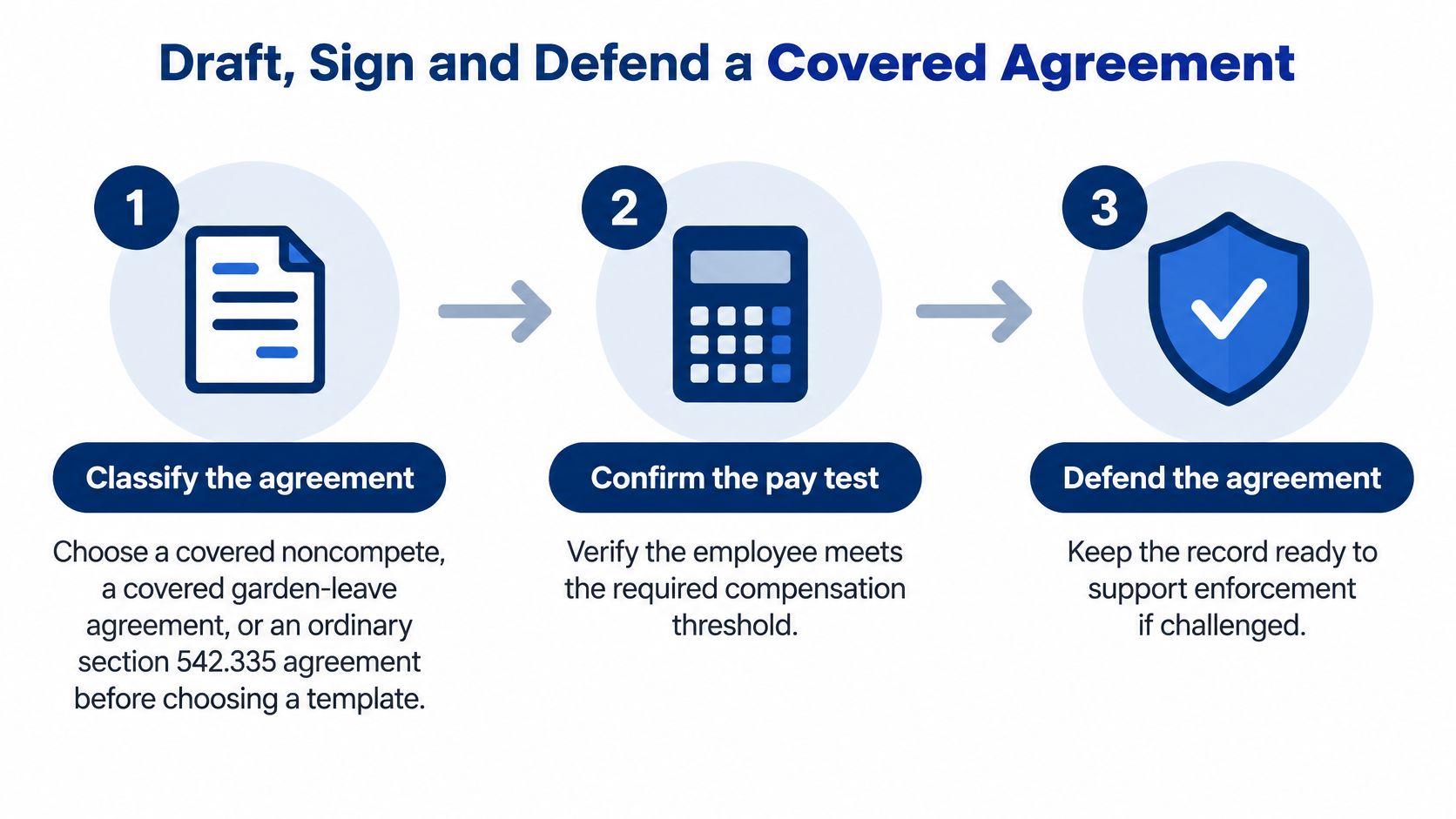
A Florida company updates a noncompete for a key employee, then prepares to send the same agreement to a remote manager in another state. The wording looks consistent, but the legal treatment may not be. For an owner handling HR alongside daily operations, the first task is classifying each agreement, not choosing the strongest-looking template.
A Florida CHOICE Act noncompete starts with the worker's circumstances and the contract's governing-law clause. A Florida address on the employer's letterhead doesn't settle coverage. Neither does a sentence stating that Florida law governs.
Florida's CHOICE Act, formally the Florida Choice of Law and Forum Selection in Certain Employment Agreements Act, took effect July 1, 2025, under Chapter 2025-213 and added Florida Statutes sections 542.41 through 542.45, according to the Florida Legislature's statutory text. An Epstein Becker Green publication describes enactment as July 3, 2025. Those different date descriptions shouldn't become an operational assumption about which agreements qualify; employment counsel should confirm the controlling text and its application.
Under the 2025 CHOICE Act, a covered noncompete can involve a covered employee whose primary place of work is Florida, regardless of a different contractual choice-of-law provision. Another trigger applies when the employer's principal place of business is Florida and the agreement expressly selects Florida law. Covered employee status also requires the eligibility checks described below, so location alone isn't enough.
The 2025 CHOICE Act didn't replace Florida Statutes section 542.335. Agreements outside the Act's definitions remain on the traditional restrictive-covenant track when Florida law applies. For workers outside Florida, counsel must also consider the law of the state where the employee works.
Which Florida track applies to a noncompete
| Situation | Primary work location | Governing-law clause | Track |
|---|---|---|---|
| Florida-based worker meeting the pay test | Florida | Any clause, including another state's law | CHOICE Act covered agreement possible |
| Florida-based worker below the pay test | Florida | Any clause | Section 542.335 governs |
| Florida-headquartered employer, worker outside Florida, pay test met | Another state | Florida law expressly selected | CHOICE Act covered agreement possible |
| Out-of-state employer, worker outside Florida | Another state | Another state's law | Outside the Act; review that state's rules |
The table is an initial sorting tool, not an enforceability opinion. An employee working from Georgia for a Florida-headquartered company needs a different review from an employee working in Florida for a Georgia-headquartered company. Counsel should confirm the exact statutory trigger before either agreement relies on the Act.
A relocation can change the facts behind that classification. A documented process for a remote employee moving to another state helps keep the personnel file aligned with the employee's actual workplace.
Before choosing a template, leadership needs clear answers to these questions:
The pay test is a gate, not a drafting preference. The Florida Legislature's 2025 CHOICE Act analysis describes a covered employee's base salary as greater than twice the annual mean wage for the relevant county and indicates that individual contractors may qualify while healthcare practitioners are excluded. A senior title or access to sensitive information doesn't substitute for those eligibility requirements.
The county selection matters. Under that legislative analysis of the 2025 CHOICE Act, the benchmark generally comes from the county containing the employer's principal place of business; when the employer is outside Florida, the relevant location can be the county where the employee resides. There isn't a single statewide salary cutoff that an employer can safely place in every offer checklist.
The employer should have counsel confirm the applicable government wage series, county and publication period. The Bureau of Labor Statistics Occupational Employment and Wage Statistics program is a named government wage resource to discuss, but the employer shouldn't assume that any available wage table supplies the statutory county measure. Save the accepted wage publication and its retrieval date with the calculation.
For a clearly hypothetical illustration, if the applicable county's annual mean wage were $60,000, a greater-than-twice test would require more than $120,000. Those amounts illustrate the calculation only; they aren't a Florida county benchmark.
A 2026 Florida Bar Journal analysis instead describes the benchmark using median wage terminology. Because mean and median aren't interchangeable, counsel should resolve that wording difference against the current statute before an agreement is issued.
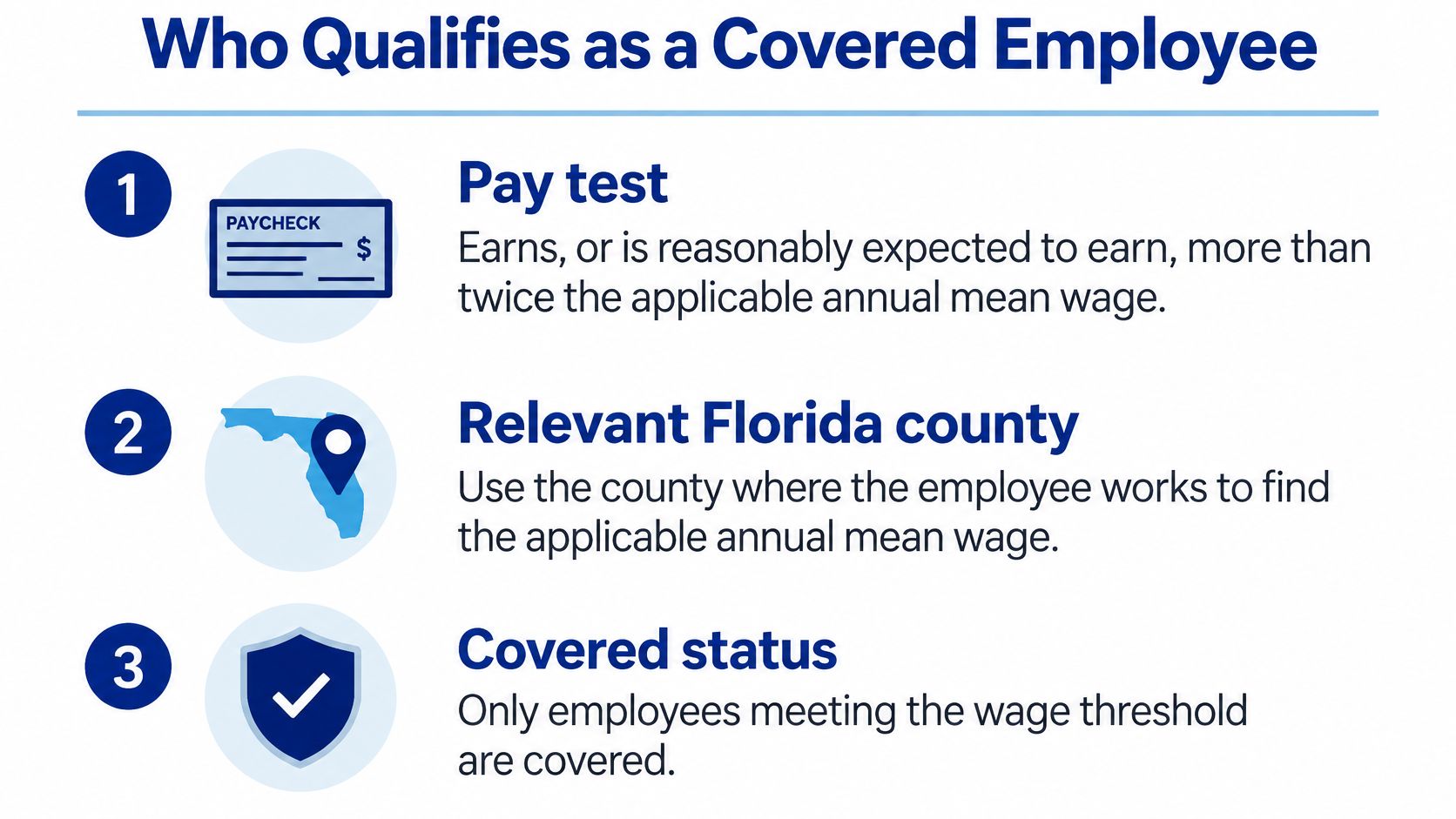
For county selection, the statutory employer-location and employee-residence rules control, rather than a general assumption that the work county always applies. Contractor eligibility also doesn't resolve whether the worker was correctly classified in the first place. The independent contractor versus employee test remains a separate review.
The eligibility record should contain:
Record the result at signing. Recheck it when the role, location or compensation changes.
The most important difference isn't a longer restriction alone. It's the combination of eligibility requirements and enforcement treatment. Under the 2025 CHOICE Act, a qualifying covered noncompete can restrict competitor employment within a defined geographic area for up to four years after termination, and qualifying restrictions receive statutory injunctive treatment, as described in the Florida Legislature's bill materials.
The agreement types also work differently in practice. A covered noncompete addresses competitor employment after the relationship ends. A covered garden-leave agreement keeps the employee employed and paid during a contractual notice period, so it requires payroll planning rather than merely an offboarding clause.
Florida's traditional framework requires a signed writing, a legitimate business interest and a reasonably necessary restraint. Under Florida Statutes section 542.335, as published in 2026, an employee restraint of six months or less is presumed reasonable, while one over two years is presumed unreasonable, subject to the statute's applicable category and exceptions. Those are presumptions, not universal expiration dates.
CHOICE Act covered agreement compared with a section 542.335 agreement
| Feature | CHOICE Act covered agreement | Section 542.335 agreement |
|---|---|---|
| Who it covers | Covered employees and individual contractors who meet the pay test and other conditions | Restrictive covenants that don't meet the Act's definitions |
| Maximum duration | Statutory covered-agreement cap | Must be reasonable in time; employee-duration presumptions apply |
| Agreement types | Covered noncompete or covered garden-leave | Restrictive covenant during or after employment |
| Review period | Specific statutory advance-delivery requirement | No equivalent CHOICE Act review rule; counsel should confirm applicable requirements |
| Enforcement | Court directed to issue a preliminary injunction when statutory conditions are met | Employer must establish a legitimate business interest and reasonable necessity |
| Burden on enforceability | Employee bears the statutory burden when the Act's conditions are satisfied | Employer carries the ordinary initial proof burden |
The comparison shouldn't encourage leadership to select the CHOICE Act solely because its enforcement provisions look stronger. An employer must first establish that the worker and agreement qualify. A document labeled “covered noncompete” doesn't become covered merely because its heading says so.
Practical rule: Select the legal track from the facts, then select the agreement. Reversing that order creates avoidable uncertainty.
The business trade-off deserves equal attention. A post-employment restriction may require litigation to enforce, while garden leave creates an ongoing employment and payment commitment. Neither tool replaces clear confidentiality obligations, controlled access to sensitive information or disciplined departure procedures.
Leadership should ask what needs protection and for how long. A narrowly identified customer relationship may call for a different approach from broad access to confidential operating information. Counsel should translate that business need into the appropriate agreement rather than defaulting to the longest available restraint.
A defensible agreement file should explain why the agreement belongs on its selected track and how it was delivered. The contract alone won't answer those questions. The offer process, salary record, work-location confirmation and signature history need to agree with it.
The Florida Senate's 2025 CHOICE Act summary describes covered restrictions capped at four years and a seven-day review requirement in specified circumstances. Those requirements make drafting an HR workflow issue as well as a legal-document issue. Recruiting, payroll and the person sending the offer must follow the same approved process.
Classify before choosing a template. Mark the proposed arrangement as a covered noncompete, covered garden-leave agreement or ordinary restrictive covenant. Keep unclear agreements out of routine offer processing until counsel resolves them.
Record the compensation calculation. Retain the salary basis, accepted county wage publication and calculation. Don't substitute a recruiting compensation estimate for the eligibility record.
Confirm location and governing law. Have the worker confirm the primary workplace in writing. Compare that answer with the contract, remote-work approval and payroll record rather than assuming those records match.
Define the protected activity and geography. Identify the confidential information or customer relationships connected to the role. A geographic description should reflect the business activity being protected, not a copied list of every territory where the employer might expand.
Control delivery and offer expiration. Under the 2025 CHOICE Act, deliver the proposed agreement at least seven days before the applicable offer expires, whether for a prospective employee or a current employee's offer to enter the restriction, as reflected in the Florida statutory compilation. Save the delivery evidence and the exact version sent.
Budget the garden-leave commitment. State the paid notice arrangement clearly and have counsel confirm payment, benefits and termination mechanics. Payroll needs instructions before the agreement is used, not after a departure becomes contentious.
Close and preserve the file. Retain delivery date, review deadline, signature date, compensation basis, county benchmark, geographic definition and protected interests. Give responsibility for the complete packet to a named person.
An electronic revision raises a separate timing question. Counsel should decide whether a changed restriction requires renewed delivery or a reset deadline before recruiting sends the replacement. Overwriting the original attachment destroys useful evidence about what the employee received.
For general drafting discipline, Documind's guide to build stronger agreements with Documind offers a supporting resource. It doesn't replace Florida-specific counsel review. Operational controls for trade-secret protection should also match the interests described in the agreement.
The Florida Senate's 2025 committee summary explains that the CHOICE Act places the burden of showing unenforceability on the employee when the statutory conditions are met. That procedural advantage makes accurate eligibility and execution records important. It doesn't make a flawed agreement reliable.
A strong enforcement provision can't repair an uncertain workplace record or missing delivery history.
Before a termination or enforcement letter, preserve relevant evidence, confirm promised payments and review prior waiver decisions with counsel. Avoid assuming that a governing-law clause overrides the Florida workplace facts. Statutory eligibility also isn't litigation certainty, particularly where courts must address constitutional or equitable-discretion arguments.
The same pause applies when the underlying employment decision is defective. In a multi-state case, Paradigm International Inc.’s review helped an employer avoid proceeding with a termination under defective policies and eliminated systemic multi-state exposure. That outcome supports checking the whole decision process, not treating a noncompete as a stand-alone safeguard.
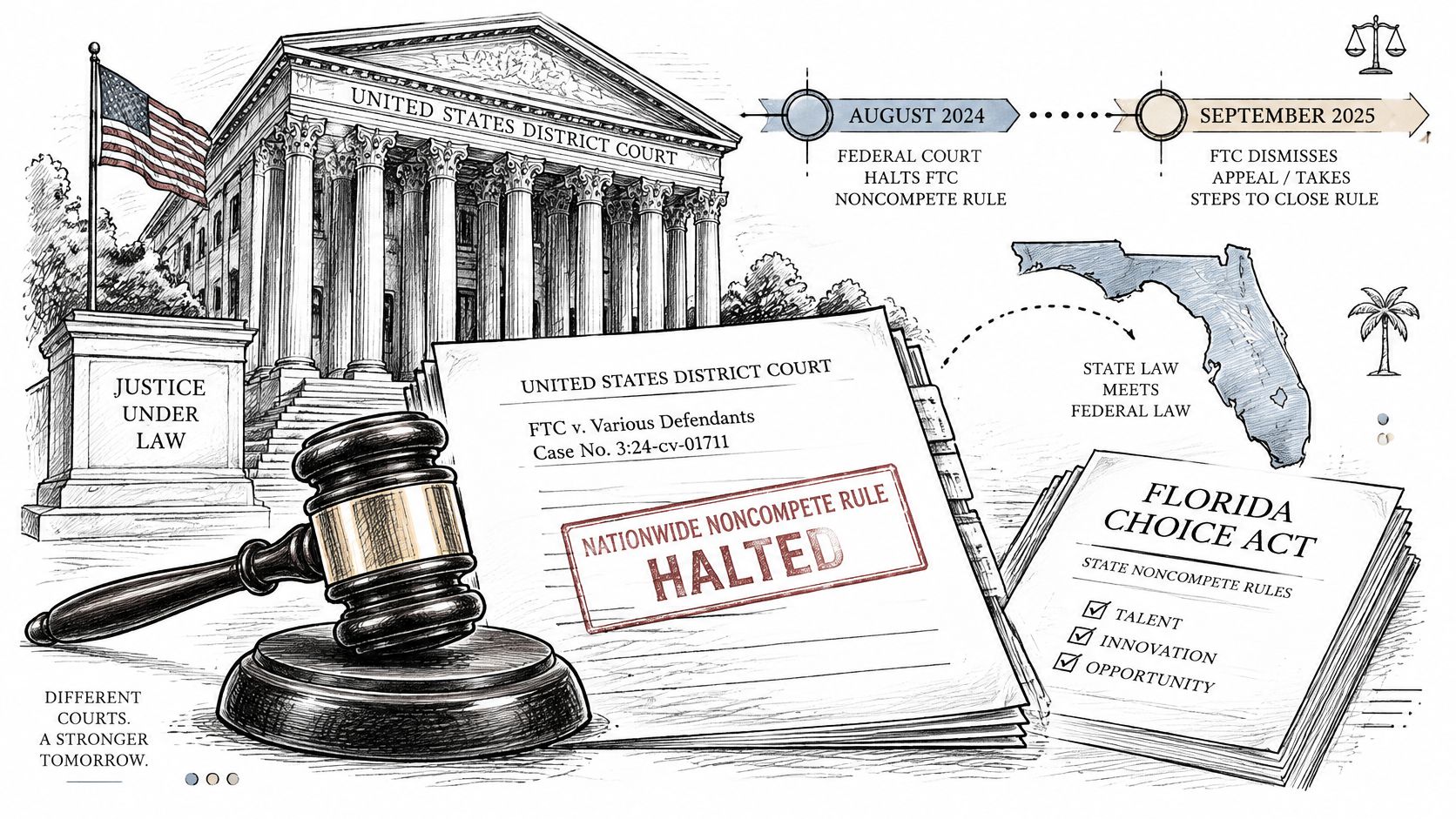
The federal backdrop doesn't support a simple claim that Florida permits noncompetes while federal law bans them. The Federal Trade Commission's Noncompete Rule status page states that the rule isn't in effect or enforceable, following a federal district court's August 2024 action; the agency also took steps in September 2025 to dismiss its Fifth Circuit appeal. Counsel should confirm the current agency and litigation position before an employer relies on that status.
Florida's 2025 CHOICE Act and the federal rule therefore require separate analysis. Federal non-enforcement isn't a permanent safe harbor, and Florida eligibility doesn't answer every interstate question. The practical direction is state-by-state sorting, not a national template with a Florida clause added.
An employee may sign while working in Florida and later request permanent remote work from California. Another may live in Georgia but regularly perform work in Florida. Neither situation should be resolved solely from the address on the original offer.
The employer should document the approved primary workplace, effective date of any move and expected work pattern. For cross-border or hybrid arrangements, counsel should determine which location controls and whether another state's mandatory rules limit the proposed restriction. Florida's statutory trigger can matter even when the employee performs some work across state lines.
In a remote-work case, the company rewrote the client's remote and hybrid work policy to define approved work locations, employee obligations and enforcement authority. Those controls help leadership obtain the location facts needed for an agreement review. A manager's informal permission to work elsewhere shouldn't remain outside the HR record.
The treatment of agreements signed before the Act's effective date needs specific counsel review. Employers shouldn't assume either automatic coverage or automatic exclusion based only on signing date. The question includes whether the document and its execution history satisfy the current statutory requirements.
A practical inventory should capture:
The federal noncompete rule overview provides additional context for leadership discussions. Constitutional and judicial-discretion concerns identified in Florida Bar commentary also reinforce the need to separate statutory coverage from predicted litigation results.
Where a restriction isn't available or appropriate, counsel can assess confidentiality terms, trade-secret controls, customer-relationship protections and paid transition arrangements. Each alternative still needs its own legal and operational review.
The best first action is an agreement inventory with a named owner. It can begin as a spreadsheet linked to the signed documents and supporting records. The purpose is to identify agreements that are ready for counsel's confirmation and those whose basic facts remain unclear.
Leadership shouldn't begin by replacing every agreement. A targeted review preserves attention for key employees, upcoming departures and contracts with missing eligibility or delivery records. It also avoids sending amendments before the employer has settled the correct process.
The checkpoint should identify who gathers the facts, who approves the agreement and who releases it for signature. Payroll or recruiting can administer an approved process, but neither should be expected to resolve disputed coverage. A short written handoff is more useful than a policy that says to obtain approval.
Decision boundary: HR can organize the facts and process. Employment counsel should confirm legal coverage, contract language and enforcement strategy.
A planned termination after a complaint or leave deserves expert help before action. The same applies to investigations, proposed noncompete enforcement and situations where leave and disability issues overlap. An urgent departure shouldn't become a reason to skip review of the employer's underlying decision.
Preparing for an employment law consultation means assembling the signed agreement, delivery record, workplace history, compensation calculation and relevant correspondence. Counsel can work more efficiently from a coherent file than from scattered messages and an unsigned template. Leadership should also identify the business outcome sought, such as protecting confidential information or arranging an orderly transition.
For employers seeking help organizing that work, Paradigm International Inc. can map workers and agreements into a review process and establish checkpoints for future hires. Its partnership is customized to the employer's size, structure and states of operation following a short compliance audit. Paradigm provides HR consulting, not legal advice.
Paradigm International Inc. offers multi-state HR decision support and counsel coordination to help employers organize agreement records and manage hiring, relocation and departure checkpoints. This article is general information, not legal advice. Employment laws change and vary by state; consult qualified employment counsel about your situation. Book a Free HR Risk Review.