
A Tampa remodeling firm can look compliant on Monday and face three different problems by Friday. The owner may receive a reemployment tax audit covering subcontractors, a workers' compensation enforcement notice, and an E-Verify issue involving public work. The contracts say “independent contractor,” but Florida contractor employment laws focus on how the relationship operates, not just what the paperwork calls it.
Florida's real challenge is fragmentation. Reemployment tax, workers' compensation, and public-sector contracting use overlapping but distinct rules. A worker can appear independent for one purpose and still create employee exposure under another. The practical question for an owner or COO is simple: Can the company defend this relationship under the specific Florida rule governing the dispute?
A Tampa remodeling firm can pay a worker through a business entity, receive invoices, and still face employee exposure. The mistake is treating one classification decision as the answer to every Florida obligation. Reemployment tax under Chapter 443 applies common-law employment principles. Workers' compensation under Chapter 440 uses statutory contractor criteria. Public-sector work adds registration, contractor controls, and E-Verify duties under Section 448.095. Florida's contractor classification frameworks operate as separate systems, not one universal test.
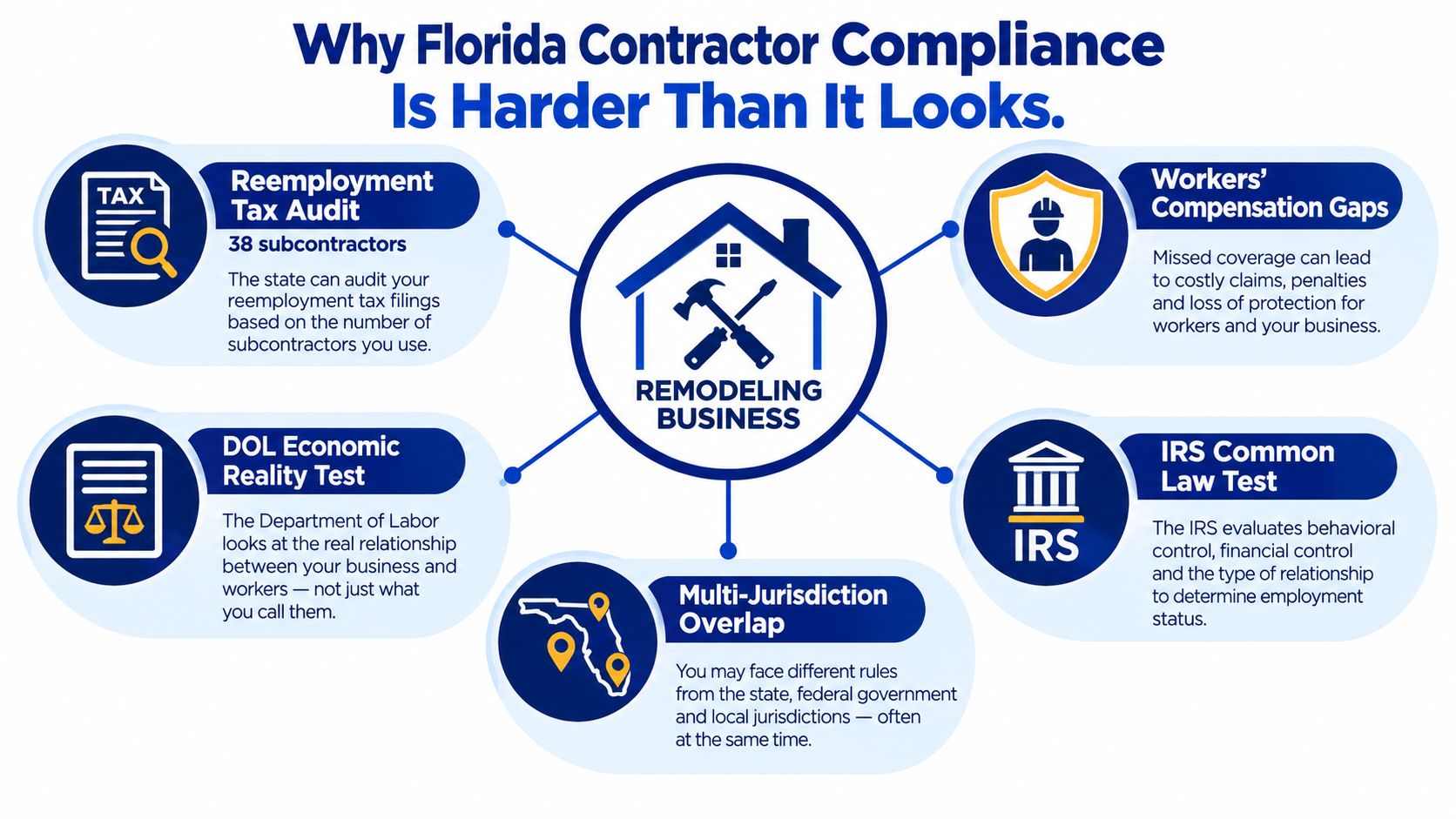
Begin with the legal question under review. A reemployment tax reviewer may assess the company's direction and control under common-law principles. A workers' compensation review may test whether the individual meets statutory contractor requirements. A public contracting review may examine E-Verify and registration compliance for the contractor and subcontractor.
The same worker can produce different outcomes. A separate business account and entity invoices may support contractor treatment in one workers' compensation analysis. Those documents do not overcome evidence that the person follows the general contractor's schedule, uses company tools, serves company customers, and has little opportunity for profit or loss. Another regime may treat those operating facts as evidence of an employment relationship.
Board-level takeaway: A signed agreement is evidence. It is not a classification ruling.
Statutory references create another control problem. A 2023 change renumbered the workers' compensation definition from Section 440.02(15) to Section 440.02(18). HR, payroll, insurance, and counsel should align their compliance files with the current numbering before finalizing a policy or audit response. The Florida Legislature's workers' compensation statute provides the current reference point.
Stop using “Are we paying this person on a 1099?” as the classification test. That describes payment method, not the relationship. Use a documented intake review:
A defensible decision starts with the applicable regime, then tests the relationship against the facts that regime considers.
A contractor can pass one review and fail another. A Florida company may face different answers under federal tax rules, reemployment tax, workers' compensation, and public-sector or E-Verify requirements. Treating “contractor” as one universal status is the classification error that creates avoidable exposure.
Federal tax analysis commonly examines behavioral control, financial control, and the type of relationship. Florida reemployment tax applies common-law principles to the employer-employee relationship. Workers' compensation adds statutory criteria. Public-sector contracting and E-Verify obligations introduce separate compliance questions. A single worker can therefore be classified differently under each regime.
| Test | Key Criteria | Burden of Proof | Primary Consequence |
|---|---|---|---|
| Federal common-law analysis | Behavioral control, financial control, and relationship type | The business must support its treatment with operational evidence | Federal tax and employment exposure |
| Florida reemployment tax | Common-law direction, control, and the overall employer-employee relationship | The business must demonstrate genuine independence | Reemployment tax liability and related filings |
| Florida workers' compensation | Statutory contractor criteria, including separate business operations, EIN status, business payment structure, business banking, other clients, and bid or task-based payment | The business must document the statutory criteria | Coverage duties, audit exposure, and penalties |
| Public-sector and E-Verify review | Contracting requirements, work authorization processes, and applicable agency rules | The business must meet the requirements tied to the engagement | Contract, hiring, and compliance exposure |
For a non-construction worker, Florida's workers' compensation framework generally requires at least four of six criteria for independent-contractor treatment. The criteria address a separate business location, an EIN, payment through a business entity, business bank accounts, work for other entities, and payment by bid or task. The statutory test matters independently of the contract label.
For reemployment tax, reviewers may focus on the right to control, not merely the instructions given on a particular day. Preserve records showing who sets schedules, supplies tools, determines pricing, accepts work, handles customer complaints, and absorbs expenses. A separate entity or project invoice supports independence only when the operating relationship supports it too.
Workers' compensation requires a separate evidence file. Map each worker against the applicable statutory criteria and retain documents supporting every conclusion. A W-9 alone does not establish contractor status. Leaders seeking broader context on rights for employees and contractors may consult that resource, but Florida-specific rules control the decision.
Use the independent contractor vs employee test 2026 to organize the review. The final record should name the legal regime, apply its test, identify the evidence, address public-sector or E-Verify requirements where relevant, and state the remediation decision. That is the standard a COO should require before approving a contractor model.
Construction companies face a different classification risk from ordinary professional-services businesses. Florida's workers' compensation rules rely on statutory definitions, so years of trade experience do not by themselves establish independent-contractor status. The same worker may be treated differently under reemployment tax, workers' compensation, and public-sector or E-Verify requirements. A contract label cannot resolve all three regimes.
A defensible construction subcontractor should have an independently established trade, appropriate licensing or registration, commercial activity separate from the hiring contractor, and responsibility for the quality and financial consequences of the work. The operating relationship should support that record through independent pricing, tools, insurance, customer access, and the ability to serve other clients.
Compare two workers. A licensed tile installer bids separate scopes, supplies equipment, invoices for completed work, carries appropriate coverage, and works for multiple general contractors. A handyman uses one general contractor's truck, follows its daily schedule, wears its branding, and receives assignments from one supervisor. Their titles may match, but their working arrangements do not.
The handyman presents the stronger employee case, even if an agreement uses independent-contractor language. Construction leaders should review licensing, insurance, and payroll classification as separate decisions, then reconcile the evidence before mobilization. Tips from Forever Florida Insurance can inform the insurance review, but an insurance certificate does not determine worker status.
Florida created a distinct statutory category for marketplace contractors under Section 451.02. It covers app-based platform work only when specified conditions are met. The platform must not unilaterally control the worker's hours, must not restrict use of other platforms, must use a written independent-contractor agreement, and must leave the contractor bearing all or substantially all expenses. Florida's public-sector contracting statute illustrates how Florida applies detailed, sector-specific requirements.
That category does not cover every technology-enabled service. The platform should preserve evidence of how its app operates, including control over acceptance, pricing, availability, customer access, and performance. If those functions are controlled in practice, written terms may carry limited weight.
Construction leaders should assess each subcontractor separately, verify licensing and coverage before work begins, and document the facts supporting the classification under each applicable legal regime. A familiar trade label is not evidence.
A contractor can be independent for one Florida rule and treated as an employee for another. A payroll review may trigger reemployment tax, the same person may create workers' compensation exposure, and public work may add registration or E-Verify duties. Treat these as three separate compliance tracks, each with its own authority, threshold, filing calendar, and enforcement mechanism.
Florida reemployment tax applies common-law employment rules under Chapter 443. The state uses a wage base covering the first $7,000 paid to each employee in a year. A business can become liable if it paid at least $1,500 in wages in a calendar quarter or had at least one employee for part of a day in 20 different calendar weeks during the current or preceding calendar year. Florida reemployment tax guidance makes the governing point clear: the working relationship, not the contract label, determines coverage.
Payroll should review contractor payments whenever the operating facts indicate employment. The team should also track reporting duties for covered independent contractor hires paid $600 or more per year, including the applicable new-hire reporting process. That review belongs with payroll and HR, not only with procurement.
Workers' compensation focuses on whether the business secured coverage for people who should be treated as employees. Florida's statutory contractor criteria apply, and construction relationships receive close scrutiny. A business that fails to secure required coverage can face a penalty of up to $5,000 for each employee classified as an independent contractor who does not satisfy the statutory criteria. Florida's workers' compensation penalty provision belongs in the exposure review.
The same worker can therefore produce different outcomes across reemployment tax and workers' compensation. Do not use one determination as a substitute for the other.
Public contractors and subcontractors must address registration and E-Verify obligations under Section 448.095. An independent contractor hired for a specified portion of labor or services is not an employee for that provision, but the hiring company still needs a process that verifies the relationship and meets public-contract requirements.
| Compliance Track | Governing Body | Coverage Threshold | Key Filing or Action | Penalty Lever |
|---|---|---|---|---|
| Reemployment tax | Florida Department of Revenue | Statutory wage and employment tests | Register, report covered wages, and review common-law status | Tax assessment and related liability |
| Workers' compensation | Florida Division of Workers' Compensation | Coverage depends on employee status and applicable industry rules | Secure coverage, verify exemptions, and retain contractor evidence | Stop-work action and statutory penalties |
| Public contracting and E-Verify | Florida contracting authorities and applicable federal requirements | Public contracts and covered hiring activity | Complete registration, E-Verify new employees, and maintain affidavits where required | Contract, compliance, and enforcement exposure |
Licensing is a separate gate before work starts. The guide to trade licensing provides general context, but Florida businesses must verify the applicable Florida license and contracting requirements before awarding work. Keep the licensing check separate from worker-status analysis, then reconcile all three records before mobilization.
A contractor file can look complete and still fail under scrutiny. A W-9, a 1099-NEC, and an agreement labeled “Independent Contractor Agreement” support the company's position, but they do not decide worker status. Auditors and investigators compare those documents with scheduling, supervision, tools, pricing, customer relationships, and economic dependence.
Workers' compensation creates direct financial exposure. If a business fails to secure required coverage and misclassifies a worker, the department may assess up to $5,000 for each employee who does not meet the statutory contractor criteria. The penalty reference appears in the applicable Florida workers' compensation statute, but the exposure does not depend on what the contract calls the relationship.
A contract may state that the worker controls the work method while a project manager assigns every task. It may require the contractor to carry insurance while the company supplies tools and absorbs customer refunds. It may describe a fixed project even though the worker receives recurring weekly assignments indefinitely.
Enforcement evaluates the relationship as operated. Reemployment tax uses its own employment analysis, workers' compensation applies statutory criteria, and public-sector work adds E-Verify and contract requirements. The same worker can therefore receive different treatment under each regime, while contradictory records expose the business across all three.
Practical rule: Never approve a contractor file until operations, payroll, insurance, and the hiring manager describe the relationship consistently.
Reclassification can produce several liabilities at once. The business may face reemployment tax assessments, wage claims, overtime exposure, workers' compensation premium recovery, and costs to correct employment records. Public work can add E-Verify and contract-compliance consequences when contractor onboarding bypasses ordinary hiring controls.
Assign ownership before an audit. HR should maintain the intake file. Finance should reconcile payments and reporting. Operations should confirm day-to-day control, while insurance or risk staff verifies coverage and exemptions. Conflicting records require corrective action, not an extended defense of a weak classification.
Policy owners must also track statutory changes and citations. Florida's workers' compensation definition was renumbered from Section 440.02(15) to Section 440.02(18). Outdated policies can send reviewers to the wrong provision, even when they identify the underlying classification issue correctly. Review the citation in every policy, checklist, and audit template before relying on it.
A contract cannot rescue inconsistent operations. Before the first invoice, require a documented intake review that tests independence under Florida reemployment tax, workers' compensation, and public-sector requirements. The same worker may qualify differently under those regimes, so the file must show which facts support each decision.
Keep these seven items together:
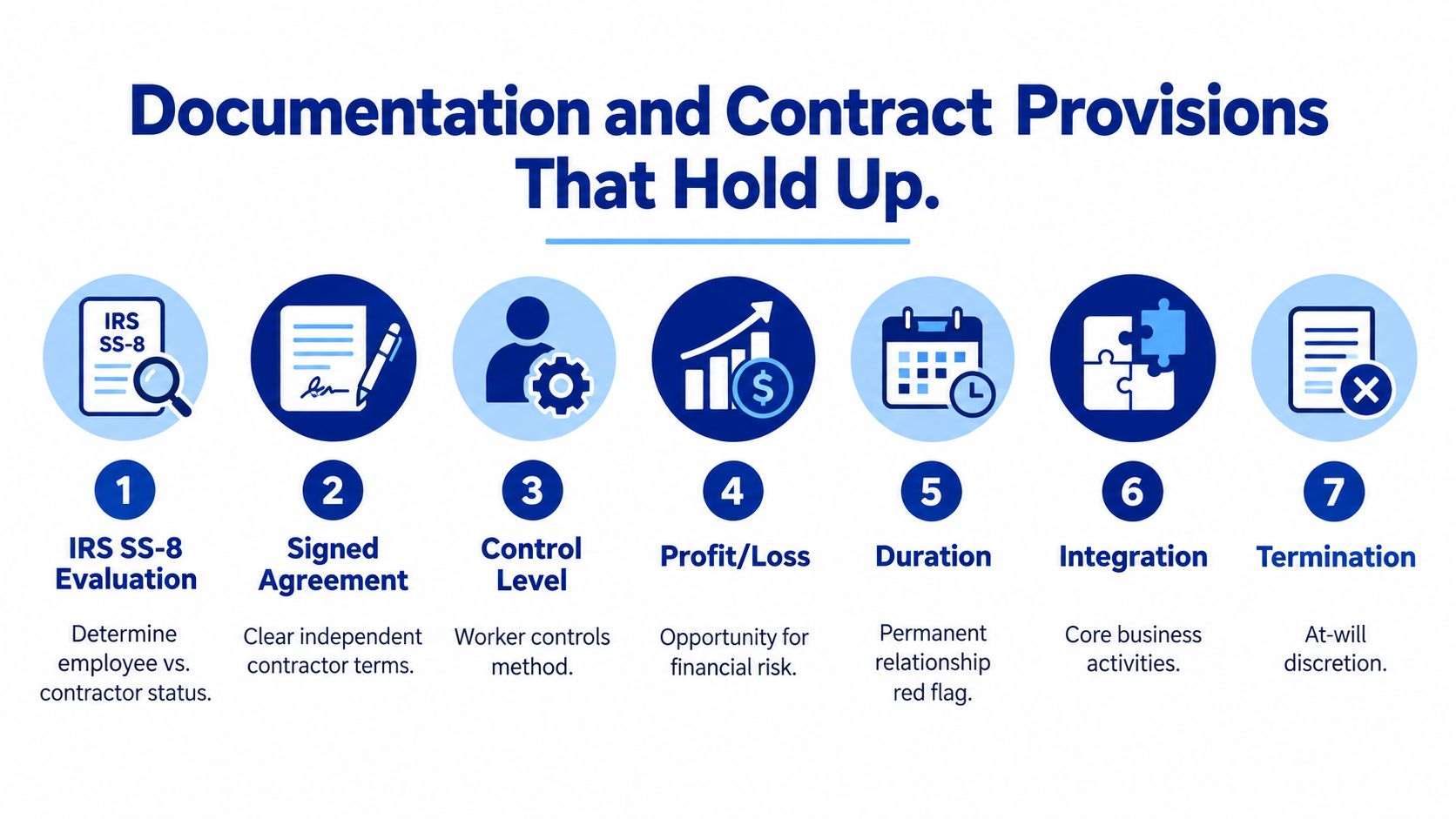
Write the agreement around deliverables, not a permanent staff role. Tie payment to milestones or accepted work. Assign ordinary business expenses to the contractor and limit company payments to agreed project charges. Include appropriate insurance and workers' compensation flow-down terms, ownership of work product, an indemnification cap, and a right to end the engagement when the project or statement of work ends.
Preserve operational independence in practice. The contractor should control the method and sequence of work, subject to lawful safety, quality, security, and customer requirements. Avoid exclusive-service terms, continuing staff language, and manager authority over every work detail.
Some protective clauses create evidence against the company. An integration waiver does not defeat an economic-realities analysis. Repeatedly renewing the same fixed-term role can suggest employee continuity. Exclusive service can weaken the position that the contractor operates an independent business.
For an exit, use the terminating contractors for SMBs resource to organize notice and records. The termination file should match the agreement, completed scope, payment history, and actual reason the engagement ended. Preserve that consistency across payroll, insurance, operations, and public-contract records.
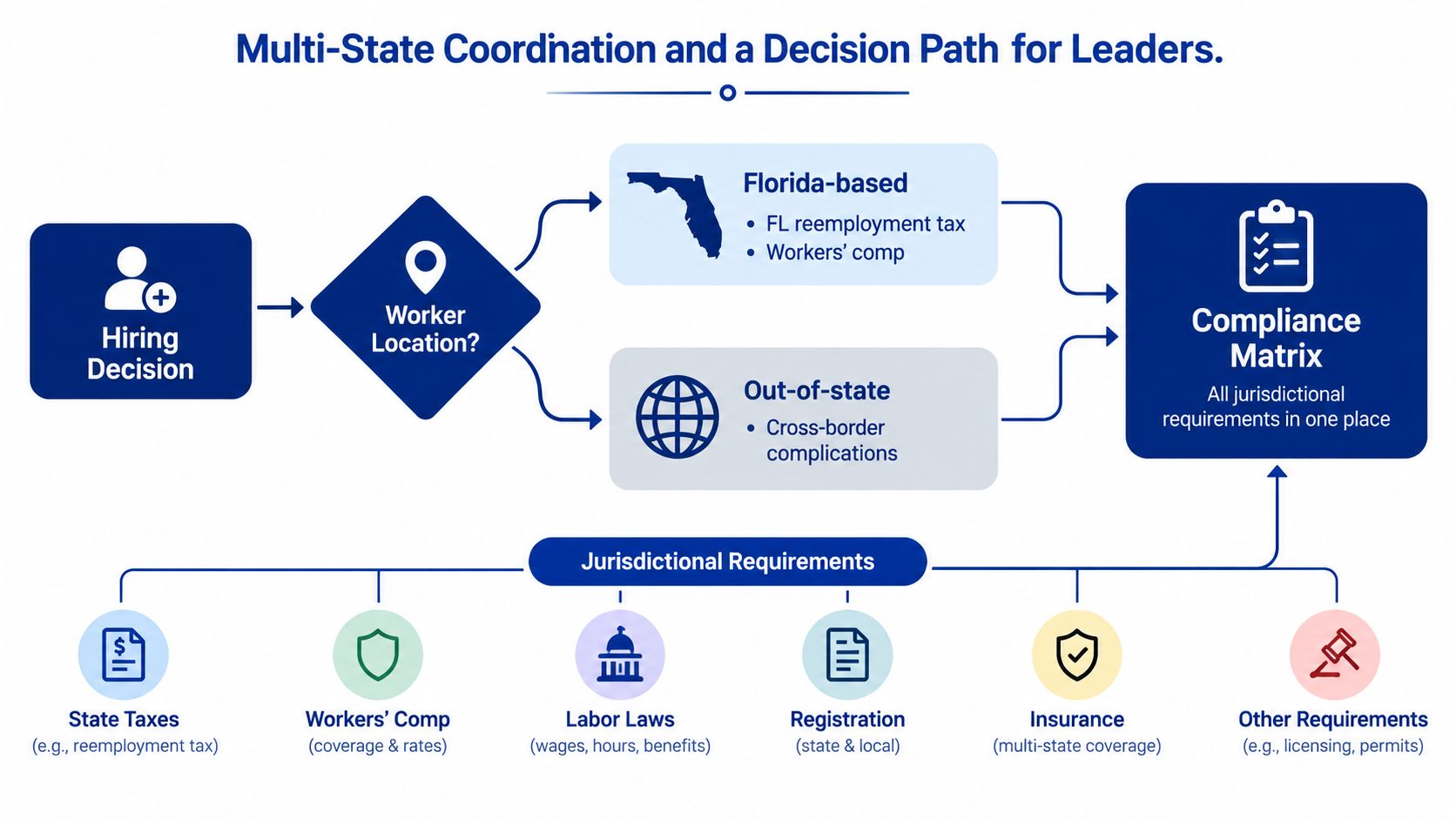
A contractor hired by a company headquartered outside Florida can still trigger Florida reemployment tax and workers' compensation duties. The same person may also create obligations in the state where they live, the state where services occur, or both. State lines do not reduce Florida exposure. They create additional decisions.
Leaders should review contractor relationships quarterly using one documented path. Start with a complete worker inventory. Record every 1099 recipient, the service state, work location, hiring entity, business unit, work type, and payment method. Accounts payable descriptions are not enough. One contractor may use several vendor names or receive payments from multiple subsidiaries.
Then test the relationship separately under each applicable regime. Reemployment tax, workers' compensation, and public-sector or E-Verify rules do not ask identical questions. A worker can qualify as an independent contractor for one purpose and still create employee-related duties under another. Review the facts under Florida reemployment tax, Florida workers' compensation, public-contract requirements, and the laws of every other relevant state.
If the record does not support independence, change the classification or redesign the engagement before the next assignment. Do not let a signed contract substitute for evidence of how the work is performed.
Reconcile operational duties by state. Confirm licensing, insurance, workers' compensation records, tax reporting, and E-Verify requirements. Public work requires separate review because Section 448.095 can impose contractor and subcontractor compliance duties that a private project may not trigger.
Document each remediation decision with its effective date, responsible owner, affected systems, and communication plan. Update payroll, insurance, contracts, vendor records, and manager instructions together. The Paradigm International handbook guide can help coordinate state employment policies with the contractor review.
Leadership decision: If the relationship is central to the business, closely supervised, and economically dependent, treat those facts as the starting point for remediation.
Florida contractor employment laws reward documentation only when the records match actual operations. The company supports owners, COOs, and HR leaders with reviews of classification, documentation, multi-state compliance, and related employment risk. Visit Paradigm International Inc. to discuss a contractor compliance review before an audit or public contract.