A restaurant owner reviews payroll on Monday and sees a familiar pattern. Several servers worked long shifts, a supervisor covered the floor, and one employee split time between serving customers and performing non-tipped tasks. The payroll system processed the hours, but no one verified whether tips reached the required minimum or whether overtime reflected the correct rate.
That routine can create a wage claim even when the owner intended to pay everyone correctly. For Florida SMBs, defensible compliance depends on more than updating a wage table. It requires accurate classification, weekly overtime controls, reliable tip-credit calculations, and records that explain how every paycheck was built.
A small payroll error rarely stays small. If a business misclassifies a salaried coordinator, ignores time worked before opening, or applies the wrong rate to tipped overtime, the same mistake can affect every comparable pay period and employee. The exposure comes from the process, not from whether the employer acted in good faith.
Florida's system creates a particular challenge because it combines a constitutional minimum wage framework with federal overtime rules. Owners often look for a single Florida rulebook, but most private-sector overtime questions are answered through the federal Fair Labor Standards Act, or FLSA. That split makes informal practices dangerous. A manager may understand the state wage rate but still miss the federal requirements for hours worked, exemptions, or overtime calculations.
Multi-role employees create another common fault line. A restaurant employee may serve tables, clean equipment, receive deliveries, and perform administrative work in the same week. A service company supervisor may cover an hourly shift while also managing staff. If the payroll system uses one job code or one rate without reviewing the work performed, the employer may struggle to prove that pay was calculated correctly.
Management standard: If you can't reconstruct the employee's hours, pay basis, rate, tips, deductions, and overtime from your records, your payroll process isn't defensible.
Weak timekeeping also creates risk through off-the-clock work. Employees may answer messages before clocking in, close a location after clocking out, or work through an unpaid break. A policy that prohibits such work doesn't erase liability if supervisors tolerate it or if the timekeeping system makes accurate reporting difficult.
Owners should treat a wage review as an operational control, not a paperwork exercise. The Florida HR compliance guide can support broader policy planning, but wage and hour decisions still need direct attention to payroll data and daily management practices.
This guide focuses on the decisions that matter most: how Florida's constitutional wage structure interacts with federal overtime, how to test exempt classifications, how tipped pay works during the 2026 transition, and how to build records that support your position if an employee challenges pay.
Florida wage and hour compliance becomes easier once you separate the framework into two layers.
Florida's modern minimum wage structure began with a voter-approved constitutional amendment adopted in 2004. Voters later approved Amendment 2 in November 2020, with 60.8% of the vote, creating a scheduled path from $10.00 per hour in 2021 to $15.00 per hour on September 30, 2026, followed by annual inflation indexing beginning in 2027, as summarized in Florida labor law guidance.
The state minimum wage was $14.00 per hour effective September 30, 2025. At that point, the tipped cash wage was $10.98 per hour, reflecting a fixed $3.02 tip credit. Florida is unusual because the employer pay floor is rooted in constitutional policy rather than an ordinary wage statute.
That matters operationally. Payroll teams shouldn't treat the minimum wage as a static number buried in an employee handbook. They need effective-date controls, updated pay tables, and a process for reviewing tipped and non-tipped workers separately.
For most private employers, the FLSA governs overtime. An eligible non-exempt employee must receive 1.5 times the regular rate for hours over 40 in a workweek, as described in Florida wage and hour practice guidance.
Florida generally doesn't require daily overtime or a seventh-day premium. The controlling measurement is the workweek, not the individual day. A worker who performs long shifts but stays at or below 40 hours for the defined workweek won't trigger federal overtime solely because one day was lengthy.
Florida also has no general private-sector meal-break mandate for adult employees, no general final-pay deadline, and no private-sector wage-statement rule under the commonly applied framework. Those gaps don't give employers permission to keep poor records or delay pay without reviewing contract, policy, or federal requirements.
One older provision remains relevant in narrow circumstances. Section 448.01 treats 10 hours as a legal day's work for certain manual laborers unless a written contract sets different daily hours, an older state-law relic that can complicate analysis for specific roles.
The practical model is simple: Florida sets the wage floor, federal law usually supplies the overtime rules, and the employer must apply both through consistent payroll controls.
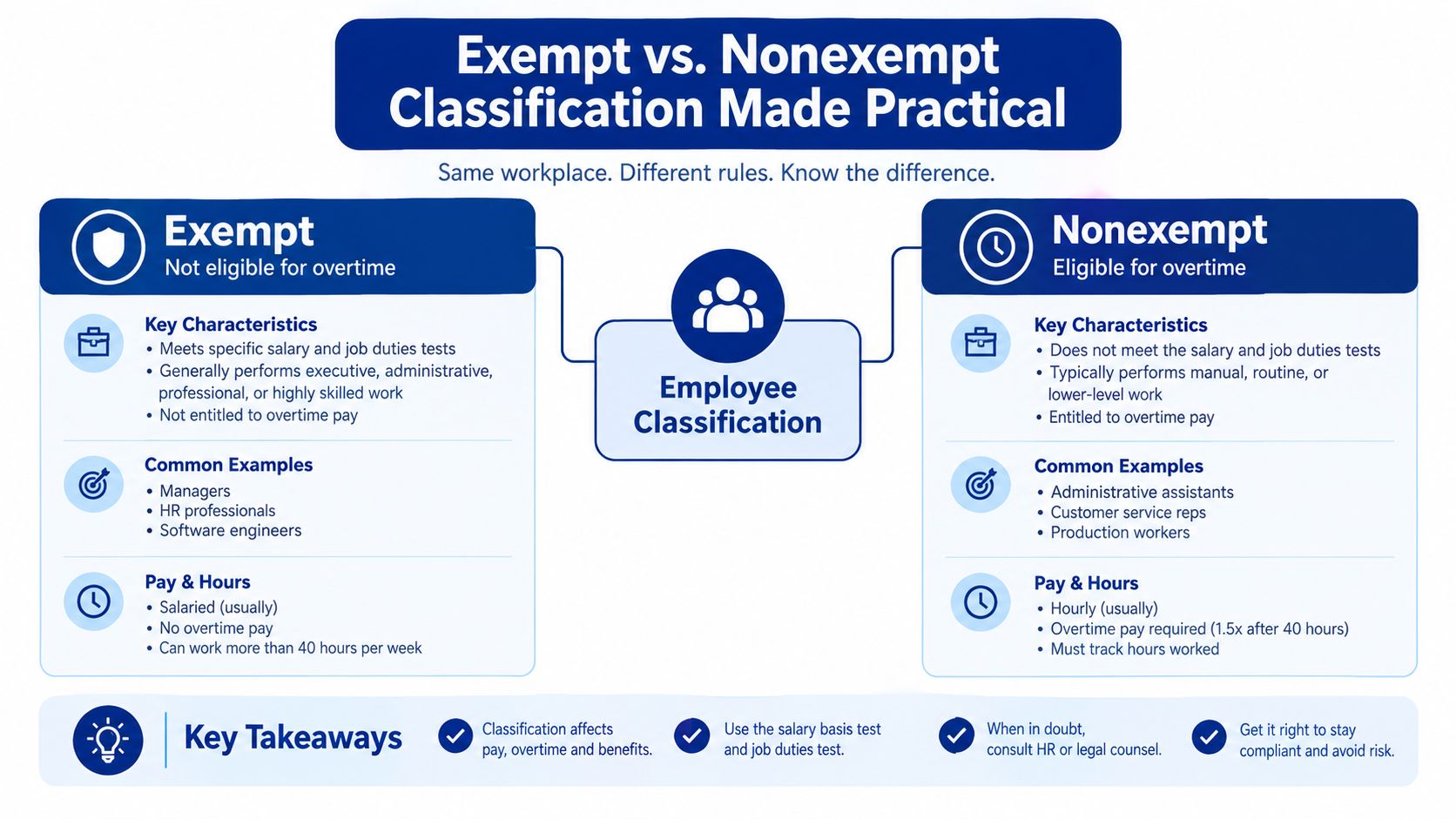
Classification determines whether the business must track hours and pay overtime. The mistake to avoid is treating “salary” as a legal conclusion. A salary is a method of payment. It doesn't automatically make an employee exempt.
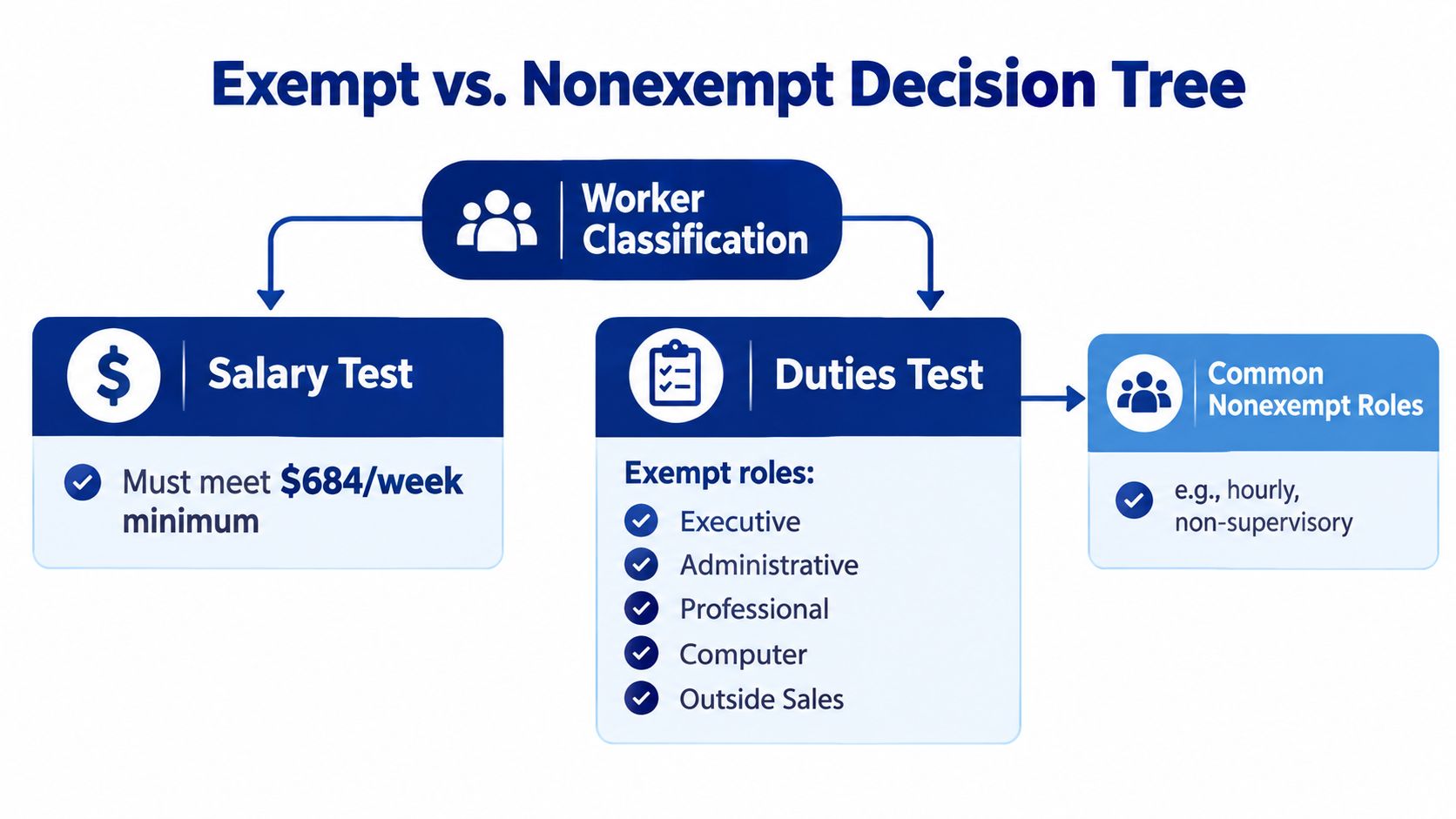
Florida employers apply federal exemption standards. The analysis generally requires both a salary-basis requirement and a duties test. The salary threshold is $684 per week, or $35,568 annually, and the employee must satisfy the applicable duties requirements, as outlined in Florida wage and overtime guidance for employers.
| Question | Exempt analysis | Nonexempt analysis |
|---|---|---|
| How is the employee paid? | The employee generally must meet the salary-basis floor. | The employee may be paid hourly, by salary, commission, or another method. |
| What work does the employee perform? | The primary duties must fit an applicable exemption. | The work doesn't meet an exemption, so overtime rules apply. |
| Does the title decide status? | No. “Manager” or “coordinator” isn't enough. | Actual duties control the result. |
| What happens above 40 hours? | No overtime only if the exemption is valid. | Overtime is generally due at 1.5 times the regular rate. |
The duties review should focus on what the employee does, not what the job description says. Executive, administrative, professional, computer, and outside-sales exemptions each have distinct requirements. A supervisor who spends most of the week performing the same production or service work as non-supervisory staff may not qualify because the company calls the role "manager."
Start with the employee's actual weekly responsibilities. Review schedules, workflow, decision authority, supervision, discretion, and the proportion of time spent on routine production work. Then compare those facts with the applicable federal exemption requirements.
For each salaried employee, keep a written classification memo that identifies:
A classification error can create back-pay exposure for all hours over 40, including hours worked by a salaried employee who was incorrectly treated as exempt. That makes weekly review important. Payroll should flag unusual hours, repeated schedule extensions, and employees whose actual work has changed since hiring.
For a practical comparison of the decision points, review how to classify employees. Don't wait for a complaint to test classifications. A role that was defensible when created may no longer match the employee's current duties.
Florida's wage transition requires payroll teams to handle two separate questions. First, did the employee receive at least the full minimum wage after direct wages and allowable tips are combined? Second, if the employee worked more than 40 hours, did the employer calculate overtime from the correct regular-rate foundation?
The state minimum wage was $14.00 per hour effective September 30, 2025, while the tipped cash wage was $10.98 per hour. The difference is the fixed $3.02 tip credit, not a waiver of the full minimum wage. The employer must ensure that direct wages plus qualifying tips reach the full state minimum wage. If they don't, the employer owes the shortfall.
On September 30, 2026, the full minimum wage rises to $15.00 per hour, and the tipped cash wage rises to $11.98 per hour, while the $3.02 tip credit remains fixed, according to U.S. Department of Labor tipped-wage guidance.
Overtime is calculated from the full minimum wage, not the reduced tipped cash wage. For a minimum-wage non-exempt employee, the benchmark is $21.00 per overtime hour through September 29, 2026, then $22.50 per overtime hour after September 30, 2026, based on the federal 1.5-times overtime rule and Florida's scheduled wage increase, as explained in Florida overtime guidance for SMBs.
| Effective Date | Full Minimum Wage | Tipped Cash Wage | Overtime Rate |
|---|---|---|---|
| September 30, 2025 | $14.00 per hour | $10.98 per hour | $21.00 per hour |
| September 29, 2026 and earlier | $14.00 per hour | $10.98 per hour | $21.00 per hour |
| September 30, 2026 | $15.00 per hour | $11.98 per hour | $22.50 per hour |
The table shows why a payroll system must use effective dates rather than changing a rate at the beginning of a calendar year. A pay period can include work performed before and after the change. Your payroll process should preserve the applicable rate for each work date and identify the rate used in the overtime calculation.
Suppose a tipped employee receives the permitted cash wage but tips vary sharply from week to week. The employer can't assume the reduced cash wage is the maximum obligation. If direct wages plus tips don't reach the full minimum wage for the covered work, the employer must pay the difference.
Mixed duties require separate attention. If a worker performs non-tipped tasks, the employer should verify whether the tip credit remains appropriate for the work performed and maintain job codes that show what work occurred. Review tip totals weekly, compare them with hours worked, and document any make-up payment before payroll closes.
Overtime review should also happen weekly. Don't rely on daily totals, shift-manager memory, or a spreadsheet that only records regular hours. The system should identify every non-exempt employee over 40 hours and apply the correct regular-rate logic.
Florida employers often focus on what the law doesn't require, then underinvest in what the employer must be able to prove. Florida has no general private-sector statute setting a final paycheck deadline, and Chapter 448 doesn't impose a standard wage-payment frequency rule for private employers, as summarized in Florida final-pay and wage-payment guidance.
That doesn't make inconsistent payroll timing a sound practice. Set a written pay schedule, apply it consistently, and state how the business handles final wages in policy. A clear internal standard reduces confusion even when Florida law doesn't provide a general deadline.
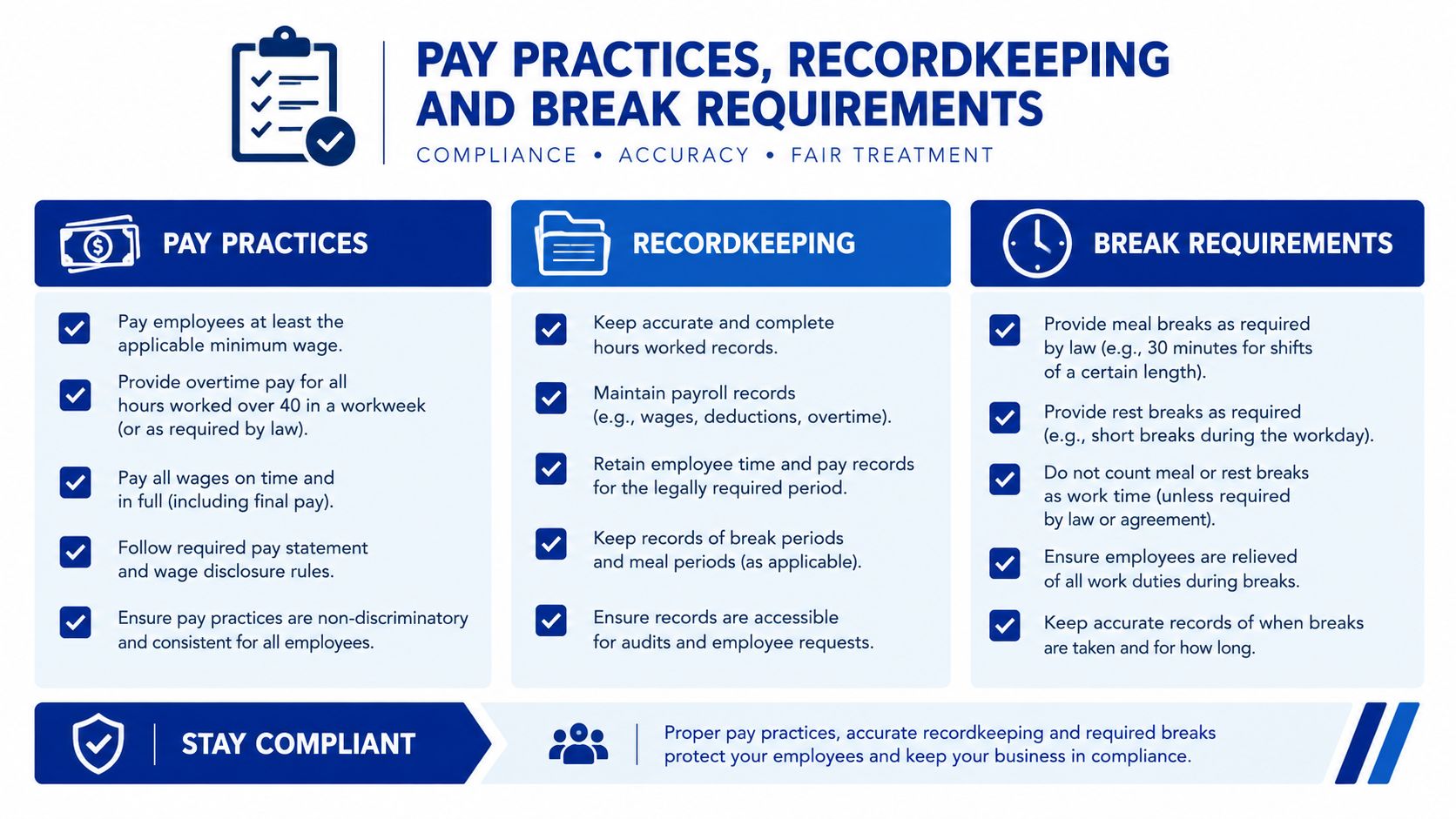
Florida has no general private-sector meal or rest-break mandate for adult employees. Employers may still choose to provide breaks, and once a break policy exists, managers must administer it consistently. If employees work during an unpaid break, the time must be captured and reviewed rather than assumed to be unpaid.
Minors have separate protections. Florida child labor rules require minors not to work more than 4 consecutive hours without a 30-minute uninterrupted break and not to work more than six consecutive days, according to the Florida child labor brochure.
Federal recordkeeping guidance requires employers to maintain information that allows payroll reviewers to reconstruct the pay decision. At minimum, an SMB should be able to identify:
Contemporaneous records are stronger than recreated estimates. A timekeeping system such as QuickBooks Time, Deputy, or a payroll platform with edit histories can help, but software won't fix a policy that permits off-the-clock work. Managers need authority to correct time entries, and each correction should retain the original record, reason, and approval.
Audit question: Can an outside reviewer trace one employee's schedule to time entries, job codes, tips, rate basis, overtime, and final payroll result without asking the employee to reconstruct the week?
Use the guide from Paradigm International when setting broader record-retention standards. The immediate wage and hour priority is consistency. Keep schedules, time records, payroll registers, tip reports, classification decisions, and correction approvals connected.
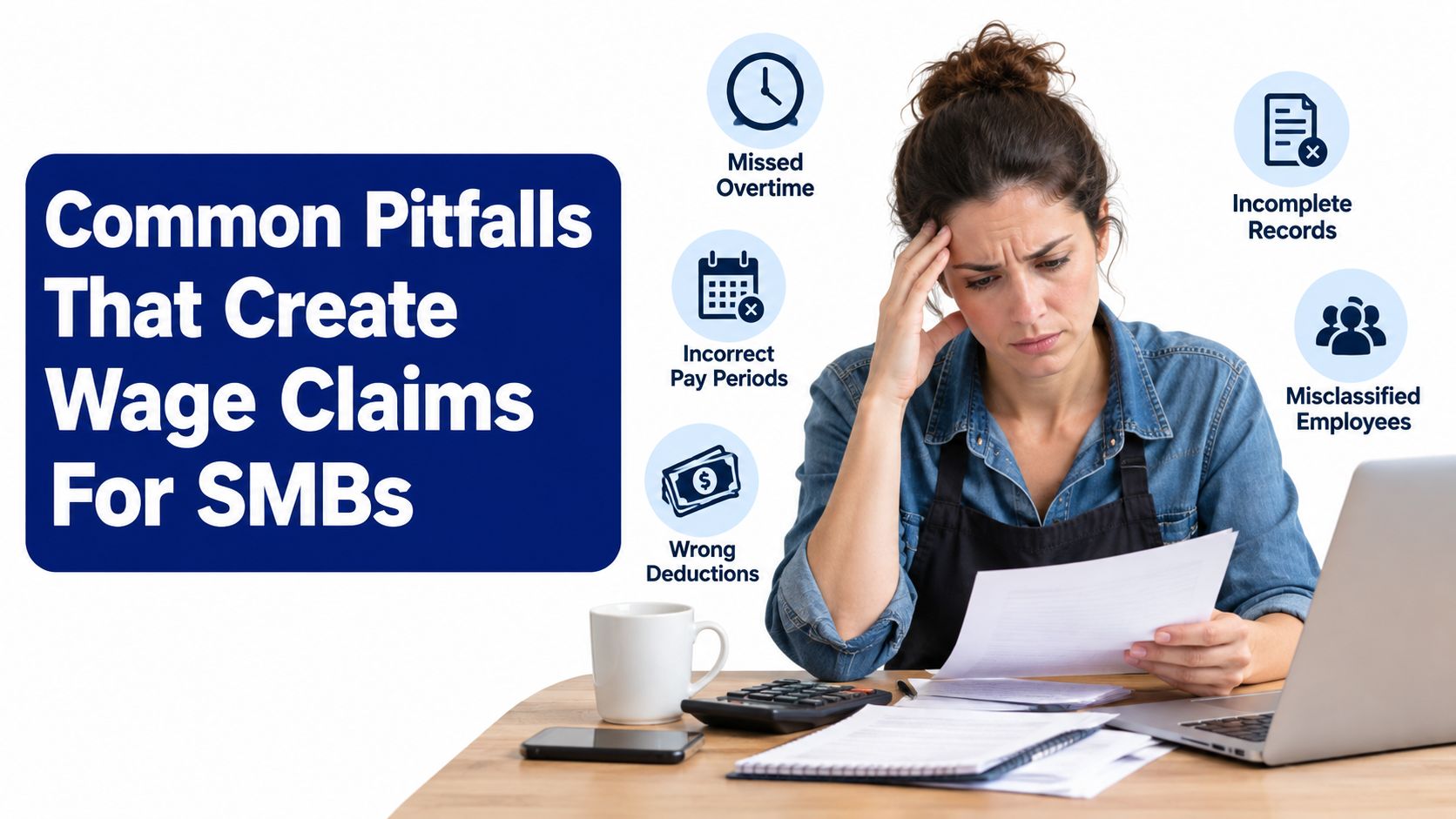
Most wage claims don't begin with an owner deliberately withholding pay. They begin with a workflow that nobody examined closely. The same employee works different roles, supervisors make informal schedule changes, and payroll receives incomplete information.
A server may perform customer service, cleaning, stocking, and closing duties. A manager may cover a service shift during a staffing shortage. A technician may perform administrative tasks that don't match the job code used for payroll. If the business treats every hour as identical without reviewing duties and tip-credit treatment, the records may not support the pay decision.
The solution is not to create unnecessary complexity. Use job codes that distinguish tipped and non-tipped work where relevant, train supervisors to record role changes, and review employees who regularly move between roles. A weekly exception report can identify unusual combinations before they become a pattern.
A written rule is useful, but it isn't enough. If a supervisor expects employees to finish closing tasks after clock-out, or if an employee routinely answers work messages before clocking in, the employer needs to correct the practice and capture the time.
Weak records make a compliant pay structure difficult to defend. Federal recordkeeping expectations include daily and weekly hours, pay basis, regular rate, overtime premium, and deductions or additions, as described in Florida payroll compliance guidance. A payroll register without reliable time records leaves too many unanswered questions.
The September 30, 2026 increase to the full minimum wage and tipped cash wage creates a predictable setup risk. A business may update the base rate but fail to update overtime, tip-credit review, job codes, or manager instructions. In a high-turnover operation, the same configuration error can affect many shifts before anyone notices.
Build a transition checklist around the effective date:
A complaint involving one employee may reveal a broader process issue. Get advisory help when the business receives a written wage complaint, discovers recurring off-the-clock work, questions a manager's exemption, or finds that tips and direct wages didn't reach the required minimum. Early fact development is more useful than a rushed response after records have been overwritten or schedules discarded.
A defensible system gives owners repeatable answers. It doesn't depend on one payroll specialist remembering a rule or one manager interpreting a shift correctly.
Use this operating checklist:
International Inc. can support this work through Florida and federal handbook development, wage and hour compliance audits, payroll and timekeeping reviews, and guidance on overtime, hours worked, and recordkeeping.
Paradigm International Inc. helps owners, COOs, and HR leaders build defensible wage and hour practices through compliance audits, handbook development, and practical advisory support. Visit Paradigm International Inc. to discuss how to review your Florida payroll controls before the 2026 wage transition.