You usually don't get a clean warning before fraternisation turns into a leadership problem. You get a complaint about a skipped schedule rotation, a manager suddenly recusing themselves from a review, or a team member saying the relationship in the department is why nobody trusts the process anymore. At that point, the issue is no longer personal. It's a governance failure, and the COO sitting on it needs a defensible response fast.
The mistake most leaders make is treating workplace relationships as a private matter until the file is already messy. That is too late. Once a relationship touches supervision, pay, performance, scheduling, promotion, or discipline, it stops being just a relationship and becomes a risk to decision credibility, documentation quality, and team trust.
That is why fraternisation in the workplace belongs in the same conversation as manager accountability, conflict handling, and investigation discipline. You are not trying to police who likes whom. You are trying to keep authority from being used, or appearing to be used, to benefit one person over another. The moment peers start asking why one employee gets flexibility, softer feedback, or better opportunities, the damage has already started.
Practical rule: If the relationship can affect a work decision, treat it as a leadership issue immediately.
The historical record makes the policy gap obvious. A 2005 survey found that 40% of employees had been involved in a workplace romance, yet over 70% of firms still had no formal written or verbal policy, and only 9% prohibited dating outright. In the same research stream, only 18% of HR professionals in an SHRM/WSJ 2005 poll said their firm had a written workplace romance policy, according to the URI research summary on workplace romance policy design, which is available here.
That mismatch still matters. Employee behavior has never matched employer governance neatly, and when leaders ignore that reality, they end up improvising under pressure. A better approach is simple, written, and specific, with rules for disclosure, recusal, reassignment, and follow-through. If you need the management side of that structure, start with manager accountability and build the relationship rule around it.
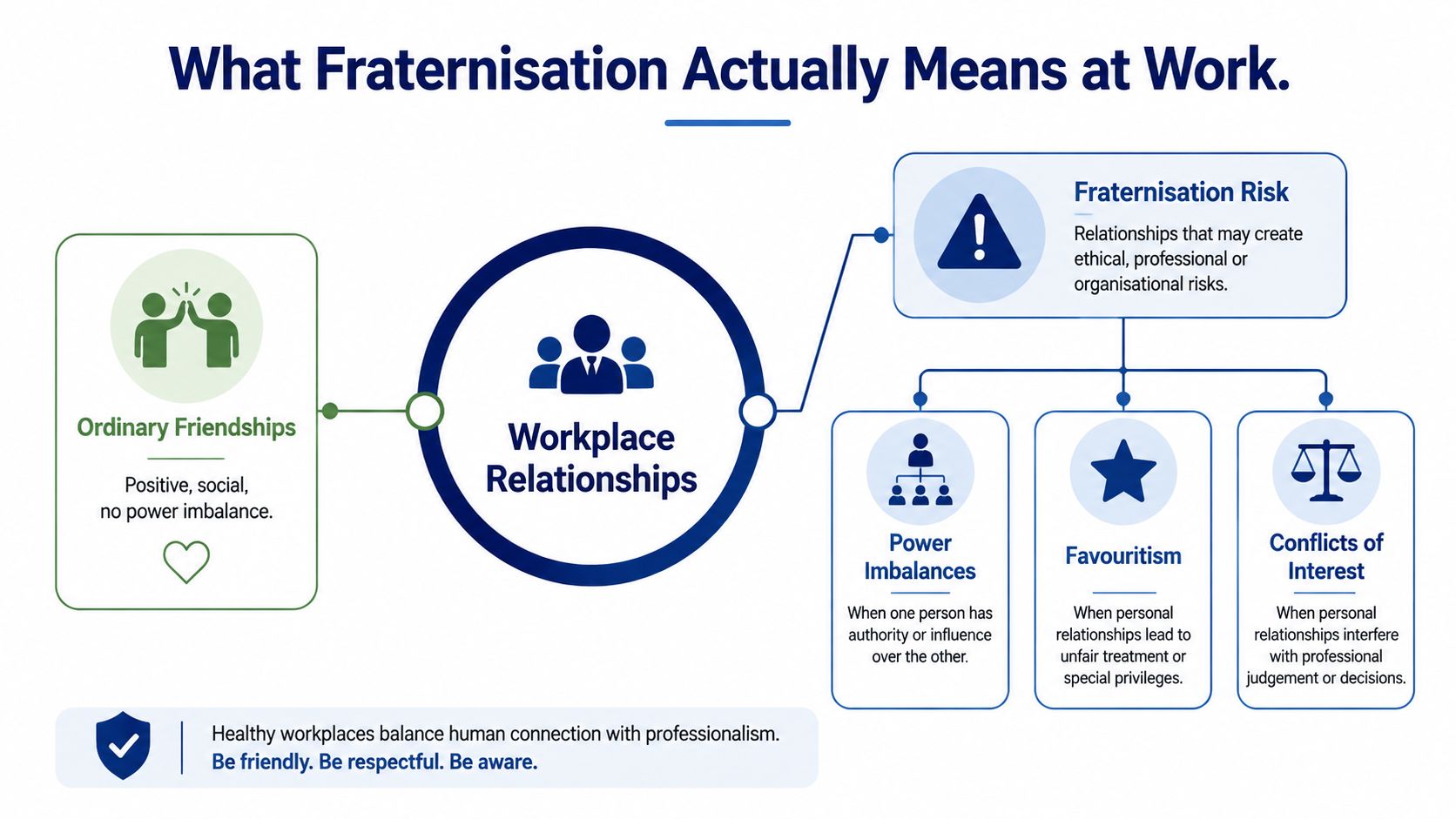
Fraternisation is the point where a personal relationship starts to intersect with workplace authority in a way that can distort decisions or create the appearance of distortion. It is not ordinary friendship, and it is not the same thing as harassment. Leaders need to use a definition that centers on power asymmetry, because that is where the exposure begins.
A policy should care less about whether two adults are dating and more about whether one of them can influence the other's work life. If one employee can affect another's hiring, compensation, review, promotion, discipline, assignment, or schedule, that relationship belongs in the high-risk bucket. That is the line that matters, because the risk comes from decision power and proximity, not gossip.
The same logic separates fraternisation from conflict of interest. Conflict of interest is the broader governance problem, the one that covers any situation where personal ties can compromise impartial judgment. Fraternisation is the relationship form that often creates that conflict in the first place. Harassment is different again, because it turns on unwelcome conduct, coercion, or hostile treatment, not just on the existence of a relationship.
Use narrow, behavior-based categories. The strongest policies focus on spouses, cohabitants, significant others, close family members, and intimate or romantic relationships only where those ties create decision risk. That is much more defensible than a blanket “no dating” rule that treats every personal relationship as a threat.
A useful internal standard is this: if the relationship does not touch a decision point, it may be socially awkward, but it is not necessarily a policy violation. If it does touch a decision point, the employer needs a disclosure path and a remediation plan. That distinction keeps the rule operational instead of theatrical.
One more thing matters. Overbroad “no fraternisation” language can be read too broadly, even to the point of interfering with ordinary employee conversations. Workplace Fairness discusses a case where a fraternising policy could reasonably be read to restrict employees from talking about working conditions, which is exactly why vague blanket language is a bad idea, as noted here. Narrow rules win because they target the actual risk and leave lawful workplace communication alone.
A relationship problem usually lands in three buckets, and the right response depends on which one is most acute. Leaders who only see “dating” miss the full exposure. The actual issue may be legal, reputational, or operational, and those are not interchangeable.
Legal exposure is strongest when the relationship affects promotions, raises, shifts, schedules, discipline, or other benefits. The Hofstra journal article on paramour favoritism notes that benefits such as promotions, raises, better facilities, and shifts can support a claim if they are tied to a relationship, and repeated favoritism by the same supervisor can strengthen a third-party claim, as discussed in this journal article. That is the sort of fact pattern that turns a private relationship into a legal dispute.
A secret supervisor-subordinate relationship is especially dangerous because it can trigger favoritism complaints and, if the relationship ends badly, harassment allegations. Employers are allowed to require disclosure of a romantic relationship with a subordinate, and refusal to answer can justify discipline if it prevents the employer from determining whether a policy was violated, according to Vigilant's employment law guidance, available here.
Reputational damage usually shows up as distrust. Co-workers notice when one person seems protected or when the same manager keeps getting a pass. Once that perception takes hold, you don't just have one relationship problem. You have a credibility problem across the department.
Operational problems are the easiest to see and the easiest to dismiss, which is why leaders misread them. Coverage gaps, awkward schedule swaps, team tension, and inconsistent discipline all eat at productivity. If a manager's judgment is questioned, even routine coaching starts to feel partisan.
Document the observable facts, not office speculation. If you can't defend the file later, you didn't document it well enough.
ADP's People at Work 2024: A Global Workforce View surveyed more than 34,000 workers across 18 countries and found that 62% believed evolving workplace norms and personal relationships significantly affect team dynamics and productivity, according to the reporting summarizing that survey, here. That doesn't tell you what happened in your company, but it does confirm that employees are watching team dynamics closely. If you want to know which risk matters most in your organization, start by asking whether the complaint is about bias, backlash, or breakdowns in daily work.
The right response depends on who has power over whom and where the relationship sits in the business. A peer relationship in a low-stakes setting is not the same thing as an owner-employee relationship or a vendor tie that can influence spending. Good policy should sort those relationships by risk, not panic.
Use this mental split:
The important point is that not every relationship needs the same remedy. A low-risk peer relationship may need nothing more than awareness. A high-risk reporting relationship needs action right away. That's why policies tied to decision points are more usable than policies built around moral language.
A leader should be able to answer three questions within minutes. Who has authority, who can influence the outcome, and what decision points are exposed? If those answers are unclear, the employer needs to gather facts before anyone starts making promises.
The Harvard Law School Forum on Corporate Governance notes that anti-fraternization policies are most defensible when they are narrowly focused on actual risks, especially supervisor-subordinate relationships and conflicts of interest, as explained in this article. That is the model to follow. Precision beats blanket prohibition every time.
A defensible fraternisation policy is narrow, specific, and tied to actual workplace decisions. Vague language like “be professional” sounds good in a handbook and fails in a dispute. You need rules people can understand, managers can apply, and investigators can defend.
Define the covered relationships with precision. Good categories include spouses, cohabitants, significant others, close family members, and intimate or romantic relationships. Then connect those categories to actual decision points, such as recruiting, pay changes, performance management, staffing, scheduling, or vendor selection.
That structure does two things. It tells employees what must be disclosed, and it tells managers what they must not handle. It also separates low-risk social contact from high-risk influence structures, which is exactly where many policies go wrong.
Here is sample policy language that works better than a blanket ban:
Employees must disclose any romantic, intimate, or close personal relationship that could create a conflict of interest, reporting concern, or appearance of favoritism.
A covered employee may not participate in hiring, pay, performance, discipline, scheduling, assignment, or vendor decisions involving the other person.
Failure to disclose a covered relationship may result in corrective action, up to and including separation from the decision process or discipline for policy violation.
Once disclosure happens, the employer should already know the menu: recusal, temporary reassignment, reporting-line change, or, in rare cases, separation of authority. That's the practical difference between a serious policy and a decorative one.
A relationship policy should also point readers to the broader handbook rules that support it, including documentation, impartiality, and manager conduct. If your current handbook is thin on those supports, mandatory employee policies belong in the same cleanup project.
| Relationship Type | Risk Tier | Minimum Control |
|---|---|---|
| Peer-to-peer with no authority | Lower | Monitor and disclose if decisions may be affected |
| Manager and direct report | High | Immediate disclosure and removal of authority |
| Owner and employee | High | Formal disclosure and recusal from employment decisions |
| Contractor or vendor tie | Medium to high | Disclosure and recusal from procurement or oversight |
| Regulated setting relationship | High | Follow company and outside disclosure rules |
A policy like this is easier to enforce because it tells leaders what to do, not just what to feel. That's the standard that holds up when an employee, lawyer, or regulator asks why the employer acted the way it did.
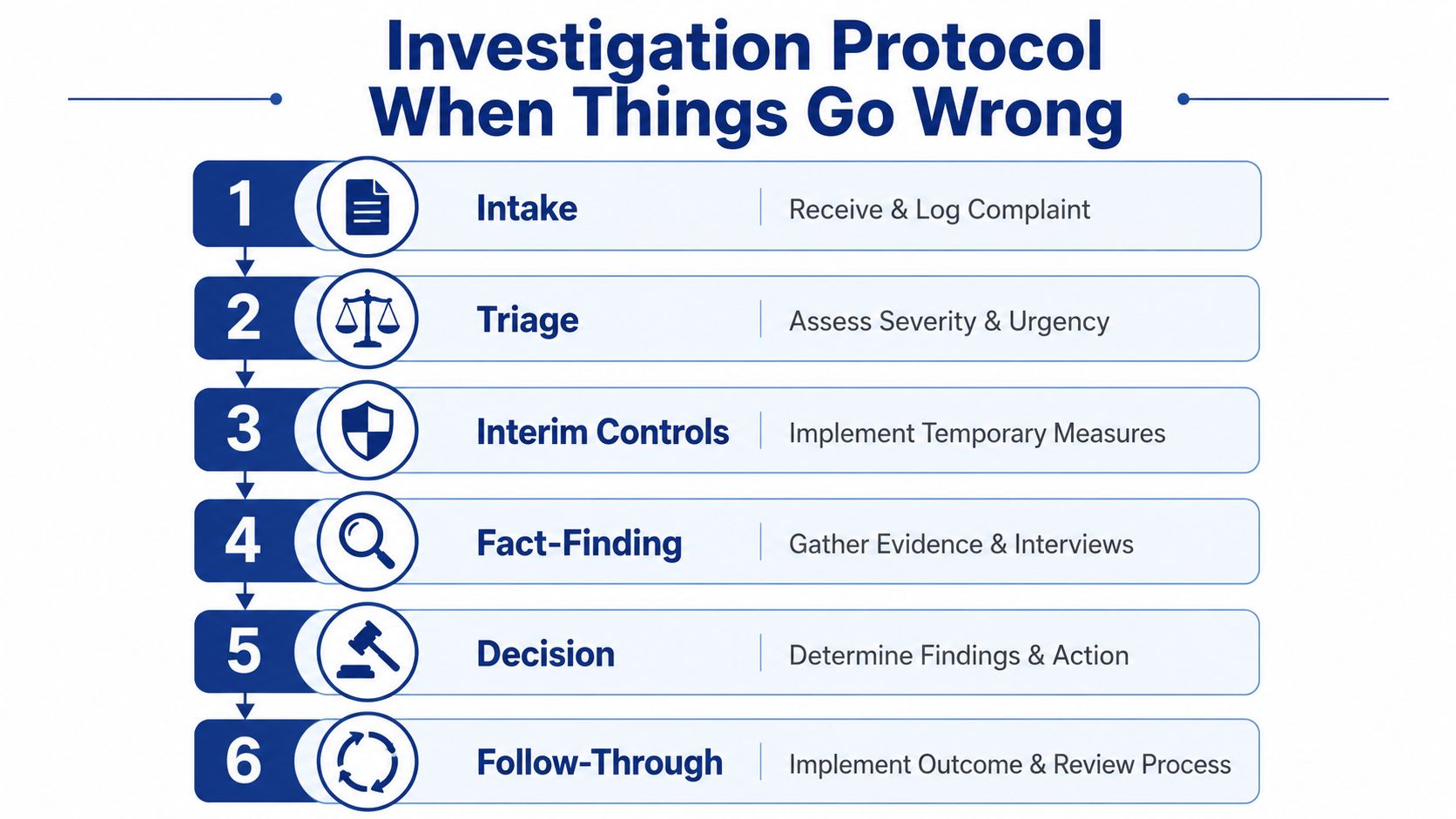
The minute a complaint, disclosure, or rumor lands, the employer needs a clean process. Not a conversation. A process. The file has to show what was known, who handled it, what changed, and why the decision made sense at the time.
Start with intake. Record the allegation or disclosure exactly as it was received, without editorializing. Then triage the risk, meaning you decide whether there's a reporting issue, a retaliation concern, or an active favoritism problem that needs immediate separation.
After that, put interim controls in place. That may mean removing one person from scheduling, pulling review authority, pausing a promotion decision, or moving the matter out of the local chain of command. The goal is to stop the relationship from shaping evidence while the facts are still being gathered.
If you can't explain why the interim control was necessary, it probably wasn't specific enough.
The file should include contemporaneous notes, a witness list, and the exact remediation steps taken. If a manager says they “handled it,” that isn't enough. You want dates, decision owners, and proof that the employer acted promptly and consistently.
The harder issue is what happens after the relationship ends. That's where retaliation complaints, biased discipline, and performance-review disputes usually surface. A broken relationship can leave behind access issues, resentment, and claims that the employer protected one person while punishing the other.
Bring in outside counsel when the matter touches a protected complaint, a high-level employee, a regulated role, or a fact pattern that could turn into litigation. A solid resource on this is PEO Metrics insights on investigations, which is useful because it frames investigations as a documented process rather than an improvised conversation. In-house teams can handle many matters, but they should know when the matter has outgrown local judgment.
The key judgment call is simple. Reassignment can solve a control problem. Discipline is appropriate when there's a policy violation or nondisclosure. Outside counsel comes in when the facts are sensitive enough that the company needs a stronger defensibility layer.
If you need a structured internal workflow, this belongs in your investigation management playbook, not in someone's memory.
A policy that works in one state can create problems in another if you assume the rules travel cleanly. They don't. Privacy expectations, off-duty conduct protections, and the enforceability of blanket no-dating provisions can all differ, which means the handbook has to be reviewed with jurisdiction in mind.
Multi-state SMBs get into trouble when they draft one rule for one office and apply it everywhere without checking local law. The safer approach is to treat the policy as a baseline and then confirm state-specific limits before rollout. If your policy is too broad, it may look strong and still be hard to enforce.
Regulated industries need even more caution. Healthcare, finance, education, and government-contracted work often add conflict, disclosure, or outside-employment rules on top of ordinary company policy. In those settings, the issue isn't just whether two people are dating. It's whether the relationship affects compliance obligations, procurement integrity, patient care, student safety, or public trust.
Before you assume a relationship policy is portable, ask:
Those questions keep the COO from overreacting in one state and underreacting in another. They also keep the company from adopting a policy that sounds firm but collapses when challenged.
The strategic point is straightforward. Multi-state exposure is not a paperwork issue, it's a governance issue. If the company is big enough to operate across jurisdictions, it is big enough to need a policy review before the next complaint arrives.
A written policy isn't a control until managers know how to use it. Training matters because most fraternisation problems become worse when a supervisor tries to “handle it discreetly” and skips disclosure, documentation, or escalation. That is where good intentions turn into evidence gaps.
Train managers to spot power asymmetry, not gossip. They should know when a relationship requires disclosure, when they must step back from a decision, and when they need HR in the room immediately. New-manager onboarding should include the rule, and annual refreshers should repeat it so nobody can claim surprise later.
A short leadership checklist keeps people from improvising under pressure:
The point is not to police personal lives. The point is to protect decision credibility and make sure the employer can defend what it did later.

A strong fraternisation rule is really a decision rule. It tells leaders when to disclose, when to recuse, and when to move authority out of the relationship. If your current policy doesn't do that, it's not ready for the next complaint.
International Inc. helps leadership teams pressure-test HR risk, including relationship policies, investigation playbooks, and multi-state compliance decisions. If you're dealing with a fraternisation issue now, or you want a defensible framework before one lands, visit Paradigm International Inc. and start the conversation with a team that works on the judgment side of these decisions.