Deciding whether to hire full-time or part-time employees is a critical choice for any business.Deciding whether to hire full-time or part-time employees is a critical choice for any business. This strategic decision directly shapes your financial obligations, operational agility, and even your company culture. For growing businesses, the stakes are even higher, as a single misstep can easily lead to costly compliance issues and operational disruption. Getting this right is foundational to building a sustainable and productive team.

This guide provides a solid framework for making this critical decision. It applies at every level of an organization, from frontline staff to executive leadership, as seen in the strategic considerations when evaluating a Fractional CFO vs. a Full-Time CFO. We will explore the nuanced financial, legal, and operational trade-offs to give you the clarity needed to build a productive and compliant team.
Here is a brief look at the core differences:
Choosing between hiring full time or part time is a legal decision, not just a strategic one. The process begins with understanding the definitions that govern each status. While it may seem straightforward, federal and state laws create specific thresholds with significant implications. Misclassification can trigger unexpected benefit obligations and financial penalties.
A common misconception is that the Fair Labor Standards Act (FLSA) provides a clear definition for full-time work. It does not. The most important federal standard comes from the Affordable Care Act (ACA), which sets a firm benchmark for health insurance. For more on how the FLSA governs pay, review our guide on exempt vs nonexempt status.
Under the ACA, an employee is considered full-time if they work, on average, at least 30 hours per week or 130 hours per month. This rule applies specifically to Applicable Large Employers (ALEs), which are companies with 50 or more full-time equivalent employees. If your business falls into this category, you are required to offer affordable, minimum-value health coverage to your full-time staff or risk substantial penalties.
That 30-hour benchmark is a hard line for benefits compliance. Allowing a "part-time" employee to consistently exceed that threshold without offering benefits can create a serious compliance issue.
For statistical purposes, the federal government generally considers anyone working fewer than 35 hours per week a part-time employee. Part-time roles constitute a significant portion of the U.S. workforce, offering flexibility that supports the economy. While full-time employment numbers are larger, reliance on part-time staffing remains a key economic driver. Discover more insights on U.S. employment trends on TradingEconomics.com.
Federal regulations are only the start. States often have their own definitions that affect paid sick leave, unemployment eligibility, and other benefits. For example, a state might require employers to offer paid sick leave to anyone working more than 20 hours a week. It is crucial to check the regulations in every state where you have employees.
To maintain clarity and consistency, your business must establish its own internal definitions for full-time and part-time status. These definitions should be clearly documented in your employee handbook and must comply with all applicable laws.
Your internal policy should clearly state:
Establishing these definitions is the first step toward building a defensible workforce strategy. Without this foundation, managing your team and ensuring compliance becomes much more difficult.
If you need help creating clear and compliant employment policies, our team can help you build the right framework for your business. You can learn more by contacting us for a consultation.
Classifying an employee as full-time or part-time impacts more than just scheduling; it determines your financial and legal responsibilities. This single decision shapes your total labor costs, benefits administration, and overall risk profile. A smart and defensible workforce strategy depends on getting this classification right.
Each status carries a different weight under wage and hour laws. The Fair Labor Standards Act (FLSA) requires overtime pay for any non-exempt employee working over 40 hours in a week, regardless of their status. However, full-time schedules naturally bring employees closer to that threshold, making diligent time tracking essential to prevent unexpected overtime costs.
The most significant compliance difference between full-time and part-time staff is benefits eligibility. This is where federal and state laws create clear distinctions that can have serious financial consequences. The Affordable Care Act (ACA) is the primary example, and its requirements leave little room for interpretation.
The ACA sets non-negotiable thresholds for who qualifies as a full-time employee for health insurance purposes.
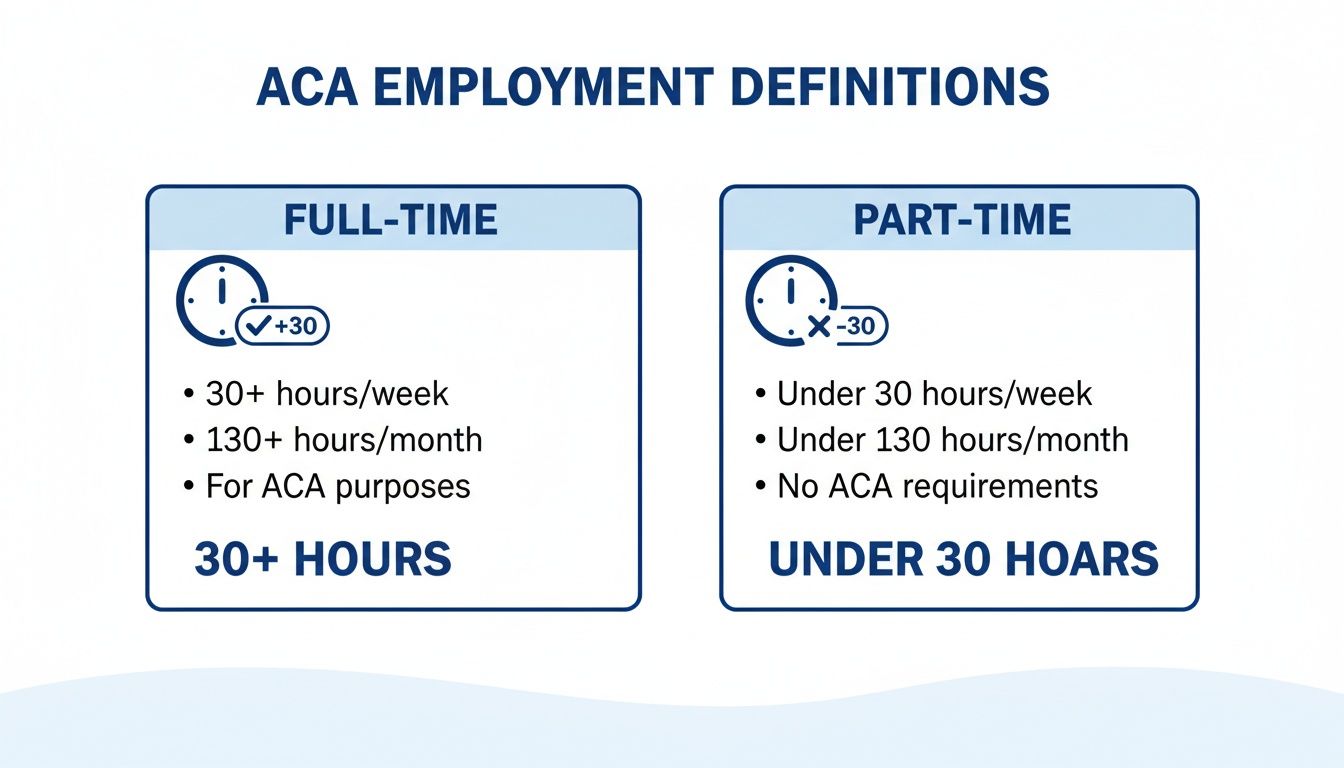
This distinction is critical. If you are an Applicable Large Employer (ALE), you must offer qualifying health coverage to anyone averaging 30 or more hours per week. Failure to comply can result in significant penalties.
Beyond healthcare, other legally required leave benefits often depend on hours worked. For example, the federal Family and Medical Leave Act (FMLA) requires an employee to have worked at least 1,250 hours in the previous year to be eligible. While some dedicated part-time employees may reach this threshold, it is a standard most full-time employees meet easily.
State laws also play a key role. Many states have their own paid leave laws with lower eligibility thresholds, so it is essential to know the local rules. Understanding specific entitlements like statutory sick pay for part-time workers is non-negotiable for accurate budgeting and legal compliance.
Your payroll tax burden also changes based on employment classification. While you pay FICA, FUTA, and SUTA taxes for all employees, the total amount is tied directly to their wages. Since full-time employees earn more annually, your total tax contributions will be higher.
Workers' compensation is another key variable. Premiums are calculated based on your total payroll and the job's risk classification. A larger full-time workforce leads to a higher payroll, which typically results in higher insurance costs.
Inconsistent pay practices for full-time and part-time staff in similar roles can create internal equity issues. We explore these challenges further in our post on what is pay compression and its impact on your team.
To clarify these critical distinctions, here is a side-by-side comparison of your primary obligations.
The table below provides a high-level overview of the key responsibilities for full-time versus part-time employees, highlighting the most important compliance checkpoints.
The financial and legal ripple effects of this classification are significant. Each obligation requires careful management to ensure you are both compliant and making financially sound decisions for your business.
Your staffing model is a direct reflection of your company's strategic goals. The decision between hiring full-time or part-time employees is not about finding one right answer. Instead, the optimal mix is driven by your unique operational needs and long-term ambitions.
Full-time employees often form the stable core of a business. They bring consistency, build deep institutional knowledge, and are typically more integrated into the company culture. This makes them the ideal choice for mission-critical roles that require unwavering focus and long-term commitment.
Part-time employees, on the other hand, offer crucial flexibility. They allow you to scale your workforce to meet fluctuating demand, cover peak operational hours, and manage labor costs with greater precision. This agility is a significant asset in industries with cyclical or unpredictable workflows.
The most effective workforce strategies often blend both models. The key is to analyze specific business functions and assign the employment status that best supports that function's goals. This requires a more nuanced approach than simply choosing one classification over the other.
Consider these real-world examples:
The goal is to build a blended model where each employee classification serves a distinct, strategic purpose, creating a workforce that is both resilient and cost-effective.
Aligning your team means looking beyond immediate needs to anticipate future challenges and opportunities. Global labor markets are constantly shifting, and these changes influence how businesses should structure their teams. Recent trends show a move towards more flexible arrangements, but this also introduces new compliance challenges for employers.
For instance, sectors like healthcare and food services have long relied on part-time staff to manage variable demand. However, multi-state operators must now navigate a complex web of differing regulations, such as state-specific ACA thresholds, to avoid significant fines.
This global context underscores the importance of a deliberate strategy. A business expanding into new states must be aware of local laws that could completely change how it classifies and manages its part-time workforce. For businesses operating internationally, these considerations become even more complex.
Ultimately, your workforce structure should be a tool for achieving your business objectives. A well-designed model provides the stability needed for core operations while retaining the flexibility to adapt to market shifts. However, this requires a clear understanding of the trade-offs involved.
A team of primarily full-time employees offers stability but can lead to high fixed costs and less agility. Conversely, a heavily part-time workforce may reduce costs but could result in higher turnover and a loss of institutional knowledge. The most successful businesses find the right balance for their specific situation.
By carefully analyzing each role and its contribution to your company's goals, you can design a workforce that is efficient, compliant, and perfectly aligned with your vision for growth.
If you need guidance on designing a workforce strategy that minimizes risk and supports your objectives, our team can help you make these critical decisions with confidence. Please get in touch with our team.
Operating across state lines transforms the choice between full-time or part-time staff into a complex compliance puzzle. A policy that is compliant at your headquarters could create legal risk in another state. Laws governing minimum wage, paid sick leave, and scheduling vary so dramatically that a centralized yet flexible approach is essential for responsible growth.
The goal is to build a core compliance framework that sets a consistent standard for your company while allowing for necessary, well-documented local adjustments.
The lack of uniformity in state employment law is a major challenge for multi-state employers. One state might define full-time for benefits eligibility at 32 hours, while another adheres to the federal ACA standard of 30 hours. These small differences have direct financial and legal consequences.
Paid sick leave mandates are another significant point of divergence. An employee in one state might begin accruing paid sick leave on their first day, while an employee in another state could face a 90-day waiting period. Managing these conflicting rules requires meticulous tracking and systemization. Our guide on remote worker compliance for multi-state businesses offers a deeper look at building these critical systems.
Focus on key areas where laws frequently differ:
The most effective way to manage these variables is to create a unified policy that meets the requirements of the strictest location where you operate. This "high-water mark" strategy simplifies administration by setting one consistent standard for all employees, regardless of their location.
By standardizing policies to the highest legal requirement, you reduce administrative complexity and minimize the risk of accidental non-compliance. This approach creates a defensible and consistent employee experience.
This strategy is even more relevant in the context of global employment trends. Across the European Union, for example, part-time work constituted 17.1% of the workforce in 2024, but rates vary widely between countries. While nations like Switzerland and the Netherlands have high part-time rates, others like Bulgaria report just 1.5%. These variations highlight the need for robust, adaptable compliance strategies. Read the full analysis of European part-time employment trends.
Of course, a high-water mark approach is not always financially feasible. If that is the case, your employee handbook must clearly outline state-specific addendums. This ensures policies are applied correctly based on an employee’s work location, providing clarity for your team and a solid paper trail for compliance.
If you need assistance developing a compliance framework that can scale with your business, our team specializes in building structured and defensible HR practices. You can learn more by visiting our contact page.
Choosing between hiring full-time or part-time staff requires a systematic evaluation, not guesswork. A structured framework helps you move beyond intuition to objectively assess your needs. This process allows you to make deliberate, well-documented choices that are both cost-effective and compliant.

The first step is to analyze the role itself and its function within your core business operations. A clear understanding of what the position needs to accomplish is the foundation of any sound hiring decision. Answering a few key questions can provide immediate clarity.
Begin by dissecting the position's fundamental purpose. Is this role essential for continuous daily operations, or is it intended to support periodic projects and fluctuating demands? This distinction often points directly to the correct employment status.
Use these questions to guide your analysis:
The goal is to match the employment status to the operational reality of the job. The best hiring decisions are made when the nature of the work, not just the budget, dictates the employment status.
Once you understand the operational need, the next step is to evaluate the total financial and strategic implications. This goes beyond salary to consider the full cost of employment alongside the long-term value the role brings. This is where you connect your staffing plan to your broader business goals.
Consider these financial and strategic factors:
This balanced approach ensures you are not just filling a vacancy but are making a strategic investment in your company's growth. For specialized roles, this analysis is even more critical.
After working through these analytical steps, the final and most important part of the framework is to document your reasoning. This creates a clear record of why you chose a full-time or part-time status, which is invaluable for ensuring consistency and defending your classification decisions.
Your documentation should summarize the key factors that led to your choice, referencing the operational and financial analysis you conducted. This simple act transforms a hiring choice into a defensible business decision, protecting your organization from future compliance risks.
Making the right hiring decision is a foundational element of building a resilient and productive workforce. If you need support in developing a structured approach to your staffing and compliance challenges, our team is here to help. Find out how we can assist you by contacting us for a consultation.
The decision to hire full-time or part-time employees is a fundamental choice that impacts your entire business. The right answer is found through a clear analysis of your operational demands, financial standing, and the complex web of employment laws. A strategic, well-documented plan is the foundation for stability and growth.
Building a defensible workforce means making precise, informed decisions that align with your broader business goals. It requires a true understanding of the trade-offs—balancing the stability of full-time staff against the flexibility of a part-time team. Every hiring decision is a strategic investment, and it is crucial to ensure your choice is deliberate and documented.
Navigating these high-stakes decisions can feel overwhelming. If you need expert guidance to build a compliant and productive team, we can provide the structure and confidence you need to move forward. To learn more, we invite you to get in touch with our expert team.