
If you're running a business across multiple states, you probably already feel the strain. One location is stable, another is losing people, a manager issue is simmering, and HR is trying to separate morale problems from compliance risk. That’s exactly why the question isn’t just how do you measure employee engagement. The critical question is how to measure it in a way that helps you make sound decisions and defend them later.
Most companies still treat engagement like a culture exercise. That’s too shallow. A defensible engagement program gives leadership early warning signs, cleaner documentation, and better footing when turnover, complaints, investigations, or terminations put your decisions under scrutiny.
Low engagement doesn’t stay contained inside survey comments. It shows up in missed handoffs, uneven manager behavior, weak documentation, avoidable resignations, and poor judgment during sensitive employee relations moments. If you only look at engagement as a morale topic, you miss the operational risk sitting underneath it.

In regulated or multi-state environments, that risk multiplies. A team that feels unsupported or confused about expectations is more likely to apply policy inconsistently. That inconsistency becomes a problem when you’re defending a termination, responding to a complaint, or explaining why one location handled an issue differently from another.
A lot of leaders expect engagement issues to appear as obvious dissatisfaction. That’s not usually what happens. More often, you see subtle failures in execution before you see open frustration.
Watch for patterns like these:
A generic engagement effort won’t catch this. A risk-focused measurement process can.
Practical rule: If your engagement data can’t help explain turnover, manager conduct, or documentation quality, it isn’t strong enough for executive decision-making.
The legal angle matters more than many operators realize. A 2025 analysis highlighted by Blink notes that 74% of disengagement in regulated SMBs ties to “unseen enablers” such as manager conduct during investigations, and that teams with low engagement post-termination face 2.5x higher lawsuit rates due to poor documentation. That should get every COO’s attention.
You can’t prevent every claim, resignation, or conflict. You can build a record showing that leadership monitored workforce conditions, identified risks, and responded with structure instead of improvisation.
That matters because employee relations problems rarely start on the day they become visible. They build over time through weak communication, unclear expectations, and managers who aren’t equipped for high-stakes conversations. Engagement measurement gives you a way to detect those conditions before they harden into larger problems.
Here’s the shift I recommend to leadership teams:
| Old view | Better view |
|---|---|
| Engagement is an HR survey project | Engagement is a management control system |
| A score tells us if people are happy | A pattern tells us where risk is building |
| Surveying is enough | Measurement must connect to actions and records |
| Problems belong to one manager | Root causes may sit in process, policy, or compliance gaps |
That’s why I push executives to stop chasing a high score. The score is not the objective. Defensible insight is the objective.
A practical example helps. If one location reports low trust in leadership right after a difficult termination, you don’t need to guess whether the issue is “culture.” You need to ask whether the process was documented, whether managers communicated consistently, and whether the team understood the rationale within legal limits. Engagement data becomes useful when it points leadership toward those operational questions.
This is also why industry-specific retention advice can be useful when read through a risk lens. For example, businesses trying to improve employee retention in your restaurant often find that retention problems aren’t just about staffing levels. They’re tied to manager consistency, communication, and workload design. The same logic applies across healthcare, professional services, and multi-site operations.
A serious engagement process helps prove four things:
Engagement data should help answer one hard question. If a claim lands on your desk six months from now, can you show that leadership saw the risk and responded responsibly?
That’s the standard. Anything less is just surveying.
You don’t need dozens of metrics. You need a small set that gives leadership a clear read on sentiment, underlying drivers, and risk over time. Most companies make this harder than it needs to be by collecting too much soft data and too little usable evidence.
Start with two core instruments. Use eNPS for speed and trend tracking. Use a validated engagement framework for deeper diagnosis. If you want both efficiency and defensibility, that combination is hard to beat.

Employee Net Promoter Score asks one simple question: how likely is an employee to recommend the company as a great place to work? Responses are grouped into Promoters, Passives, and Detractors, and the score is calculated as % Promoters minus % Detractors, producing a range from -100 to 100. Global benchmarks place top-quartile organizations around +30 to +50, while average scores tend to sit around +10 to +15, according to SoHookd’s explanation of eNPS measurement.
That simplicity is the main advantage. A COO can track eNPS over time, compare locations, and spot movement quickly. It’s useful for pulse checks after leadership changes, reorganizations, benefit changes, or difficult employee relations events.
But eNPS has a real limitation. It tells you how people feel in broad terms. It doesn’t tell you why.
If you need a stronger answer to how do you measure employee engagement in a way that stands up to scrutiny, use a validated framework. Gallup’s Q12 is still one of the strongest options because it was developed through decades of research involving over 17 million employees worldwide and classifies workers as engaged, not engaged, or actively disengaged using a proprietary method that goes beyond simple satisfaction measures, as outlined in Gallup’s employee engagement indicator.
The data behind that matters. Gallup reports that only about 23% of U.S. employees are engaged, with 21% worldwide, and estimated $8.8 trillion globally in productivity losses in 2019 alone due to low engagement. It also links higher Q12 scores to 21% greater profitability and 17% higher productivity. That’s why Q12 is useful with boards, owners, and legal counsel. It has benchmark value and credibility.
If eNPS is your smoke detector, Q12 is your diagnostic workup.
Use the metric that matches the decision in front of you.
| Metric | Best use | Strength | Limitation |
|---|---|---|---|
| eNPS | Quick sentiment checks | Fast, easy to explain, trend-friendly | Thin on root causes |
| Q12 or similar validated survey | Annual baseline and deep analysis | Research-backed and benchmarkable | Requires more discipline to administer |
| Custom engagement index | Internal dashboards and specific risk questions | Tailored to your environment | Only useful if built carefully and consistently |
A custom index can work, but only if you’re disciplined. Many companies build homegrown engagement scores that are too vague, too broad, or too loaded with outcome questions. That weakens the data and makes action harder, not easier.
For multi-state SMBs, I recommend this structure:
If your leadership team is trying to tie survey results to business decisions, HR analytics for strategic business decisions becomes useful. The value isn’t in collecting more data. It’s in choosing metrics you can compare, defend, and act on.
Some measurement choices create noise and false confidence. Avoid these mistakes:
The strongest setup is boring by design. It’s consistent, benchmarked, understandable, and tied to decisions. That’s what makes it useful.
Bad surveys create bad decisions. If your questions are weak, your rollout is sloppy, or your confidentiality standards are shaky, the data won’t help you. Worse, it can mislead leadership into acting on noise.
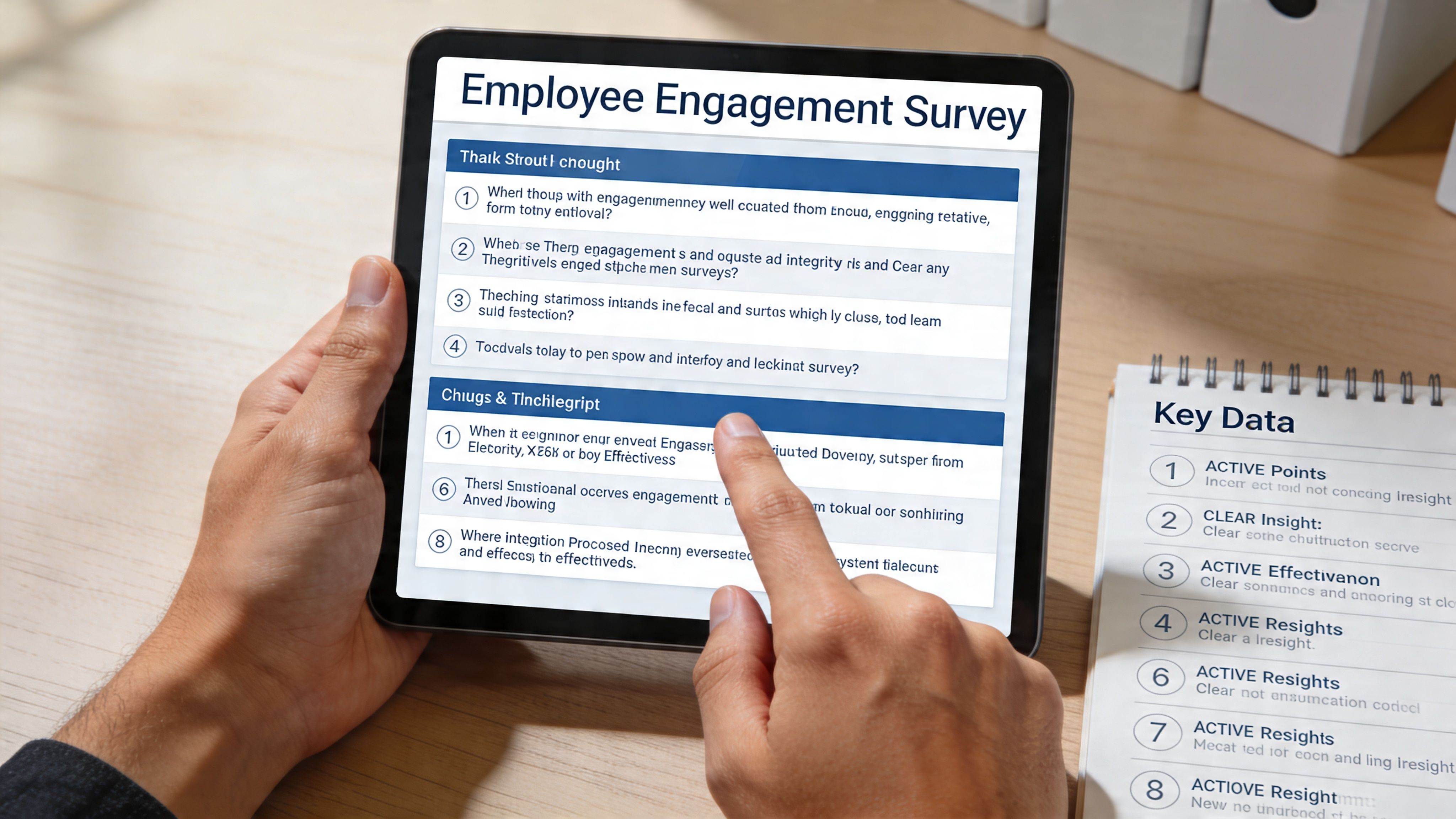
A rigorous baseline survey should contain 28 to 35 validated questions, and anonymity is key to achieving the 85%+ response rates needed for valid data, according to Quantum Workplace’s guidance on measuring employee engagement. The same guidance warns that survey fatigue can strike 60% of employees in organizations that repeatedly fail to act on feedback. That’s why survey design and follow-through have to work together.
Too many companies begin with short pulse surveys because they seem easier. That’s backward. Pulse surveys are useful only after you’ve established a proper baseline.
Your baseline survey should answer foundational questions such as:
Without that baseline, a pulse survey only tells you that something moved. It won’t tell you what the movement means.
Employees won’t tell you the truth if they think the data can be traced back to them. That’s especially true when the survey asks about manager conduct, investigations, favoritism, discipline, or confidence in leadership.
Use practical safeguards:
Employees don’t need a promise that leadership “cares.” They need proof that speaking candidly won’t put them at risk.
Questions should help leaders decide what to fix. That means each item needs a purpose. If a question produces interesting commentary but no operational next step, it probably doesn’t belong.
Good engagement survey design usually includes:
| Survey element | What it should do |
|---|---|
| Validated core questions | Establish reliable trends over time |
| Small number of optional open-ended prompts | Add context without overwhelming employees |
| Demographic segmentation | Expose meaningful differences across groups |
| Stable rating scale | Support trend analysis and manager interpretation |
Open-ended questions can be useful, especially if you use text analysis tools to identify themes. Keep them optional. Require too much written input and completion rates drop.
An effective schedule is simple. Run a full baseline survey annually. Then use quarterly pulse surveys with a narrow purpose.
Pulse checks should focus on issues like:
Don’t ask everything every time. Repetition with intent is better than variety without direction.
In multi-state organizations, some of the most important engagement drivers sit close to process confidence. Employees want to know whether rules are applied fairly, whether concerns are addressed, and whether management behavior is consistent.
That’s why I prefer survey items that reveal control issues, such as whether expectations are clear, whether employees trust decisions are handled consistently, and whether they feel safe raising concerns. Those questions are more useful than broad statements about company pride.
If you’re evaluating tools, one option in the market is a provider that offers employee engagement surveys and an Employee Engagement Index to quantify sentiment around factors such as job satisfaction, alignment with company values, and workplace relationships. The useful standard for any platform, though, is the same. It should support anonymity, stable trend reporting, segmentation, and clean executive reporting.
Before you send the survey, confirm five things:
If those five conditions aren’t met, wait. Launching a survey without them creates mistrust faster than no survey at all.
Survey scores are not enough on their own. They become far more useful when you put them next to hard operating data. That’s how you turn sentiment into evidence.
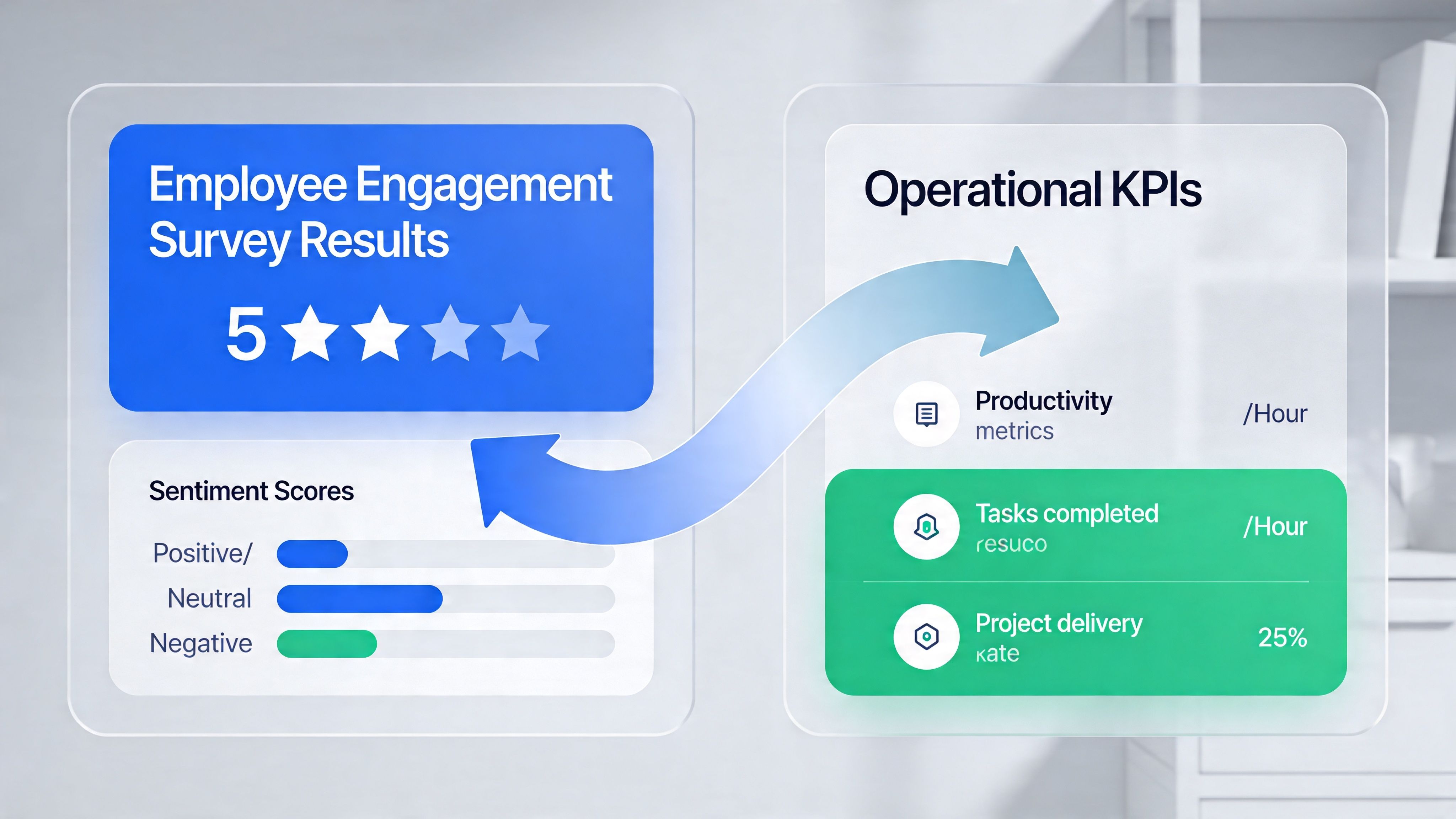
Workhuman recommends triangulating survey data with 10 operational metrics, including voluntary turnover below 12%, absenteeism below 2%, and revenue per employee at a $200k+ benchmark, and cites a Queen’s University meta-analysis finding that firms integrating metrics with surveys achieve 18% productivity gains and 23% higher profitability in its overview of employee engagement metrics. The point isn’t to copy every benchmark blindly. The point is to connect people data to business outcomes.
A COO already has operational dashboards. Use them.
The most useful pairings usually include:
One bad metric doesn’t prove disengagement. A cluster of changes does.
Here’s a practical example:
| Team signal | Operational signal | Likely implication |
|---|---|---|
| Lower trust in manager communication | Rising voluntary turnover | Manager issue or unstable local process |
| Decline in role clarity | Increase in errors | Training, workload, or supervision gap |
| Lower confidence in leadership decisions | More absenteeism | Uncertainty, burnout, or poorly handled change |
That combined picture gives you a stronger basis for intervention than survey comments alone. It also gives you a stronger record if someone later questions why leadership stepped in, reassigned oversight, or required manager coaching.
Soft data becomes credible when hard data moves in the same direction.
This is particularly valuable in retention work. If you’re already analyzing how to prevent employee turnover, engagement data helps explain why people leave, while KPI trends show where the damage is already affecting execution.
The common mistake is that HR owns the survey and operations owns the KPIs, with no shared review. Fix that. Engagement review should include HR, operations, and the executive leader responsible for the function being discussed.
Keep the review focused on three questions:
That’s where engagement measurement stops being abstract and starts becoming a management system.
Most engagement programs commonly fail. They collect a companywide score, maybe break it out by department, and stop there. That approach misses one of the biggest sources of distortion in a growing business. Employees in different states are not working under the same practical conditions, even when they share the same handbook.
A 2025 ADP report discussed by Culture Amp highlights that 68% of HR leaders in regulated SMBs report engagement drops linked to multi-jurisdictional compliance burdens. That gap matters because generic survey interpretation can blame the wrong cause. A location may look like it has a manager problem when the underlying issue is confusion about local leave rules, pay practices, scheduling requirements, or inconsistent compliance documentation.
If you operate in more than one state, state-level segmentation is not optional. You don’t need to expose individual responses. You do need to understand whether certain patterns are concentrated where legal requirements differ.
At minimum, analyze results by:
This lets you separate broad cultural issues from location-specific friction. If one state reports weaker confidence in job security, fairness, or issue handling, that may reflect how local policies are being communicated or applied. It may have very little to do with the local manager’s personality.
Most engagement tools ask about trust, fairness, communication, and support. That’s fine, but those responses need context. In a multi-state operation, confidence can drop because employees are dealing with inconsistent procedures that leadership hasn’t fully standardized.
Look for warning signs such as:
None of those patterns should be read in isolation. Put them next to policy rollout timing, handbook updates, leave administration issues, training completion, and escalation volume.
A local dip in engagement may be a compliance systems problem wearing a culture mask.
I don’t recommend overloading the survey with legal terminology. I do recommend adding a few targeted questions that surface confidence in workplace processes.
Examples of useful themes include:
| Theme | Why it matters |
|---|---|
| Confidence in fair application of policies | Reveals inconsistency risk |
| Clarity on workplace expectations | Exposes training and communication gaps |
| Trust in reporting concerns | Flags breakdowns in employee relations handling |
| Confidence in leadership during difficult decisions | Surfaces risk after investigations, discipline, or restructuring |
These questions help you identify whether engagement issues are tied to the work itself or to how the organization governs the work.
Executives often rush to attribute low scores to a local manager. Sometimes that’s right. Often it’s incomplete.
Suppose one branch has lower engagement right after a policy enforcement push. If the branch manager followed direction from corporate but received incomplete guidance, the root failure may sit at the system level. If you discipline or replace that manager without addressing the process gap, the underlying problem remains and the next manager inherits it.
A sound review process asks:
External benchmarks can help orient you, but they won’t tell you enough about your own risk. Your strongest benchmark is your own history.
Track movement across time:
That trend view is where good analysis happens. A single weak score can be noise. A repeated location-specific drop tied to a process change is not noise.
Most executive teams don’t need more commentary. They need a simple risk view that connects engagement data to operating reality.
A workable review table looks like this:
| Segment | Survey pattern | Business context | Likely next step |
|---|---|---|---|
| State A office staff | Lower trust in issue handling | Recent policy changes and manager turnover | Audit manager training and escalation procedures |
| State B field team | Lower clarity of expectations | Rapid growth and uneven onboarding | Standardize onboarding and communication |
| Multi-state new hires | Lower confidence in policies | Inconsistent orientation by site | Tighten new hire compliance communication |
That format forces discipline. It stops the team from defaulting to generic morale talk and keeps attention on actionable causes.
This part gets ignored too often. If you want a defensible engagement program, document not only the action plan but also the reasoning behind your interpretation.
Keep a clean record of:
That record matters because it shows leadership did more than react to a score. It shows a reasoned review process. In a multi-state environment, that distinction matters.
Once the data is in, leadership has to respond with discipline. If you ask employees for input and then do nothing visible with it, you train them not to participate next time. You also weaken your position when later disputes raise questions about whether leadership knew about workforce issues and ignored them.
Every major finding should map to an owner, a response, and a follow-up date. Keep the actions proportionate. Not every issue needs a companywide initiative.
A workable structure looks like this:
Managers need candid feedback, but they also need direction. Don’t turn survey results into public rankings or broad accusations. That creates defensiveness and encourages score management instead of actual improvement.
Use a simple action log:
| Finding | Owner | Action | Follow-up evidence |
|---|---|---|---|
| Low confidence in manager communication | Department leader | Manager coaching and check-in cadence | Pulse results and documented team meetings |
| Confusion about workplace processes | HR and operations | Update communication and retrain supervisors | Completion records and issue trend review |
| Lower trust after a high-stakes event | Executive sponsor | Leadership follow-up and listening sessions | Summary notes and next pulse review |
The record should show that leadership heard the issue, chose a response, and checked whether it worked.
You don’t need to share every detail. You do need to communicate what was heard and what will happen next.
That usually means:
If you want stronger day-to-day execution around this, resources on employee relations and engagement can help frame how managers and leaders reinforce trust after survey cycles.
The final step is follow-up measurement. Run the pulse. Recheck the KPI trend. Review whether the manager behavior, process issue, or policy confusion did improve. If it didn’t, escalate. Good engagement measurement is not about gathering feedback. It’s about proving the organization can listen, respond, and manage risk responsibly.
If your organization needs a more defensible way to measure engagement across locations, managers, and high-risk employee relations moments, Paradigm International Inc. can help you build a structured process that supports better decisions, clearer documentation, and stronger multi-state consistency.