

There is no universal employee-count cutoff, but 15 employees is the practical point at which federal anti-discrimination coverage generally creates a need for dedicated HR judgment. A company may need HR capacity at one employee, while a lower-risk employer may use shared support instead of a full-time hire as it approaches 75 to 100 employees.
You may be asking this because the founder still approves every offer, the office manager handles onboarding between other duties, or a COO has become the unofficial investigator for every employee complaint. That arrangement can work briefly. It becomes dangerous when managers make inconsistent decisions, leave records are incomplete, or leadership treats a sensitive termination like an ordinary business task.
The right question isn't, “How many employees before you need dedicated HR?” Ask instead: Can the business make employment decisions consistently, document them properly, and respond to risk without improvising? Headcount matters, but legal exposure, state coverage, manager capability, hiring velocity, and the seriousness of employee issues matter more.
Many owners look for a single trigger, usually 50 or 100 employees, before they consider dedicated HR. That shortcut is attractive because it turns a judgment call into a simple staffing rule. It's also the reason many small businesses wait until a complaint, failed accommodation, or poorly documented termination exposes the weakness in their people processes.
There is no universal employee-count cutoff at which every company must hire a dedicated HR professional. The more defensible benchmark is the workload created by headcount, complexity, and employment risk, as reflected in SHRM's Human Capital Benchmarking Report.
A single-location company with straightforward roles may manage basic administration through a fractional resource for a period of time. A smaller company with employees in several states, regulated positions, high turnover, or recurring complaints may need experienced HR judgment much earlier.
Employee count measures volume, but not the difficulty of the work. One employee can raise a disability or religious accommodation request. One manager can create repeated retaliation risk. One termination can expose weak documentation that has existed for years.
The early warning signs usually appear in the operating model:
Practical rule: Hire or assign HR ownership when leaders are making consequential employment decisions without a repeatable process, not when a round number appears on the payroll report.
The practical milestone is often 75 to 100 employees, when recurring HR work becomes substantial enough to justify dedicated internal ownership or a clearly assigned HR function. That does not automatically mean a large department. It means someone must own the decisions, records, escalation path, and consistency of execution. For a broader assessment of timing and structure, review Paradigm International's comprehensive guide.
Benchmarks help with budgeting and org design. Use them to estimate workload, coverage, and cost. Do not use them as a hiring trigger.
SHRM's historical benchmarking gives leaders a useful range, not a staffing formula. One report recorded a median HR department size of 3 full-time-equivalent employees and an average of 9.2 across participating organizations. For organizations with about 85 employees, it recorded a median HR-to-employee ratio of 3.03 HR employees per 100 workers. Applied mechanically, that would suggest roughly 2.6 HR FTEs. Applied intelligently, it shows something more important: employers with similar headcounts still staff HR very differently because their models, manager load, and administrative demands differ. See the underlying SHRM benchmarking report for the original context.
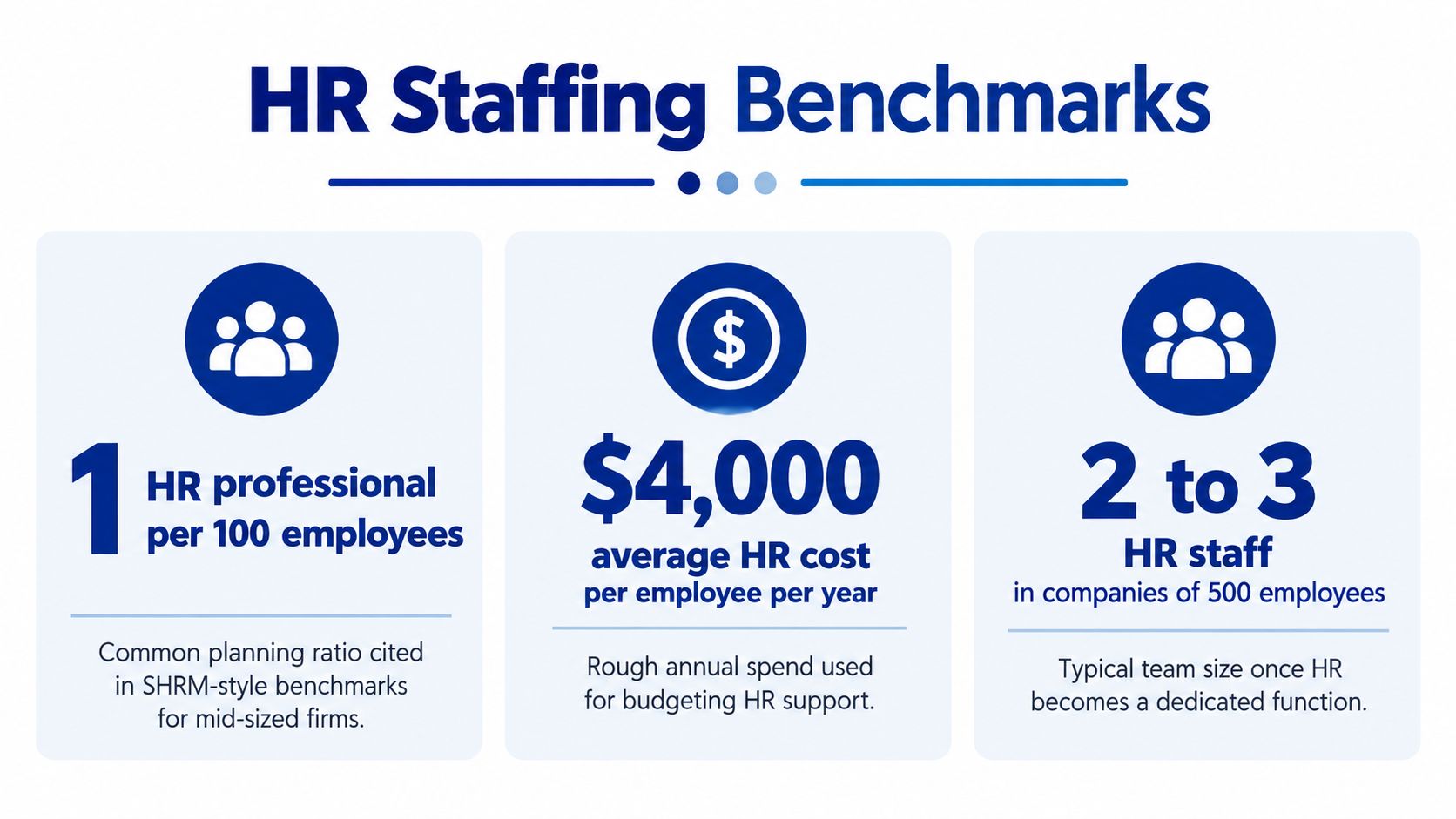
More recent benchmark coverage shows the same pattern. SHRM reported a median of 1.5 HR employees per 100 workers in 2018, described as the highest level in that survey's history, and later reported an average of 1.7 HR staff per 100 employees in 2022, with a broader practical range of 1.5 to 4.5 HR staff per 100 employees in SHRM's reported benchmarking coverage.
Those numbers are planning ranges. They are useful for finance, hiring plans, and executive discussions about whether the current support model is underbuilt. A 100-person company sitting near the low end should expect a lean structure. A similar company near the high end is usually paying for more service depth, more specialization, or more administrative load. That is why benchmark tables help most when leaders read them alongside scope. Recruiting volume, leave administration, employee relations traffic, onboarding complexity, and manager support all change the staffing picture.
The biggest mistake is pretending that one ratio answers three different questions: how many people HR should have, what level of expertise the team needs, and whether the work is getting done well. Ratios answer the first question only loosely. They do not tell you whether investigations are stalling, whether documentation is defensible, or whether managers are applying policy consistently.
A better management test is capacity. If HR work is piling up, leadership already has a staffing problem, even if the benchmark looks normal.
Track the signals that expose strain:
Use benchmark ranges as a planning reference. Build the function around actual workload, decision speed, and documentation quality. If those three are slipping, add HR capacity or reassign ownership before the backlog turns into a legal problem.
Legal coverage starts before most businesses think they need a full-time HR employee. The compliance question isn't whether a company has an HR department. It's whether the company can identify covered employees, apply the right process, preserve records, and respond consistently.
Under the major federal statutes enforced by the Equal Employment Opportunity Commission, Title VII, the Americans with Disabilities Act, the Genetic Information Nondiscrimination Act, and the Pregnant Workers Fairness Act generally apply at 15 employees. The EEOC's private-employer coverage guidance explains that covered employees generally must have worked for the company for at least 20 calendar weeks in the current or preceding year.
The Age Discrimination in Employment Act generally applies at 20 employees, also measured over at least 20 calendar weeks. The Equal Pay Act can apply to employers with one or more employees. These thresholds don't require a full-time HR hire, but they do require leadership to stop treating complaints, accommodations, personnel records, and manager conduct as informal owner-only tasks.
At 15 employees, a company should have a defined process for:
State and local law can apply at lower thresholds. Available legal summaries identify California coverage beginning at five employees and New York State coverage beginning at four employees. A company expanding into another state can therefore create new obligations without a dramatic change in total headcount.
The 20-employee ADEA threshold makes age-related decision-making and documentation more important. A manager who describes an experienced employee as “too old” or replaces that person without a documented performance rationale has created a problem that a staffing ratio won't detect.
The Family and Medical Leave Act creates a more complex 50-employee operational threshold. Under the Department of Labor's FMLA eligibility guidance, a private employer is generally covered when it employs at least 50 employees during 20 or more calendar workweeks in the current or preceding year. An individual employee generally must work at a site where the employer has at least 50 employees within a 75-mile radius, have worked for the employer for 12 months, and have completed 1,250 hours during the preceding 12 months.
That calculation requires reliable worksite, payroll, eligibility, notice, and leave records. Multi-location employers can't safely administer it from memory or scattered spreadsheets.
Employee counting itself demands control. For EEOC coverage, qualifying part-time, seasonal, and temporary employees are included, while independent contractors and other non-employees, including owners, generally are excluded. Separate companies may also be treated as one employer when their operations are sufficiently interrelated, as explained in the EEOC employee-counting guidance.
For leaders operating across borders, the same discipline matters. A useful resource on avoiding hiring traps in the MENA reinforces a broader point: hiring practices must reflect the jurisdiction in which people work, not just the location of the headquarters.
A company can need dedicated HR judgment before it needs a full-time HR employee. Choose the model based on risk exposure, management strain, and the volume of recurring HR work that requires a dedicated owner.
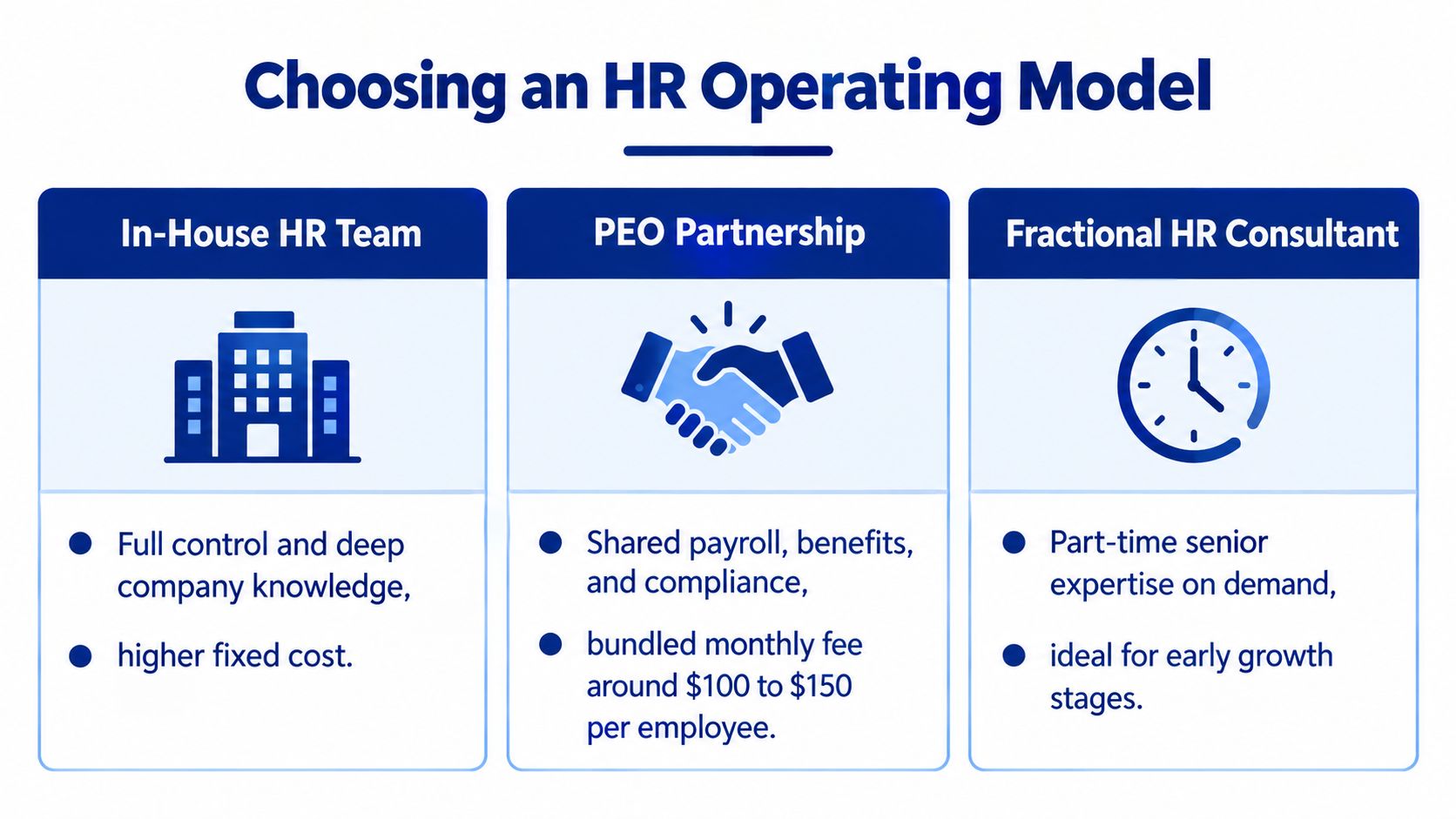
A full-time internal hire makes sense when HR work is constant and managers need same-day support. A 70-person manufacturer with shift hiring, attendance issues, recurring discipline, and regular onboarding usually needs someone on site who owns documentation, benefits coordination, employee relations intake, and manager follow-through. In that setting, access matters because delays create legal and operational exposure.
This model gives the business direct accountability. It also creates a common failure point. Many companies hire one HR generalist, load that person with payroll questions, onboarding paperwork, and benefit administration, then expect senior judgment on investigations, accommodations, and terminations. That is poor design. If the role is mostly administrative, leadership still needs experienced review for sensitive decisions.
Fractional or shared HR is the right choice when the company needs judgment before it has enough volume for a full internal role. A 25-person software company in one state, hiring steadily but not daily, can use a fractional lead to clean up policies, train managers, review documentation, set onboarding controls, and step into escalations before they turn into claims.
This model works only if ownership is explicit. Someone must decide who approves discipline, who reviews leave and accommodation issues, and who keeps records current. It loses effectiveness when managers need daily coaching, employee relations cases stay open, or the company operates across multiple jurisdictions. At that point, part-time support often becomes too thin. A practical guide on fractional HR for SMBs helps frame that choice as an operating model, not a stopgap.
Outsourced advisory support fits companies facing concentrated risk or specialized issues. A 40-person employer with staff in several states, inconsistent policies, and a pending termination dispute may be better served by an outside HR advisory firm than by rushing into a junior internal hire. The firm can review policies, support investigations, guide manager conduct issues, and help leadership reset process controls quickly.
Keep one distinction clear. Outsourcing administration is not the same as outsourcing judgment. A vendor can process payroll or benefits tasks, but leadership still needs a defined reviewer for high-risk decisions and a record of how those decisions were made. Guidance on when to outsource HR setup is useful if the company needs external support without building a full department too early.
Leadership shouldn't wait for a crisis to decide whether its HR model is working. Review the indicators below on a recurring basis, then choose the response that matches the highest-risk pattern.
| Indicator | Risk Level | Recommended Action |
|---|---|---|
| Unresolved employee complaints remain open or lack a clear owner | High | Assign experienced HR or investigation support immediately |
| Managers escalate discipline, accommodations, or terminations without documented review | High | Create mandatory HR review and manager decision protocols |
| Payroll, leave, or onboarding errors recur | Medium to high | Audit the process, assign ownership, and add operational HR capacity |
| Executives spend substantial time handling employment matters | Medium to high | Shift routine ownership to a full-time, fractional, or outsourced HR resource |
| Policies differ by state, location, or manager | High | Conduct a multi-state policy and compliance review |
| HR records are incomplete, scattered, or difficult to retrieve | Medium to high | Establish a controlled personnel-record and documentation process |
| Hiring volume is rising faster than onboarding and manager support | Medium | Add scalable HR capacity before the next hiring push |
| Employee relations work is infrequent but highly sensitive | High | Use on-demand senior HR or specialist advisory support |
One high-risk indicator can justify action before the company reaches a conventional staffing milestone. A formal complaint, accommodation request, retaliation concern, or termination involving protected activity requires judgment regardless of whether the business has a full-time HR employee.
Several medium-risk indicators point to capacity failure rather than a single legal event. Recurring leave errors, overdue documentation, and executive time drain usually mean that the current model has outgrown its design. Hiring more administrative help may not solve the problem if leaders lack a senior reviewer for sensitive decisions.
Leadership test: If the owner or COO disappeared for a week, would managers still know how to handle a complaint, accommodation request, investigation, or termination?
If the answer is no, the business has an HR ownership problem. It may need a full-time employee, fractional leadership, or an advisory relationship, but it needs a defined escalation path now. Cost should be evaluated against scope and risk, not against a generic internet benchmark. For planning purposes, review the HR consultant cost range, then compare it with the leadership time and exposure created by the current arrangement.
The answer to how many employees before you need dedicated HR isn't a single number. At 15 employees, federal anti-discrimination coverage generally creates a strong case for dedicated HR judgment. At 20, age-discrimination obligations add another concern. At 50, FMLA administration can require reliable eligibility and leave systems. Around 75 to 100, recurring workload often justifies dedicated internal ownership, though complex employers may need support earlier.

Start with an honest audit. Map employees by state, review worker classifications, identify open complaints, test the quality of leave and personnel records, and list the employment decisions currently handled without documented review. Then select the operating model that matches your exposure: internal HR for sustained volume, fractional support for intermittent but important needs, or outsourced advisory capacity for specialized risk.
The worst time to build HR ownership is after a preventable dispute has already become expensive. Put decision rights, documentation standards, escalation rules, and manager accountability in place while the organization can still change deliberately.
Paradigm International Inc. helps owners, COOs, and executive teams manage high-stakes employment decisions, investigations, terminations, manager conduct, documentation, and multi-state compliance. Visit Paradigm International Inc. to learn how an advisory-first HR risk partner can help your organization grow with greater consistency and defensibility.

