


Full-time is not one universal legal number. In the U.S., the IRS and ACA treat 30 hours per week, or 130 hours per month, as the benefits threshold, while many employers still write 40 hours into their handbook. That gap is where compliance mistakes happen.
The popular advice says to treat full-time as a simple scheduling question. That advice is wrong for multi-state employers. How Many Hours Is Full-Time? depends on which rule you're answering, and the wrong answer can expose your company to benefits errors, overtime mistakes, and inconsistent policy enforcement.
The first mistake employers make is assuming full-time is a fixed legal category. It isn't. Under the Fair Labor Standards Act, there is no single federal legal definition of full-time employment, so employers usually set the threshold themselves, while federal agencies and benefit rules layer their own standards on top of that silence. The U.S. Department of Labor also says that full-time or part-time status generally does not change FLSA wage-and-hour coverage, which means the label does not control overtime or minimum wage obligations. U.S. Department of Labor guidance on full-time employment
That creates a practical trap. A worker can be part-time under your handbook and still be treated as full-time for ACA purposes. If your internal policy says 35 or 40 hours but your scheduling pattern pushes someone to 30 hours on average, federal benefits rules can still apply.
Employers often talk about full-time status as if it were one thing. In reality, it is a compliance label, a benefits label, and an internal scheduling label, and those do not always match. Once HR, payroll, and benefits each use a different standard, the risk moves from theory to administration.
Practical rule: Never let your handbook definition be the only definition your managers use. Benefits eligibility and wage-hour compliance have to be tracked separately.
The safest mindset is simple. Treat full-time as a multi-layered status, not a universal one. Track the threshold that controls pay, the threshold that controls benefits, and the threshold that controls your own operating model.
For employers building hiring workflows around that distinction, resources such as async screening to meet AI hiring rules can help you think more carefully about how classification decisions flow through recruiting and onboarding. The point is not software preference, it's reducing the chance that your process drifts away from your policy.
The 40-hour workweek became the standard because it marks the practical edge of overtime law. The FLSA requires non-exempt employees to receive overtime pay at one and one-half times their regular rate for hours worked over 40 in a workweek, so many employers still use 40 as the operational ceiling. Overview of full-time hours and FLSA overtime
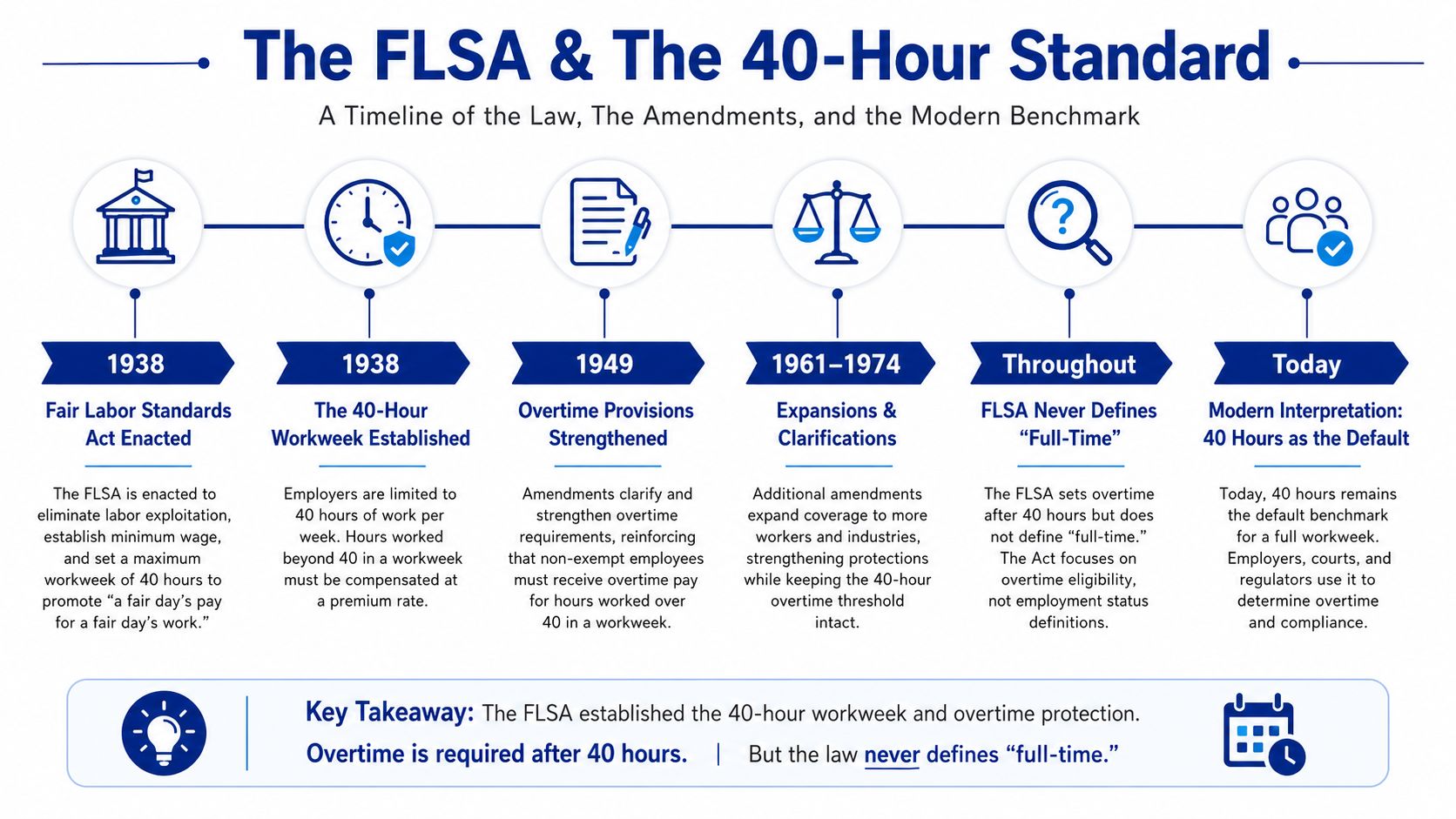
The number did not appear by accident. U.S. government tracking began in 1890, when the average workweek for full-time manufacturing employees was about 100 hours. Congress first capped the workweek at 44 hours in the Fair Labor Standards Act of 1938, then reduced it to 40 hours in the 1940 amendment, which took effect on October 24, 1940. OECD employment outlook and working-time history
That history matters because it shows why business culture still clings to 40. It is a policy outcome, not a natural law. The OECD also notes that many member countries set the statutory limit for normal weekly hours at 40, usually organized as five 8-hour days, which explains why the benchmark feels so familiar across organizations and jurisdictions.
The FLSA does not create a universal full-time label. It regulates pay, recordkeeping, minimum wage, and overtime coverage. If a manager tells an employee, “You're not full-time, so overtime rules don't apply,” that manager is wrong.
Employers get burned here because they confuse status with exemption. A person can be called full-time, part-time, or something in between, and the FLSA still applies if the worker is non-exempt. That is the only question that matters for overtime.
A handbook definition can help operations. It cannot override wage-and-hour law.
The Affordable Care Act creates the most dangerous gap for employers. For employer shared-responsibility purposes, the IRS defines a full-time employee as someone averaging at least 30 hours of service per week or 130 hours of service in a calendar month. IRS full-time employee identification rules
That is the threshold that catches employers off guard. If your handbook says full-time starts at 40 hours, you can still owe a health coverage offer to someone who averages 30 hours under ACA rules. The handbook does not control the federal benefits trigger.
| Regulation | Threshold | What It Triggers |
|---|---|---|
| FLSA | More than 40 hours in a workweek for overtime pay | Overtime compensation for non-exempt employees |
| ACA and IRS | 30 hours per week, or 130 hours per month | Full-time status for employer shared-responsibility rules |
| Common employer handbook | 35 or 40 hours per week | Internal scheduling and benefits policy, if the employer chooses |
The IRS also allows either monthly measurement or look-back measurement methods to determine status. That means a manager's week-to-week scheduling instinct is not enough. You need a measurement process that stands up when hours fluctuate.
If you are also dealing with hiring volume, review processes, and policy consistency, a compliance resource such as Approved Lux Personal Assistant comparison can be useful when your team is comparing different work arrangements and role designs. The important point is that classification must stay aligned with legal thresholds, not just job titles.
The gap usually appears in three places. An employee picks up extra shifts and crosses the 30-hour line. A seasonal worker stays busy longer than planned. A part-timer is scheduled “just below full-time” for operations, but that pattern still creates ACA exposure.
That's why this issue belongs in a COO's risk review, not just in payroll. The ACA threshold is not a soft guideline. It is a hard compliance line for applicable employers.
Variable-hour and seasonal employees need a measurement method, not guesswork. The IRS allows employers to use a look-back measurement period of not less than three and not more than 12 consecutive calendar months to determine whether a worker averaged at least 30 hours of service per week. IRS look-back measurement method
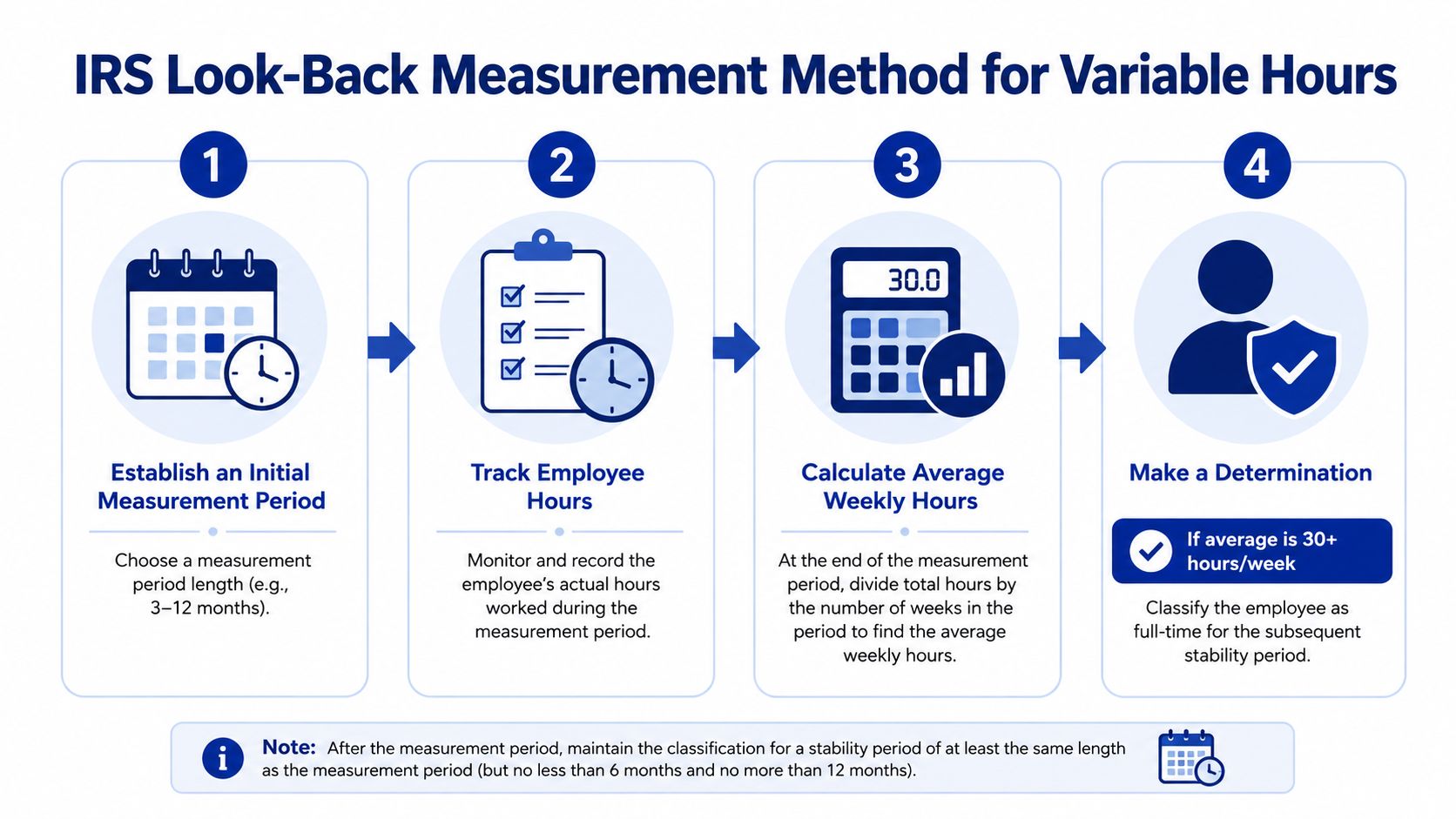
A retail employee who works 20 hours one week and 38 hours the next does not fit a simple label. You need a measurement window that captures the pattern. If the average reaches the ACA threshold during the measurement period, that employee is treated as full-time for the following stability period under the IRS framework.
The discipline here is documentation. Pick the measurement period, apply it consistently, and keep the calculations. If HR changes the window every time staffing gets tight, the process stops being defensible.
The stability period matters because it prevents constant status churn. Without it, employers would be forced to reclassify people every time seasonal demand shifts. That creates confusion for employees and unnecessary risk for the company.
For organizations trying to document flexible roles more carefully, Dilicheck Rep compliance blog articles can be a practical place to review related compliance topics before you lock in your measurement policy. Use the resource as a reference point, not as a substitute for a written internal process.
Federal rules set the baseline, but state law can still change the way you manage hours. Multi-state employers cannot assume a single handbook definition will work everywhere. The safer approach is to build a compliance map by jurisdiction and then layer your company policy on top of it.
Healthcare often runs on coverage needs, not neat schedules. Retail and hospitality deal with variable demand and fast staffing shifts. Professional services can look stable on paper, but project work often pushes people toward hours that trigger policy or benefit reviews.
That's why the same full-time policy can behave differently across teams. One location may sit comfortably under your internal threshold, while another location regularly brushes up against ACA exposure because managers cover open shifts aggressively.
For a state-specific example, see what is full time in CA. California is a good reminder that federal baseline rules are only part of the picture.

The business takeaway is blunt. If your company operates across states, your “full-time” policy has to survive more than one jurisdiction. One number is rarely enough.
Your handbook should separate operational status from benefits eligibility. That is the cleanest way to reduce confusion. If you call someone part-time for scheduling but full-time for ACA purposes, say so plainly.
A defensible policy usually does three things. It defines the company's internal scheduling category. It preserves the company's right to change assignments. It also states that benefits eligibility will be determined under applicable law, including federal measurement rules where relevant.
Do not write a single sentence that makes your internal definition sound absolute. That can create contractual expectations you did not intend. It also increases the chance that managers treat the handbook as if it overrides federal thresholds.
Policy language should be precise, not dramatic.
Use separate sentences for scheduling status and benefits status, and do not collapse them into one vague definition.
The internal handbook should not force your HR team to improvise every time hours change. It should tell managers what to do when an employee approaches the ACA line, who reviews the data, and how the decision gets documented.
If your company is standardizing broader HR documents, the Paradigm International handbook requirements article can help you think about how policy language interacts with state-level expectations. The key is consistency. A good handbook should be readable, but it also has to survive scrutiny.
A full-time audit should be short, direct, and repeatable. If it cannot be done the same way every time, it is not a real control. Start with policy, then trace what payroll, scheduling, and state rules do.
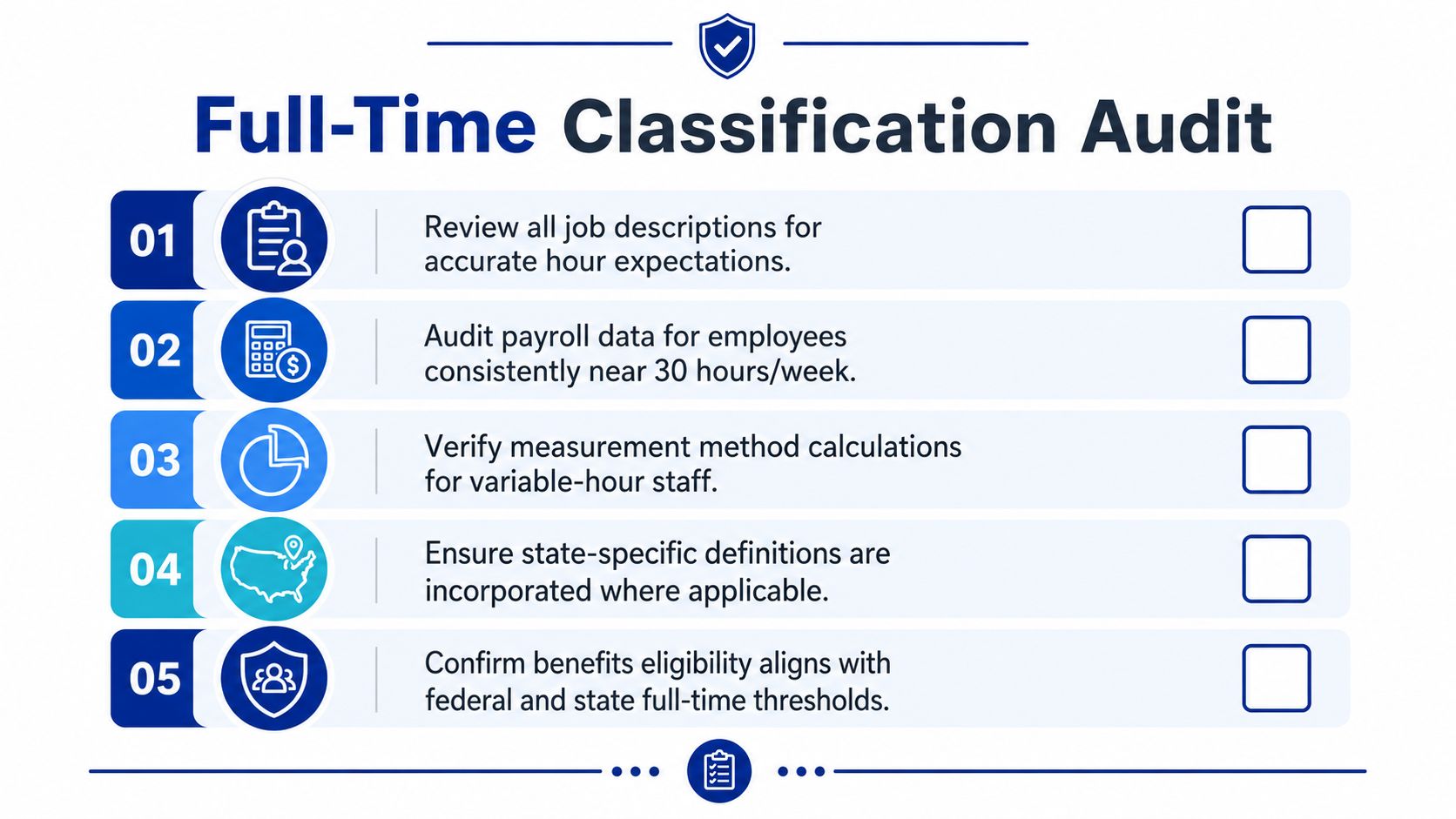
The gap between how managers schedule people and how HR classifies them for benefits is the central issue. That gap is where handbook language gets tested against ACA exposure. If you have growth, multiple states, or a mixed workforce, you need a written review process, not a verbal norm.
For a broader HR audit framework, compare your results with a broader HR audit framework and review related compliance guidance in Dilicheck Rep compliance blog articles. Use both to tighten controls around staffing, documentation, and manager behavior.

