If you're hiring in Texas, the question usually comes up when a manager wants a simple answer and payroll needs a policy that won't blow back later. The short answer is that Texas doesn't give private employers one universal hour cutoff, and that's exactly why a defensible internal rule matters.
What looks like a straightforward scheduling issue often turns into a benefits, payroll, and compliance problem. A worker can be part-time for one purpose, full-time for another, and covered by a completely different rule set for state or federal purposes. Employers that write this down clearly avoid a lot of confusion later.
Texas is more flexible than many business owners expect. For private-sector employers, there isn't one state-mandated number of hours that automatically makes someone part-time. The Texas Workforce Commission explains that many employers define full-time as 40, 37.5, 45, or similar hours per week, and then treat anything below that employer-set threshold as part-time, which means the actual answer to how many hours is part time in texas is often found in company policy, not state statute. Texas Workforce Commission guidance on part-time and full-time status

That flexibility is useful, but it also creates risk if leaders rely on verbal understanding instead of written standards. Texas guidance also notes that an employee who occasionally works 40 or more hours in a week does not automatically become full-time if their regular schedule is still part-time. In practice, that means you need to separate a temporary spike in hours from the employee's defined status.
A defensible policy starts with consistency. If your handbook says part-time means fewer than a certain threshold, managers need to use that threshold the same way across similar jobs. Changing the label based on convenience, department pressure, or who is asking for benefits is where employers create unnecessary exposure.
Practical rule: write the threshold into the handbook, then train supervisors not to improvise when staffing gets tight.
For businesses that also manage final pay or separation issues, the classification should stay aligned with your wage and hour process. A useful reference point is Texas final paycheck rules, because classification mistakes tend to show up again when employment ends.
The main takeaway is simple. Texas gives private employers room to define part-time status, but that freedom only works if the rule is documented, stable, and consistently applied. Without that, the company ends up making case-by-case calls that are hard to defend later.
Texas may leave room for policy choice, but federal law still draws hard lines in the areas that matter most. The Fair Labor Standards Act does not define part-time employment at all, so there's no single federal hours rule that overrides your handbook for every purpose. The U.S. Department of Labor says the FLSA “does not address part-time employment,” while the Bureau of Labor Statistics commonly uses less than 35 hours per week as the practical part-time benchmark in labor statistics. U.S. Department of Labor part-time employment guidance
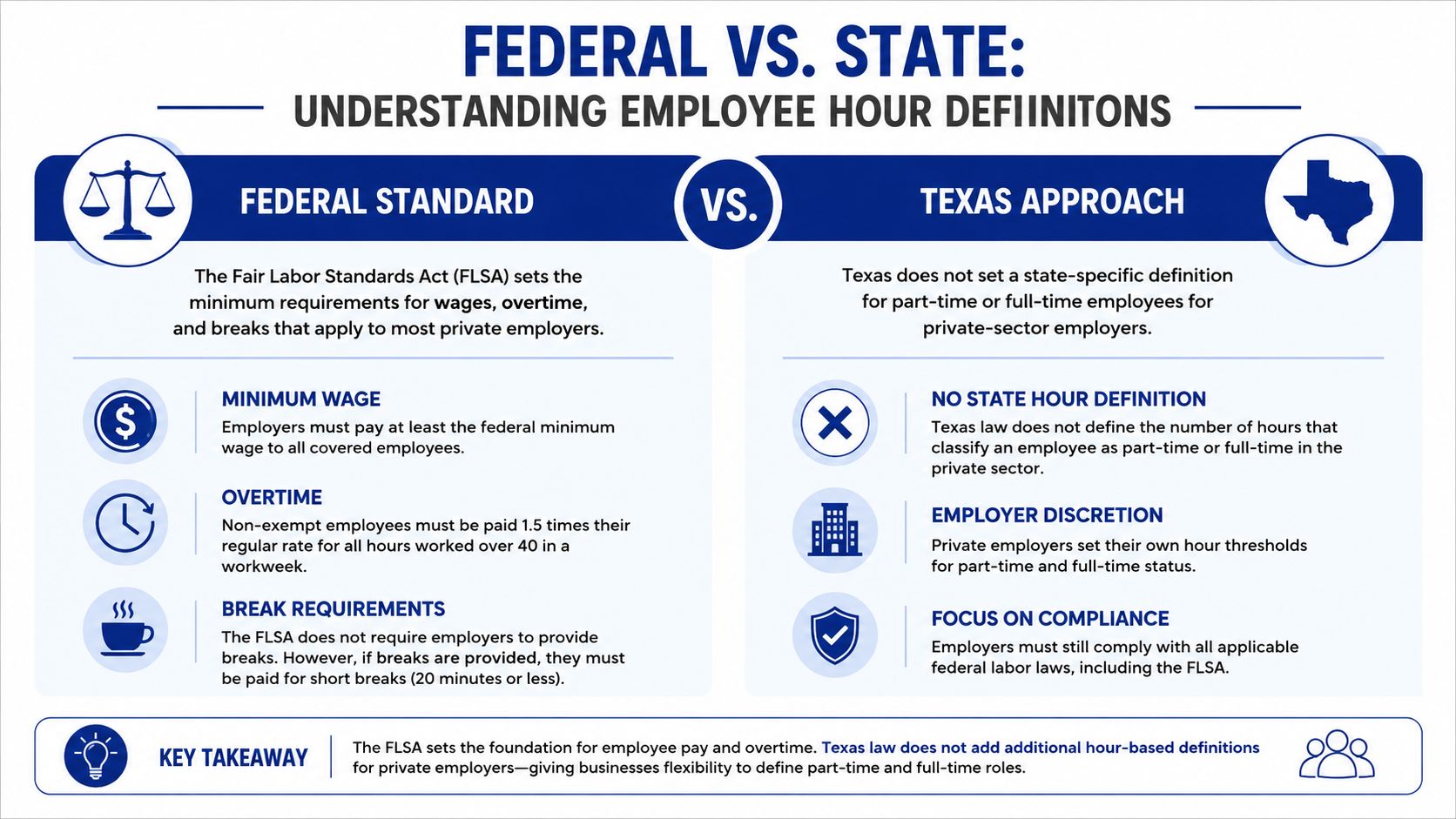
For many employers, a primary compliance concern is the Affordable Care Act. Under the employer mandate, employees averaging 30 hours per week or 130 hours per month are treated as full-time for health coverage purposes at applicable large employers, so 29 hours or fewer becomes the practical part-time range for that benefit test. That means a worker can be part-time under your scheduling policy and still trigger ACA full-time measurement if their hours cross that line. ACA employer mandate hour threshold
That distinction is why businesses with variable schedules need cleaner tracking than businesses with fixed shifts. If your managers “keep someone at 29 hours” without monitoring actual averages, the policy can fail as soon as coverage measurement kicks in. The issue is not just legal terminology, it's whether your system can prove the hours behind the classification.
A useful internal rule has to work across payroll, benefits, and scheduling. If one department treats 30 hours as the tipping point and another uses a different cutoff, employees will notice the inconsistency quickly. That often leads to grievances, benefits questions, and avoidable disputes over who should have been offered what.
For role-based classification, it also helps to keep exempt-status analysis separate from hour status. A part-time employee may still be exempt if the job duties and salary basis fit the test, which is why a duties test for exempt employees should sit alongside, not inside, the part-time policy.
Federal rules don't give you one clean part-time definition. They give you several hour-based triggers, and each one affects a different compliance obligation.
The smartest approach is to treat federal law as the floor your policy must survive, not as the policy itself. Texas employers that build around ACA measurement and FLSA recordkeeping are usually in a much better position than employers who define part-time loosely and hope the details never matter.
Most employers don't choose a part-time cutoff by accident. They choose it to manage benefits cost, scheduling flexibility, and the line between eligible and ineligible workers. In practice, that usually means a threshold lower than the company's full-time schedule, with enough buffer to avoid accidental ACA exposure or unnecessary benefit commitments.
Common thresholds in the market tend to cluster around a few practical points. Some businesses use a lower cutoff to keep benefit eligibility narrow. Others choose a middle ground so they can still attract workers who want stable hours without creating a full-time benefits footprint.
The key strategic question is whether the threshold matches the company's actual plan design. If your health plan, retirement plan, or paid time off structure only works cleanly at one level, set the policy there and document the reason. If you pick a threshold because it sounds common but it doesn't fit your costs, the policy will feel unstable the first time staffing gets tight.
A good threshold is not the one with the fewest complaints. It's the one the company can apply consistently, explain clearly, and defend when someone asks why one role is part-time and another isn't. That usually means aligning the number with scheduling patterns, benefit tiers, and the administrative burden of tracking hours.
The best policies also avoid hidden exceptions. If managers are allowed to move people over the line without review, the company loses the value of the threshold almost immediately. A policy only works when operations can follow it.
If you're building pay rules for mixed-hour teams, especially instructors or trainers with different assignment patterns, tools like calculate instructor pay correctly can help you think more carefully about how hours, rates, and classifications interact.
A market-standard threshold is useful, but it isn't the final answer. What matters is whether it gives your business a stable rule that fits your workforce and your benefit structure. If it doesn't, the threshold becomes a label instead of a control.
Part-time status affects far more than scheduling. It shapes overtime exposure, benefits eligibility, leave administration, and the way payroll has to handle records. If the classification is sloppy, the errors usually show up in the most expensive places first.
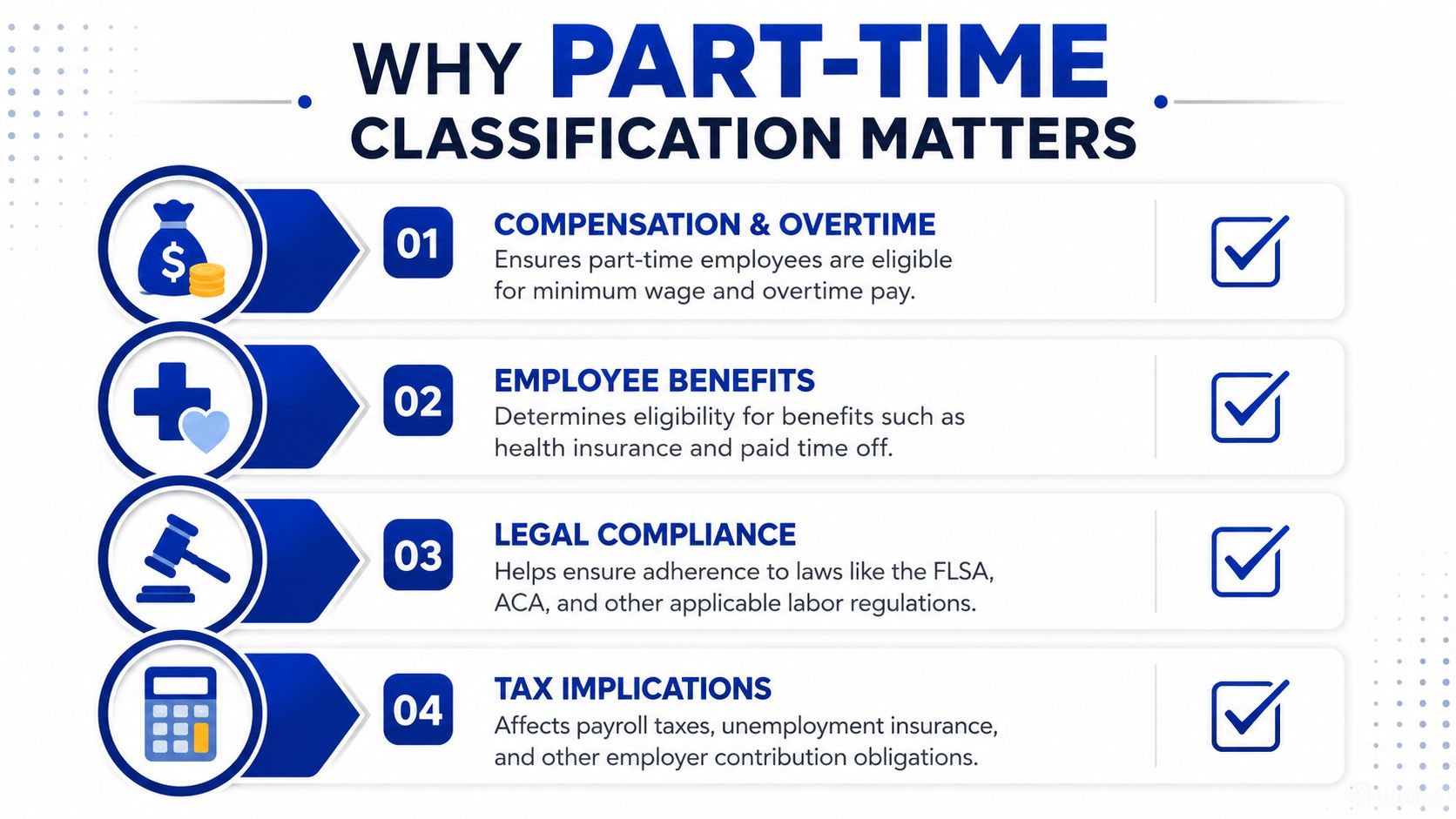
Under federal wage law, part-time status does not erase overtime. The actual weekly hours worked control whether overtime is due, not the employee's label. A part-time worker who crosses the overtime line has to be paid correctly just like a full-time worker would be.
That matters because scheduling decisions often get made by managers who are trying to cover shifts, not by payroll professionals who are watching cumulative hours. When the weekly hours stack up, the classification label won't protect the employer from a wage claim. The recordkeeping has to be tight enough to support the pay calculation.
Benefits are where part-time definitions become operational, not just legal. Health coverage, retirement eligibility, and paid time off all depend on how the company defines eligibility. If your handbook leaves those rules vague, employees will assume the company is deciding differently from one person to the next.
A good benefits policy makes the eligibility rules visible early. If someone is not eligible until they reach a certain hour threshold, that should be written in plain English before the first schedule is posted. For a deeper look at the benefit side of the equation, see part-time employees benefits guidance.
Part-time status also affects leave tracking and payroll administration. If the company uses one definition for scheduling and another for benefits, the systems will drift apart unless someone actively reconciles them. That's where employers lose time and create mistakes that are hard to unwind later.
For businesses that rely on outside payroll support, the policy also has to be understandable to the person entering the data. If a policy is too vague for a payroll clerk to apply consistently, it's too vague for a manager to enforce. That's why many businesses build a written rule first, then align benefits and payroll settings to that rule rather than the other way around.
A broader workforce policy resource like restaurant employee policies guide can be helpful if you manage a high-turnover environment where schedules shift often.
The real risk isn't the label itself. It's the mismatch between the label, the hours actually worked, and the benefit or payroll rule attached to it.
A strong part-time policy does three jobs at once. It tells managers what to do, tells employees what to expect, and gives the company a record it can stand behind if the classification is challenged. That's especially important in Texas, where private employers have room to define the rule themselves, but state roles have a much tighter statutory standard.
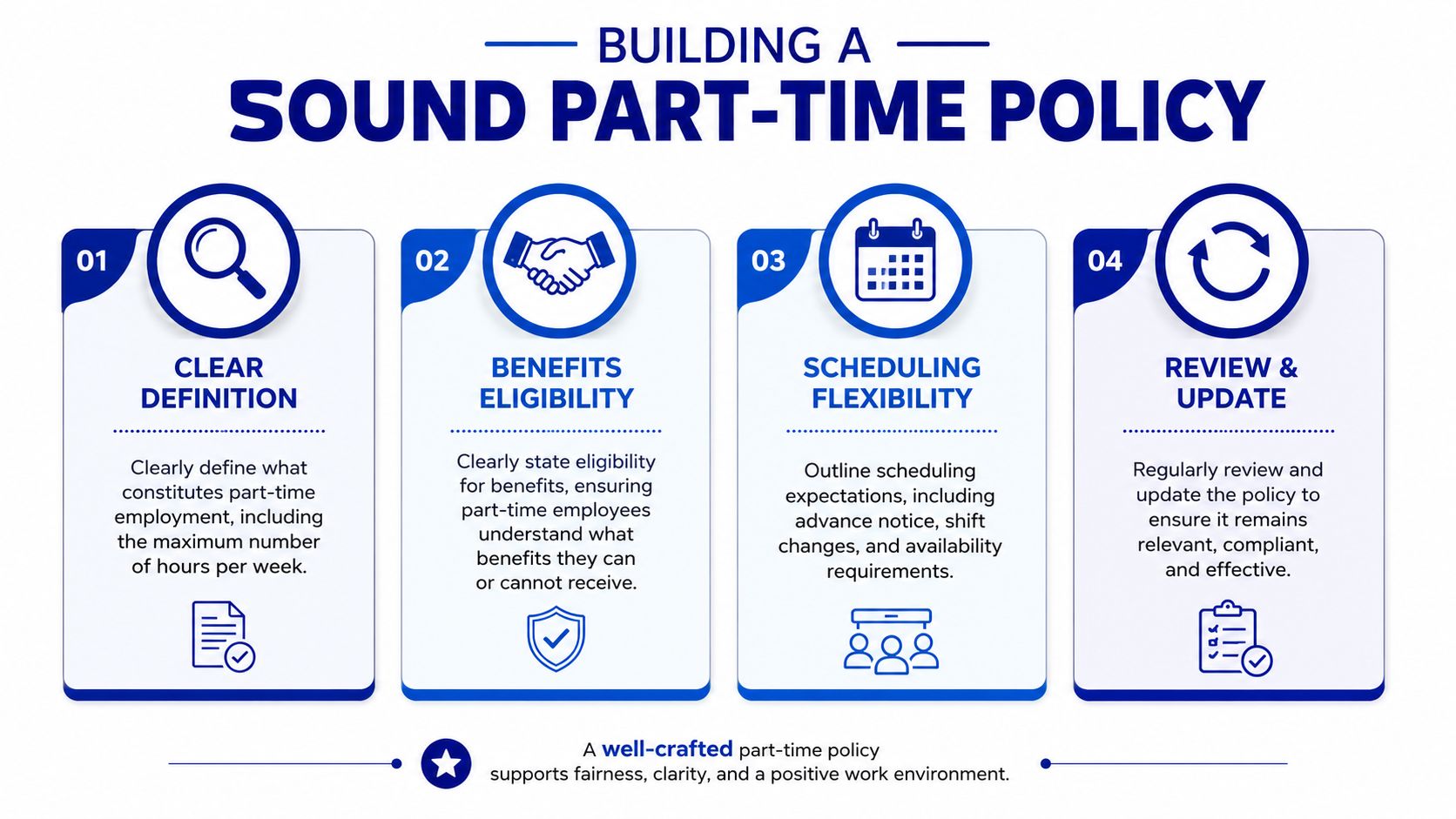
Put the number in writing. If your company treats part-time as fewer than a certain number of hours each week, say that directly and keep the definition in one place in the handbook. Avoid wording that sounds flexible unless you're prepared to defend every exception.
A useful policy sentence might read, “Part-time employees are those regularly scheduled to work fewer than X hours per week.” That sentence does the most important thing well, it sets a regular schedule standard instead of a vague feeling about workload. You can then layer in benefit rules separately.
For Texas state employees, the statutory benchmark is much more exact. Texas Government Code Section 662.001 defines a part-time state employee as one who normally works fewer than 40 hours each week, which shows why private employers benefit from making their own written standard equally clear. Texas Government Code Section 662.001
The policy should also say how benefits eligibility works and what happens when hours change. If a part-time employee moves into a full-time schedule, who reviews the change, when the change becomes effective, and what documentation gets updated should all be spelled out. The same is true if a full-time employee moves down into a part-time arrangement.
Many employers write themselves into trouble by using informal manager discretion. If one supervisor can upgrade hours and another cannot, the company no longer has a defensible system. Consistent approval steps matter more than clever wording.
If you operate in more than one state, keep the core definition consistent and layer in state-specific addenda where needed. That approach avoids rewriting the entire handbook every time you expand, but it still lets you address local requirements that may differ from Texas. In multi-state settings, one handbook plus separate jurisdiction notes is often easier to defend than a vague universal policy.
The policy should also be reviewed regularly. Laws change, benefit carriers change, and operational models change even faster. If the company expands, adds remote roles, or adjusts schedules seasonally, the part-time definition should be checked again before assumptions harden into practice.
A written policy won't solve every classification problem, but it gives the company a standard it can enforce. That's the difference between a process and a guess.
Texas gives private employers flexibility, but flexibility without documentation turns into risk. If your company hasn't put the part-time definition in writing, you're leaving too much to manager judgment, and that usually creates inconsistency in payroll, benefits, and leave administration.
The better model is straightforward. Set one threshold, explain who qualifies for which benefits, and make sure your scheduling practice doesn't conflict with ACA measurement or other federal rules. For employers with employees in different states, the policy has to be even tighter because one clean Texas rule may not be enough everywhere.
If your business hires in specialized or remote roles, it helps to compare your policy with state-specific workforce patterns, such as remote pharmacist jobs in Texas, where hours, coverage, and operational expectations can be especially sensitive. Those roles often expose the gap between what a manager intends and what a written policy says.
A sound classification policy is really a risk-management tool. It protects the company when hours fluctuate, when benefits questions come up, and when an employee later challenges how they were treated.
A CTA for Paradigm International Inc.. If you want a part-time classification policy that's clear, consistent, and built to hold up across states, contact Paradigm International Inc. to start a practical review of your current HR approach.