Let's be honest: firing an employee is one of the hardest things you'll ever have to do as a leader. It is a moment filled with emotion, legal risk, and the potential to disrupt your team. But sometimes, it's a necessary step to protect the health of your business. To fire an employee legally, you need more than just a reason—you need a fair, consistent, and well-documented process. A termination should always be the final, justifiable step, never a surprise that invites a lawsuit.
Getting a termination right is one of the most critical responsibilities for any business owner or HR leader. A misstep can spiral into costly wrongful termination claims, damage team morale, and harm your company's reputation. This guide provides a clear, actionable framework to manage the entire process, from the first signs of a performance issue to the final post-termination follow-up.
Our goal is to help you build a defensible termination process—a structured system that mitigates legal, financial, and cultural risks. It all starts with a foundation of fairness, giving every employee a genuine opportunity to succeed while protecting the organization when they can't. A proactive strategy for handling underperforming employees is the essential first step.

A clear, consistent approach to terminations does more than just satisfy a legal requirement. It reinforces a culture of accountability and respect. When your team sees that these tough decisions are based on objective criteria and documented facts, it builds trust in leadership.
This process has a few key components, which we’ll break down in detail:
Ultimately, learning how to fire an employee legally isn't just about avoiding lawsuits. It's about leading with integrity, even when the conversations are tough.
The decision to fire an employee should never be a surprise. A legally sound termination is the final step in a thoughtful, well-documented process that began months earlier. This proactive groundwork is your best defense against wrongful termination claims. It proves you provided clear expectations, consistent feedback, and every reasonable chance for the employee to succeed.
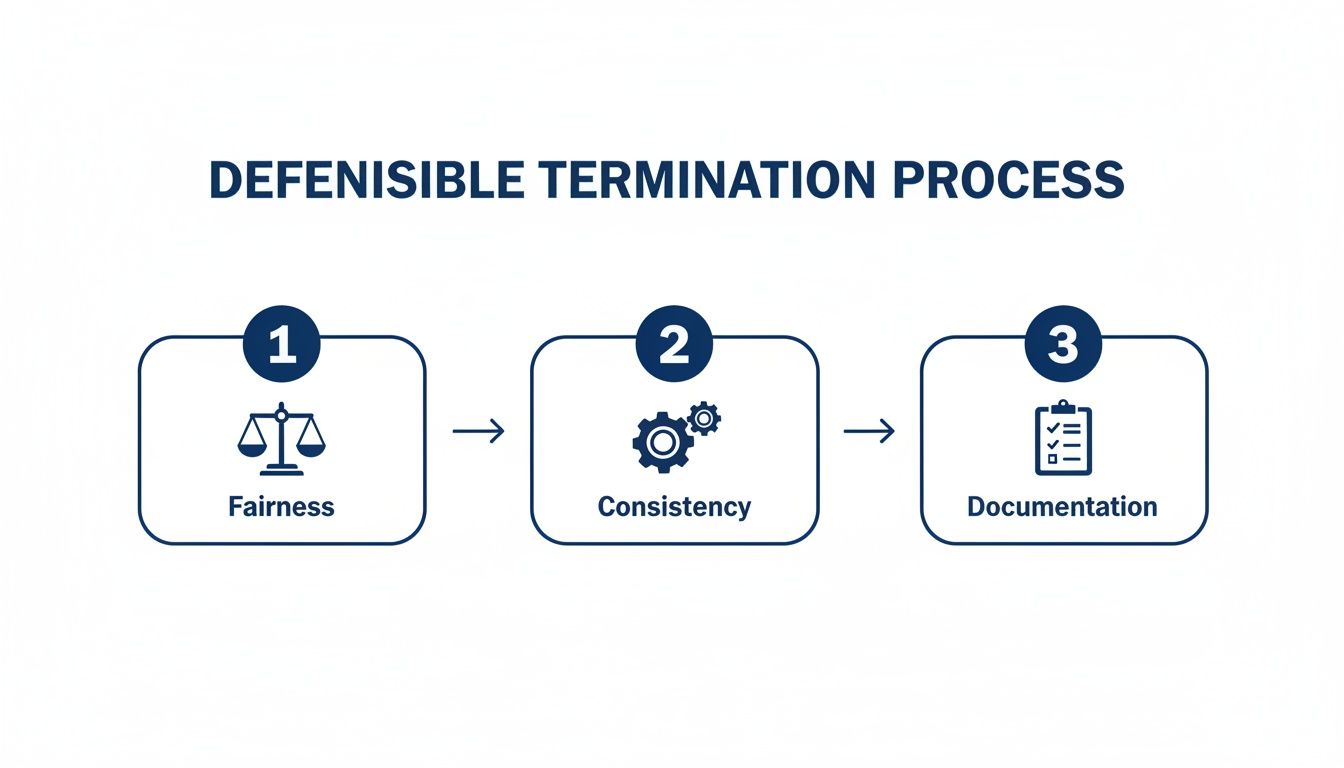
When handled correctly, a termination becomes a justifiable business decision rather than a significant legal risk. The process is built on three core pillars: fairness in your standards, consistency in how you apply them, and documentation of every key interaction.
Progressive discipline is a structured communication plan, not a punishment system. It is a framework for addressing performance or conduct issues with corrective actions that become more formal over time. The goal is simple: correct the behavior and give the employee a clear path to get back on track.
Rushing this process or applying it inconsistently is one of the fastest ways to create legal risk.
A typical progressive discipline policy includes these steps:
This structure is crucial because it demonstrates that you acted in good faith, which is a significant factor in any post-termination dispute.
Every conversation, warning, and performance review becomes part of a cumulative record. Your documentation must be objective, behavioral, and free of emotional or subjective language. Do not write that an employee has a "bad attitude." Instead, document specific, observable behaviors: "On three separate occasions this week, the employee raised their voice at a colleague during team meetings."
Your documentation should tell a clear and factual story. A third party, like a judge or juror, should be able to read the file and understand exactly what the performance issues were and what steps you took to address them. Before making a final decision, it is vital to have a clear, documented history of performance management.
Organizing these records makes a potentially contentious situation a straightforward, evidence-based decision.
For more significant performance gaps, a formal Performance Improvement Plan (PIP) is an essential tool. A PIP is a structured, time-bound roadmap with specific, measurable goals the employee must achieve to retain their job. It demonstrates you are making a final, dedicated effort to help them succeed. Our guide on how to write a Performance Improvement Plan can help you create an effective one.
This approach does not apply to all situations. For serious misconduct like theft or harassment, you would skip progressive discipline and move straight to a thorough investigation. In those cases, a well-documented investigation, like those discussed in mastering the internal affairs investigation process, is the foundation of a defensible termination.
Before moving forward with any termination, you must check for legal red flags. Even with perfect documentation, certain situations can dramatically increase your risk of a wrongful termination lawsuit. These red flags do not always mean you must stop, but they do mean you should slow down, double-check your process, and consider seeking an expert opinion.
Ignoring these issues can turn a standard termination into a costly, reputation-damaging legal battle if a protected characteristic or activity is involved. A standard termination can morph into a costly, reputation-damaging legal battle if a protected characteristic or activity is even remotely in the picture.

The biggest legal minefields involve discrimination and retaliation. Federal law is clear: you cannot fire someone because they belong to a protected class. These characteristics must have zero influence on your decision.
It’s illegal to base a termination on any of these factors:
Retaliation is the other major risk. You cannot fire an employee for engaging in a legally protected activity, such as filing a harassment complaint or requesting a reasonable accommodation. If a termination occurs shortly after one of these events, it will likely be viewed as retaliation, even if you have other legitimate reasons. An employee only needs to show that discrimination was a motivating factor, not the only reason.
Beyond discrimination, several key federal laws create specific rules and risks during terminations. Business leaders must be familiar with the WARN Act, FMLA, and the ADA.
The WARN Act
The Worker Adjustment and Retraining Notification (WARN) Act applies to larger employers planning mass layoffs or plant closings. If you have 100 or more full-time employees and are laying off at least 50 people at a single site, you generally must provide 60-day advance notice. Failure to comply can result in liability for back pay and benefits for every affected employee.
The Family and Medical Leave Act (FMLA)
The FMLA provides eligible employees with up to 12 weeks of unpaid, job-protected leave each year. You cannot fire someone for taking FMLA leave or hold it against them in performance reviews. Firing an employee shortly after they return from FMLA is a massive red flag for retaliation and will require iron-clad documentation to defend.
The Americans with Disabilities Act (ADA)
The ADA requires employers to engage in an "interactive process" to find a reasonable accommodation for an employee with a known disability. If performance issues are tied to a disability, you must explore accommodations before considering termination. Skipping that process can lead directly to a discrimination claim.
Many employers mistakenly believe "at-will employment" is a bulletproof shield. While at-will means you can terminate employment for any legal reason, it does not protect you from claims based on illegal reasons like discrimination or retaliation.
Additionally, many states have created exceptions to the at-will doctrine through implied contracts or public policy. For example, some states have "public policy" exceptions that protect employees for actions like refusing to break the law at their employer's request. State and local laws also add layers of complexity regarding final pay deadlines and other requirements.
The termination meeting is often the most difficult part of the process. How you handle this single conversation matters—not just for legal reasons, but for the dignity of the employee and the morale of your remaining team. A poorly handled meeting can create unnecessary legal risks and emotional distress. The goal is to be clear, firm, and direct, but never cold or argumentative.
The logistics of the termination meeting are just as important as the words you use. To get it right, focus on three key elements: who, where, and when.
Clarity and brevity are essential in a termination meeting. The decision is final, so this is not the time for debate or a lengthy review of past issues. Your script should be direct, factual, and focused on communicating the decision and outlining the next steps. The purpose of the meeting is to inform, not to convince.
Before the meeting, ensure all paperwork is in order. A precise and legally sound contract termination letter is essential to protect your organization and prevent future disputes.
Here is a simple structure for the conversation:
Reactions to being terminated can range from quiet acceptance to anger or tears. Your role is to remain calm, professional, and empathetic without backing down from the decision. Never apologize for the decision itself, as it can be interpreted as an admission of wrongdoing. Instead, you can acknowledge their feelings by saying, "I know this is difficult news to hear."
If an employee becomes hostile, do not engage; prioritize safety and de-escalation. If they become emotional, offer them a moment to compose themselves but keep the meeting on track. The key is to manage the conversation with compassion while ensuring the process is completed professionally.
If you are facing a complex termination and need guidance, our team of experts can provide the support you need to act with confidence. Feel free to contact us to discuss your situation.
The termination meeting may be over, but the process is not complete. The steps you take in the hours and days after an employee leaves are critical for protecting your business and maintaining a stable work environment. A structured offboarding process is your playbook for tying up every loose end, from issuing the final paycheck correctly to managing the transition for the remaining team.
As soon as the termination meeting concludes, a series of operational tasks must happen quickly. This is about closing legal obligations, securing company assets, and thoughtfully communicating the change to your team.
Your immediate priorities should be:
Final pay compliance is a major legal tripwire. While the federal Fair Labor Standards Act (FLSA) doesn't set a specific deadline, many states do, and they vary dramatically. Missing a deadline can result in significant penalties.
For example, in California, final wages are due immediately at the time of termination. In New York, the deadline is the next regularly scheduled payday. If you operate in multiple states, you must adhere to each location’s unique requirements.
This table highlights why multi-state compliance is so critical for business operators.
Always verify the laws for the specific state where the employee works to avoid costly mistakes.
While not legally required in most terminations, offering a severance package in exchange for a signed release of claims is a powerful risk management tool. It provides the former employee with a financial cushion and protects your company from future lawsuits.
A severance agreement is a smart move in higher-risk situations, such as:
How you announce the departure to the rest of the team is critical for maintaining morale. Keep the communication simple, professional, and forward-looking. Let the team know that the person is no longer with the company and briefly explain how their responsibilities will be handled. Never share details about why they were terminated, as this is a privacy violation and creates a culture of fear.
Managing these final steps correctly is essential for a clean and compliant separation. If you need help developing a solid offboarding process, our experts can provide the guidance you need. Please feel free to contact us to learn more.
Most terminations are straightforward, especially with a solid internal process. But some situations are genuine minefields. Knowing when to pause and call an employment attorney is one of the smartest things a leader can do to protect the business. A quick consultation with a lawyer costs a fraction of what a wrongful termination lawsuit can.
Certain situations should be an automatic trigger to seek legal advice. If the employee you're considering letting go fits into any of these categories, get an expert opinion before you make a move. The appearance of discrimination or retaliation can be just as damaging as the real thing.
Key triggers for escalation include situations where the employee:
An attorney can pressure-test your documentation and reasoning before they become a serious liability. They can review everything from your initial warnings to the final termination script, ensuring every step you take is defensible.
Navigating these challenging separations requires an expert partner. If you're facing a complex termination and need guidance, our team is here to help ensure your actions are sound and defensible. Contact us to learn how we can support your leadership team.
Navigating employee terminations always brings up tough questions. While every situation is unique, understanding the principles behind these common challenges can help you make sound, defensible decisions. Here are direct answers to the most pressing questions we hear from business owners and HR leaders.
While “at-will” employment means you don’t need a specific cause for termination, it does not mean you can fire someone for an illegal reason. This is a critical distinction. Illegal reasons include any form of discrimination based on protected characteristics like race, age, or disability. It also includes retaliation against an employee for engaging in legally protected activities. Relying on "at-will" status as your only defense is a dangerous approach.
A warning is a formal notice that an employee's performance or behavior is not meeting expectations. A Performance Improvement Plan (PIP), on the other hand, is a more structured and serious tool used for significant performance issues. A PIP is a formal, time-bound action plan—usually for 30, 60, or 90 days—with specific, measurable goals. It explicitly states that failing to meet these goals will lead to further disciplinary action, including termination.
Keep the termination meeting direct, brief, and professional. The goal is to deliver a final decision, not to get into a debate. Stick to a simple, factual reason that aligns with your documentation, such as, "As we discussed in your performance plan, the required goals have not been met." Avoid emotional language or rambling justifications, as they only create unnecessary legal risk.
Generally, no. There is no federal law that requires you to offer a severance package unless it is specified in an employment contract or company policy. However, offering severance in exchange for a signed release of claims is a powerful strategic move. It helps mitigate legal risk and can prevent a former employee from filing a wrongful termination lawsuit.
Navigating the complexities of high-stakes terminations requires sound judgment and expert guidance. The team at Paradigm International Inc. acts as a strategic partner for leaders facing these critical decisions, ensuring every action is defensible and aligned with best practices. If you need support with a complex employee situation, contact us to learn how we can help protect your organization.