A Florida business owner calls on a Monday morning. A manager wants an employee out immediately after months of documented performance problems. The employee also submitted a workplace complaint recently, asked about leave, and mentioned a medical issue. The performance file may be strong, but the timing creates a separate problem.
That situation is why how to fire an employee safely in Florida isn't mainly a question of whether the employer can end the relationship. It's a question of whether the company can prove the decision was lawful, consistently applied, properly documented, and separated from protected activity. A rushed meeting can turn a defensible business decision into a retaliation narrative.
Florida's at-will framework gives employers meaningful flexibility. In general, an employer can end employment without a stated reason or advance notice, subject to statutory and contractual limits. That flexibility often creates false confidence. Leaders assume that because the state recognizes at-will employment, the termination itself carries little risk.
The safer view is narrower. At-will does not mean consequence-free. A termination can still create exposure if the reason involves discrimination, retaliation, a contract, protected leave, an accommodation request, whistleblowing, or a workers' compensation issue. The meeting is only one event in a larger decision record.
A defensible termination usually has four characteristics:
The strongest performance case doesn't always create the safest termination. If the employee raised a wage complaint shortly before the decision, requested an accommodation, reported a safety issue, or took protected leave, those facts may matter more than the length of the performance file. The company should pause, identify an independent reviewer, and test whether the same decision would have been made without the protected activity.
Practical rule: Don't schedule the meeting until someone uninvolved in the conflict has reviewed the reason, timing, comparators, and post-termination obligations.
Start by confirming the employment relationship and company rules. Review the offer letter, handbook, commission plan, leave policies, disciplinary policy, and any collective bargaining or employment agreement. Multi-state employers should also compare the Florida process with their broader handbook requirements for multi-state employers, because a policy may create expectations beyond the minimum legal rule.
A safe process doesn't require a perfect conversation. It requires deliberate preparation before the conversation begins. The legal screen comes first.
Florida follows at-will employment. A termination is generally permitted unless a statutory or contractual exception applies. Florida does not recognize a common-law wrongful-discharge cause of action, according to Florida employment law guidance from Alfa International. At-will status gives an employer room to act, but it does not remove retaliation, discrimination, contract, or consistency risks.
The practical question is more specific: what evidence supports the decision, and what protected facts surround it?
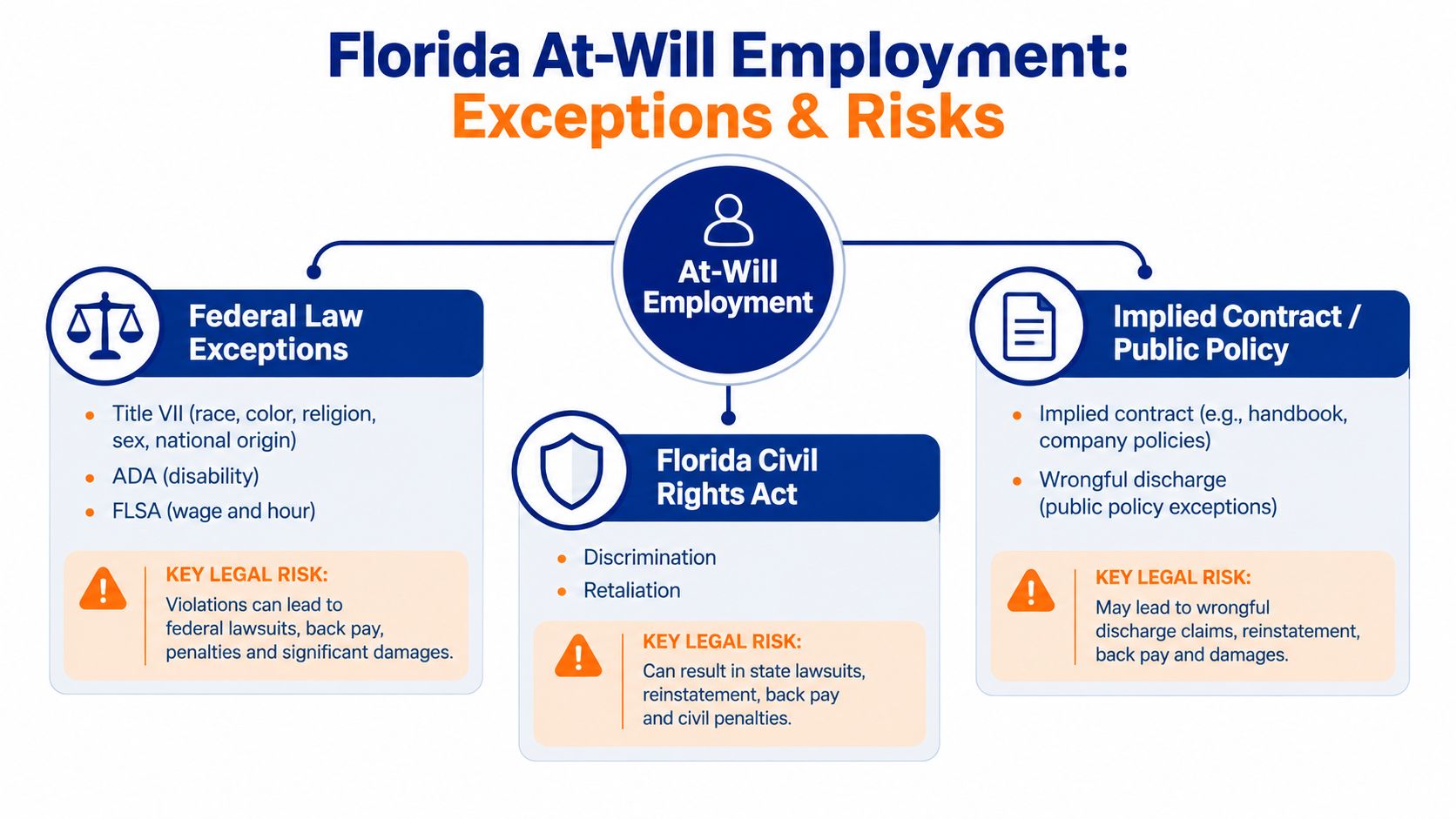
Florida's major statutory exceptions include the Florida Civil Rights Act, the Florida Whistleblower Act, and workers' compensation retaliation rules. The Florida Civil Rights Act generally covers federal protected classes and applies to employers with 15 or more employees. It also sets a 365-day filing window with the Florida Commission on Human Relations, as described in the Alfa International summary.
Before approving a termination, review these questions:
A recent complaint does not automatically block termination. It does require a documented review of timing, evidence, decision-maker independence, and comparable cases. Confirm whether the stated reason existed before the complaint and whether management applied the same standards elsewhere.
The Select Insurance Group employer primer provides a general reference on employer duties. Use it to organize questions, not to replace advice about a specific employee.
A manager may sincerely view an employee's performance as unacceptable. That belief alone does not answer whether the decision could appear retaliatory. An independent reviewer should test the record, identify concrete conduct, and reject unsupported labels such as “bad attitude” or “not a fit.”
Ask one controlling question: Would the company make the same decision if the complaint, leave request, accommodation discussion, wage issue, or safety report had never occurred? If the answer is unclear, pause the termination. Review the chronology, assign a reviewer who was not involved in the conflict, and confirm that the documentation supports the stated business reason.
Owners can also consult Florida exceptions for business owners while setting up that review. The decision should be separated from protected activity wherever possible, with timing, reviewer independence, and documentation controls recorded before the meeting.
A Florida termination should survive review by someone who was not involved in the dispute. Build the file before the meeting, while the facts are current. Records created after a claim often look like explanations assembled to justify a decision already made.
Start with one specific business reason. Connect it to the requirement, relevant date, prior communication, applicable policy, employee response, and resulting decision. “Poor performance” is too broad. Identify the missed deliverable, documented expectation, or conduct that supports the decision.
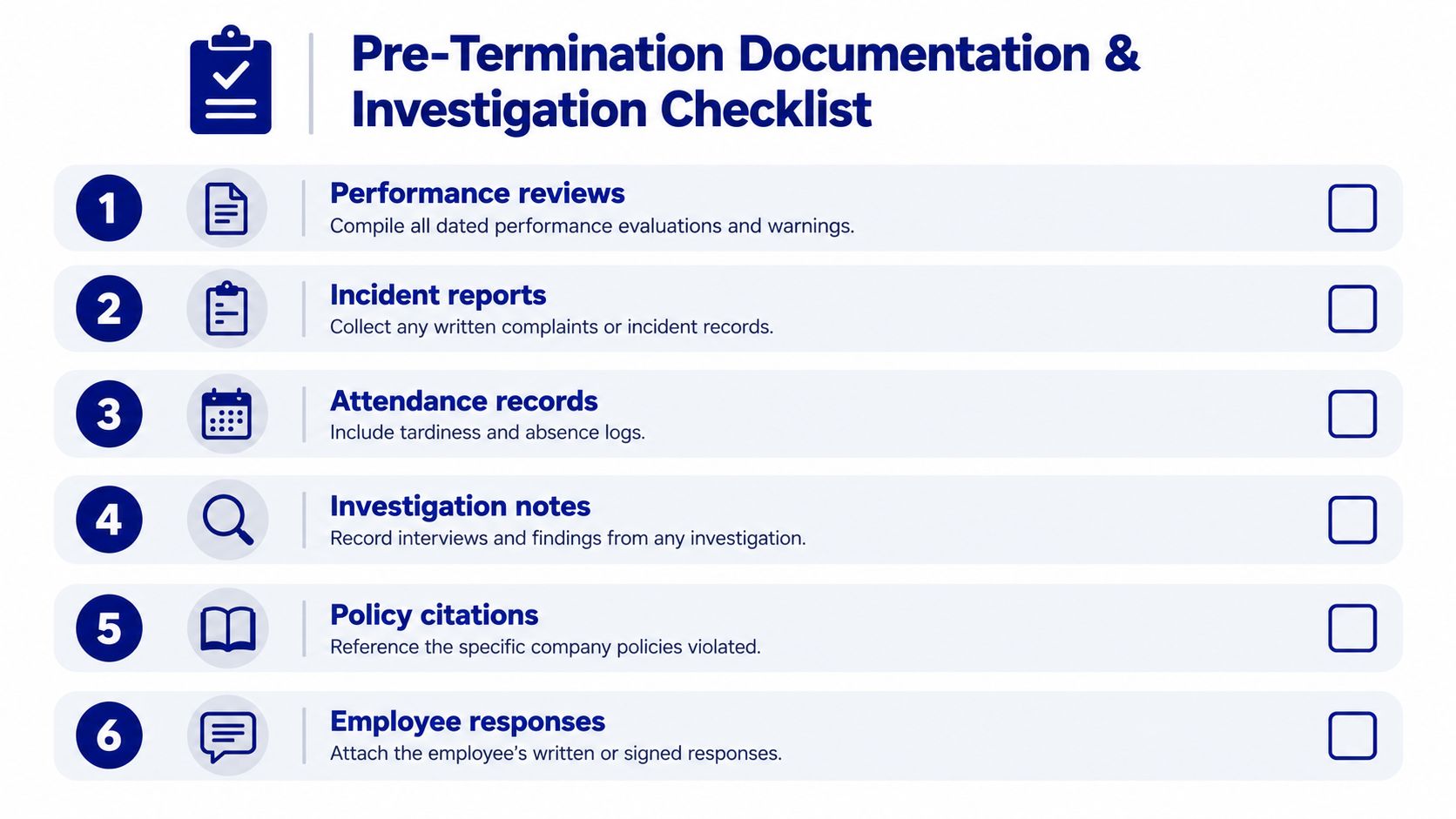
Use the same collection method for every case. Gather information that supports the proposed action and information that could change the outcome.
Keep facts separate from conclusions. “The employee was careless” is a label. “The employee failed to complete the required review after receiving written instructions” is a testable fact.
Protected activity creates a retaliation risk even when the manager's performance concerns are sincere. A defensible termination depends on separating the decision from a complaint, leave request, accommodation discussion, wage issue, or safety report. Review Florida employment law guidance on protected activity when identifying activity that may affect the analysis.
Create a timeline containing:
Assign the review to someone who was not the subject of the complaint and was not the primary manager in the conflict. That reviewer should test the evidence, compare treatment of similar employees, and confirm that the stated reason existed before the protected activity.
Use the Florida exceptions for business owners as a general reference while setting up the review. For broader employer duties, the Select Insurance Group employer primer can help organize questions, but neither resource replaces advice about a specific employee.
Pause when the timeline looks suspicious. Strong documentation does not cure a decision that appears to punish protected activity.
Proceed only when the company can answer these questions clearly:
If any answer is incomplete, pause. Correct inconsistencies, complete the record, or obtain qualified employment counsel before communicating the decision. The review should show that the company acted on documented business facts, not on the employee's protected activity.
The termination meeting should be controlled, brief, and humane. Don't use the meeting to investigate the entire employment history or persuade the employee to agree with the decision. The investigation belongs before the meeting. The meeting communicates the decision and manages the transition.

Choose a private location and limit attendance to people with a legitimate role, such as the manager and an HR representative or designated witness. For a remote employee, use a private video meeting and coordinate the immediate access and equipment process in advance.
Bring the termination letter, final-pay information, benefits instructions, property checklist, and contact details for follow-up questions. Confirm who will disable systems, collect equipment, notify payroll, and handle the employee's workspace. The company should complete those assignments before the meeting starts.
Use a simple structure:
A suitable explanation might be: “The company has decided to end your employment because the documented performance requirements for the role haven't been met.” Don't add unapproved allegations, speculate about motives, or introduce a new reason.
Florida's at-will status doesn't eliminate the need for a documented, lawful workflow. Terminations based on protected characteristics or protected activity can still trigger claims under federal law and the Florida Civil Rights Act. Before the meeting, confirm the reason, recent protected activity, contract or union status, leave, whistleblower concerns, and workers' compensation issues, consistent with Florida termination workflow guidance.
The manager shouldn't improvise. Give the manager a short script and rehearse likely questions:
Answer only what the approved materials support. If the employee raises a new complaint during the meeting, listen, document the concern, and route it for review. Don't dismiss it or argue about whether it has merit.
Afterward, write a factual meeting summary immediately. Record who attended, what was communicated, the employee's response, documents provided, property collected, and any new concerns raised. Don't characterize the employee as emotional, difficult, or dishonest unless the record specifically supports a relevant factual description.
A safe separation can still create avoidable exposure after the meeting. Final pay, benefits, unemployment records, property recovery, and system access need one owner-assigned checklist. Set the deadlines and responsibilities before the termination, then confirm completion afterward.
Florida final wages must be paid by the next regular payday after separation, whether the employee resigned or was fired, according to Florida final paycheck guidance. Before the meeting, payroll should calculate wages, approved commissions, earned incentives, expense reimbursements, and lawful deductions under the company's governing rules.
Benefits require a separate handoff. Confirm the coverage end date, prepare required notices, and name the person who will answer benefits questions. Employers with group health coverage should review navigating COBRA notification requirements and coordinate the post-separation notice process with the plan administrator or benefits provider.
Florida reemployment assistance rules can disqualify an employee discharged for work-connected misconduct for up to 52 weeks. The employee must earn income equal to at least 17 times the weekly benefit amount before the disqualification condition is satisfied, according to the Florida unemployment statute.
A separate rule addressing criminal-law violations or dishonest acts connected with work uses the same 52-week maximum and 17-times-benefit-amount earnings threshold, as described in that statutory source. A performance termination does not automatically establish misconduct. The company's records must identify the specific work-related behavior, the applicable expectation, and the employee's response.
Florida law also addresses disqualification for misconduct or a dishonest act connected to the job. Preserve proof of the conduct rather than relying on a broad performance label. See the Florida reemployment assistance statute cited above.
| Compliance Item | Florida Requirement | Action Before or After Meeting |
|---|---|---|
| Final wages | Pay by the next regular payday after separation. | Confirm payroll calculations and schedule payment. |
| Benefits | Coordinate coverage information and required notices. | Prepare the benefits contact and written instructions. |
| COBRA | Review applicable continuation-coverage notice duties. | Coordinate with the plan administrator or benefits provider. |
| Unemployment | Misconduct-related disqualification requires work-connected evidence. | Preserve specific conduct records and submit a consistent response. |
| Company property | Recover equipment, keys, records, and credentials. | Use a written property checklist during or immediately after the meeting. |
| System access | Protect company systems and confidential information. | Coordinate access changes at the effective time while preserving required records. |
Weak documentation makes the company's position harder to defend. Calling a separation misconduct based only on general performance notes leaves the unemployment response exposed. Detailed records tied to specific conduct, policy expectations, investigation steps, and employee responses provide a consistent account.
Before closing the file, assign someone to verify each item. Confirm payment, benefits communications, property recovery, access changes, and the unemployment response rather than assuming another department completed them.
After the meeting, preserve the full decision record. Keep the decision memo, timeline, investigation materials, meeting notes, payroll confirmation, benefits communications, and access records together. Florida's Civil Rights Act provides a 365-day filing window with the Florida Commission on Human Relations. Preserve the termination file through that period and longer when another legal or business requirement applies.
Brief remaining employees on workflow, reporting relationships, client coverage, or operational continuity. Do not disclose medical information, complaint details, disciplinary history, or the former employee's personal circumstances. Assign one owner to control what is shared and keep the message consistent.
Audit the decision promptly. Confirm that the company followed its policy, access was revoked consistently, payroll completed the required payment, and similarly situated employees received comparable treatment. Review who made the decision, who reviewed it, and whether the reviewer was independent of the underlying complaint or dispute. A short review can expose a process defect before it becomes a repeat problem.
Document the decision, not the drama. The file should show what happened, what the company knew, what it reviewed, and why it acted.
Get advisory support before proceeding if the employee recently made a complaint, requested protected leave, discussed an accommodation, reported a safety or wage issue, filed a workers' compensation claim, or raised whistleblower concerns. Pause as well when the decision-maker is personally involved in the complaint, the reason changed during review, or comparable cases do not align. Safe termination depends on separating the business decision from protected activity, then documenting that separation clearly.
Florida reemployment assistance rules can disqualify a worker for up to 52 weeks when the separation involves misconduct or a dishonest act connected to the job. The finding must relate to work-connected conduct. Retain evidence describing the behavior instead of relying on a general performance label, as noted earlier.
For structured support on high-stakes terminations, Paradigm International Inc. works with leadership teams to assess risk, review documentation, and script meetings that hold up under scrutiny. Bring in that support before the decision is final, not after an inconsistent record has been created.