
Monday morning, a manager wants an employee out by lunch. The performance file is thin, the timing is awkward, and nobody has decided who will handle final pay, system access, or the script for the meeting. That is how employers create avoidable claims.
Treat a California termination as an operational event that must hold up under scrutiny. Authority to terminate is only part of the job. Defensibility is what matters. Your record should show what happened, who addressed it, when the decision was made, and why the company acted in a consistent, lawful way. If you need a refresher on the employment at-will doctrine and what it actually allows, start there, then come back to process.
A defensible termination is built on discipline in four places:
Business owners get into trouble when they focus only on whether the employee deserves to be fired. That is not the standard that protects you. The standard is whether your process shows a legitimate business decision carried out with consistency and clean execution.
A weak termination usually breaks down in the details. Missing warnings. Confused managers. Loose language in the meeting. Delayed paperwork. Contradictions between the file and the stated reason. Those are the mistakes that turn an ordinary separation into a legal defense problem.
Run the process like you expect your documents, emails, and meeting notes to be examined later. That mindset keeps the decision tighter, the message cleaner, and the risk lower.
If you're searching for how to fire someone in California, you probably aren't looking for a law school summary. You need a practical playbook for a decision that already feels loaded. Maybe the employee has missed targets for months. Maybe there's a conduct issue you can't ignore anymore. Maybe the role itself no longer fits the business.
California makes leaders nervous because the margin for error is smaller than they want it to be. Owners and executives often know the decision is right for the business, but they delay because they're unsure whether the file is strong enough, whether timing looks bad, or whether the final steps will be handled correctly. That uncertainty is where mistakes happen.
The right approach is to stop treating termination as a single conversation. It's a process. The process starts before the meeting and continues after the employee leaves the room. If any part of that chain is careless, your risk goes up.
Here's the practical reality. California's at-will rule gives employers broad discretion in theory, but in real-world use it's narrowed by discrimination and retaliation limits. A firing can't be based on protected traits such as race, gender, age 40+, religion, or disability, and it can't be retaliation for protected activity such as reporting harassment, wage violations, or safety concerns, as described in this summary of California wrongful termination limits and employer obligations.
That means every termination should be built around a simple standard. You need a legitimate business reason, consistent handling, and clean documentation. If you don't have those three, pause the decision and fix the process before you move.
The legal baseline is simple, but many employers misuse it. California is at-will, which leads some managers to think they can terminate quickly and explain later. That's backward. In California, the strength of the decision depends on the quality of the employer's record.
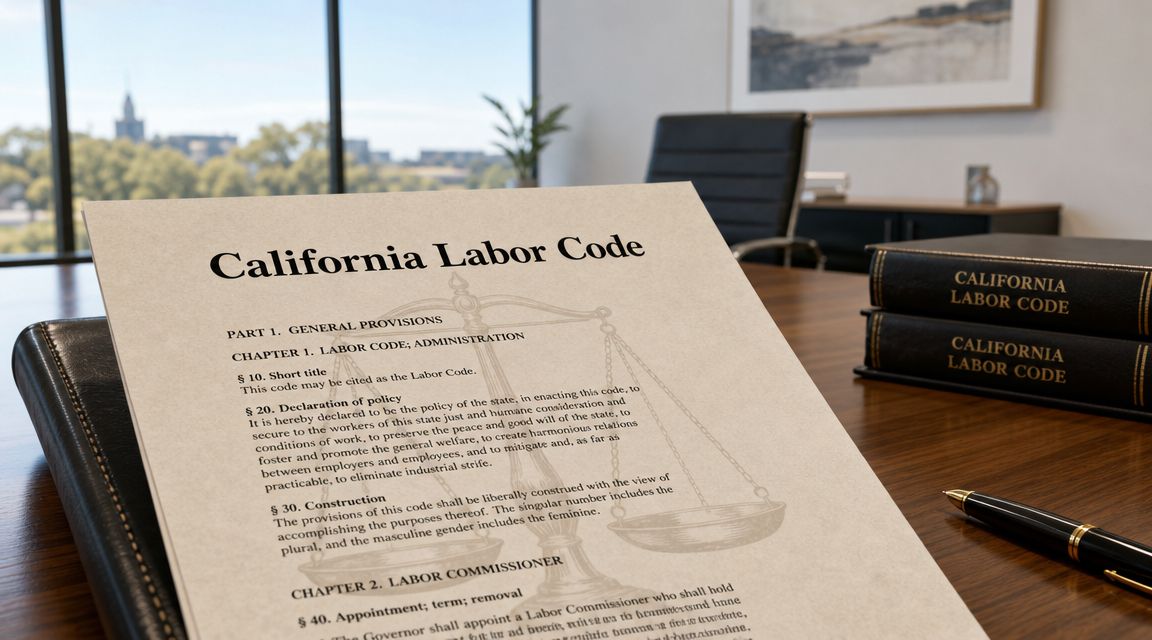
California Labor Code Section 2922 allows employers to end employment at any time, with or without notice, for any reason or no reason, so long as the reason isn't illegal. In practice, the rule is narrowed by anti-discrimination and anti-retaliation protections. A firing cannot lawfully be based on protected traits such as race, gender, age 40+, religion, or disability, and it cannot be retaliation for protected activity such as reporting harassment, wage violations, or safety concerns, as outlined in this explanation of California at-will employment doctrine and its limits.
That distinction matters because employers often defend the wrong point. They spend time saying, “California is at-will,” when they should be proving, “We made this decision for a legitimate business reason, and our record shows it.”
Practical rule: If a jury, agency investigator, or plaintiff's lawyer reviewed your file, they should be able to see the business reason without guessing.
Before any termination moves forward, confirm these points:
The highest-risk mistakes usually come from timing and loose language.
| Risk area | Why it matters |
|---|---|
| Complaint proximity | A termination soon after a complaint can look retaliatory if the file is weak |
| Policy inconsistency | Departing from handbook rules or normal practice invites questions |
| Thin documentation | If the file is sparse, the employer's stated reason looks manufactured |
| Manager commentary | Casual remarks can undercut an otherwise valid business decision |
Managers do real damage when they improvise. Statements like “this just isn't working out,” “we need a different type of person,” or “you've been difficult since raising concerns” can become evidence against the employer. Keep the message tied to documented business reasons and nothing else.
Use a strict internal test before you terminate:
If you can't answer those cleanly, don't schedule the meeting yet.
Most of the work should happen during the preparation. The cleanest termination meetings are built on disciplined preparation. If you want a defensible exit, build the record before anyone says a word to the employee.
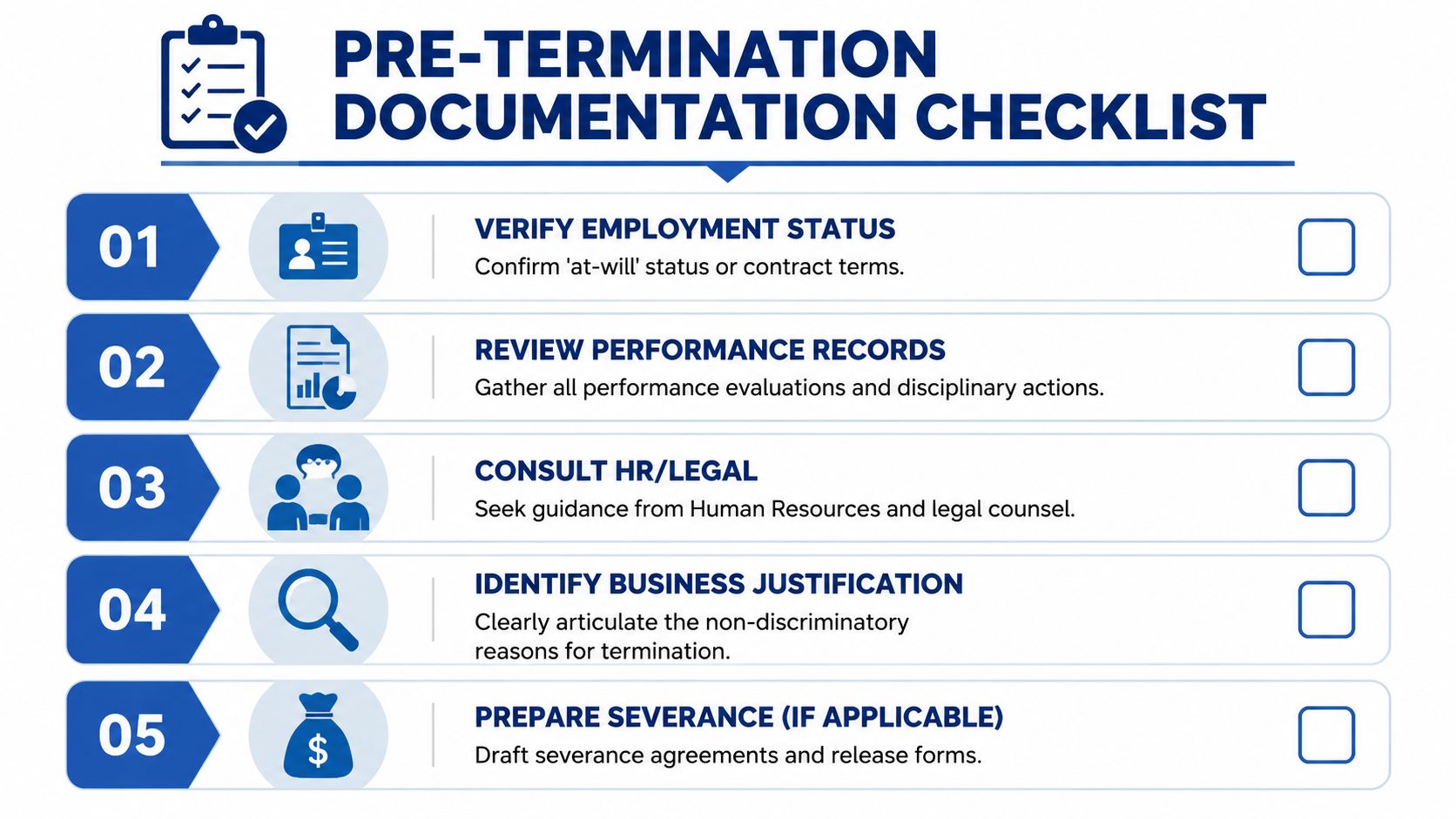
California may be at-will, but the sequence still matters. Employers should confirm the reason is lawful, compare it against handbook and past practice for consistency, document performance or conduct issues, and prepare final-pay materials before the meeting. A practical workflow is summarized in this guide to a California employee termination checklist and final pay process.
Start with the personnel record, but don't stop there. Review performance evaluations, corrective action notices, attendance records, investigation materials, prior coaching emails, and any written acknowledgments tied to policy. If the reason is performance, your file should show specific expectations and where performance fell short. If the reason is misconduct, your file should show dates, facts, policy references, and prior corrective steps if applicable.
Don't write a novel. Write a clean factual summary that answers four questions:
That summary should be understandable without your oral explanation.
Bad terminations often come from good reasons applied unevenly. Before moving forward, compare the situation against your own history. If other employees committed similar violations and received a warning, you need a documented reason for treating this case differently.
Use a short internal review like this:
If your reasoning changes every time someone asks about the decision, you're not ready to terminate.
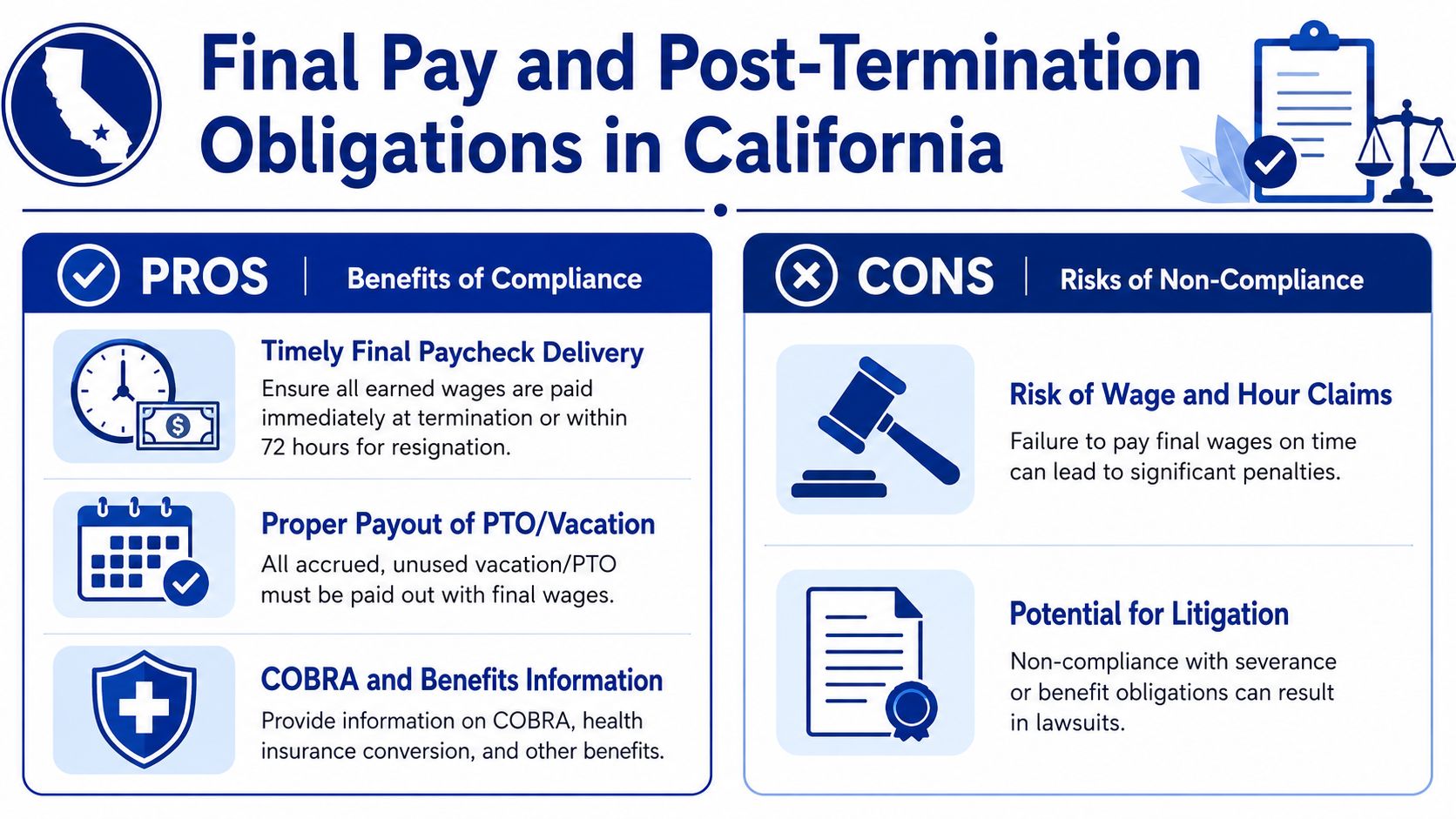
This is not an administrative detail. It's a legal control point. California Labor Commissioner guidance and practitioner checklists emphasize payment on the last day of employment for involuntary terminations, and missed or incomplete final pay can create exposure to waiting-time penalties of up to 30 calendar days of the employee's daily rate of pay, according to this review of final pay timing and termination workflow in California.
That means you prepare the final wage materials before the meeting, not after it. Don't terminate first and let payroll catch up later.
Your pre-meeting checklist should include:
The meeting should reflect the preparation. If the employee can pull you into a debate, you've already lost control.
“We've made the decision to end your employment effective today. This decision is final. We'll walk through your final pay, benefits information, and the return of company property.”
That opening works because it's direct and closed. It doesn't invite argument, and it doesn't over-explain. You are delivering a decision, not negotiating one.
Avoid these common mistakes:
A disciplined file gives you confidence. A weak file forces improvisation. When employers ask how to fire someone in California safely, the answer usually starts here.
The meeting itself should be short, controlled, and uneventful. If it becomes emotional, argumentative, or improvised, your process broke down before the meeting started.

Keep attendance limited. Usually that means the direct manager and an HR representative or another management witness. You want one person to communicate the decision and one person to observe, document, and help manage logistics.
Don't crowd the room. Don't turn the meeting into a tribunal. Too many people increases tension and makes the employer look defensive.
Use a simple sequence:
There's no prize for a long conversation. The longer the meeting runs, the more likely someone says something unnecessary.
Keep the tone respectful, but keep the message final.
A professional termination script is direct. It doesn't wander into personal commentary or moral judgments. It doesn't invite the employee to relitigate the past six months.
Use language like this:
Avoid statements like these:
Each of those comments creates risk for no business benefit.
Use a private setting. Don't conduct terminations in an open office, hallway, or cafeteria. Choose a time that limits disruption and protects confidentiality. The meeting should be planned, not squeezed between unrelated calendar items.
Have the documents ready on the table. Know where the employee will go afterward. If the employee needs to retrieve personal belongings, decide in advance whether that will happen immediately or later under supervision.
Many employers blur these together and create confusion. Keep them distinct.
| Category | What to handle |
|---|---|
| Financial | Final paycheck, wage paperwork, separation documents |
| Administrative | Device return, badge collection, key recovery, systems access removal |
| Communication | Internal need-to-know notice, external reference limits, client messaging if necessary |
That separation matters because each task has a different owner. Payroll handles pay. HR or management handles documents. IT handles access. Facilities handles physical security. If nobody owns the step, the step gets missed.
Once the message is delivered and materials are provided, close the meeting. Don't let it drift into a grievance session. If the employee is upset, acknowledge it without changing course.
A simple ending works best: “We understand this is difficult. The decision is final. We'll now review the departure steps.”
That's professional. That's clear. That's defensible.
A termination doesn't end when the conversation ends. In California, your exposure often shifts immediately to wage compliance, access control, and post-exit administration. At this point, operational sloppiness becomes expensive.
Then you're not ready to terminate.
For involuntary terminations, final pay timing is a critical point, and the safest practice is to have the final paycheck and related wage materials ready at termination. Employers who treat this as a back-office cleanup issue create preventable risk. The termination event and the pay event need to be coordinated.
That means payroll cannot be an afterthought. Before the meeting begins, confirm the amounts, the form of payment, and the package the employee will receive.
Then your offboarding process is incomplete.
Post-termination control isn't only about legal compliance. It's also about protecting data, clients, trade information, internal communications, and business continuity. Disable email, software, shared drives, messaging platforms, and building access immediately after the meeting. Collect devices, keys, badges, credit cards, and any other company property as part of a planned checklist.
Use a coordinated handoff among HR, IT, facilities, and the manager. If you rely on memory, something will be missed.
Don't overshare. Use a limited, neutral message.
You don't need to defend the decision to the workforce. You need to keep operations stable and avoid careless statements. Tell relevant employees only what they need to know to continue business operations. If clients or vendors need an update, keep that message equally narrow.
After termination, loose internal commentary can create as much risk as a bad meeting script.
Use a simple closeout list:
Decide your reference practice in advance and stick to it. Many businesses choose a limited response model. That usually means only authorized personnel respond, and they provide only approved categories of information. The important point is consistency.
Don't let well-meaning managers improvise after the fact. A glowing reference after a performance-based termination can undermine your stated reason. A hostile reference can invite a different kind of dispute. Controlled, neutral, and centralized is the better model.
A lawful business reason is only part of a defensible termination. The rest is execution. If the employee leaves with working credentials, incomplete paperwork, unpaid wages, or unrestricted access to company systems, the business has shifted from personnel management into risk creation.
That's why employers need to treat the last hour of employment as carefully as the months leading up to it.
Some terminations need more than a clean file and a short meeting. They require heightened scrutiny because the surrounding facts make retaliation, discrimination, contract, or notice claims more likely. In those cases, the right move is to slow down and tighten the review.
If the employee recently reported harassment, raised wage concerns, participated in an investigation, requested accommodation, or complained about safety issues, don't treat the case like routine separation. Even when the business reason is valid, the timing can create a retaliation argument.
That doesn't mean you can never terminate someone who engaged in protected activity. It means your record has to be stronger. The file should show that the issue existed independently of the complaint, that the decision follows documented facts, and that the organization applied the same standards it would use with anyone else.
Employees on protected leave or with disability-related issues create a higher-risk scenario because employers often confuse frustration with justification. That's where they get into trouble.
If leave, medical restrictions, or accommodation requests are involved, stop and test whether the termination reason is fully separate from those issues. Review timing, communications, prior manager comments, and documentation quality. If you need a deeper review of this scenario, this article on terminating an employee who is on leave is a useful starting point.
Not every California employee is purely at-will in practice. Offer letters, employment agreements, and collective bargaining agreements can limit termination rights or impose procedural requirements. If a contract governs discipline, notice, or cause standards, follow that document. Don't assume the at-will baseline overrides it.
Here's the practical test:
| Situation | Employer focus |
|---|---|
| At-will employee | Lawful reason, consistency, documentation, process |
| Contract employee | Contract terms, cause standard, notice obligations, procedure |
| Union-represented employee | Collective bargaining rules, grievance process, representation rights |
If you ignore a controlling agreement, the termination problem changes shape. You may move from a wrongful termination dispute into a contract or labor dispute.
Layoffs, restructures, and role eliminations need a broader lens. According to this discussion of California termination checklists, access removal, and WARN-style planning, employers often focus on at-will concepts but need stronger operational planning around documentation, access removal, retrieving devices, limiting references, coordinating announcements, and evaluating notice obligations for qualifying layoffs under state and federal WARN rules.
That's especially important for multi-state or regulated businesses. A reduction that looks simple inside one location may trigger notice, sequencing, or communication issues across the broader organization.
This is the category leaders underestimate most. The manager may insist the termination is justified. The record may be partly there. But the optics are rough. The employee just complained, just returned from leave, just disclosed a disability, or just challenged pay practices.
In those cases, ask a blunt question. If this decision were challenged tomorrow, would your documents persuade a skeptical outsider? If the answer is “probably,” that's not enough. High-risk scenarios need a file that is organized, specific, consistent, and complete.
A California termination usually goes bad in the last 24 hours before the meeting. A manager freelances the message, the file has holes, final pay is not ready, system access stays live too long, or the company says more than it should after the employee leaves. That is how a routine separation turns into a claim.
The right standard is simple. Run terminations like a controlled process, not a manager discretion exercise. Build a file that would make sense to an outsider, use a short meeting script, prepare final wages and required paperwork in advance, and assign ownership for access removal, property return, and internal communications before the conversation starts.
Documentation discipline matters. So does meeting discipline. Post-termination discipline matters just as much.
The goal is not to prove you had a reason. The goal is to show that the reason was lawful, supported, consistently applied, and executed correctly from the first draft of the write-up to the final offboarding step. That is what makes a termination defensible in California.
If your leadership team is dealing with a high-risk termination, investigation, or multi-state employment decision, Paradigm International Inc. acts as a decision partner focused on defensible process and risk control. You can learn more about its advisory services or contact an advisor here before the decision is made.